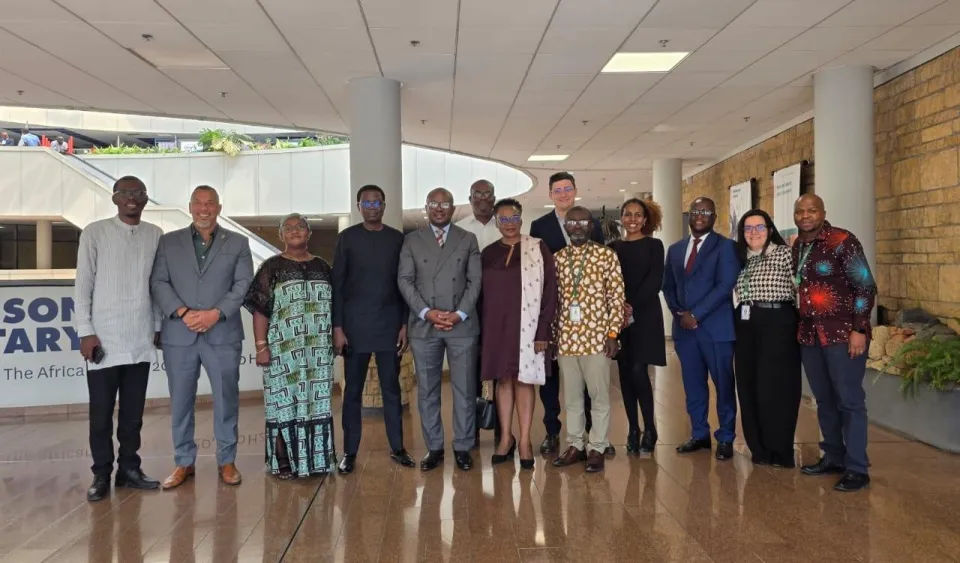
The fifth Artificial Intelligence (AI) for Electoral Actors Executive Workshop is set to take place in Dakar, Senegal, between the 30th of September and the 1st of October, 2025.
Search
Region
Country
Type
23 results
September 30, 2025 - October 01, 2025
Events
September 14, 2025 - September 16, 2025
The International Institute for Democracy and Electoral Assistance (International IDEA), in partnership with regional and international partners, is pleased to announce the Fourth Annual Retreat for Special Envoys and High Representatives of the Regional Economic Communities, to be held in Dakar, Senegal, from 14 to 16 September 2025.
Events
March 08, 2024
Event will be broadcasted in English and French.
Events
November 27, 2025
After hosting five workshops across five countries with Electoral Management Bodies and Civil Society Organizations on the use of AI in elections, what has International IDEA learned from these exchanges?
News
November 12, 2025
Artificial Intelligence (AI) is rapidly reshaping electoral processes worldwide, offering new opportunities to enhance efficiency, transparency, and credibility in elections. At the same time, AI presents significant ethical, legal, and governance challenges, particularly in fragile information environments where misinformation and manipulation can undermine public trust.
News
October 16, 2025
Digital spaces have become key arenas for citizens to receive and share information, turning social media platforms into primary sources of political communications.
News
October 13, 2025
International IDEA convened the Fourth Annual Retreat for African Regional Economic Communities (RECs), Special Envoys and High Representatives in collaboration with the Government of the Republic of Senegal and with the support of the Governments of the Netherlands, Switzerland, and Norway from 14 to 16 September 2025 in Dakar, Senegal.
News
October 09, 2025
Foreign manipulation of information and electoral interference were the key topics of the event hosted in Dakar on 2 October by AfricTivistes and International IDEA.
News
October 02, 2025
On the 30th of September and the 1st of October, International IDEA hosted the AI for Electoral Actors workshop in Dakar; the fifth and final event in this series.
News
August 20, 2025
The International Institute for Democracy and Electoral Assistance (International IDEA), in partnership with regional and international partners, is pleased to announce the Fourth Annual Retreat for Special Envoys and High Representatives of the Regional Economic Communities, to be held in Dakar, Senegal, from 14 to 16 September 2025.
News
August 19, 2025
As part of the African Union’s commitment towards promoting electoral integrity in Africa, a four-day BRIDGE (Building Resources in Democracy, Governance, and Elections) customised modular training was organised in Dakar, Senegal, from August 19 to 22, 2025.
News
July 14, 2025
The Regional Dialogue on Gender and Inclusion for Electoral Management Bodies (EMBs) in the ECOWAS Region, held from 14–15 July 2025 in Dakar, Senegal, concluded with renewed commitment, clear roadmaps, and a shared vision to build inclusive electoral institutions that truly reflect the diversity of West African societies.
News
April 07, 2025
Since the effective collapse of central authority in Somalia in 1991, local systems have provided crucial platforms for governance. Local systems of governance continue to be relevant alongside efforts to rebuild the Somali state, such as attempts to revive formal pre-1991 local government institutions.
Publication
December 30, 2024
Effective governance of mineral resources is vital to Africa’s sustainable development, with the potential to transform resource wealth into broad-based economic growth. With the right governance frameworks, the continent’s vast mineral endowments can benefit local communities, national economies and global markets. However, many African countries face ongoing challenges related to governance, transparency and the equitable distribution of resource revenues.
Publication
December 30, 2024
Women’s presence in politics is vital for shaping policy outcomes in the economic, social and cultural spheres. Despite progress over the past two decades, women remain under-represented in political leadership in Africa. This publication examines the factors motivating women’s participation and representation in politics on the continent, providing insights to enhance gender equality and empower women politically.
Publication
July 10, 2024
A resource tool that demonstrates the status of women's political participation in Africa.
News
March 26, 2024
As Africa navigates this super year of elections, election and information integrity and voting rights will come under pressure due to the zero-sum nature of Africa's politics.
News
March 25, 2024
Within the framework of its MOU with the ECOWAS Network of Electoral Commissions (ECONEC) and with funding from the European Union, through the – ‘Strengthening Pan-African Capacities for Electoral Observation and Assistance project, the International Institute for Democracy and Electoral Assistance (International IDEA) supported the ECONEC Peer Support and Learning Mission (PSLM) to the 24 March 2024 Senegalese Presidential Election .
News
March 07, 2024
Female politicians and young women aspiring to join politics from 47 counties have received a five-day training from the 5th Women in Political Participation (WPP) Academy on how to enhance their political leadership skills, promote inclusivity in political participation and inspire young women to join politics.
News
March 06, 2024
The informal and formal barriers to women’s political decision-making still exist, six years before the expiration of the Sustainable Development Goals (SDGs). Amongst the informal factors we still witness, culture, tradition and religion are being used to water down women’s agency in meaningful participation in political decision-making. This Women’s Day should be a time to reflect on how women influenced some milestone political decisions.
News