


Reimagining Democracy in the Global South
Concepts, Challenges and Emerging Opportunities
Discussion Paper No. 3, 2026

Democracy in the Global South faces mounting pressures and demands urgent rethinking. Despite widespread transitions to multiparty democracy since the 1990s, many states in Africa, Asia and Latin America have struggled to consolidate democratic governance. Corruption, electoral manipulation, human rights abuses and unmet socio-economic expectations have deepened citizen disillusionment, weakening trust in institutions and fuelling demands for alternative political arrangements.
Across these world regions, several trends stand out. The imposition of Western democratic models often failed to reflect local contexts and diverse political cultures. Institutions remain fragile, frequently vulnerable to manipulation and sudden leadership shifts. Meanwhile, technology has emerged as both an enabler and disruptor of accountability—by turns facilitating citizen oversight and mobilization, and exposing democratic processes to disinformation and state surveillance.
In Africa, unmet promises of democracy are starkly visible. Where democratic regimes have failed to deliver on livelihoods, youth employment, rights and basic services, citizens increasingly question the value of democracy itself. This frustration is particularly evident in the Sahel, where disillusionment has contributed to tolerance of military takeovers in Burkina Faso, Mali and Niger. Globally, the crisis is compounded by backsliding in established democracies of the North, where rising populism, executive overreach and erosion of minority rights mirror challenges once thought unique to the Global South.
Yet, the crisis also creates opportunities. The Global South is pushing for reforms in international governance systems that currently entrench inequalities—it is calling for climate justice, fairer economic frameworks and more inclusive pathways of development. This moment presents a chance to reimagine democracy around principles of citizen agency, responsive governance and context-specific institutional design.
This paper argues that reimagining democracy in the Global South requires:
- context-sensitive frameworks of democratic governance that move beyond ‘one-size-fits-all’ liberal or neoliberal models;
- stronger institutions capable of resisting manipulation and upholding accountability;
- citizen-centred approaches to policymaking that prioritize livelihoods, services and security as the foundation of democratic legitimacy;
- innovative use of technology to empower rather than suppress civic voice; and
- global solidarity to rebalance unequal governance structures and advance justice for the Global South.
Policy recommendations
While imposing elements of Western liberal democracy was once a standard practice across much of the Global South, reimagining democracy today requires context-specific approaches that reflect local histories, values and realities. Democratic consolidation must be prioritized to prevent retrenchment, strengthen institutional resilience and restore citizens’ trust in governance. Building on the challenges identified—ranging from abrupt leadership transitions to corruption and electoral manipulation—this paper proposes the following constitutional, policy and legal reforms:
Legislators
- Curb divisive politics. Enact legislation sanctioning actors who exploit race, ethnicity or religion to fuel social division.
- Protect democratic institutions. Pass laws shielding oversight and accountability bodies from political interference.
- Safeguard digital rights. Develop legal frameworks to protect citizens’ privacy and prevent abuses linked to artificial intelligence and digital technologies.
Governments
- Guarantee judicial independence. Strengthen security of tenure and insulate judges from political pressure.
- Enable civic space: Ensure protections for civil society, freedom of expression and press freedom to enhance transparency and accountability.
- Harness technology for governance. Use digital tools to expand civic engagement, improve access to public services and close the gap between citizens and the state.
Political parties
- Ensure inclusive representation. Mandate the participation of women, youth, minorities and LGBTQIA+ communities in party structures and candidate lists.
- Strengthen integrity in leadership. Disqualify candidates implicated in corruption or serious crimes from holding public office.
- Modernize engagement. Adapt political mobilization strategies to responsibly harness digital platforms and social media.
Civil society
- Advance civic education. Promote awareness of voting rights, political tolerance and respect for diversity.
- Institutionalize participation. Advocate for participatory policymaking that reflects citizens’ voices in law and policy design.
- Counter authoritarianism. Support grassroots and direct democracy initiatives to amplify citizen power and resist authoritarian trends.
Regional organizations
- Promote democratic solidarity. Foster cooperation among Global South states to uphold the rule of law, democratic norms and peer accountability.
- Enforce regional commitments. Rigorously implement and enforce regional democracy charters and treaties to prevent backsliding and intervene early in cases of democratic crisis.
Multiple and contested schools of thought view democracy as a colonial and imperial imposition grounded in the notion that the democratic model advocated in Africa—particularly the liberal, Western-style democracy—was introduced from Europe during and subsequent to the era of colonial governance. It did not arise in a manner that reflects the inherent political traditions, social frameworks or historical contexts of these societies (Brooks, Ngwane and Runciman 2020). Another school of thought is that while democracy in the South does not replicate the Western ‘norm’, aspects that could be characterized as liberal democracy are not entirely absent (Brooks, Ngwane and Runciman 2020). This argument holds a factual significance as it pertains to the operational dynamics of democracy in practice—which, in essence, encapsulates the existence of democratic governance, albeit tailored to specific and local contexts. Other schools of thought have shifted their attention and emphasis to ‘democratic backsliding’, defined as an elected government then eroding the foundations of the democratic system through purportedly legal mechanisms (Daly 2025). This paper discusses the evolution of democratic principles within Africa and the Global South, reimagining the liberal emphasis on the interplay between adherence to human rights, the respect for individual freedoms and limitations on governmental power.
After what appeared to be progress in democratization in the 1990s, recent years have seen a decline in adherence to democratic practice. While this is a global pattern and the North has not been spared—with far-right populism, executive overreach, and anti-immigrant and anti-minority policies on the rise in many Western countries—the focus of this paper is on reimagining democracy in the Global South. A growing number of countries in the Global South have, on paper, embraced the tenets of democratic governance. But in practice, many of these countries do not adhere to the fundamental principles essential for the creation of a true democratic framework. Many of the challenges relate to corruption, financial influence in politics, policy capture and issues of inequality and social exclusion. Some leaders and parties persist in their efforts to manipulate democratic processes and institutions, a phenomenon that frequently exacerbates the issue of democratic backsliding (International IDEA 2017).
In exploring ‘Reimagining Democracy in the Global South’, this paper examines the limitations inherent in liberal democracy, investigates alternative political systems that emphasize citizen involvement and empowerment, and identifies the conceptual, structural and institutional indicators that are crucial for reassessing democratic systems.
Historically, democratization is often said to have occurred in three waves. The first started in 1828 with the extension of the franchise in the United States and peaked with the proliferation of new nation-states after the breakup of several empires in 1918. The ‘second wave’ took place during the period 1943 to 1962 and had a major impact in Asia and elsewhere (Kasuya 2024). ‘Third wave’ democratization started with the end of dictatorships in Portugal and Spain in the 1970s and thereafter spread through 20 countries in South and Central America; former Eastern Bloc countries in Europe; and other world regions (on Asia see: Hao and Gao 2016)—a result of the end of the Cold War (Schraeder 1995) and the downfall of single-party communist regimes together with their patron–client relationships.
1.1. Asia
The history of democracy in Asia is relatively short and can be traced from the ‘second wave’, when many newly independent countries in Asia became democracies. The late 19th century had seen some jurisdictions in Asia embarking on democratic processes that resulted in elected governments (Kasuya 2024). However, democracy floundered during the Cold War in the 1950s (Scalapino 1951) and failed to develop and survive. Notwithstanding this rocky democratic evolution, today, some Asian countries such as India, Japan and South Korea have achieved notable democratic milestones by becoming some of the leading democracies of the world (Baek 2023) albeit to varying degrees. While India, for instance, prides itself on being the world’s largest democracy, challenges with regard to electoral integrity, economic inequality and the proper functioning of institutions still remain key concerns.
Formerly authoritarian countries such as Indonesia, South Korea and Thailand joined Japan in becoming democracies in the 1980s and 1990s. Before then, Japan was the only country that was regarded as democratic in East Asia as it obtained its democracy in the 1950s. Rather than a single East Asian model of democratization, three pathways can be identified, namely—an overthrow model; the urban pressure model; and the inside-out model. Six ‘causal conditions contributing to democratization’ (Hao and Gao 2016) were: economic development, urbanization, mass contention, Christianity and alliance with the United States. Other scholars are of the view that the region is home to democracies, pseudo-democracies and different kinds of authoritarian regimes (Cheung 2022).
During the second and third waves of democracy, most countries in Asia transformed into liberal democracies wherein there were regular elections and significant protections of rights and judicial independence (Hao and Gao 2016). Democracy in Southeast Asia during the 21st century has matured remarkably, including many further democratic transitions. However, the region is now facing an overall regression in levels of democracy (Human Rights Watch 2021) with several countries continuing to display ‘authoritarian resilience’, marked by corruption and human rights violations (Gaens and Ruohomäki 2022). The Varieties of Democracy (V-Dem) Institute Democracy Report 2022 (Boese et al. 2022) revealed that all Southeast Asian countries were grouped in the bottom 50 per cent of V-Dem’s liberal democracy index, except for Indonesia, which is categorized as an electoral democracy. Some countries could be regarded as electoral autocracies or closed autocracies, with authoritarians ‘more sophisticated in their strategies to maintain and consolidate power’ than previously (Gaens and Ruohomäki 2022).
China (a de facto one-party state) has become an assertive power in Southeast Asia and a major investor that does not put human rights at the forefront in dealings with Southeast Asian countries. As a result, many autocratic governments embrace China and ‘look up to the Chinese premier Xi Jinping as a model of strongman leadership to buttress their hold on power’ (Gaens and Ruohomäki 2022). The evident decline of democratic principles in Western countries, coupled with the ongoing conflict between Russia and Ukraine, has made the ‘Western-style’ democratic model progressively less appealing to countries in Southeast Asia. However, the conflict does not indicate a decline in democratic principles; rather, it represents a challenge for European democracies and their position within the broader international context (Gaens and Ruohomäki 2022).
International IDEA’s Global State of Democracy 2023 report reveals a significant decline in freedom of expression and the press in countries like Sri Lanka and Taiwan, among others (International IDEA 2023). Non-democracies like North Korea (DPRK) commit serious violations of nearly all democratic rights (International IDEA 2017), while in Myanmar, supporters of the autocratic regime have become significant economic players (International IDEA 2017). Other countries, especially Nepal and Sri Lanka, show signs of institutional and constitutional resilience amid widespread challenges in Asia. This resilience indicates a constitutional system’s ability to endure efforts to change or weaken its core democratic elements, implying that despite democratic backsliding, certain Asian states maintain mechanisms to protect essential democratic principles (Cohen and Fung 2004).
1.2. Latin America
Over the past three decades, Latin America has witnessed the growth of democracy, evident in the successful holding of free and fair elections and the recognition, promotion and respect for fundamental freedoms and human rights (Ramirez 2022). As recent as 2016, it could be argued that ‘democracy has been consolidated and is now the default system in the region’ insofar as electoral processes are concerned (Morlino et al. 2016). As noted in Ramirez (2022: 2) ‘according to the Economist Intelligence Unit Democracy Index 2020, Latin America is “the most democratic emerging-market region in the world”, with over 80% of its population enjoying democracy’.
Despite its democratic resilience, Latin America is challenged by issues such as gender inequality, the construction of better citizenship and responsiveness to contemporary global issues (Morlino et al. 2016). According to the 2024 Democracy Index (Economist Intelligence Unit 2025), only Costa Rica and Uruguay are categorized as full democracies in Latin America. Others like Venezuela deteriorated from democracy to dictatorship (International IDEA 2025) while the socialist dictatorship in Cuba has continued to suffer serious democratic contraction (International IDEA 2023) and Argentina is considered a flawed democracy (Ramirez 2022) with mixed results: improvements in electoral participation and representation and declines in rule of law, human rights and judicial independence (International IDEA 2025). Notwithstanding its democratic record, Latin America is one of the world’s most unequal regions, with challenges of poverty and widespread corruption. In many countries democracy has shortcomings, marked by poor enforcement of rights and inadequate mechanisms for government accountability, as seen in Paraguay (International IDEA 2025) and Guatemala, which has seen improvements in judicial independence and corruption but declined in freedoms for political parties (International IDEA 2025).
While challenges differ from one country to another, several governments’ routine interference with the independence of the judiciary and the muzzling of civil society are also key problems (Morlino et al. 2016; Ramirez 2022).
1.3. Africa
The post-colonial adoption of Western democratic practices in Africa has shaped the trajectory of the continent, with some scholars arguing that failures of democracy in Africa can be largely attributed to its being a foreign import. Englebert notes that Africa has the highest proportion of countries where state creation was imposed externally, with leadership inheriting the state instead of shaping it as a tool for their own hegemony (Englebert 2000). Thus, African countries were created without legitimacy since they were not endogenous to their cultures or historically rooted in power and dominance (Englebert 2000). African scholars have challenged the relevance, applicability and suitability of democratic norms and practices to African societies. Some have argued that the ‘cut and paste’ of Western democracy has disrupted Africa's communal values, leading to political rivalry, individual competition and violence—contradicting Africa’s traditions of consensus, community consultation, restorative justice, and the roles of elders and traditional leaders (Edor 2024). Scholars further argue that it is this misfit that has eroded Western democracy’s legitimacy and fostered political instability in Africa.
Scholars question the ontological and epistemological foundations of liberal democracy and its compatibility with African societal contexts. Debates on African democracy hinge on the critical role of African agency in governance. The discourse on liberal democracy in Africa focuses on its compatibility, adaptability and desirability (Fredrickson 1995). In practice, the post-colonial adoption of Western democratic practices in Africa has led to significant political and socio-economic challenges, prompting inquiries into their relevance and effectiveness on the continent (Mazadou 2022). The arguments for rethinking or reimagining democracy in Africa have therefore been premised on a sense that Western democracy is itself an ill-suited colonial remnant that imposed a neoliberal agenda, disregarding rich Indigenous values and culture that could inform a unique governance model (Adejumobi 2000).
By contrast, universalist scholars argue that despite it being alien to Africa, the ‘liberal democratic model with its basic constitutive elements of regular governmental and legislative elections with universal and equal franchise, multiple parties, formal equality before the law, and some protection for minorities is a good point of departure for the expansion of democratic space’ (Chole and Ibrahim 1995: 130). In practice, however, democracy has not equated to accountability in governance (Osaghae and Osaghae 2013). It has not generally led to a widening of the political elite, and even where it has, this has not led to the containment of clientelism and patronage networks. In essence, Africa’s democratic legacy post-colonialism has thus been varied and can be classified as stable with advances (notable improvements in electoral participation, administration and civic space) in some countries1 as well as sharp declines (coups, conflict, flawed elections and declines in participation, term limit extensions) in others2 (International IDEA 2023). Areas of decline have included representation (Figure 1.1), manifesting in failures in electoral administration and declining trust in institutions. Positively, participation—including electoral participation and civic engagement—has continued to improve in most countries around the continent (Figure 1.2).
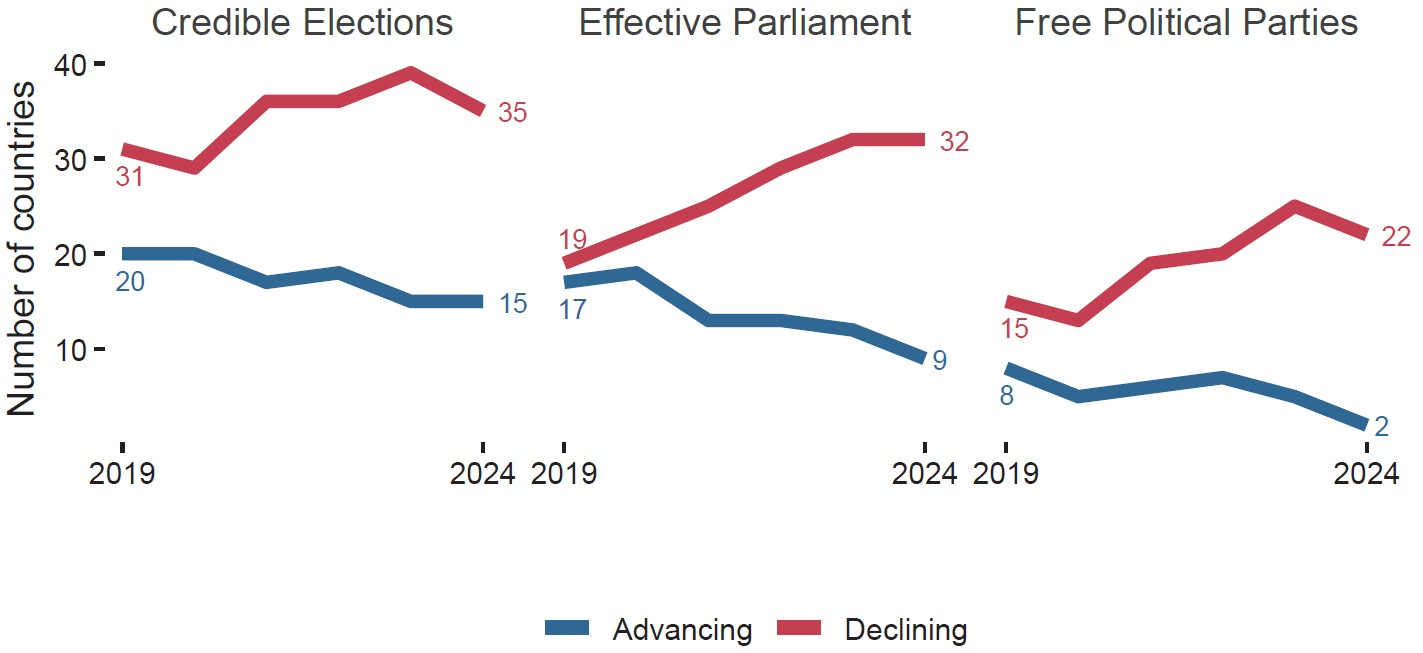

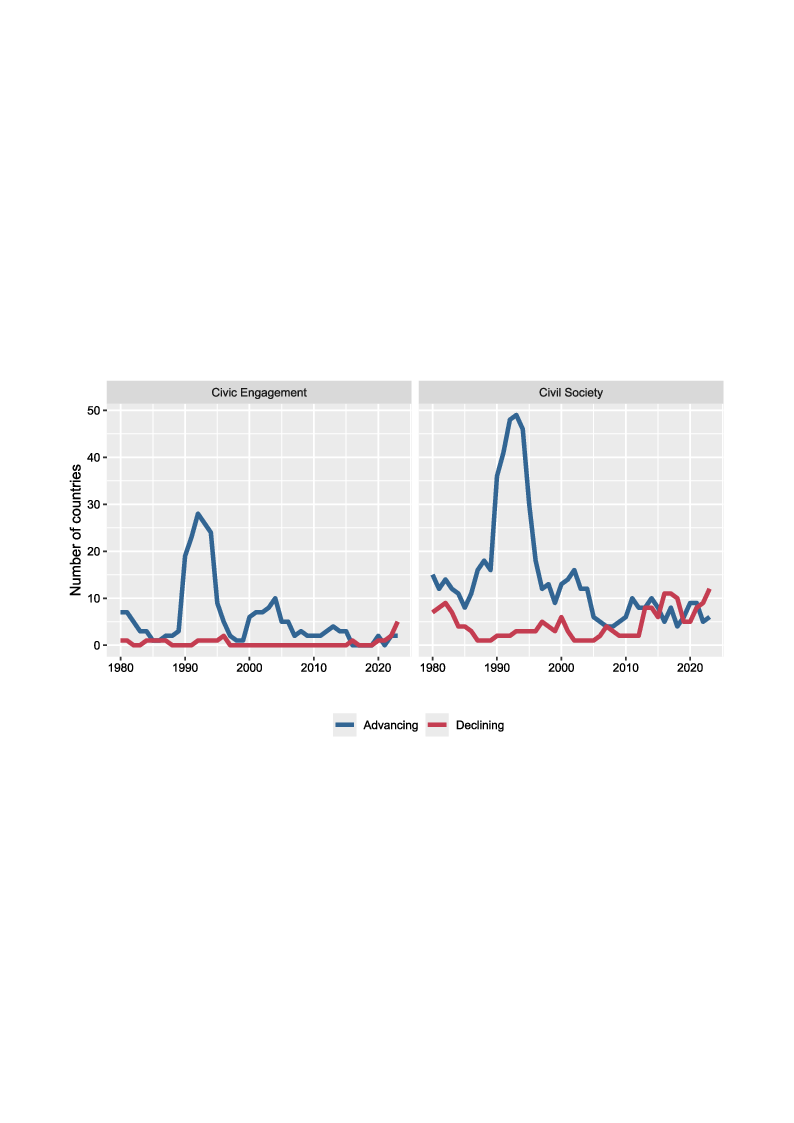
This contrast between losing trust in electoral processes and institutions, yet remaining enthusiastic and participating, indicates that Africans care about democracy and are willing and ready to defend it, but this support is not unconditional. Unless democracy can deliver on issues that most impact their lives—such as livelihoods; security; rights; economic opportunity, especially for young people; and public services—Africans will not value it (The Economist 2023; Bagnetto 2023) from State of Democracy.
Unlike in Asia, where both democracy (Hong Kong, Malaysia, South Korea and Taiwan) and authoritarianism (China and Singapore) have delivered some notable economic transformations, democracy in countries in Africa has yet to yield the anticipated outcomes of social development, such as closing the gap between the rich and poor. The continent remains marred by instances of civil war, unconstitutional changes of government, genocide, poverty and insecurity (Fayemi 2009).
Yet, the inability to deliver economic transformation remains the albatross for Africa’s democracies and authoritarian regimes alike. For example, the new Botswana administration must expand its economy beyond diamonds after its sovereign debt default in 2022, Ghana faces high inflation and poverty (Brown 2025), while revolutionary military governments in Burkina Faso, Gabon and Mali show a return to authoritarianism. These challenges stem from the lack of innovative governance frameworks for better tackling and collective advancement of citizens through recognizing cultural diversity, ethnicity and linguistic identities (Zambakari 2025). The failure of democratic systems to meet fundamental material needs has compelled populations in the Sahel to exchange governance for assurances of safety and security from military regimes. The absence of physical security in nations like Burkina Faso, Mali and Niger—where ongoing conflict and instability pose significant risks to democracy and various human rights—highlights this issue. In a slightly different context, Rwanda shows significant similarities with China and Singapore regarding its strategies for economic development and the delivery of essential needs and services.
1.4. Common observations of democracy in the Global South
As discussed, most of the countries in all three regions in the Global South were colonized, and a Western concept of democracy was introduced. Consequently, this mode of rule dealt away with pre-colonial, Indigenous systems of knowledge and governance, wherein societies of the Global South practised their own kind of social contract under the pre-colonial traditional governance systems which were replaced by the new post-colonial forms of state–civilian relations.
Second, countries within and across the regions are significantly diverse, and therefore, it has never been possible to adopt a one-size-fits-all approach to democracy. This design flaw and failed ‘cut-and-paste’ approach have fuelled democratic decline and a return to authoritarian rule in some cases.
Third, the three regions discussed face common challenges of corruption, human rights violations and electoral decline in some form or another, whether it is decline in space for political parties, or participation in elections or electoral maladministration. In most countries, democratic institutions confront threats from election manipulation and sudden leadership shifts. In some countries, the desire for benevolent dictatorship appears to stem from persistent flaws in democracies, including embezzlement, nepotism, tribalism and gerontocracy.
Fourth, technology has played a game-changing role in bolstering democracy and enhancing accountability among officials across all regions. Asian countries have implemented novel methods for the public to leverage technology in reporting corruption issues. In Africa, despite inadequate Internet connectivity and other infrastructure challenges, digital technology has transformed and improved access to information and the nature of electoral campaigns, and ease of mobilizing and reaching voters. Technology—in particular social media—has also played a transformative role in facilitating mobilization, public protests and popular uprisings in Egypt, Kenya, Nigeria, Sudan, Tunisia, Zimbabwe and other countries. However, resource constraints hinder the adoption of technology in Africa as well as some parts of Asia and Latin America while disinformation, digital surveillance and shutdowns remain an albatross and ready instrument for authoritarian regimes. Conversely, technocratic governance may encounter legitimacy challenges, particularly when appointed experts exert significant policy influence absent public oversight. Expert politics or technocracy can alienate citizens and diminish legitimacy, especially when specific reforms worsen the socio-economic conditions of the populace or when experts are perceived as tools of political elites (Adebanwi 2014). This issue is intensified in contexts marked by misinformation and governmental monitoring. The regulation of information dissemination by authorities or technocratic elites, the distortion of narratives through misinformation, and the surveillance of citizens to suppress dissent lead to a substantial decline in public confidence in expertise and governance (Bueno and Salapa 2022). Consequently, while expert politics may offer a short-term remedy for political instability, it must operate within frameworks that ensure transparency, accountability and the protection of information freedoms to enhance legitimacy and reduce the harmful effects of disinformation and surveillance on democratic governance.
2.1. Asia
Despite the challenges in Asia, there is something positive that can be taken from the use of democratic innovations such as technology to enhance grassroots participatory democracy, and accountability. To this end, Baek has rightly observed that, in South Korea, advanced technology employs blockchain in politics, which enhances secure and transparent public engagement in governance and increases public involvement in politics. Also, Indonesia and Mongolia are leveraging digital technology to improve citizen engagement and transparency in policymaking (Baek 2023). Singapore is another example of a leader in East Asia regarding the investment in data-driven technology for urban governance and digital public welfare, reflecting a data-solutionist approach to national branding. Its Digital Mental Health Connect (DMHC) platform is being developed to enhance predictive and cybernetic care, thus supporting the consolidation of authoritarian legitimacy. To compare this to China brings certain aspects to light. The Chinese Communist Party exemplifies technocratic authoritarianism, where legitimacy comes from expertise and technical skill instead of democratic involvement (Ahlers 2023). China’s governance model, rooted in pre-communist traditions, relies on experts to efficiently implement policies across its diverse regions. This technocratic approach enhances governance and adaptability but sharply contrasts with democracy, which relies on citizen participation and accountability (Alhers 2023).
Considering the above, these democratic innovations are likely to serve as good lessons for other regions or continents. Technology has made things accessible, and it will also enhance democracy and ensure that the public is involved in the decision-making processes and in the day-to-day affairs of governance. While technology may serve as a tool that will improve reimagined democracy, resource constraints may be a challenge for other continents, such as Africa, where data remains expensive and is only available to a few.
2.2. Latin America
To reimagine democracy and respond to the challenges in Latin America, some social movements have introduced new democratic approaches such as the ‘Buen Vivir’ principle, an Indigenous concept that calls for a ‘harmonious relationship between living beings that ensures diversity, life and the equality of redistribution’ (Alcoreza 2013: 147). Some countries in the region also took new steps by introducing an institutional innovation to ‘return power to the people and deconcentrate the policymaking process’ (Galindo-Delgado 2023). In order to enhance participatory democracy and involve citizens in the political process, Brazil introduced participatory budgeting wherein citizens can allocate public funds to projects of their choice (Goncalves 2014).
In the 1990s, Chile and Argentina implemented national electoral quotas for women to enhance gender representation in politics (Gray 2003). Chile began a public participatory process to replace the Constitution from Augusto Pinochet’s dictatorship, but citizens rejected the proposed drafts twice. These initiatives embody a governance vision in Latin America—an inclusive, grassroots approach focused on restoring citizen trust and fostering participatory democracy. The emergence of pro-social-justice governments aiming to incorporate Indigenous communities in development projects signifies an ongoing commitment to equity and pluralism (Galindo-Delgado 2023). Ongoing political instability, frequent leadership changes (Freeman 2023), and fragmented multiparty systems resulting in oversized coalitions (Meireles 2016) expose alternative visions and tensions in the region’s governance models. Some actors advocate for participatory and rights-based democracy, while others prioritize stability and control, despite worsening human rights conditions, highlighted by rising violence against women, journalists and human rights defenders (Ramirez 2022). These divergent paths highlight conflicting perspectives on achieving effective and legitimate governance in Latin America.
2.3. Africa
Debates on reimagining democracy in Africa have essentially been a critique that Western liberal democracy fails to capture the distinctiveness of African countries and their people. This discourse arises from the inadequacies of Western democracy in fulfilling the aspirations of societies that value tradition, equality and consensus in governance. Western democracy’s limitations in Africa have raised questions of compatibility, adaptability and desirability for Africans. The arguments have been that Western values fail to provide sustainable solutions for Africa’s socio-political and economic challenges. Advocates of dependency theory contend that Africa’s challenges stem from external forces aiming to exploit its resources. As Ferim (2023) highlights, the dependency theory argues that attempts by African nations to resist neo-colonial incursions are counteracted by Western powers through sanctions and military interventions. Critics contend that a universal growth path is lacking, and Western nations cannot steer African countries towards stability (Mohammed and Ibrahim 2023).
African feminist scholarship and conversation on reimagining democracy in Africa centre on intersectionality and deconstructing hegemonic political practice characterized by unequal representation of marginalized groups, particularly women (Dube 2024). African feminism challenges the power dynamics, including patriarchy, neoliberalism, authoritarianism and elite politics that define liberal democracy in Africa (Mutiso 2023). It argues that democracy is not just anchored in ‘partyism’ or periodic elections but a structural process of transformation, inclusion and decolonization (Dieng 2024). Democracy transcends electoral institutions; it involves sites such as local associations and traditional institutions, wheres the voice of the marginalized groups, including women, are recognized (Gaynor 2022).
African feminism and feminist activists have argued for a critical place of collectivism rooted in African cultural norms and historical realities (Tripp 2024). The consensus among the African feminists is that the primary need is to decolonize the political space to accommodate norms, policies and values that best serve African interests (Ndhlovu 2025). In place of Western democracy, which allows for ‘hegemonic governance’ that institutionalizes patriarchy in politics, African feminism has argued for an ‘intra-party democracy’—a practice that is anchored on party systems and policies that promote equal representation and participation of marginalized groups, particularly women. However, feminists have cautioned against ‘cosmetic inclusion’ as a feature of many African countries, such as Rwanda, Tunisia and Uganda which boast of women’s representation in politics with no commensurate structural influence (Tripp 2024). Overall, African feminists advocate for a reimagining of democracy that is structurally rooted in African experience, realities, history and communal values, deconstructing the hegemonic governance underlying structural exclusion.
To Africanists within and beyond feminism, liberal party democracy inherited by post-colonial African societies is adversarial and breeds political struggle. To proffer an alternative to liberal democracy and making a case for non-party systems, Wiredu draws on the ‘consensus democracy’ practice in traditional African society, where people gathered under trees to talk in villages until they reached agreement (Wiredu 1995). Similarly, Reddy (2015) contended that liberal democracy does not resonate with African societies and emphasized the essentiality of developing democratic systems rooted in African Indigenous experiences.
The emergence of authoritarian regimes in Burkina Faso, Mali and Niger when juxtaposed with President Kagame’s seemingly benevolent authoritarianism in Rwanda, has sparked intensified discussions regarding the characteristics and trajectory of democracy across the African continent. It has been argued that centralized power, whether coercive or benevolent, can promote stability and economic growth, and protect African states from neo-colonial influence (Han 2021). Conversely, there is a contention that this concentration of power erodes democratic accountability, civic freedoms and long-term political inclusivity. Consequently, a contrast exists between perceiving authoritarianism as a practical instrument for development and sovereignty, and regarding democracy as crucial for sustainable governance and the empowerment of citizens across the continent. Critics note repression and human rights violations in authoritarian regimes; however, a recent survey shows declining trust in liberal democracy in Africa, with many seeming to favour dictatorial rule that provides public goods and fosters development (Josua and Edel 2021). A 2024 Afrobarometer survey indicates that 53 per cent of Africans across 39 countries favour military rule or authoritarianism due to democratic leaders’ abuses of power and inability to provide public goods. However, the survey does not provide clear evidence regarding whether such preferences stem from experiences related to democracy or authoritarianism. Protests in Mali, for example, oppose military leader Assimi Goïta’s attempts to dissolve political parties and extend authoritarian control. However, the challenge remains—what is the ideal form of governance in Africa?
Scholarly research has shown that the institutional transfer model is a fallacy, and hence, solutions imported from the West (including liberal democracy as a form of government) have not succeeded in providing sustainable solutions to the political and economic malaise plaguing Africa, Asia and Latin America (Wiredu 1995). The re-imagination of democracy should be conceptualized from the viewpoint of this current reality.
3.1. Demographic shifts and role of young people
Young people were at the forefront of revolutions and protests during the colonial and post-colonial eras. Students in particular participated in, contributed to and organized mass protests at Tiananmen Square in China; founded the anti-oligarch student resistance movement in Chile; and were involved in the civil rights movement, including the radical Black Panther movement in the United States in the 1960s. They also participated in anti-colonial liberation movements across Africa, Asia and Latin America, including the anti-apartheid movement in South Africa from the 1960s to the early 1990s. In more recent years, young people have led demands for change in Tunisia, spreading to other Arab countries such as Egypt, Libya, Syria and Yemen, known as the Arab Uprisings. In 2011 the Sudanese Revolution, driven by young people, also led to the fall of the Bashir regime. More recently, in 2024, the pro-democracy Student-People’s Uprising led to the fall of the Sheikh Hasina regime in Bangladesh (Sourek 2025).
What makes the role of young people more significant for democracy in the Global South, especially in Africa—now more than ever—is the considerably larger proportion of young individuals in the populations of these regions, combined with their dissatisfaction over governments’ failure to deliver tangible benefits. In Africa, for example, young people under the age of 25 make up 60 per cent of the population (UNECA 2023). Africa’s median age is 19.7 years. The changing electoral landscape (discussed below), highest unemployment rates, poor levels of development, and lack of access to technological and digital connectivity represent a cocktail of factors that will transform the democratic trajectory of Africa—whether by ballot or revolution.
3.2. Changing electoral landscape
The dynamics of democracy in Africa are rapidly changing, especially regarding electoral processes. A notable succession of setbacks for ruling parties were witnessed in 2024, with deep ramifications for the trajectory of democratic governance throughout Africa. For example, South Africa’s African National Congress’ failure to attain 50 per cent of the parliamentary vote—a first since multiparty politics in 1994—points towards a significant shift in the domestic order, democratic consolidation and potential for shifts in international dynamics too (see: Sridharan 2012). Botswana’s national elections serve as another example wherein Botswana’s Democratic Party, which has been in power since the country’s independence in 1966, faced an electoral setback against the Umbrella for Democratic Change.
In the December 2024 elections in Ghana, former president John Mahama adeptly regained his position by overcoming the vice president of the ruling party. The success he achieved can be primarily linked to economic discontent prevalent among the people. In Asia, the 2024 uprisings in Bangladesh, which resulted in the end of autocratic rule by Prime Minister Sheikh Hasina, cannot be ignored (Chowdhury 2025). In Latin America, the election of President Lopez Obrador, who inter alia seeks to change the appointment of judges (to be done via popular election), has been seen as a threat to constitutional democracy and separation of powers in Mexico (Velasco-Rivera et al. 2024).
3.3. Democratic retrenchment
Democracy is fundamentally based on principles of equality, which are evident in the existence of elected representatives, the conduct of free and fair elections, the provision of broad suffrage, the facilitation of open political competition, and the implementation of institutional safeguards. These safeguards include the autonomy of associations and the protection of freedom of expression (Arthur 2025). Democratic retrenchment is increasingly observable on a global scale, with numerous states publicly committing to democratic norms while concurrently implementing authoritarian measures to strengthen their control (Rakner 2018). This phenomenon, frequently referred to as ‘electoralism’ or ‘democratism’, illustrates a worldwide trend where the superficial semblance of democracy conceals a slow decline in authentic participatory governance and adherence to democratic principles. This typically involves violations of citizens’ rights, suppression of opposition and the use of force to achieve political goals (Agbaje 1990). Sections (3.5: Electoralism) and (4.2: Harnessing digital technology, impact of AI) further elaborate on this.
Worldwide, while the principles and fundamental freedoms of democracy such as freedom of speech, freedom of association and access to information are facing significant challenges, even jeopardy, economic drivers such as poverty, livelihoods, unemployment and lack of access to economic and social rights and opportunities present universal challenges for many countries in the Global South. In Africa, a newly established government typically faces considerable political and economic challenges in achieving its objectives, especially within a context where both informal and formal institutions are intricately integrated into a governance framework marked by favouritism and the misappropriation of resources. These challenges also undermine the electorate’s capacity to select their political representatives, the rule of law supported by impartial judicial systems, and the safeguarding of personal integrity and privacy (Rakner 2018).
In order to gain a deeper understanding of democratic retrenchment, two significant aspects emerge for consideration. The initial observation is the inclination of political leadership to undermine democratic principles in favour of authoritarian decision making. This occurs despite the fact that the general populace continues to regard those principles as both legitimate and normative (Abdulrasheed and Fanny-Kinge 2024). Secondly, democratic retrenchment encompasses more than just the negation of procedural elements, such as regular elections or specific systems for selecting representatives; it also involves the dismantling of governance that relies on popular control and political equality. Democratic retrenchment should not be perceived as a viable alternative to liberal democracy, nor should it be regarded as a catalyst for emerging forms of organic democratic practice (Abdulrasheed and Fanny-Kinge 2024).
3.4. Revisiting social contracts; a new constitutionalism
At the of core of citizens’ dissatisfaction with democracy in the Global South is its failure to meet expectations and fulfil the obligations and responsibilities of political leaders or governments. The gap between expectation and outcomes can best be addressed by revisiting and consistently implementing social contracts. To reimagine democracy in Africa in relation to the social contract, subjects/citizens and the sovereign authority would engage in some kind of negotiation about how the former’s rule might benefit the latter (Nugent 2010). A social contract also entails how citizens map the way forward for peaceful co-existence among themselves regardless of their diversity (Loewe, Zintl and Houdret 2021; McCandless 2018). The problem, however, is defining democracy in a way that enables citizens or participants to consent to a government they did not necessarily support. Reimagining democracy through a social contract lens entails asking: if ‘we the people’ are left to freely establish new forms of governance, what forms and features would be established? In answering this question, people might seek solutions in traditional, customary and historical forms of governance with relevant modernization, or in a new constitutionalism, one oriented to securing political equality for the future—and present—of the digital-industrial revolution.
New constitutionalism sets limits for government institutions and key aspects of modern legal and political debates (Melo and Buckhart 2022). Because it shapes our questions about the government and its possible responses, constitutionalism is essential for understanding politics and law. Recent innovations in the Global South show that these nations are developing constitutionalisms of, or rather from, the Global South—which is not to essentialize the geopolitical meaning of these regions, nor to suggest there is a constitutionalism ‘specific’ to them (Melo and Buckhart 2022). This shift highlights the rich constitutional experiences of Africa shaped by unique historical, political and social contexts instead of following a fixed model of what democracy can be.
3.5. Electoralism
Electoralism refers to a strategy employed by authoritarian leaders to gain and maintain political dominance despite, indeed through, elections. In credible democracies, influential decision makers are selected through fair, open and periodic elections, enabling unrestricted competition for votes (Huntington 1991). Under electoralism, elections lack authenticity and true democratic intent. This underscores the intrinsic fragility and susceptibility of democracies reliant solely on elections. Democratic systems may falter when elected leaders embrace electoralism, as evidenced in recent events in Europe and the United States. Electoralism fosters diminished political equality—a widening chasm between the political elite capable of election manipulation, and the citizens they claim to represent (International IDEA 2017). Transnational issues such as inequality, migration and globalization pose deep challenges to democratic institutions. Without robust responses, these will continue to undermine perceived legitimacy and drive electoralism in the Global North.
Post-colonial democratic practices in Africa and other regions in the Global South have largely resulted in political challenges and widespread dissatisfaction, provoking a continuous continental-wide call for reimagining the ideal and idea of democracy. Failed democracy in Africa manifests in dictatorial regimes, ongoing corruption, lack of basic services, unreliable elections, insecurity and a concerning neglect for fundamental rights and human life (Attoe 2024). While various indicators have been put forward to demonstrate the need for an alternative political practice, it is useful to discuss key variables in developing or hindering new visions of democracy.
4.1. Centrality of leaders to the quality of democracy
After independence, the continental political landscapes became a theatre of leadership crises characterized by corrupt practices, patronage networks and repressive regimes which weakened political institutions in many countries (Gyimah-Boadi 2021). Many African leaders diverted public resources to amass personal wealth and perpetuate themselves in offices—thus becoming the primary instruments for the continued exploitation of the continent’s resources at the expense of citizens (Ferim 2023). That is, African leaders have often created ‘structures of domination, oppression and misuse of power’ (Ferim 2023)—a contributing factor, as well as a consequence, of recurrent military coups.
In Gambia, Ghana, Nigeria and Uganda, military-to-democratic transitions have sometimes led to democratism (Agbaje 1990) and the ‘sit-tight syndrome’ whereby elected leaders stay in office despite worsening health. Cameroon’s President Paul Biya has been in power since 1982; Uganda’s President Yoweri Museveni since 1986. Further, leadership crises in South Sudan and Nigeria led to civil war after independence. The failure of the leaders in several African countries to build inclusive institutions and respond to domestic grievances and demands incapacitated their country’s democratic prospects, leading to conflict and terrorism (Gyimah-Boadi 2021).
A troubling feature of Africa’s leadership woes is gerontocracy, which is rule by leaders who are much older than the average adult population (Onebunne and Chukwujekwu 2023). Despite being the world’s youngest continent, Africa continues to be governed mainly by elderly leaders. According to Adebayo, Africa’s youth have not shared in post-colonial governance. The reasons range from political apathy and passivity on the part of the youth, to governments that are skewed to prevent new entrants and a culture that silences them (Adebayo 2018). Botswana, Cabo Verde, Ghana, Mauritius, Namibia and Seychelles have demonstrated free elections, leadership changes and strong legal systems much of which can be attributed to better quality leaders, resilient institutions and a strong democratic culture.
In 2024, Transparency International revealed that merely three sub-Saharan African countries—Seychelles (70/100), Botswana (60/100) and Cabo Verde (60/100)—achieved scores exceeding 50 on the Corruption Perceptions Index (Transparency International 2024). In stark contrast, Nigeria recorded a score of 26/100, placing it at 140th out of 180 countries. The prevalence of corruption has consistently incited significant public outrage and demonstrations, exemplified by the 2020 #EndSARS movement in Nigeria. Initially focused on police brutality, this cause has expanded to include wider political discontent (BBC 2021). In post-apartheid South Africa, the connection between leadership and corruption became evident during the state capture scandal involving President Zuma. This situation prompted the formation of the Zondo Commission. Also, a survey conducted by Afrobarometer (2024) revealed that a significant 82 per cent of South Africans expressed frustration regarding corruption among officials. Despite the protests and inquiries, public outrage has seldom resulted in effective or enduring solutions. Systemic corruption persists, undermining governance and eroding public trust throughout the region.
In Asia, Malaysia has faced challenges of high-profile corruption scandals linked to political leadership ever since its independence (Razita and Santoso 2024). Hong Kong and Singapore experience high levels of corruption and dropped scores in recent years (Political & Economic Risk Consultancy 2024). In countries such as Thailand and Cambodia there has been authoritarian interference with democratic institutions and the suppression of dissent (Razita and Santoso 2024).
In Latin America, for example, 88 per cent of Peruvians believe that most of their political leaders were involved in corruption and were using state resources for personal gain (Lupu, Rodríguez and Zechmeister 2021). The problem of leaders who come into power for personal gain, misuse public resources and interfere with democratic institutions is therefore a challenge that cuts across all the three regions. While all the regions have adopted anti-corruption measures to try and curb corruption, these measures are yet to produce significant results.
4.2. Harnessing digital technology and the impact of AI
Digital technology has played a significant role in transforming the democratic landscape globally. It has dramatically changed the pace of information sharing between citizens, the way people mobilize public protests, the manner of political and electoral campaigns, and the participation of young people—who are early adopters and heavy users of these technologies. Artificial intelligence (AI) technologies offer unique opportunities for major changes in the economy and business landscape, and for society and individual users (Njontini 2021). AI has also advanced to a stage where it impacts and changes production, blurring the lines between capital and labour—and between the biological and built environment (Njontini 2021).
The AI and social media have the potential to serve as valuable tools in various aspects of democracy (Lefakane 2022). For example, social media and online technologies were used during the Arab Uprisings to mobilize youth to clamour for democratic change. There is no doubt that online technologies have opened spaces for the rise of online independent publishers, promoting freedom of speech and expression. Print publications remain important given the numerous Internet shutdowns especially in parts of Africa (Rydzak et al. 2020) and Asia (Yilmaz et al. 2022) during elections and times of civil strife.
However, AI and virtual media also present glaring threats of infringements of human dignity and rights such as the right to privacy, data protection and dignity, and the risk of weaponized disinformation as seen in the ongoing Ukraine and Israel–Palestine conflicts. The United Nations Educational, Scientific and Cultural Organization (UNESCO) discusses the importance of developing AI technologies that uphold human rights and benefit society (UNESCO 2021). While the full impact of AI on democracy is not yet known, there is no doubt that it will be a game-changer.
4.3. The quality of constitutional settlements in fragmented societies
There is a dearth of scholarship on the contemporary application of a social contract to countries that have been affected by conflict and instability or are transitioning from autocratic rule to democracy (Loewe, Zintl and Houdret 2021). It has been suggested that a comprehensive social contract, as seen in 20th century welfare states, has enjoyed more consensus support in ethnically homogenous societies (e.g. in northern Europe). However, in the majority world, ethnic diversity is the norm. Consequently, there is a need for a social contract that would respond sensitively to geographical locations, cultures and religions.
Before the emergence of democracy in Africa, Asia and Latin America, some countries had developed ‘populist-authoritarian social contracts, which provided protection and social benefits for citizens but not for political participation’ (Loewe, Zintl and Houdret 2021), as enshrined in liberal democracies (ORF 2017). However, these faltered over time and, without a basis in rights, could often be discriminatory in application. Along with the far-reaching impacts of technology, inequality and urbanization (ORF 2017), this is a factor that will continue to affect the prevailing notion of social contracts in the Global South and worldwide. During the Arab Uprisings in the Middle East and North Africa, the populace expressed a desire for a new social compact that would promote social change, political liberation, recognition of basic human rights and liberties, electoral reform and a broad democratization process (le Pere 2013). Deep dissatisfaction with long-standing authoritarianism, widespread corruption and socio-economic inequality is reflected in these movements. Although the upheavals at first inspired hope for inclusive administration and democratic regeneration, the results have turned out to be diverse and intricate.
For diverse societies, what is envisaged is a dynamic agreement between state and society, including different groups in society, on how to live together, how power is exercised and how resources are distributed. It allows for the peaceful mediation of conflicting interests and different expectations and understandings of rights and responsibilities (including with nested and/or overlapping social contracts that may transcend the state) over time, and in response to contextual factors (including shocks, stressors and threats), through varied mechanisms, institutions and processes (McCandless 2018).)
In light of the above, there is a need to explore a new social contract that will bring about a democratic dispensation to respond to the needs of the people in the Global South.
4.4. Popular movements
Popular movements from within civil society play a fundamental role in bringing about political change and address issues affecting the public such as crime and cost of living (Brandes and Engels 2011). While funding of civil society organizations by foreign donors sometimes causes discomfort among political figures vigilant about externally imposed regime change (Brandes and Engels 2011), civil society plays a key role in holding the government accountable and in raising awareness about human rights. African social movements are regarded as ‘one of the most effective engines for political change anywhere in the world’ despite usually operating in volatile environments (Marks 2024) beset with violations of human rights.
In Latin America, too, popular movements have played a pivotal role in reactive campaigns against tyranny, threats and intimidation (Bülow 2023: 521). In Asia (Sri Lanka), the people’s movement known as Janatha Aragalaya overthrew the ‘corrupt and authoritarian Rajapaksa regime in 2022’ before being hijacked by politicians of the caretaker government (Anisa 2024). In Bangladesh, in July 2024, the Student-People’s Uprising which began as a protest against quotas culminated in the overthrow of President Sheikh Hasina and her regime. In Africa, the Gen Z protests in Kenya during 2024 were a result of an organized digital and street mobilization against the rise of high costs of living (Gathara 2025). These few examples demonstrate the power of civil society movements in the democratic space notwithstanding their susceptibility to political manipulation at times. Given their closeness to the people whom they represent, their spontaneity, their mobilization capacity and their potential to overthrow both democratically elected and authoritarian governments, popular movements undoubtedly have a key role to play in reimagining democracy in Africa and the Global South.
It is no longer business as usual. Authoritarian leaders who remain in power have witnessed the popular uprisings as observed across all the three regions in the Global South. In a contrasting view, frustrations with the dismal performance of democratically elected leaders have resulted in either military coups, such as in parts of West Africa, or the decline of hegemonic parties across all the three regions. Technology, especially social media platforms, has influenced the way parties, civil society organizations and citizens mobilize to bring about political, economic and social transformation. There is no dictator who is safe. There are signs of a new social contract; a reimagined democracy is unavoidable. However, it remains unclear how this reimagined democracy will look. It will be marked by the heterogeneity of countries, each seeking to forge its own path and informed by its specific history, cultural heritage and political economy—including its position in relation to external influences and the global power hierarchy. Regions in the Global South can learn from experience and borrow best practices from one another, and also from the Global North. Nonetheless, the legal and policy reforms outlined below could enhance democratic practice in all these diverse contexts. It is important that policies be put in place to guarantee substantial and meaningful participation and representation for women and young people, moving past merely cosmetic efforts. In our diverse societies, policies that promote inclusion and equality for everyone, irrespective of gender, orientation, class, ethnicity, religion or background, are vital. As much as elections, these socio-economic foundations will determine the effectiveness and durability of tomorrow’s democracies.
While imposing elements of Western liberal democracy was once a standard practice across much of the Global South, reimagining democracy today requires context-specific approaches that reflect local histories, values and realities. Democratic consolidation must be prioritized to prevent retrenchment, strengthen institutional resilience and restore citizens’ trust in governance. Building on the challenges identified—ranging from abrupt leadership transitions to corruption and electoral manipulation—this paper proposes the following constitutional, policy and legal reforms:
Legislators
- Curb divisive politics. Enact legislation sanctioning actors who exploit race, ethnicity or religion to fuel social division.
- Protect democratic institutions. Pass laws shielding oversight and accountability bodies from political interference.
- Safeguard digital rights. Develop legal frameworks to protect citizens’ privacy and prevent abuses linked to AI and digital technologies.
Governments
- Guarantee judicial independence. Strengthen security of tenure and insulate judges from political pressure.
- Enable civic space. Ensure protections for civil society, freedom of expression and press freedom to enhance transparency and accountability.
- Harness technology for governance. Use digital tools to expand civic engagement, improve access to public services and close the gap between citizens and the state.
Political parties
- Ensure inclusive representation. Mandate the participation of women, youth, minorities, and LGBTQIA+ communities in party structures and candidate lists.
- Strengthen integrity in leadership. Disqualify candidates implicated in corruption or serious crimes from holding public office.
- Modernize engagement. Adapt political mobilization strategies to responsibly harness digital platforms and social media.
Civil society
- Advance civic education. Promote awareness of voting rights, political tolerance and respect for diversity.
- Institutionalize participation. Advocate for participatory policymaking that reflects citizens’ voices in law and policy design.
- Counter authoritarianism. Support grassroots and direct democracy initiatives to amplify citizen power and resist authoritarian trends.
Regional organizations
- Promote democratic solidarity. Foster cooperation among Global South states to uphold rule of law, democratic norms and peer accountability.
- Enforce regional commitments. Rigorously implement and enforce regional democracy charters and treaties to prevent backsliding and intervene early in cases of democratic crisis.
- For example, in Zambia and the Gambia.
- For example, in Burkina Faso, Democratic Republic of the Congo, Ethiopia, Guinea and Sudan.
Abbreviations
| AI | Artificial intelligence |
|---|---|
| LGBTQIA | Lesbian, Gay, Bisexual, Transgender, Queer/Questioning, Intersex, Asexual/Aromantic |
With support from the Open Society Foundations, this discussion paper was written by Professor Moses Retselisitsoe Phooko (Lead Author) with Professor Valery Ferim and Seraphine Kwanje. Valuable feedback and inputs on the draft versions were provided by Gram Matenga and Winluck Wahui. The study was reviewed by Siphosami Malunga.
Special thanks to Clara Mutanda for coordinating the study and to Lisa Hagman and Tahseen Zayouna in International IDEA’s Publications team for facilitating the production of the discussion paper.
Abdulrasheed, M., and Fanny-Kinge, R., ‘An overview of democratic consolidation and
regression in Africa’, Hasanuddin Journal of International Affairs, 4/1 (2024), pp. 10–21, <https://doi.org/10.31947/hjirs.v4i01.32505>
Adebanwi, W., ‘Technocrats and political elites in Nigeria: The politics of expertise and the future of democracy’, African Affairs, 113/450 (2014), pp. 362–81
Adebayo, J. O., ‘Gerontocracy in African politics: Youth and the quest for political participation’, Journal of African Elections, 17/1 (2018), pp. 140–61, <https://library.au.int/fr/gerontocracy-african-politics-youth-and-quest-political-participation-research>, accessed 13 February 2026
Adejumobi, S., ‘Elections in Africa: A fading shadow of democracy?’, International Political Science Review, 21/1 (2000), pp. 59–73, <https://doi.org/10.1177/0192512100211004>
Afrobarometer, ‘African insights 2024: Democracy at risk – the people’s perspective’, July 2024, <https://www.afrobarometer.org/publication/african-insights-2024-democracy-at-risk-the-peoples-perspective>, accessed 29 September 2025
Agbaje, A., ‘Travails or the secular state: Religion, politics, and the outlook of Nigeria’s third republic’, Commonwealth and Comparative Politics, 28/3 (1990), pp. 288–308, <https://doi.org/10.1080/14662049008447593>
Ahlers, A. L., ‘Technocracy on the ground: Cadre competence, expert involvement, and scientific advice in China’s local governance’ , in C. Ergenc and D. S. G. Goodman (eds), Handbook on Local Governance in China (Edward Elgar Publishing, 2023), <https://doi.org/10.4337/9781800883246.00018>
Alcoreza, R. P., ‘Buen Vivir as a model for state and economy’, in M. Lang and D. Mokrani (eds), Beyond Development: Alternative Visions from Latin America (Amsterdam: Transnational Institute, 2013), <https://www.tni.org/files/download/beyonddevelopment_buenvivir.pdf>, accessed 29 September 2025
Anisa, ‘Even as the multiple crisis deepens in Asia, social movements advance the struggle for alternatives’, Focus on the Global South, 19 December 2024, <https://focusweb.org/even-as-the-multiple-crisis-deepens-in-asia-social-movements-advance-the-struggle-for-alternatives/>, accessed 29 September 2025
Arthur, P., ‘Countering the wave of democratic backsliding and the crisis of democracy in West Africa’, Insight on Africa, 17/2 (2025), pp. 212–34, <https://doi.org/10.1177/09750878241312188>
Attoe, A. D., ‘Why democracy fails in Africa’, The Philosophical Forum, 55/2 (2024), pp. 137–56, <https://doi.org/10.1111/phil.12358>
Baek, J., Exploring Worldwide Democratic Innovations Outside the West: Lessons from Asia (Brussels: European Democracy Hub, 2023)
Bagnetto, L. A., ‘Zambia’s Hichilema: “Debt is the python around our necks”’, The Africa Report, 26 June 2023, <https://www.theafricareport.com/313748/zambias-hichilema-debt-is-the-python-around-our-necks/>
BBC News, ‘Nigerian army “shot and killed #EndSars protesters”: Report’, 15 November 2021, <https://www.bbc.com/news/world-africa-59300011>, accessed 29 September 2025
Boese, V. A., Alizada, N., Lundstedt, M., Morrison, K., Natsika, N., Sato, Y., Tai, H. and Lindberg, S. I., ‘Autocratization Changing Nature? Democracy Report 2022’, Varieties of Democracy Institute, March 2022, <https://v-dem.net/media/publications/dr_2022.pdf>, accessed 9 February 2026
Brandes, N. and Engels, B., ‘Social movements in Africa’, Stichproben: Wiener Zeitschrift für kritische Afrikastudien, 11/20 (2011), pp. 1–15, <https://stichproben.univie.ac.at/alle-ausgaben/stichproben-nr-202011/>, accessed 15 December 2025
Brooks, H., Ngwane, T. and Runciman, C., ‘Decolonising and re-theorising the meaning of democracy: A South African perspective’, The Sociological Review, 68/1 (2020), pp. 17–32, <https://doi.org/10.1177/0038026119878097>
Brown, F. Z., ‘The Four Big Questions Shaping Democracy in Africa’, Carnegie Endowment for International Peace, 8 April 2025, <https://carnegieendowment.org/research/2025/04/the-four-big-questions-shaping-democracy-in-africa?lang=en>, accessed 29 September 2025
Bueno, D. C. and Salapa, A., ‘Decentralization, technocracy, democracy and media, administrative control, participation, devolution and local governance: A rapid literature review’, January 2022, <https://doi.org/10.13140/RG.2.2.25479.52642>
Bülow, M., ‘Transnational Social Movements in Latin America’, in The Oxford Handbook of Latin American Social Movements, Federico M. Rossi (ed.), (Oxford Academic, 2023) p. 521, <https://ouci.dntb.gov.ua/en/works/4kYnWao9/>, accessed 16 February 2026
Cheung, O., ‘An East Asian theory of democracy’, in S. Cooke (ed.), Non-Western Global Theories of International Relations (London: Palgrave Macmillan, 2022), pp. 103–32, <https://doi.org/10.1007/978-3-030-84938-2_5>
Chole, E. and Ibrahim, J., Democratisation Processes in Africa: Problems and Prospects (Dakar: CODESRIA, 1995)
Chowdhury, N., ‘The return of politics in Bangladesh’, Journal of Democracy, 36/1 (2025), pp. 65–78, <https://doi.org/10.1353/jod.2025.a947884>
Cohen, J. and Fung, A., ‘Radical democracy’, Swiss Journal of Political Science, 10/4 (2004), pp. 23–34
Daly, T. G., Designing Resilient Institutions: Countering Democratic Backsliding in Asia (Stockholm: International IDEA, 2025), <https://doi.org/10.31752/idea.2025.15>
Dieng, R. S., ‘Speaking out, talking back? African feminist politics and decolonial poetics of knowing, organising and loving’, Review of African Political Economy, 51/179 (2024), pp. 135–47, <https://doi.org/10.1080/03056244.2023.2284524>
Dube, S., ‘Inspiring inclusion: Afro-feminist approaches for women’s political participation’, International IDEA, 6 March 2024, <https://www.idea.int/news/inspiring-inclusion-afro-feminist-approaches-womens-political-participation>, accessed 1 October 2025
Economist Intelligence Unit, ‘Democracy Index 2024’, February 2025, <https://www.eiu.com/n/campaigns/democracy-index-2024/>, accessed 19 September 2025
Edor, M., ‘Navigating Democracy: Perspectives on Western-Style Democracy in Africa’, Master’s Thesis, Illinois State University (2024), unpublished, <https://ir.library.illinoisstate.edu/etd/1904>
Englebert, P., State Legitimacy and Development in Africa (Boulder, CO: Lynne Riener, 2000), <https://doi.org/10.1515/9781685850050>
Fayemi, A. K., ‘Towards an African theory of democracy’, Research Review of the Institute of African Studies, 25/1 (2009), pp. 1–21, <https://doi.org/10.4314/rrias.v25i1.44929>
Ferim, V. B., ‘Why is Africa trapped at the bottom of the global political economy? A Review of contending theoretical propositions’, Journal of African Foreign Affairs, 10/3 (2023), pp. 185–202, <https://doi.org/10.31920/2056-5658/2023/v10n3a9>
Fredrickson, G. M., Black Liberation: A Comparative History of Black Ideologies in the United States and South Africa (Oxford: Oxford University Press, 1995), <https://doi.org/10.1093/oso/9780195057492.001.0001>
Freeman, W., ‘The coming crisis for Latin America’s left-wing leaders’, Americas Quarterly, 27 September 2023, <https://www.americasquarterly.org/article/the-coming-crisis-for-latin-americas-left-wing-leaders/>, accessed 29 September 2025
Gaens, B. and Ruohomäki, J., Southeast Asian Democracy: Democratic Regression or Autocratic Hardening, Finnish Institute for International Affairs Briefing Paper 342 (Helsinki: FIIA, 2022)
Galindo-Delgado, G., ‘Reimagining democracy from Latin America: An invitation to expand the political and sociological imagination’, Arizona State University (Global Human Rights Hub fellows Blog), 21 November 2023, <https://newcollege.asu.edu/global-human-rights-hub/fellows-program/ghr-fellows-blog/galindo-delgado>, accessed 29 September 2025
Gathara, P., ‘East Africa’s rulers saw what Gen Z can do – now they’re striking first’, Al Jazeera, 11 June 2025, <https://www.aljazeera.com/opinions/2025/6/11/east-africas-rulers-saw-what-gen-z-can-do-now-theyre-striking-first>, accessed 29 September 2025
Gaynor, N., Engendering Democracy in Africa: Women, Politics and Development (London: Taylor and Francis, 2022), <https://doi.org/10.4324/9781003147879>
Goncalves, S., ‘The effects of participatory budgeting on municipal expenditures and infant mortality in Brazil’, World Development, 53 (2014), pp. 94–110, <https://doi.org/10.1016/j.worlddev.2013.01.009>
Gray, T., ‘Electoral gender quotas: Lessons from Argentina and Chile’, Bulletin of Latin American Research, 22/1 (2003), pp. 52–78, <https://doi.org/10.1111/1470-9856.00064>
Gyimah-Boadi, E., Democratic Backsliding in West Africa: Nature, Causes, Remedies (Geneva: Kofi Annan Foundation, 2021)
Han, K., ‘Autocratic welfare programs, economic perceptions, and support for the dictator: Evidence from African autocracies’, International Political Science Review, 42/3 (2021), pp. 416–29, <https://doi.org/10.1177/0192512119897387>
Hao, S. and Gao, Q., ‘East Asian pathways toward democracy: A qualitative comparative analysis of “the third wave”’, Journal of East African Studies, 16/2 (2016), pp. 239–60, <https://doi.org/10.1017/jea.2016.2>
Human Rights Watch, World Report 2021: Events of 2020 (New York: Human Rights Watch, 2021), <https://www.hrw.org/sites/default/files/media_2021/01/2021_hrw_world_report.pdf>, accessed 30 September 2025
Huntington, S. P., The Third Wave: Democratization in the Late Twentieth Century (Norman, OK: University of Oklahoma Press, 1991)
International IDEA, The Global State of Democracy: Exploring Democracy’s Resilience (Stockholm: International IDEA, 2017), <https://www.idea.int/gsod-2017/files/IDEA-GSOD-2017-REPORT-EN.pdf>, accessed 30 September 2025
—, The Global State of Democracy 2023: The New Checks and Balances (Stockholm: International IDEA, 2023), <https://doi.org/10.31752/idea.2023.78>
—, The Global State of Democracy 2025: Democracy on the Move (Stockholm: International IDEA, 2025), <https://doi.org/10.31752/idea.2025.53>
Josua, M. and Edel, M., ‘The Arab uprisings and the return of repression’, Mediterranean Politics, 26/5 (2021), pp. 586–611, <https://doi.org/10.1080/13629395.2021.1889298>
Kasuya, Y. ‘Democratization in Asia’, in R. Sohashi, Y. Matsuda and W. Aoyama (eds) Asia Rising: A Handbook of History and International Relations in East, South and Southeast Asia, (Singapore: Springer, 2024), pp. 221–87, <https://doi.org/10.1007/978-981-97-4375-9_12>
Lefakane, N. V., ‘The use of artificial intelligence for adjudication in South Africa’, North-West University, April/June 2022, <https://repository.nwu.ac.za/items/73c4d5ad-1a67-4cdc-8410-986edeede0c3>, accessed 16 February 2026
le Pere, G., ‘The Middle East, North Africa and the “Arab Spring”: Towards revolutionary change or authoritarian adaptation?’, Africa Insight, 43/1 (2013)
Loewe, M., Zintl, T. and Houdret, A., ‘The social contract as a tool of analysis: Introduction to the special issue on “Framing the evolution of new social contracts in Middle Eastern and North African countries”’, World Development, 145 (2021), <https://doi.org/10.1016/j.worlddev.2020.104982>
N. Lupu, M. Rodríguez and E. J. Zechmeister (eds), Pulse of Democracy (Nashville, TN: Latin American Public Opinion Project (LAPOP), 2021),<https://www.vanderbilt.edu/lapop/ab2021/2021_LAPOP_AmericasBarometer_2021_Pulse_of_Democracy.pdf>, accessed 30 September 2025
Marks, Z., ‘African popular protest and political change’, Journal of Democracy, 35/3 (2024), pp. 99–114, <https://doi.org/10.1353/jod.2024.a930430>
Mazadou, O., ‘Democracy in postcolonial Africa: Imitation, adaptation and re-creation’, Open Journal of Philosophy, 12/1 (2022), pp. 1–20, <https://doi.org/10.4236/ojpp.2022.121001>
McCandless, E., Forging Resilient Social Contracts: A Pathway to Preventing Violent Conflict and Sustaining Peace (New York: United Nations Development Programme, 2018), <https://www.undp.org/publications/forging-resilient-social-contracts-preventing-violent-conflict-and-sustaining-peace>, accessed 30 September 2025
Meireles, F., ‘Oversized government coalitions in Latin America’, Brazilian Political Science Review, 10/3 (2016), <https://doi.org/10.1590/1981-38212016000300001>
Melo, M. P. and Buckhart, T. R., ‘A constitutionalism “of” the Global South? Epistemological reflections on emerging constitutional trends’, Revista de Estudos Constitucionais, Hermenêutica e Teoria do Direito (RECHTD), 14/3 (2022), pp. 420–38, <https://doi.org/10.4013/rechtd.2022.143.08>
Mohammed, S. A. and Ibrahim, M., ‘Critique of the modernization theory’s conceptions of underdevelopment: A theoretical approach’, Nnamdi Azikiwe Journal of Political Science, 8/2 (2023), pp. 113–29, <https://www.researchgate.net/publication/379331619_Critique_of_the_Modernization_Theory's_Conceptions_of_Underdevelopment_A_Theoretical_Approach>, accessed 30 September 2025
Morlino, L., Rial, C., Saez, M., Tommasoli, M. and Zovatto, D., The Quality of Democracies in Latin America (Stockholm: International IDEA/LUISS, 2016), <https://www.idea.int/sites/default/files/publications/the-quality-of-democracies-in-latin-america.pdf>, accessed 30 September 2025
Mutiso, A., ‘Embracing feminism: A Kenyan women’s perspective’, Includovate, 17 July 2023, < https://www.includovate.com/embracing-feminism-a-kenyan-womans-perspective/>, accessed 30 September 2025
Ndhlovu, H.‘Reimagining Africa’s future: A decolonial intersectional feminist vision’, Wits School of Governance, 22 May 2025, <https://www.wsg.ac.za/news/reimagining-africas-future-decolonial-intersectional-feminist-vision>, accessed 30 September 2025
Njontini, M. N., ‘Disruptive technologies and the future of regulations – ICT regulatory structure(s) determined’, De Jure Law Journal, 54/1 (2021), pp. 175–76, <https://doi.org/10.17159/2225-7160/2021/v54a11>
Nugent, P., ‘States and social contracts in Africa’, New Left Review, 63 (2010), pp. 35–68, <https://doi.org/10.64590/iuy>
Onebunne, J. I. and Chukwujekwu, O. N., ‘Gerontocratic kakistocracy in Nigerian Polity’, AMAMIHE: Journal of Applied Philosophy, 21/4 (2023), <https://www.igwebuikeresearchinstitute.org/o_journals/AMAMIHE_21.4.1.pdf>, accessed 30 September 2025
Observer Research Foundation (ORF)/Raisina Debates, ‘The emerging social contract in Asia’, 20 February 2017, <https://www.orfonline.org/expert-speak/emerging-social-contract-asia>, accessed 29 September 2025
Osaghae, E. E. and Osaghae, V. A., ‘Rethinking democratic governance and accountability in Africa’, Forum for Development Studies, 40/3 (2013), pp. 393–412, <https://doi.org/10.1080/08039410.2013.812138>
Political & Economic Risk Consultancy, Ltd., ‘Corruption in Asia – 2024’, 20 March 2024, <http://www.asiarisk.com/subscribe/exsum1.pdf>, accessed 16 June 2025
Rakner, L., ‘Breaking BAD: Understanding backlash against democracy in Africa’, Chr. Michelsen Institute, 2018, <https://www.cmi.no/publications/6518-breaking-bad-understanding-backlash-against>, accessed 30 September 2025
Ramirez, E. G., ‘Democracy and Human Rights in Latin America: Is Democratic Erosion Gathering Pace?’, European Parliamentary Research Service, Briefing, January 2022, <https://www.europarl.europa.eu/RegData/etudes/BRIE/2022/698868/EPRS_BRI(2022)698868_EN.pdf>, accessed 30 September 2025
Razita, S. and Santoso, M. P. T., ‘The decline of democracy in the South East Asian region’, Politics and Humanism, 3/1 (2024)
Reddy, T., South Africa, Settler Colonialism and the Failures of Liberal Democracy (London: Zed Books, 2015), <https://doi.org/10.5040/9781350222694>
Rydzak, J., Karanja, M. and Opiyo, N., ‘Dissent does not die in darkness: Network shutdowns and collective action in African countries’, International Journal of Communication, 14 (2020), pp. 4264–87, <https://ijoc.org/index.php/ijoc/article/view/12770/3185>, accessed 30 September 2025
Scalapino, R. A., ‘Democracy in Asia: Past and future’, Far Eastern Survey, 20/6 (1951), pp. 53–57, <https://doi.org/10.2307/3024129>
Schraeder, P. J., ‘Understanding the “third wave” of democratization in Africa’, The Journal of Politics, 57/4 (1995), pp. 1160–71, <https://doi.org/10.2307/2960407>
Sourek, A., ‘Future leaders, present voices: Youth shaping democratic governance through the 2025 VNRs’, International IDEA, 8 August 2025, <https://www.idea.int/news/future-leaders-present-voices-youth-shaping-democratic-governance-through-2025-vnrs>, accessed 30 September 2025
E. Sridharan (ed.), Coalition Politics and Democratic Consolidation in Asia (Oxford: Oxford University Press, 2012), <https://doi.org/10.1093/acprof:oso/9780198079392.001.0001>
The Economist, 'Africa faces a mounting debt crisis', 16 May 2023, <https://www.economist.com/middle-east-and-africa/2023/05/16/africa-faces-a-mounting-debt-crisis>, accessed 20 February 2026
Transparency International, ‘Corruption Perception Index’, 2024, <https://www.transparency.org/en/cpi/2024/index/bwa>, accessed 16 February 2026
Tripp, A. M., ‘How African autocracies instrumentalize women leaders’, Politics and Gender, 20/1 (2024), pp. 217–22, <https://doi.org/10.1017/S1743923X22000484>
United Nations Economic Commission for Africa (UNECA), ‘3rd Edition of the NTA Africa Conference: Focus on Demographic Dividend, Generational Economics and Sustainable Development in Africa’, 1 September 2023, <https://www.uneca.org/stories/3rd-edition-of-the-nta-africa-conference-focus-on-demographic-dividend%2C-generational#:~:text=Africa's%20population%20is%20projected%20to,2017%20roadmap%20on%20demographic%20dividend>, accessed 15 September 2025
United Nations Educational, Scientific and Cultural Organization (UNESCO), Recommendation on the Ethics of Artificial Intelligence (Paris: UNESCO, 2021), <https://unesdoc.unesco.org/ark:/48223/pf0000381137>, accessed 30 September 2025
Velasco-Rivera, M., Prieto, I. P., Olaiz-Gonzalez, J. and Daly, T. G., ‘Mexico’s constitutional democracy under threat: The judicial overhaul is only the beginning’, Verfassungsblog, 16 September 2024, <https://doi.org/10.59704/f215c0a86deeaba0>
Wiredu, K., ‘Democracy and consensus in African traditional politics: A plea for a non-party polity’, Centennial Review, 39/1 (1995), pp. 53–64, <https://www.jstor.org/stable/23739547>, accessed 30 September 2025
Yilmaz, I., Ali Saleem, R. M., Pargoo, M., Shukri, S., Ismail, I. and Shakil, K., ‘Religious Populism, Cyberspace and Digital Authoritarianism in Asia: India, Indonesia, Malaysia, Pakistan, and Turkey’, European Center for Populism Studies (ECPS), 20 January 2022, <https://doi.org/10.55271/rp0001>
Zambakari, C., ‘The Future of African Sovereignty in a Multipolar World: Challenges and Opportunities’, SSRN Working Paper, 19 May 2025, <https://doi.org/10.2139/ssrn.5187748>


© 2026 International Institute for Democracy and Electoral Assistance
International IDEA publications are independent of specific national or political interests. Views expressed in this publication do not necessarily represent the views of International IDEA, its Board or its Council members.
With the exception of any third-party images and photos, the electronic version of this publication is available under a Creative Commons Attribution-NonCommercial-ShareAlike 4.0 (CC BY-NC-SA 4.0) licence. You are free to copy, distribute and transmit the publication as well as to remix and adapt it, provided it is only for non-commercial purposes, that you appropriately attribute the publication, and that you distribute it under an identical licence. For more information visit the Creative Commons website:
<http://creativecommons.org/licenses/by-nc-sa/4.0>.
International IDEA
Strömsborg
SE–103 34 Stockholm
SWEDEN
Tel: +46 8 698 37 00
Email: info@idea.int
Website: <https://www.idea.int>
Cover illustration: International IDEA, with elements from Adobe Express
Design and layout: International IDEA
Copyeditor: Andrew Robertson
DOI: <https://doi.org/10.31752/64910>
ISBN: 978-91-8137-104-8 (PDF)
ISBN: 978-91-8137-105-5 (HTML)


