


Democracy Tracker Methodology and User Guide
Version 3, April 2026

The Democracy Tracker is a data project that provides event-centric information on democracy developments in 173 countries, with a data series beginning in August 2022. The monthly event reports include (a) a narrative summary of the event; (b) indications of the specific aspects of democracy that have been impacted; (c) the magnitude of the impact on a five-point scale ranging from exceptionally positive to exceptionally negative; (d) links to original sources; and (e) keywords to enable further research. The project is run by the Democracy Assessment (DA) Unit at International IDEA. To produce the reports, analysts in the DA Unit review thousands of documents every month, including media reports and varied expert analysis and advocacy and, where needed, directly contact in-country experts.
The Democracy Tracker is grounded in the Global State of Democracy (GSoD) conceptual framework and thus covers 29 aspects of democratic performance, which are organized hierarchically into ‘categories’, ‘factors’ and ‘subfactors’. Among its many uses, the Democracy Tracker acts as a qualitative and timely complement to the annually updated quantitative scores found in the Global State of Democracy Indices (GSoD Indices).
The Democracy Tracker reports events that signal a significant change in a country’s democratic performance in a particular month, either positively or negatively. In addition, it reports events that signal such a change is very likely in the near future (events to watch) and all national elections. The reporting is not intended to be a comprehensive accounting of political events but is intended to focus attention on events that have an impact on the quality of democracy in a given country. Evaluations of the direction and magnitude of the events’ effects are relevant to a specific month and specific aspects of democracy, reflecting each country’s particular context. They do not constitute a judgement of a country’s overall democratic performance, nor are they comparable between countries and across time.
While the Democracy Tracker’s primary audiences are policymakers and influencers—including donors, development cooperation actors and advisors to, and the staff of, government ministers and legislators—it is also useful for the media, researchers, civil society and anyone else who wishes to stay informed. The data can be useful for a range of outputs, including diplomatic briefings, policy briefs, media reports, academic articles, strategic planning and risk assessment.
Ultimately, the Democracy Tracker reports are launching pads for deeper analysis.
The Democracy Tracker aims to:
- provide regular, qualitative information that can ‘round out’ the meaning of the quantitative scores provided by the annually updated quantitative data in the GSoD Indices; and
- go beyond the indicators in the quantitative data set and thus provide a more holistic picture of contemporary democratic developments.
2.1. Units of analysis
The Democracy Tracker reports at monthly intervals at the country level. Generally, therefore, the unit of measurement is the country-month. However, each country-month may include any number of event report observations. Whenever at least one event report has been created, there will also be an overall country-month observation. As described in further detail below, the magnitude of the impacts of the events is coded on a scale from ‘exceptionally negative’ to ‘exceptionally positive’ and with reference to the conceptual framework developed for the GSoD Indices. The organization of these concepts is shown in Figure 2.1. A list of covered countries is included in Annex A.
The choice to use states as the unit of analysis creates some challenges, but it is the unit that can be used most consistently. Even so, some events have a transnational character. Good examples of this include interstate (and sometimes intrastate) wars, environmental catastrophes and migration. When reporting on events that have a transnational aspect, the Democracy Tracker seeks to maintain the state-centric approach by reporting the event in the country or countries in which the event took place, even if the event was caused somewhere else. For example, if the rights of migrants are violated in a particular country, the event is reported there, even if the violation occurred as a result of policies created elsewhere. In exceptional cases, such as those involving transnational repression, an event may be reported in the country whose citizens were targeted by the repressive event rather than in the country where the event took place. The state-centric methodology also means that the Democracy Tracker only reports on the activities of supranational institutions (such as the United Nations, European Union and African Union) when those activities have a direct impact on the state of democracy in a particular country. There are times when investigative reports reveal long-standing and systematic problems that may not have been common knowledge. In these cases, analysts determine how the revelations impact the status quo in a country and then integrate a description of the findings into the country profile narrative. In this way, the findings are considered a part of the country’s context rather than a ‘new event’. New developments related to the investigations’ findings are then subsequently reported as standard event reports, as relevant.
The state-centric methodology also means that the focus is on actions taken by the central-level executive or legislature, and assessments primarily focus on impacts on these central-level institutions. However, in some cases, where a development is assessed as affecting subnational institutions (state-level government and legislatures in the case of a federal state) but has a significant impact nationwide, a standard report is written. An example of this is a Supreme Court ruling in India regulating the power of state governors over bills passed by state legislatures (2025).
Similarly, while the use of months as the unit of time has some disadvantages, it appears to be a unit that is both useful and manageable. Monthly event reports are published by the middle of each month and reflect the previous month’s developments. In general, monthly event reports will strictly reflect what happened in one month only. When relevant, however, some flexibility can be applied in order to avoid creating artificial limitations in reporting that would hinder users as they look for information in the Democracy Tracker. Finally, there are cases when significant developments are identified and assessed as meeting the threshold of reporting several months after the actual event has taken place. In such cases, an event report is added retroactively as a standard or a ‘to watch’ report in the month the event took place.
2.2. Concepts
Many aspects of the Democracy Tracker’s methodology are anchored by International IDEA’s conceptual framework of democracy, originally created for a qualitative assessment process (the State of Democracy Assessments) and in its most recent iteration formulated for the GSoD Indices.
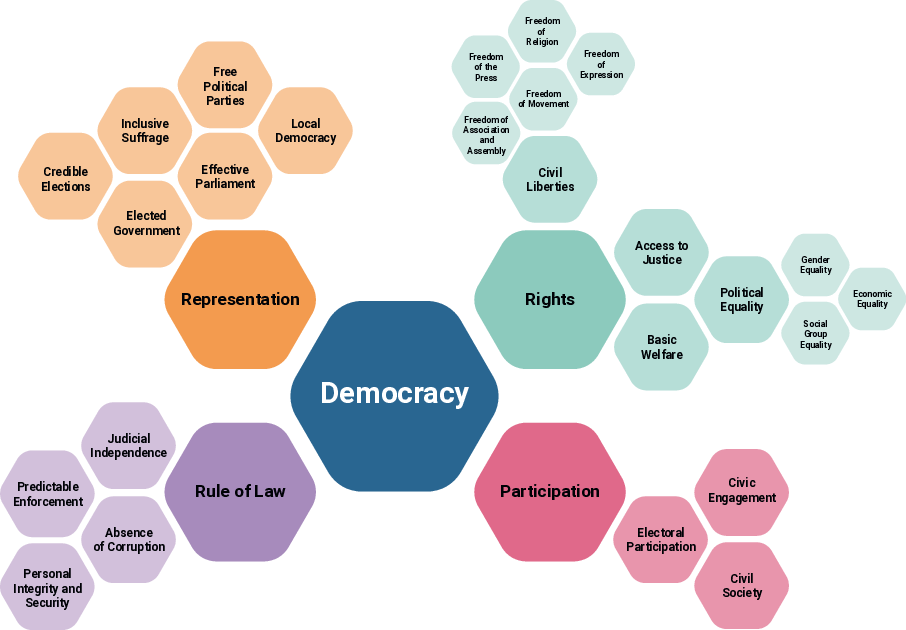
The framework is hierarchical and is based on four core categories of democratic attributes—Representation, Rights, Participation and the Rule of Law. The four categories are made up of factors (such as Credible Elections or Judicial Independence). Finally, at the lowest level are subfactors (such as Freedom of Expression or Social Group Equality). Please refer to the GSoD Indices methodology and codebook for more detailed information on the GSoD conceptual framework.
3.1. Standard event reports
Most of the event reports in the Democracy Tracker take the form of a standardized summary of what analysts consider to be the most important democracy-related developments every month. These reports include a narrative describing the event, its context and its significance. Analysts are asked to do this as concisely as possible, ideally using between 500 and 1,000 characters to convey only the necessary information. Data users can access linked sources for further details as necessary. Analysts also provide an assessment of the direction and magnitude of each event using the five-point scale (see 4.3.2: Coding event impacts). These narratives are drafted by the analysts and edited and fact-checked by the staff tasked with quality control (see below).
3.2. ‘To watch’ reports
In some cases, recent events have not reached the level of significant change required for a standard report, but there is good reason to believe that an ongoing process will reach that threshold within a year. These events may be reported as ‘to watch’ (see 4.2: Inclusion rules for further details on the reporting of this type of event). Because the anticipated impacts have not yet materialized, such events are reported with neutral coding (which differs from the standard event reports).
3.3. Election reports
Elections are at the core of contemporary democratic practice and as such are always reported in the Democracy Tracker. Neutral event reports are therefore written for every national election. They contain straightforward, non-judgemental descriptions of the official results and other key data (for the guidance on the content of the election report, see 4.2.4: National election reports). The neutrality of the election reports means that they do not include coding of the direction or magnitude of any impact of the election on the quality of democracy in the country.
4.1. Data collection
The data collection process involves a comprehensive review of online and print news media items and expert reports and analysis relating to democracy in each of the 173 countries at monthly intervals. Analysts primarily use two large-scale media monitoring services that collect media and expert reporting from around the world, supplemented by country-specific data sources and individual expert inputs where needed.
The first media monitoring source is Nexis NewsdeskTM, produced by the publisher LexisNexis. Nexis Newsdesk allows access to reporting from more than 120,000 media outlets, covering 241 countries and regions, and includes content in more than 99 languages. In collaboration with the content experts at LexisNexis, analysts have created a number of complex Boolean queries that identify the media reports that are relevant to the aspects of democratic performance that are covered by the Democracy Tracker. The search results are often filtered and denoised using Nexis Newsdesk’s tools, which leverage the known characteristics of media sources to identify the most useful and authoritative reporting. These tools are used differently depending on the volume of media and expert coverage in each country (i.e. more filters are required in larger countries with more media outlets). Nexis Newsdesk includes both free and licensed content, including subscriptions to the main print sources in many countries. Analysts make frequent use of in-browser translations to read content published in languages that they do not read.
The second media monitoring source is the Global Database of Events, Language and Tone (GDELT), which covers online media in over 100 languages. GDELT scrapes many thousands of news sites for content, and is updated at
Finally, as necessary, analysts also consult major news sources in the countries to which they are assigned as a final step to ensure that nothing has been missed. In each region, there are some relatively authoritative news sources and analysts give special attention to events reported in these news outlets. Analysts validate the sources they review during the research process, which may entail filtering out irrelevant, less reliable sources including mis- and disinformation. The process may include cross-checking information between different sources, verifying data against established, reputable references and consulting local or thematic experts to ensure accuracy and credibility, as detailed in the following paragraph.
Beyond news media, analysts utilize information reported by national and international non-governmental organizations (NGOs) and UN agencies. Wherever possible, analysts also consult primary sources, including court judgments, legislation, election observation reports and official government communications. In cases where information is difficult to find, the publicly available information is not consistent or the event is controversial or sensitive, or if analysts assess that on-the-ground verification/supplemental information is necessary, analysts consult with International IDEA’s regionally based experts and country offices, and other local experts and partners.
Analysts will not include events that have only been reported in low-quality media sources, or which are not reported by multiple independent media and expert sources. However, events reported by only one media source can be included if the source has a reputation for quality of international standing or if the story can be verified by International IDEA’s regional and country-based staff or by International IDEA’s partners. For example, if a major national newspaper or an international wire service published exclusive reporting on a significant event, this can be included even if other media organizations cannot confirm the report. Whenever possible, analysts will include at least one local source in addition to international sources.
4.2. Inclusion rules
Having used news media and expert data sources to comprehensively assess what has taken place in a given country, in a given month analysts must then decide which events should be reported in the Democracy Tracker. As noted above, events are selected for reporting on the basis that they signal a significant change in the status quo, either positive or negative. In addition to these, the Democracy Tracker also reports events that signal such a change is very likely in the near future (events ‘to watch’) and all national elections.
The Democracy Tracker is not intended to be a comprehensive accounting of political events. Instead, the value added is in classifying events and describing their impact on the quality of specific aspects of democracy. This means that many events that have political significance are not reported, because they are a continuation of the status quo. Many final decisions about what to include are made at the quality control stage, as more senior staff are consulted about what may constitute a notable change in the status quo.
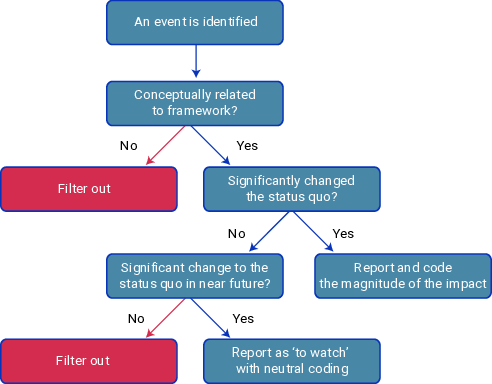
As noted above, all national elections are reported in the Democracy Tracker. For all other events, analysts use the following questions to decide whether or not an event should be reported (see also an illustration of the decision-making process in Figure 4.1):
- Is the event closely related to a concept in the GSoD conceptual framework?
- If yes, the analyst moves on to the next question.
- If no, the event is filtered out.
- Has the impact of the event changed the status quo in the country to such an extent that it will very likely prompt a change in the current GSoD Indices score(s)?
- If yes, the analyst reports the event and codes the direction and magnitude of the impact of the event for the relevant concepts.
- If no, the analyst moves on to the next question.
- Is the event notable in and of itself and is it very likely to have a significant impact on the status quo in the country in the next 12 months?
- If yes, the analyst reports the event as ‘to watch’ with neutral impacts.
- If no, the event is not reported.
4.2.1. Conceptually related to the GSoD framework
To ensure alignment between the GSoD Indices and the Democracy Tracker, events are only reported when they bear a close conceptual relationship to one or more of the categories, factors or subfactors in the GSoD Indices conceptual framework (see Figure 2.1). To help them define the parameters of the framework, analysts may consult the GSoD Indices methodology (which defines the concepts); however, a broader understanding of the concepts is often appropriate for the qualitative assessments made in the Democracy Tracker.
Examples of types of issues that are not directly measured by the GSoD Indices but are still sufficiently related to the core concept include (a) those that focus on suffrage (the GSoD Indices include only de jure measures of suffrage, while the Democracy Tracker includes de facto disenfranchisement and special voting arrangements); (b) gender-based violence (GBV) (the GSoD Indices do not include GBV as part of Gender Equality but the Democracy Tracker does include GBV stories when they have significant impacts at the country level); and (c) digitalization (the GSoD Indices cover digital aspects of the freedom of information, but the Democracy Tracker reports broader digitalization and democracy issues). The Democracy Tracker also includes (d) events that focus on non-citizens (e.g. migrants, refugees and asylum seekers). These events are reported in the country in which the event takes place (i.e. a story on the capsizing of a migrant boat off the coast of Italy would be coded in Italy if the Italian authorities had the responsibility to respond).
The Democracy Tracker ensures integration of gender, inclusion and equality issues in its research methodology. An inclusion lens is used in data collection and analysis, and events may be coded with Gender Equality and/or Social Group Equality depending on the assessment of the impact. Keywords such as gender-based violence, disability rights, indigenous rights, LGBTQIA+ rights, minorities, SDG 5 (Sustainable Development Goal 5), women’s political participation and youth are tagged, enabling users to conduct tailored searches. Please see the concept descriptions in Annex E for a comprehensive description of what is included in each factor.
Decision-making examples: Conceptual relationship to the GSoD framework
Uruguay, December 2025
On 22 December, the Fray Bentos Court in Uruguay sentenced nine retired military officers to prison terms ranging from 11 to 15 years for crimes committed during the 1973–1985 military dictatorship. They were convicted of serious human rights violations, including arbitrary detentions and systematic torture, with the case highlighting the torture and death of Dr Vladimir Roslik, the dictatorship’s last known victim. The court classified these acts as crimes against humanity and issued a formal apology on behalf of the state to the victims and their families. This ruling marks a pivotal step towards addressing historical injustices and reaffirming the state’s commitment to truth, justice and reparation.
Categories: Rights
Factors: Access to Justice
Decision: REPORTED. The event concerned a court ruling related to historical injustices which show important evidence of changes in Access to Justice.
Maldives, November 2025
The Maldives has become the first country in the world to enforce a generational smoking ban. Anyone born on or after 1 January 2007 will not be able to purchase, sell or use tobacco. The law came into effect on 1 November and applies to both citizens and visitors. Health experts have hailed the measure as a positive step towards protecting public health and creating a tobacco-free generation. The ban, backed by President Mohamed Muizzu earlier last year, also covers vaping devices and e-cigarettes. According to the World Health Organization, tobacco use and smoking-related illnesses have been on the rise in the Maldives in recent years, with youth tobacco use nearly doubling since 2019.
Proposed categories: Rights
Proposed factors: Basic Welfare
Decision: NOT REPORTED. Insufficiently strong evidence of the event’s impact on the category and factor proposed.
4.2.2. Status quo changed
The principal category of events reported by the Democracy Tracker are those which have significantly changed the quality of the country’s democratic performance. The following non-exhaustive list of questions helps to guide this assessment:
- Is this event part of an observed pattern for at least the last three months?
- Is this event part of a broader phenomenon or pattern and does it add another dimension to that phenomenon or clearly entrench that phenomenon?
- Is the impact of the event likely to be long-lasting?
- If the scale of the event can be quantified (e.g. number of protesters/casualties/women elected), how does it compare with prior events of this sort?
- Has the event brought about structural change (e.g. enactment of a law or a precedent-setting court judgment)?
Decision-making examples: Status quo change
Pakistan, December 2025
On 17 December, Pakistan’s president assented to the long-delayed National Commission for Minority Rights Bill 2025, fulfilling a decade-old Supreme Court directive to establish a statutory body dedicated to protecting minority rights. The law creates a National Commission for Minorities’ Rights to monitor violations, advise the government and support non-Muslim religious communities, replacing a previous ad-hoc advisory body. The framework mandates the inclusion of women and members from every province in the Commission and introduces mechanisms to assist victims of minority-related abuses—marking an important step towards institutionalizing minority rights. However, rights advocates and opposition parties criticized the bill for explicitly excluding the long-persecuted Ahmadi community (legally declared non-Muslim since 1974), arguing it further entrenches their lack of legal protections.
Proposed categories: Rights
Proposed factors: Civil Liberties
Proposed subfactors: Freedom of Religion
Decision: REPORTED. The new legislation brought about structural change in terms of institutionalizing minority rights and therefore constituted a significant change in the status quo with regard to Freedom of Religion.
Bulgaria, December 2025
Bulgaria adopted the euro on 1 January 2026, 19 years after joining the EU, becoming the Eurozone’s 21st member and replacing the lev. The move aims at boosting living standards and strengthening key sectors like tourism, banking, manufacturing and energy. In 2025, nationalist parties spearheaded a protest campaign opposing the euro. Public sentiment is divided, with 53 per cent supporting the change, while many worry about opportunistic price hikes during the transition. Although complaints about speculative pricing have prompted official investigations, regulators said that many alerts come from anti-euro groups exaggerating isolated cases. With euro adoption following the country’s entry into the Schengen area in January 2025, Bulgaria has completed its EU integration.
Proposed categories: Rights
Proposed factors: Political Equality
Proposed subfactors: Economic Equality
Decision: NOT REPORTED. Insufficiently strong evidence of the event’s impact on the category, factor and subfactor proposed.
4.2.3. Future changes in the status quo (‘to watch’ reports)
The Democracy Tracker also reports events that are notable in and of themselves and that are very likely to have an impact on the status quo in the country in the near future (i.e. within the next 12 months—this must be clearly communicated in the narrative of the report). This is most often the case where the event is procedural, with a trajectory and impact that is reasonably foreseeable. An example would be the introduction or passage of a bill, the potential impact of which is indicated by its provisions and the path to enactment is governed by domestic rules. Bills awaiting executive or royal assent will be reported as ‘to watch’ when their likelihood of entering into force is uncertain or not imminent. Non-procedural events, such as state repression of protesters, or procedural events whose outcomes are generally less predictable (such as the arrest of senior opposition party leaders) are reported where the context allows the analyst to say with confidence that the event is likely to have an important impact on democracy and where their assessment is supported by the opinion of one or more country experts. A ‘to watch’ report includes descriptive text clarifying (a) how the event connects to the GSoD conceptual framework and (b) which future developments to monitor in order for the predicted impact on the status quo to materialize; a special icon is also applied. ‘To watch’ reports should only be used if such future developments are not imminent. If the analyst expects such future developments to occur within a highly condensed timeframe (e.g. one month), the event can be captured in a standard report the following month.
Generally, when there are new developments related to the ongoing process which are expected to impact the status quo, the ‘to watch’ report is ‘closed’ through a new, standard report that conveys the end or closure of the process. See 4.4.1: Updates below for more details.
Decision-making examples: Future changes in the status quo
Zambia, December 2025
On 18 December, President Hakainde Hichilema signed into law constitutional amendments that analysts fear could undermine the credibility of the forthcoming general election, slated for 12 August 2026. Among these revisions is a substantial increase in the size of the National Assembly, with the number of elected MPs going from 156 to 266 (a 58.6 per cent increase), including an additional 70 new constituency-based members. This expansion is based on a boundary delimitation report produced by Zambia’s election commission, but the government’s refusal to make the report public has fuelled widespread suspicions of gerrymandering in favour of the ruling party. Also criticized is a provision that appears to extend MPs’ access to public resources until a day before a general election, where previously this ended when parliament was dissolved, 90 days prior to the election. This is likely to further strengthen incumbency advantage and reduce the competitiveness of parliamentary contests.
Decision: REPORTED. There was sufficient evidence to suggest that the constitutional amendments could change the status quo with regard to Credible Elections.
Slovakia, December 2025
On 17 December, the Constitutional Court provisionally suspended a law passed on 9 December that would abolish the Office for the Protection of Whistleblowers (UOO) and would significantly reduce whistleblower protections. The law, which sparked nationwide protests against the ruling coalition, was due to take effect on 1 January 2026 and would have replaced the UOO with a new office under direct government control. The UOO and existing whistleblower protections will remain in force until the Court issues a final ruling following a full review of the law.
Decision: REPORTED. The court’s provisional suspension of a recently passed law has implications for whistleblower protections. The outcome—including the extent to which the law will be revised, and the final ruling—could significantly impact the status quo with regard to Absence of Corruption.
Uganda, November 2025
On 6 November, judges at the International Criminal Court (ICC) confirmed 39 war crimes and crimes against humanity charges against Ugandan rebel leader Joseph Kony, nearly two decades after issuing a warrant for his arrest. The Pre-Trial Chamber said there were ‘substantial grounds to believe’ he was responsible for crimes committed in northern Uganda between 2002 and 2005, including murder, sexual slavery and the conscription of children, noting he allegedly issued standing orders to attack civilian settlements and abduct women and children. The decision—described by ICC officials as historic—marked the first time the court had confirmed charges in a suspect’s absence, allowing the case to proceed to trial once he is captured. Kony, who remains at large and is believed to be hiding in the Central African Republic, continues to evade arrest despite years of international efforts. ICC representatives said they are working with partners to secure his surrender, and victims’ groups welcomed the confirmation of charges, expressing hope it would renew efforts to bring him before the court.
Decision: NOT REPORTED. Insufficiently strong evidence for a high likelihood of Joseph Kony being apprehended within the next 12 months; the development is unlikely to impact the status quo of the proposed category and factor.
4.2.4. National election reports
The critical importance of elections to democratic governance means that the Democracy Tracker reports all national elections. Election reports contain non-judgemental descriptions of the official results and other key data (for guidance on the content of the election report, see the list of information to cover below). The neutrality of the election reports means that the impacts of the event are not coded. However, it is important to note that, where the analyst determines that an aspect of the election marks a significant change in the status quo—for example in the level of repression, the number of women elected or other matters of substantive importance—they will report this in a separate, conventional event report in which the magnitude of the impacts is recorded with the usual directional coding. This could include cases when there is an increase or a decrease of more than 10 percentage points on voter turnout or the number of women being elected. However, the assessments are always made based on context; if a change is extremely rare, a move of 5 percentage points may also merit a separate, coded report. In general, election reports do not include the ideological positions of political parties, though there may be exceptional circumstances, for example to elucidate a change in political power dynamics or underscore the party’s significance given the country’s context and history.
Election reports constitute neutral descriptions of the official results and will cover (subject to the availability of information close to the election):
- the date(s) on which voting took place;
- which offices were contested in the election;
- the official election results, including vote share to one decimal place (note: in the case of legislative elections, election results are conveyed in terms of seats won by leading candidates and political parties; vote share is optional);
- any legal challenges to the results;
- key findings of election observers (where available);
- voter turnout to one decimal place; and
- number of women elected and number of women candidates.
A special icon is also applied for all election reports.
Election report example
Tanzania, October 2025
On 29 October, Tanzania held general elections for the presidency and the National Assembly. President Samia Suluhu Hassan was declared the winner of the presidential race with 97.7 per cent of the vote, following the exclusion earlier in the year of the main opposition parties, Chadema (Chama cha Demokrasia na Maendeleo) and ACT-Wazalendo, leaving her to contest against smaller parties. Hassan was one of three women candidates among the 17 on the ballot. In parallel parliamentary elections, her ruling Chama Cha Mapinduzi (CCM) won 270 of the 272 directly elected seats, with ACT-Wazalendo securing the remaining two. Voter turnout reached nearly 87.0 per cent, up from the disputed 2020 figure of 50.0 per cent. Women will hold 39.3 per cent of seats in the National Assembly (compared to 36.9 per cent in 2020), including 37 directly elected MPs and 115 women appointed through party lists. The election proceeded amid a nationwide Internet shutdown and heightened security presence. Regional observers, including the Southern African Development Community (SADC), raised concerns over incidents of violence, restrictions on media, the exclusion of key opposition candidates, and limited electoral competitiveness.
4.3. Coding procedure
4.3.1. Areas of impact
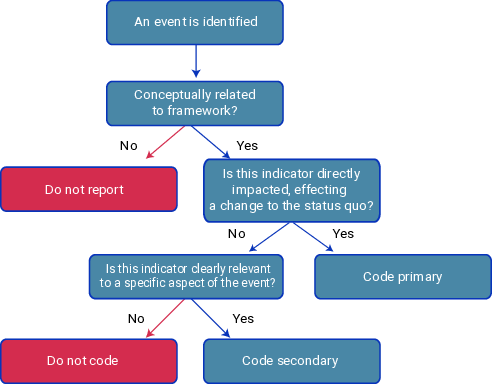
If an event merits inclusion, the next step is to code the direction and magnitude of the impact of the event with reference to the relevant categories, factors and subfactors of democratic performance. These indicators are coded at two levels—primary and secondary. This shows which aspects of democracy are principally impacted by the event and which aspects are secondarily impacted. The primary coding relates to aspects of democracy that are directly affected by the main story of the event, significantly altering the status quo; the secondary coding relates to aspects that are relevant to the event, but status quo remains. Coding takes place first at the lowest level of analysis (i.e. the factor or subfactor). Coding the direction and magnitude of the impact of an event at the factor level then necessitates coding the category as well (see below for further details). The following guidelines are used to make the distinction between primary- and secondary-level coding:
- If an indicator is principally impacted by an event (i.e. it is directly impacted, implying a significant change to the status quo), it will be coded as primary.
- If a factor is secondarily impacted by an event (i.e. it is relevant but status quo remains), it will be coded as secondary. The effects of the event on the secondary factor will be coded as neutral (zero on the five-point scale).
This decision-making process is also illustrated in Figure 4.2.
Coding examples: Areas of impact
Australia, October 2025
On 30 October, the parliament of the state of Victoria passed the Statewide Treaty Bill, establishing the first-ever treaty framework for First Nations people in Australia. This legislation establishes a permanent, democratically elected Indigenous body called ‘Gellung Warl’, which will replace the existing and temporary First People’s Assembly that was established in 2019. The new body is legally required to be consulted on laws and policies that affect Indigenous communities, whereas the previous body had more of an advisory role, providing informal input and working to establish the treaty negotiation framework. The treaty agreement also includes commitments to include more information about Victoria’s First Nations people in school curricula, among other things. The bill is the result of decades-long advocacy efforts led by Indigenous communities and follows the findings and recommendations of the Yoorrook Justice Commission’s truth-telling report in July 2025. The legislation received royal assent on 13 November.
Primary categories: Rights
Primary factors: Political Equality
Primary subfactors: Social Group Equality
Secondary categories: Participation
Secondary factors: Civic Engagement
Secondary subfactors: N/A
Malaysia, September 2025
The Gig Workers Bill passed into law on 9 September, marking the first time a legal framework defines and recognizes ‘gig workers’ as workers. Employers are now required to provide social security contributions on their behalf, establish a dispute resolution mechanism for mediating conflicts between employers and employees, and more. An estimated 1.2 million Malaysians are employed in some form of gig work, which the law defines as work for online platforms and specific occupations performed under a service agreement, such as driving for ride-hailing services, care services, hairdressing and more. The bill’s passage was celebrated by Malaysian unions and the Human Rights Commission, although the latter called for stronger enforcement mechanisms, better access to legal aid and explicit legal recognition of gig workers’ right to associate and unionize.
Primary categories: Rights
Primary factors: Political Equality
Primary subfactors: Social Group Equality
Secondary categories: Rights
Secondary factors: Civil Liberties
Secondary subfactors: Freedom of Association and Assembly
4.3.2. Coding event impacts
Having determined which factors have been impacted, the next step is to code the magnitude of the impact. Each standard event report in the Democracy Tracker is coded on a five-point scale (ranging from ‘exceptionally positive’ to ‘exceptionally negative’) indicating the magnitude and direction of an event’s impact on relevant categories and factors of democracy (as defined by the GSoD Indices, see Figure 2.1). ‘To watch’ events always take on a neutral coding. As noted above, for each event, directional coding takes place at the lowest level of the theoretical framework (either the factor or subfactor level depending on the factor) and then at the category level. While rare, it is possible to code an event as having different directional impacts on the various relevant factors even within a single category. As the coding takes place primarily at the event level, this poses no immediate procedural problems. However, with upwards aggregation more rules must be applied.
Scale
| Code | Meaning |
|---|---|
| Exceptionally positive | The event signals an exceptionally positive change in the status quo |
| Positive | The event signals a significant positive change in the status quo |
| Neutral | The event is neutral and does not impact on the status quo |
| Negative | The event signals a significant negative change in the status quo |
| Exceptionally negative | The event signals an exceptionally negative change in the status quo |
Application of the scale
Having determined at the inclusion stage that the event represents a significant deviation from the status quo, the analyst has determined that the event merits inclusion. In assessing whether the magnitude of the event’s impact has been exceptionally positive or negative, analysts are guided by the following questions.
Exceptionally positive:
- Does this event reflect the codification of new rights or laws that protect democratic institutions and/or norms?
- Does this event reflect a significant change in the context such that there are markedly more openings for democratic reform?
- Is this event representative of the significant expansion of any individual factor or category, such that it will be difficult to describe the context without referencing this development?
Exceptionally negative:
- Is this event a coup d’état, unconstitutional change of regime, political assassination or an outbreak of severe armed hostility?
- Does this event include the pronouncement of genocide, crimes against humanity or other severe violations of international law?
- Is this event representative of the severe degradation of any individual factor or category, such that it will be difficult to describe the context without referencing this development?
Coding examples: Magnitude of impact
Namibia, March 2025
Women’s political representation was strengthened in Namibia in March, when Netumbo Nandi-Ndaitwah, the country’s first woman president, appointed a gender-balanced cabinet and another woman, Lucia Witbooi, as her vice-president—also a first for the country. Nandi-Ndaitwah announced her cabinet on 22 March, a day after she was sworn in as president, revealing that 8 of the 14 ministers (57.1 per cent) were women (up from 42.9 per cent in the previous government). According to the African Commission on Human and Peoples’ Rights, Namibia is only the third African country to achieve a gender-balanced cabinet and the first in which women hold the positions of both president and vice-president. Further, on 21 March, Namibia’s National Assembly elected its first woman speaker, Saara Kuugongelwa-Amadhila, who had previously served as the country’s prime minister.
Event-level coding:
Primary categories: Rights (exceptionally positive)
Primary factors: Political Equality (exceptionally positive)
Primary subfactors: Gender Equality (exceptionally positive)
Secondary categories, factors and subfactors: N/A
Georgia, April 2025
Parliament passed several laws restricting civil society and media on 1 April, including a so-called ‘foreign agents’ law (FARA) imposing sweeping registration requirements and sanctions on independent organizations and media outlets. The law tightens regulation on broadcasters and revokes a requirement to involve civil society in the legislative process. On 17 April it passed a law mandating prior permission from the Georgian Anti-Corruption Bureau to receive a grant from any foreign donor. The Georgian FARA law requires any organization or individual deemed to be acting at the direction of a foreign power, including receiving a grant, to register with the government or face up to five years’ imprisonment. Broadcasters are now subject to stricter state ‘coverage standards’ and banned from foreign funding, which journalists say amounts to state control and censorship. The law on civil society participation was justified by what Georgian Dream lawmakers called the ‘anti-democratic’ actions of NGOs.
Event-level coding:
Primary categories: Rights (exceptionally negative), Participation (exceptionally negative)
Primary factors: Civil Liberties (exceptionally negative), Civil Society (exceptionally negative)
Primary subfactors: Freedom of the Press (exceptionally negative)
Secondary categories, factors and subfactors: N/A
Once factor- or subfactor-level codes have been assigned, category-level codes are calculated. If only one factor or subfactor is coded, the associated category or factor code mirrors this lower-level code. If, however, there are two or more lower-level codes, they are averaged to produce the higher-level code. Finally, countries are assessed to have an overall direction for democratic performance at the country-month level, again using the five-point scale. These overall country codes reflect the averages of the country’s multiple event reports, if relevant, or simply mirror the sole event report that month. There are cases in which analysts’ expertise overrides the mathematical average. If one factor—in case of multiple factors coded to a single event—or one event—in case of multiple event reports—has a disproportionate impact on the political landscape, analysts may decide to code the country at large to reflect that impact. It is important to note that the overall direction for democratic performance applied at the country level is limited to the specific factors of democracy and to that month and does not in any way reflect an assessment of the overall democratic performance of that country.
Coding examples: Country-level coding
Romania, July 2025
In July, the Constitutional Court upheld the constitutionality of proposed amendments to Emergency Ordinance No. 31/2002 strengthening measures against hate speech. The legislation, adopted by Parliament on 11 June, criminalizes the distribution of materials (including images, videos, books and text messages) deemed to have a fascist, racist or xenophobic character, or that deny genocide or war crimes, with penalties of up to five years in prison. Previously, the legislation focused solely on the prohibition of certain symbols and organizations. Additionally, the scope of the legislation is expanded to refer specifically to the 1927–1941 legionary movement which briefly entered government during Ion Antonescu’s dictatorship. The Constitutional Court dismissed challenges by opposition MPs and President Nicoșur Dan citing risks to freedom of expression during a preliminary review of the constitutionality of the bill. The rulings are legally binding and clear the way for the legislation’s promulgation.
Event-level coding:
Primary categories: Rights (positive)
Primary factors: Political Equality (positive)
Primary subfactors: Social Group Equality (positive)
Secondary categories: Rights, Rule of Law
Secondary factors: Civil Liberties, Predictable Enforcement, Personal Integrity and Security
Secondary subfactors: Freedom of Expression
Country-level coding:
Categories: Rights (positive), Rule of Law (neutral)
Overall country-month score: positive
Mexico, November 2025
On 15 November, approximately 17,000 people participated in anti-government protests initially organized by Gen Z activists to draw attention to drug-related violence and corruption. Dissatisfaction had intensified following the 1 November assassination of Carlos Manzo, mayor of Uruapan in Michoacán, after he urged authorities to take a tougher stance against organized crime. The government alleged that opposition parties and their supporters used bots to amplify calls for the protest, claiming the movement was not organic but opposition-driven. While the demonstrations began peacefully, reports indicated the use of violence by a small group of protesters, including criminals who exploited the unrest to loot businesses, as well as excessive use of force by police. Officials reported around 100 police officers and 20 protesters injured. Human rights organizations documented instances of police violence against journalists and urged authorities to refrain from language that stigmatizes protesters.
Event-level coding:
Primary categories: Participation (positive)
Primary factors: Civic Engagement (positive)
Primary subfactors: N/A
Secondary categories: Rights, Rule of Law
Secondary factors: Civil Liberties, Personal Integrity and Security
Secondary subfactors: Freedom of Association and Assembly
On 12 November, President Claudia Sheinbaum presented an executive plan to combat sexual abuse. The plan, which would require some legislative changes, includes: standardizing the legal definition of sexual abuse as a serious crime; strengthening mechanisms to encourage women to report cases; enhancing training for prosecutors and public officials; and launching public awareness campaigns aimed at driving cultural change. During the announcement, President Sheinbaum referenced her own recent experience, in which a man groped her while she was speaking with citizens on the street—an incident that intensified public outrage over the country’s high rates of sexual and gender-based violence.
Event-level coding:
Primary categories: Rights (positive)
Primary factors: Political Equality (positive)
Primary subfactors: Gender Equality (positive)
Secondary categories, factors and subfactors: N/A
Country-level coding:
Categories: Rights (positive), Participation (positive), Rule of Law (neutral)
Overall country-month score: positive
4.3.3. Red-flagged events
In addition to coding the magnitude of the event’s impact on a five-point scale, analysts may apply a red flag to notably egregious events that represent severe and exceptional threats to democracy or human rights. These include assassinations of national politicians, coups d’état or other unconstitutional regime changes, outbreaks of severe intrastate or interstate hostilities, or reports of genocide, crimes against humanity, war crimes or ethnic cleansing from authoritative sources such as the UN. A red flag icon is applied to these events. The application of a red flag in cases of political assassinations is restricted to senior politicians, with the exception of few extraordinary cases, in view of contexts where political violence is widespread. Attempted political assassinations are usually coded as negative (
Example of a red-flagged event
Madagascar, October 2025
On 14 October, Colonel Michael Randrianirina announced that the army unit he commanded had taken power and suspended the Constitution and several government institutions, including the Senate and the High Constitutional Court (HCC) (although both have subsequently been allowed to operate). The development came three days after the unit, the Army Corps of Personnel and Administrative and Technical Services (CAPSAT), came out onto the streets in support of Gen Z protesters, who had been calling for the resignation of the now-deposed president, Andry Rajoelina. The announced takeover immediately followed the National Assembly’s impeachment of Rajoelina for fleeing the country, prompting the HCC to hand presidential power to Randrianirina. Randrianirina was then inaugurated as interim president on 17 October and then appointed a largely civilian cabinet that he said would govern the country alongside a military-led committee for a transitional period of up to two years, ending with elections.
4.4. Other elements of event reports
4.4.1. Updates
Considering that months are the Democracy Tracker’s units of time, reports are only updated after publication on an exceptional basis. When there is a new development related to an already published standard event report, an update is provided in the original report. The update is labelled as such and includes the date of the update.
For ‘to watch’ reports, generally, new information related to an ongoing process that is expected to impact the status quo will be included in the Democracy Tracker as a new standard report that conveys the end or closure of that process and the original ‘to watch’ report will be included as a source to the new report. In exceptional circumstances, when a new development is considered crucial for users’ understanding of the process that is being followed but the process as such is still ongoing, concise updates may be added to the original report and are also labelled and dated. In some cases, the development (e.g. introduction of a new bill) that is reported as ‘to watch’ may revert to status quo (e.g. the bill is rejected in the following stages including parliamentary vote or presidential approval). In such a case, there will be no new coded report to close the matter but an update will be added to the ‘to watch’ report to inform the reader of the outcome of the development (e.g. saying that the reported bill was rejected).
In election reports regarding countries where run-off elections are held, a single report with the initial results is published and will include an update with the final run-off results that is labelled and shows the date of the update.
Examples of updates to reports
Türkiye, May 2025
On 12 May, the Kurdistan Workers’ Party (PKK) announced that it would disband and disarm, and proposed a peace deal with Türkiye. The PKK’s disbandment puts an end to more than 40 years of conflict with the Turkish state that saw over 40,000 deaths. President Recep Tayyip Erdoğan welcomed the move as important for security. Designated a terrorist organization by Türkiye, the United States and the EU, the PKK initially sought an independent Kurdish state but later shifted to demands for autonomy and rights of Kurds within Türkiye. Previous peace efforts collapsed, most recently in 2015.
Update: In August, a 51-member parliamentary committee that includes MPs from most major parties was established in Türkiye to oversee legal and political reforms of the peace process.
Chile, November 2025
Chile held general elections on 16 November, the first under mandatory voting and automatic registration. Jeannette Jara, representing the Unity for Chile coalition, led the presidential race with 26.8 per cent of the vote, followed by José Antonio Kast of the Republican Party with 23.9 per cent. Both candidates will now advance to a run-off scheduled for 14 December. Voter turnout reached a record 85.3 per cent, driven by the introduction of compulsory voting. This marks a significant increase from the 47.3 per cent turnout in the last presidential election (November 2021) when voting was not mandatory. In parliamentary elections, the Republican Party gained significant ground, securing 31 seats in the Chamber of Deputies, though the broader right-wing bloc did not achieve a majority. Women’s representation in the Senate increased from 13 to 15 seats, while in the Chamber of Deputies, it decreased from 55 to 52 seats. Key campaign issues included public security, migration and economic reforms, highlighting a polarized political environment. Electoral observation missions’ preliminary reports highlighted the high voter turnout and adherence to democratic standards, with final assessments expected in the coming weeks.
Update: On 14 December, Chile held the second round of its presidential election, in which José Antonio Kast was elected president with a decisive margin over Jeannette Jara. According to official results, Kast received just over 58.2 per cent of the vote compared with approximately 41.8 per cent for Jara, with a voter turnout of 84.1 per cent. Kast is scheduled to assume office in March 2026.
4.4.2. Tags
In addition to coding the relevance of the events to the categories and factors of democracy, analysts also assign tags to the events that facilitate searching and filtering the data later. These tags include important concepts and political institutions, and the names of people (such as heads of government) and institutions (such as courts, electoral authorities and political parties) that are named in the reports. Events that are relevant to more than one country are tagged as ‘transnational’. Sustainable Development Goals 5, 10 and 16 are also tagged to event reports coded with corresponding categories, factors and subfactors of the GSoD conceptual framework, to enable further research and contribute to monitoring the Sustainable Development Goals.
4.4.3. Icons
The Democracy Tracker features icons representing the four categories of democratic attributes—Representation, Rights, Participation and the Rule of Law (along with the lower level factors and subfactors)—which are applied to all standard event reports and ‘to watch’ reports following the methodology described in sections 4.2.1, 4.2.2 and 4.2.3 above.
Furthermore, special icons are applied to (a) ‘to watch’ reports; (b) national election reports; and (c) red-flagged events, as described in sections 4.2.3, 4.2.4 and 4.3.3 above (see Figure 4.3).
4.4.4. ‘In the spotlight’
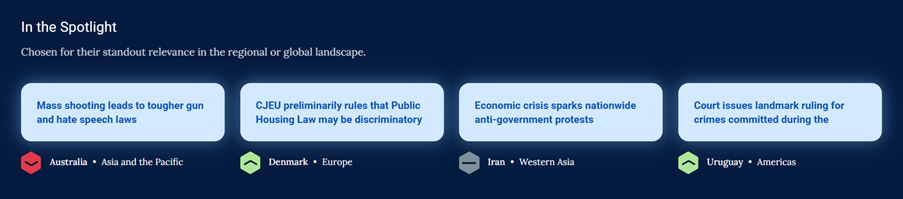
Every month, analysts from each region will select one event to spotlight—which could be a standard report, a ‘to watch’ report or an election report—based on their standout relevance (they signal a particularly momentous change or they are unique events, given the context) in the regional or global landscape. The events are featured in the ‘spotlight’ section on the Democracy Tracker homepage.
4.4.5. Archived sources
The source material for the event reports is almost without exception online. As online media sites are subject to various interruptions and URL changes, analysts are required to archive reliable sources for the events and to provide links to the archived pages in the event reports. The Democracy Tracker uses Perma.cc for this purpose. This is a subscription-based service developed and maintained by the Harvard Law School Library in conjunction with other university law libraries in the United States and has significant contingencies in place to ensure link accessibility even if the initiative shuts down at some point. Articles with paywalls and licensed content are also archived with Perma.cc (even if the entire content is not visible). Users with the relevant subscription can access the full article directly from the source.
4.5. Quality control
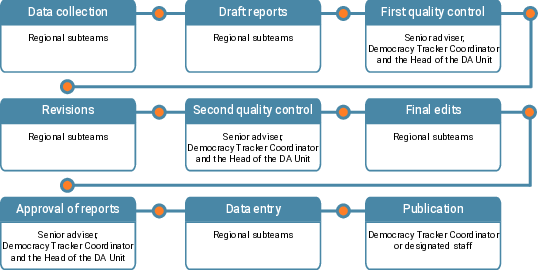
Difficult decisions are made at two stages of the Democracy Tracker data collection and reporting process, namely (a) in choosing which events to report; and (b) in interpreting the significance of those events. DA regional analysts in the project team make these calls in the first instance. However, the DA Senior Adviser, the Democracy Tracker Coordinator and the Head of the DA Unit (‘quality controllers’) check the event reports for accuracy and quality. In this way, at least five individuals have verified each of the event reports.
Each month, the DA analysts complete their research, consult regional colleagues and partners (as necessary), draft their reports and code the impact of the events. These first drafts are reviewed by the DA Senior Adviser, the Democracy Tracker Coordinator and the Head of the DA Unit. In especially sensitive or controversial cases, these first drafts are also reviewed by regionally based colleagues and International IDEA’s Director of Global Programmes. These quality controllers verify the accuracy of the reporting, confirm or amend the directional codings and more broadly ensure that the event reports are of a high quality. It is common at this stage that quality controllers suggest dropping several event reports that do not meet the standard of signalling a significant change in the status quo. After this first round of review, the analysts edit the event reports to incorporate the changes requested by the quality controllers and resubmit the event reports for a second review. During this second review, quality controllers verify that the changes they requested have been completed and again review the overall quality of the reporting. When necessary, a second round of revisions may take place. Event reports are not published until they receive final clearance from the Democracy Tracker Coordinator, Senior Adviser and the Head of the DA Unit.
4.6. Staff
The Democracy Tracker is maintained by the DA Unit at International IDEA’s Global Programmes division in Stockholm. The DA Unit ensures gender parity among its staff, who come from and have professional experience in a diverse array of countries representing all the regions covered by the Democracy Tracker. Work for the Democracy Tracker is overseen by the Head of the DA Unit and Senior Adviser, and coordinated by the Democracy Tracker Coordinator. The data collection, reporting and quality control tasks are assigned to regional subteams. These groupings follow International IDEA’s broad regional divisions: Africa and Western Asia, Americas, Asia and the Pacific, and Europe. An adviser and associate programme officer are responsible for the primary data collection, with the adviser overseeing the overall regional work. The Senior Adviser, the Democracy Tracker Coordinator and the Head of the DA Unit are responsible for quality control.
Additional oversight and guidance are provided by International IDEA’s Director of Global Programmes and senior management, including validating the research methods used in the Democracy Tracker and advising on findings that are politically sensitive.
4.7. Workflow
The various elements of the monthly reporting process are described in more detail in the subsequent sections of this guide. However, the basic steps in the process are depicted in the workflow schematic in Figure 4.4.
4.8. Developing and validating the methodology
In developing and validating the Democracy Tracker methodology, International IDEA consulted peer organizations that have developed similar tools, as well as expert methodologists in academia. Select examples include the International Crisis Group’s CrisisWatch tool and Uppsala University’s Uppsala Conflict Data Program.
5.1. Country pages
5.1.1. Country profile overview
Monthly event reports are featured on individual country pages. Each country page includes qualitative and quantitative background data to provide an overview of the country’s democracy landscape, as described below.
5.1.2. Country briefs
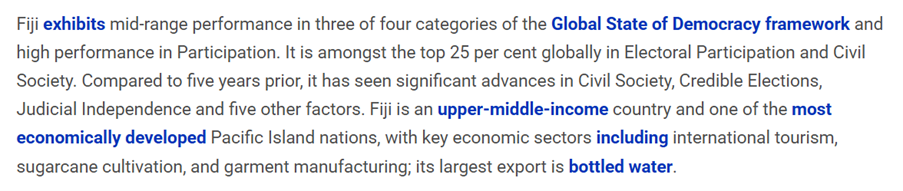
Each country page features a brief that sets out the country’s political context. Among other things, the briefs describe how the country performs at the category level, recent trends in the annual GSoD Indices data, relevant socio-political history, politically salient social cleavages, primary drivers of politics and an outlook on political developments to watch over the next 10 years. As an example, the first paragraph of the country brief for Fiji is copied in Figure 5.1. Country briefs also systematically incorporate analysis regarding gender equality and inclusion (e.g. legal framework and developments impacting women and other historically marginalized groups).
5.1.3. Basic information boxes
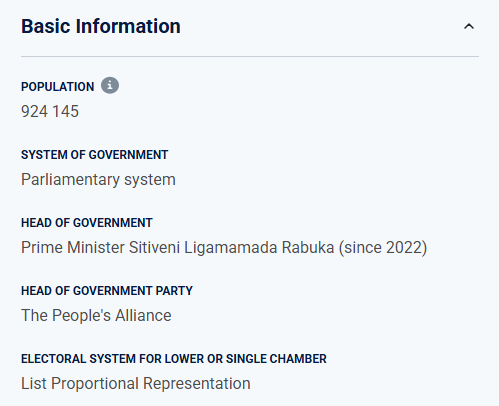
Complementing the narrative text of the country briefs are a series of key data points describing the institutional features of a country’s political system, recent elections, the representation of women in the legislature and the country’s engagement with the UN’s Universal Periodic Review (a mechanism for reviewing member states’ human rights records) (see Figure 5.2). The information is updated using the sources listed in Annex B.
5.1.4. Human rights treaty boxes
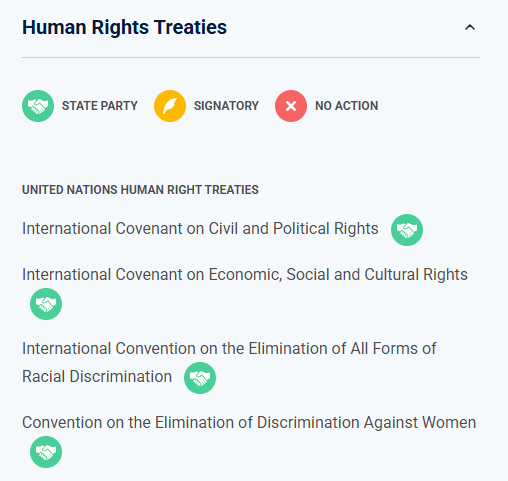
Users are given a further indication of how countries engage with the international human rights system through summary information on the ratification status of three sets of human rights treaties—the UN’s core international human rights treaties, the International Labour Organization’s Fundamental Conventions and the principal regional human rights treaties. This information is regularly updated using the sources listed in Annex C. An example of a country’s ratification status of human rights treaties is shown in Figure 5.3.
5.1.5. Global State of Democracy Indices data
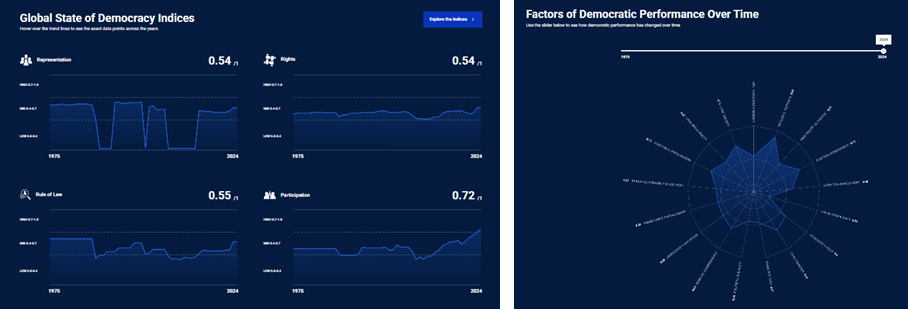
The country pages also feature visualizations of key GSoD Indices data. The global ranking data show the country’s ranking per category of democratic performance from the most recent data set. Trendlines show the country’s performance on the GSoD Indices’ four categories since 1975 to date. A spider chart offers the user an overview of the state of democracy in the country, illustrating performance levels across the GSoD Indices’ 17 factors of democracy. An interactive slider allows users to produce a spider chart for any year (see Figure 5.4).
5.2. Regional and global pages
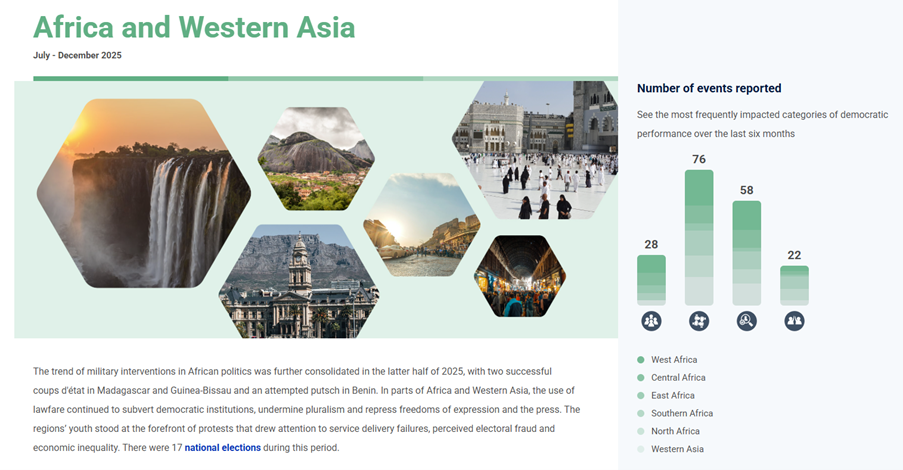
In addition to country pages, the Democracy Tracker offers regional and global summary pages on a biannual basis. Regional and global pages highlight and analyse the most important trends from the last six months, as well as what to watch (see Figure 5.5). They also feature visual data, including a spider chart which shows regional or global averages of the 17 factors from the latest data set, as well as bar charts with the most frequently impacted categories and factors of democratic performance.
5.3. Data archive
In addition to being published on the relevant country profile pages and the main content on the home page, event reports are accessible to users in a data archive. There, users are able to filter the event reports and download them as a Microsoft Excel spreadsheet.
When a user downloads the data archive, the file will include the variables listed in Table 5.1.
| Variable | Description |
|---|---|
| country_name | The short name of the country for which the event was reported |
| region_name | The name of the region in which the event was reported |
| month | The month in which the event took place |
| year | The year in which the event took place |
| upload_date | The date on which the event was added to the Democracy Tracker database |
| event_title | A short description of the event |
| event_text | A summary of what took place in the event (generally 500–1,000 characters) |
| url | The location on the Democracy Tracker website where the event report can be found |
| tags | A list of proper nouns, event types and concepts that are relevant to the event, separated by commas |
| red_flag_value | A binary record of whether or not a red flag icon was applied to the event (1=red flag, 0=no red flag) |
| to_watch | A binary record of whether or not a ‘to watch’ icon was applied to the event (1=indicator applied, 0=not applied) |
| election | A binary record of whether or not an election icon was applied to the event (1=election, 0=no election) |
| representation | Records the directional coding for the Representation category. When the category is not relevant to the event, the cell is empty |
| rights | Records the directional coding for the Rights category. When the category is not relevant to the event, the cell is empty |
| rule_of_law | Records the directional coding for the Rule of Law category. When the category is not relevant to the event, the cell is empty |
| participation | Records the directional coding for the Participation category. When the category is not relevant to the event, the cell is empty |
| credible_elections | Records the directional coding for the Credible Elections factor. When the factor is not relevant to the event, the cell is empty |
| inclusive_suffrage | Records the directional coding for the Inclusive Suffrage factor. When the factor is not relevant to the event, the cell is empty |
| free_political_parties | Records the directional coding for the Free Political Parties factor. When the factor is not relevant to the event, the cell is empty |
| elected_government | Records the directional coding for the Elected Government factor. When the factor is not relevant to the event, the cell is empty |
| effective_parliament | Records the directional coding for the Effective Parliament factor. When the factor is not relevant to the event, the cell is empty |
| local_democracy | Records the directional coding for the Local Democracy factor. When the factor is not relevant to the event, the cell is empty |
| access_to_justice | Records the directional coding for the Access to Justice factor. When the factor is not relevant to the event, the cell is empty |
| civil_liberties | Records the directional coding for the Civil Liberties factor. When the factor is not relevant to the event, the cell is empty |
| basic_welfare | Records the directional coding for the Basic Welfare factor. When the factor is not relevant to the event, the cell is empty |
| political_equality | Records the directional coding for the Political Equality factor. When the factor is not relevant to the event, the cell is empty |
| judicial_independence | Records the directional coding for the Judicial Independence factor. When the factor is not relevant to the event, the cell is empty |
| personal_integrity_ and_security | Records the directional coding for the Personal Integrity and Security factor. When the factor is not relevant to the event, the cell is empty |
| predictable_enforcement | Records the directional coding for the Predictable Enforcement factor. When the factor is not relevant to the event, the cell is empty |
| absence_of_corruption | Records the directional coding for the Absence of Corruption factor. When the factor is not relevant to the event, the cell is empty |
| civil_society | Records the directional coding for the Civil Society factor. When the factor is not relevant to the event, the cell is empty |
| civic_engagement | Records the directional coding for the Civic Engagement factor. When the factor is not relevant to the event, the cell is empty |
| electoral_participation | Records the directional coding for the Electoral Participation factor. When the factor is not relevant to the event, the cell is empty |
| freedom_of_expression | Records the directional coding for the Freedom of Expression subfactor. When the subfactor is not relevant to the event, the cell is empty. |
| freedom_of_the_press | Records the directional coding for the Freedom of the Press subfactor. When the subfactor is not relevant to the event, the cell is empty |
| freedom_of_association _and_assembly | Records the directional coding for the Freedom of Association and Assembly subfactor. When the subfactor is not relevant to the event, the cell is empty |
| freedom_of_religion | Records the directional coding for the Freedom of Religion subfactor. When the subfactor is not relevant to the event, the cell is empty |
| freedom_of_movement | Records the directional coding for the Freedom of Movement subfactor. When the subfactor is not relevant to the event, the cell is empty |
| social_group_equality | Records the directional coding for the Social Group Equality subfactor. When the subfactor is not relevant to the event, the cell is empty |
| gender_equality | Records the directional coding for the Gender Equality subfactor. When the subfactor is not relevant to the event, the cell is empty |
| economic_equality | Records the directional coding for the Economic Equality subfactor. When the subfactor is not relevant to the event, the cell is empty |
5.4. Monthly alerts
The alert system allows users to receive a customized selection of reports every month. Users are able to select parameters tailored to their interests, including the regions and countries, aspects of democracy, positive/neutral/negative events and election reports.
The Democracy Tracker covers 173 countries in accordance with the Global State of Democracy data set, which only includes country-year data for countries that have at least 250,000 inhabitants, from 1975. The criteria have been established based on the consistency and availability of data. The following countries are included in the Democracy Tracker’s monthly reporting:
| Afghanistan | Albania | Algeria |
| Angola | Argentina | Armenia |
| Australia | Austria | Azerbaijan |
| Bahrain | Bangladesh | Barbados |
| Belarus | Belgium | Benin |
| Bhutan | Bolivia | Bosnia and Herzegovina |
| Botswana | Brazil | Bulgaria |
| Burkina Faso | Burundi | Cabo Verde |
| Cambodia | Cameroon | Canada |
| Central African Republic | Chad | Chile |
| China | Colombia | Comoros |
| Congo | Costa Rica | Côte d’Ivoire |
| Croatia | Cuba | Cyprus |
| Czechia | Democratic People’s Republic of Korea | Democratic Republic of the Congo |
| Denmark | Djibouti | Dominican Republic |
| Ecuador | Egypt | El Salvador |
| Equatorial Guinea | Eritrea | Estonia |
| Eswatini | Ethiopia | Fiji |
| Finland | France | Gabon |
| Gambia | Georgia | Germany |
| Ghana | Greece | Guatemala |
| Guinea | Guinea-Bissau | Guyana |
| Haiti | Honduras | Hungary |
| Iceland | India | Indonesia |
| Iran | Iraq | Ireland |
| Israel | Italy | Jamaica |
| Japan | Jordan | Kazakhstan |
| Kenya | Kosovo | Kuwait |
| Kyrgyzstan | Lao People’s Democratic Republic | Latvia |
| Lebanon | Lesotho | Liberia |
| Libya | Lithuania | Luxembourg |
| Madagascar | Malawi | Malaysia |
| Maldives | Mali | Malta |
| Mauritania | Mauritius | Mexico |
| Mongolia | Montenegro | Morocco |
| Mozambique | Myanmar | Namibia |
| Nepal | Netherlands | New Zealand |
| Nicaragua | Niger | Nigeria |
| North Macedonia | Norway | Oman |
| Pakistan | Palestine | Panama |
| Papua New Guinea | Paraguay | Peru |
| Philippines | Poland | Portugal |
| Qatar | Republic of Korea | Republic of Moldova |
| Romania | Russian Federation | Rwanda |
| Saudi Arabia | Senegal | Serbia |
| Sierra Leone | Singapore | Slovakia |
| Slovenia | Solomon Islands | Somalia |
| South Africa | South Sudan | Spain |
| Sri Lanka | Sudan | Suriname |
| Sweden | Switzerland | Syrian Arab Republic |
| Taiwan | Tajikistan | Tanzania |
| Thailand | Timor-Leste | Togo |
| Trinidad and Tobago | Tunisia | Türkiye |
| Turkmenistan | Uganda | Ukraine |
| United Arab Emirates | United Kingdom | United States |
| Uruguay | Uzbekistan | Vanuatu |
| Venezuela | Viet Nam | Yemen |
| Zambia | Zimbabwe |
| Description | Sources | Frequency of update/verification |
|---|---|---|
| Population | World Bank | Once a year, based on the World Bank population data |
| System of government | CIA The World Factbook | Once a year |
| Head of government | Democracy Tracker monthly event report research; official government sites | Following presidential/legislative elections |
| Head of government party | Democracy Tracker monthly event report research; official government sites | Following presidential/legislative elections |
| Electoral system for lower or single chamber | International IDEA Electoral System Design Database | Once a year |
| Women in lower or single chamber | Inter-Parliamentary Union (IPU) | Following legislative elections |
| Women in upper chamber | Inter-Parliamentary Union (IPU) | Once a year for all countries + following legislative elections at the country level |
| Last legislative election | Democracy Tracker monthly event report research; IFES Election Guide, Recent and Upcoming Elections | Once a year for all countries + following legislative elections at the country level |
| Effective number of political parties | Trinity College Dublin Election Indices; legislature websites as necessary | Following legislative elections |
| Head of state | Democracy Tracker monthly event report research; official government sites | Following presidential elections/changes in the monarch |
| Selection process for head of state | International IDEA ConstitutionNet Head of State selection process | Once a year |
| Latest Universal Periodic Review (UPR) date | UN Human Rights Council Universal Periodic Review | Once a year |
| Latest UPR percentage of recommendations supported | UN Human Rights Council Universal Periodic Review | Once a year |
Table C.1. UN’s core international human rights treaties
Table C.2. International Labour Organization fundamental conventions
Table C.3. Regional human rights conventions
The following CAMEO codes are used to filter data from GDELT for analysis.
024 Appeal for political reform 0241 Appeal for leadership change 0243 Appeal for rights 0244 Appeal for change in institutions, regime 0251 Appeal for easing of administrative sanction 0252 Appeal for easing of political dissent 0253 Appeal for release of persons or property 034 Express intent to institute political reform, not specified below 0341 Express intent to change leadership 0342 Express intent to change policy 0343 Express intent to provide rights 0344 Express intent to change institutions, regime 0811 Ease restrictions on political freedoms 0812 Ease ban on political parties or politicians 0814 Ease state of emergency or martial law 082 Ease political dissent 0831 Accede to demands for change in leadership 0833 Accede to demands for rights 0834 Accede to demands for change in institutions, regime 092 Investigate human rights abuses 094 Investigate war crimes 1041 Demand change in leadership 1042 Demand policy change 1043 Demand rights 1044 Demand change in institutions, regime 1052 Demand easing of political dissent 1122 Accuse of human rights abuses 113 Rally opposition against 123 Reject request or demand for political reform, not specified below 1231 Reject request for change in leadership 1233 Reject request for rights 1234 Reject request for change in institutions, regime 1242 Refuse to ease popular dissent 1321 Threaten with restrictions on political freedoms 1322 Threaten to ban political parties or politicians 1323 Threaten to impose curfew 1324 Threaten to impose state of emergency or martial law 133 Threaten with political dissent, protest 140 Engage in political dissent, not specified below 141 Demonstrate or rally, not specified below 1411 Demonstrate for leadership change 1412 Demonstrate for policy change 1413 Demonstrate for rights 1414 Demonstrate for change in institutions, regime 1421 Conduct hunger strike for leadership change 1422 Conduct hunger strike for policy change 1423 Conduct hunger strike for rights 1424 Conduct hunger strike for change in institutions, regime 1431 Conduct strike or boycott for leadership change 1432 Conduct strike or boycott for policy change 1433 Conduct strike or boycott for rights 1434 Conduct strike or boycott for change in institutions, regime 1441 Obstruct passage to demand leadership change 1442 Obstruct passage to demand policy change 1443 Obstruct passage to demand rights 1444 Obstruct passage to demand change in institutions, regime 145 Protest violently, riot, not specified below 1451 Engage in violent protest for leadership change 1452 Engage in violent protest for policy change 1453 Engage in violent protest for rights 1454 Engage in violent protest for change in institutions, regime 1721 Impose restrictions on political freedoms 1722 Ban political parties or politicians 1723 Impose curfew 1724 Impose state of emergency or martial law 175 Use tactics of violent repression 176 Attack cybernetically 1822 Torture 1831 Carry out suicide bombing 1832 Carry out vehicular bombing 1833 Carry out roadside bombing 1834 Carry out location bombing 185 Attempt to assassinate 200 Use unconventional mass violence, not specified below 201 Engage in mass expulsion 202 Engage in mass killings 203 Engage in ethnic cleansing 204 Use weapons of mass destruction, not specified below 2041 Use chemical, biological, or radiological weapons 2042 Detonate nuclear weapons
This annex contains descriptions of the 17 factors and 8 subfactors that comprise the second and third layers of the Global State of Democracy Indices conceptual framework. The purpose of the descriptions is to explain to readers how we define and interpret these concepts, which form the basis of the Democracy Tracker’s methodology and analysis.
Absence of Corruption
Corruption disrupts the effective functioning of democratic institutions by introducing partiality and arbitrariness in the application of laws and distribution of resources. This kind of activity can undermine popular control over decision making, hindering the ability of opposition parties, civil society, independent media and the population at large to hold the government accountable.
When public officials engage in the arbitrary exercise of power, for example by using state resources for personal benefit or by rewarding allies, decisions are not made in the public interest and are instead driven by personal or political motives (Huntington 1996). This fosters favouritism and personalism (Rose-Ackerman 1999) often resulting in a lack of accountability. Fundamentally, corruption undermines the principle of equality before the law—a fundamental pillar of democracy.
Such dynamics also undermine policy effectiveness, exacerbate inequality and prevent democratic governments from meeting the needs of their citizens (Mauro 1995), eroding public trust in institutions and threatening the legitimacy of democratic institutions (Norris 2011).
Definition: Absence of Corruption measures the degree to which public officials (including elected representatives and public servants) abuse their positions through the arbitrary exercise of power for illicit personal or political gain. It also includes lax or selective enforcement of relevant laws intended to prevent significant acts of corruption in the private sector.
What the Democracy Tracker measures: The primary focus is on events that shed light on corrupt activities, events that address (investigate, prosecute, etc.) cases of corruption and strengthen/weaken laws that regulate corrupt activities.
Access to Justice
The opportunity for all people to have access to legal remedies when they have been harmed is fundamental in a democracy. In most cases, this takes place through courts established by the national constitution, but it may also involve traditional dispute resolution systems and even supranational courts. However it is facilitated, Access to Justice serves as a procedural safeguard of other rights and of the rule of law more broadly (United Nations Human Rights Committee 2007). The International Covenant on Civil and Political Rights (ICCPR) guarantees the right to a fair trial and to guarantees of due process, equal treatment and equal access to the courts (United Nations 1966a: articles 14–15), which are key to ensure Access to Justice.
Access to Justice is closely related to Judicial Independence. In many cases, effective Access to Justice depends on a high level of Judicial Independence. However, for the purposes of the GSoD framework, matters that relate to the independence of judges (including appointment processes and the compliance of other actors with judicial rulings) are covered by the Judicial Independence measures.
Definition: Access to Justice measures the extent to which individuals and groups can use legal institutions to redress injustices and wrongful acts, including historic wrongs. It also entails a guarantee that all people are equal before courts and tribunals and those accused of a crime have an effective right to a fair trial. That is, that people have equal access to the justice system without discrimination and are also guaranteed due process (free from corruption), including when they are accused and charged with a crime. Access to Justice may also take the form of non-judicial (or quasi-judicial) mechanisms for traditional dispute resolution, transitional justice, and truth and reconciliation processes (Office of the United Nations High Commissioner for Human Rights n.d.b).
What the Democracy Tracker measures: Democracy Tracker reports measure the extent to which people can defend their rights before the courts. Democracy Tracker reports are not focused on high-profile or widely covered cases, but those that demonstrate a change in the ability of people to seek redress when wronged or defend themselves from legal consequences when charged with a crime or accused of wrongdoing. It also covers legislation or executive decisions that impact the ability to access justice. Reports related to progress or setbacks surrounding accountability measures, victims’ rights and transitional justice are also relevant to measure Access to Justice. Truth and reconciliation processes related to historic crimes, in both domestic and international settings, are important evidence of changes in Access to Justice.
Basic Welfare
The Basic Welfare factor serves as an indicator of how well a population’s most fundamental needs are met in a given country. This may initially seem a marginal aspect when assessing democratic performance; however, basic welfare provides a crucial material foundation for democracy. Citizens who cannot meet their basic needs for a full and dignified life cannot fully engage in democratic participation or exercise their rights (Sen 1999a). Moreover, since no one would willingly choose poverty, limited access to essential services—such as clean water, sufficient and nutritious food, education and healthcare—reflects a lack of citizen influence over political decisions shaping their lives (SIDA 2022).
Basic Welfare indicates the ability and willingness of a government to ensure its population has access to essential needs, such as food, clean water, healthcare and education. This may be done through policies, programmes and actions that aim to alleviate poverty and guarantee access to key services across the population. The ability of governments to guarantee Basic Welfare can be affected by external factors such as armed conflicts and natural disasters, which can lead to displacement, destruction of critical infrastructure and food supply disruptions. Environmental issues, such as pollution and degradation, can also compromise water supplies, increase food insecurity and contribute to the spread of diseases. In this sense, Basic Welfare reveals the government’s responsiveness and preventive capabilities towards crisis situations.
Definition: Basic Welfare measures the extent to which a population’s basic needs, including access to essential goods and services such as nutrition, healthcare and education, are met.
What the Democracy Tracker measures: The focus is on policy changes or government
Civic Engagement
Engagement in political activities as part of organized groups has been a critical part of democracy for centuries. As an example, Alexis de Tocqueville famously characterized the associational life of the early United States as a key contributor to its democratic development (Tocqueville 1945: 196). However, the democracy-enhancing effects of associations are not inevitable or universal (Theiss-Morse and Hibbing 2005; LeVan 2011). Along with electoral participation, associational engagement is the second form of participation measured in the GSoD framework. Civic Engagement may also be understood to include other ways in which individuals participate in political activities (absent membership in a formal association) such as through political speech (verbal or written expression, including posts on social media), joining protests of various kinds, or even through acts of public service.
Definition: Civic engagement primarily encompasses membership in voluntary, non-party, formal associations (Theiss-Morse and Hibbing 2005), but may also include individual participation in collective political activities. Note that membership or support for a political party is not considered to be part of Civic Engagement and should be dealt with under the concept of Free Political Parties.
What the Democracy Tracker measures: The Democracy Tracker reports on events that demonstrate that the level of actual participation in organized associations and in political activities in a given country has changed. Participation by members of formal associations is not required for an event to be relevant to Civic Engagement. For example, participation in somewhat spontaneous protests may indicate that there has been a change in Civic Engagement. However, in the main, events that affect this concept should deal with associational life, such as the prevalence of voluntarism, membership in trade unions, or participation in civic, socially oriented, or religious movements. Beyond the level of participation, the Democracy Tracker also measures the extent to which civic movements drive positive change (e.g. by halting legislative processes that would restrict rights or triggering accountability actions) under the Civic Engagement indicator.
Civil Liberties
The idea of civil liberties has a long tradition in Western legal theory (Russell 1969), but it has also been important to independence and liberation movements in the majority world (Brooks 2018; Upadhyay and Hegde 2018). These rights are often included in concepts of democracy and feature prominently in human rights treaties, most notably the ICCPR.
Definition: Civil liberties are those negative rights that are understood to be most closely linked to political activity or personal fulfilment. Some theorists see these rights as being inherent to human personhood (Foster 2008: 3). Civil liberties set boundaries for state conduct, specifying the areas where a citizen’s ‘freedom of action, conduct, or condition’ should be legally protected (Katalin 1991) and which can only be limited by the government when their completely free exercise would conflict with other goals of democratic government (Hovius 1986; Gardbaum 2007). Note that civil liberties are generally understood to apply to individuals and not to groups. The list of rights that are included within the concept of civil liberties is not universally agreed upon. However, the most common rights to be included are the freedoms of expression, association, assembly and religion, along with rights to life, property, privacy, bodily integrity and a fair trial. Civil liberties differ from civil rights (at least in contemporary English-language discourse) in that civil rights primarily concern guarantees against discrimination (Schmidt 2016: 1). Some aspects of civil rights are included under Social Group Equality.
What the Democracy Tracker measures: Civil Liberties are protected to the extent that the government both takes no disproportionate or unjustifiable actions to restrict the exercise of these rights itself and prevents other actors in society from illegitimately interfering with the free exercise of these rights. The Democracy Tracker’s work is focused on six specific freedoms (expression, press, association, assembly, religion and movement).
Civil Society
Long considered to be one of the key social enablers of democracy, civil society serves several functions, including structuring citizen political participation (Scholte 2002) and providing organized systems of accountability for governments (Goodin 2003). In the GSoD framework, the closely related concepts of Civil Society and Civic Engagement are measured separately. Civil Society is focused on the context in which citizens engage with each other and with the government, while Civic Engagement is focused on the extent to which citizens actively engage in political activities and associations beyond voting and political parties. Civil Society also overlaps to some degree with Freedom of Association and Assembly, which measures the extent to which citizens are free to physically gather with like-minded (or indeed oppositional) individuals and groups to pursue projects of common interest.
Definition: One of the leading scholars of this concept defined it this way: ‘The words “civil society” name the space of uncoerced human association and also the set of relational networks—formed for the sake of family, faith, interest and ideology—that fill this space’ (Walzer 1995: 7). For the purposes of the GSoD framework, the most important elements of this definition are the ‘space’ and the ‘networks’. We also consider the interactions between these uncoerced associations and the state to be part of this ‘network’.
What the Democracy Tracker measures: The Democracy Tracker reports events that have an impact on these spaces and networks. This may include changes in the regulatory environment or funding conditions for civil society organizations and NGOs. Note that the focus here is on the regulatory and social environment that supports (or hinders) the organization and functioning of civil society organizations. The level of participation in these organizations is covered by Civic Engagement. Beyond the impact on civil society spaces and networks, the Democracy Tracker also measures the extent to which civil society mobilize public support or action for specific reforms and the extent to which civil society is consulted by the government or has the chance to provide inputs to reform ideas.
Credible Elections
By many measures, elections serve as the foundational building block of any democratic system (Schumpeter 1950; Przeworski 1999). In contemporary times—and notwithstanding the recent surge in deliberative forms of democracy—elections are the primary means through which constituents make their political views known, either by endorsing policy platforms or by recalling disappointing leaders. In an era of illiberal democracy (Zakaria 2003), however, undemocratic leaders and regimes often hold ‘sham’ elections that are marked by factors such as excessive incumbency advantage, suppression of opposition parties and candidates, and laws that enable a skewed playing field. Even in democratic contexts, of course, elections can be problematic or tainted by certain irregularities that cast a shadow over the legitimacy of the result. Against this backdrop, scholars have devoted decades of work to defining the minimum standards of ‘free and fair’ or ‘credible’ elections (Elklit and Svensson 1997; Schedler 2002; Goodwin-Gill 2006; Norris 2013; Norris, Frank and Martínez i Coma 2013), a topic that is again in the spotlight as election disputes are on the rise around the world (International IDEA 2024). While there is no definitive consensus on such minimum standards, there is widespread agreement that the credibility of a result is dependent upon the credibility of the entire process.
Definition: Credible Elections is a measure of the extent to which electoral processes are free and fair. Our conception is based on the electoral cycle approach, which emphasizes the importance of the cyclical nature of elections and the ways in which the pre-election, election day and post-election periods are interlinked and impact each other. Based on this approach, our measure of Credible Elections may be impacted by a range of activities and events, including, for example, changes to the electoral law, the process of observer accreditation, candidate registration, polling station irregularities, election authorities’ independence and post-election audits. We do not assess the overall credibility of any electoral process.
What the Democracy Tracker measures: The focus is on the quality of the electoral cycle (at national and subnational levels), including all its constituent phases. Reports of irregularities and other breaches of the electoral law, as well as significant changes to the relevant legal frameworks, feature prominently. Examples of relevant issues include campaign finance, boundary delimitation and voters’ and candidates’ security. The Democracy Tracker also includes incidents of election delays, coups and other unconstitutional or illegal regime changes.
Economic Equality
Economic Equality is a core part of International IDEA’s definition of democracy, based on the understanding that meaningful political equality is contingent on the lack of significant socio-economic inequities and the absence of poverty. This can be thought of as another way of articulating the interdependence of human rights—that the rights enumerated in ICCPR (United Nations 1966a) and those in the International Covenant on Economic, Social and Cultural Rights (United Nations 1966b) are mutually reinforcing and dependent. This concept is also rooted in the latter treaty’s requirement that states take positive action to ensure that everyone within their borders fully enjoys these rights, rather than just refraining from actions that may violate them, discriminate or lead to unequal economic outcomes.
Economic Equality is not intended to be a proxy of income or wealth disparities, but instead a measure of how inequalities impact the ability of individual citizens or groups to influence political decision making or exercise their rights.
Definition: Economic Equality is a measure of the extent to which individuals and social groups enjoy equal socio-economic rights and ability to exert political influence. Events coded as affecting Economic Equality may overlap with Social Group Equality, but this measure is related to changes in a country’s economy that primarily affect the relative economic position of individuals or social groups. Social Group Equality is more directly related to events that impact a social group’s ability to directly engage in politics or democratic processes on non-economic grounds.
What the Democracy Tracker measures: The core focus is events that are likely to increase or decrease the extent to which disparities in wealth or income impact the ability of individual citizens or groups to influence political decision making or exercise their rights. Events may concern policy decisions, binding legal opinions and acts of parliament that can be reasonably expected to significantly narrow or widen the distribution of wealth or income in a country. However, given the state’s ultimate responsibility to ensure the enjoyment of social, economic and cultural rights within its borders, the immediately responsible party for any change does not necessarily have to be the state itself. This can also include reports or data that significantly alter the perception of the status quo ante of economic inequality’s influence on political processes, representation or the enjoyment of rights in the country.
Effective Parliament
The primary underlying concept for what we call ‘effective parliament’ is representation. The selection of a group of representatives who then make laws on behalf of the people has been a central institution of democratic government for at least 4,000 years (Keane 2022). We use the term ‘parliament’, but this is a shorthand reference to what is more generally called the legislative branch of government.
Definition: Effective Parliament describes the extent to which the legislature fulfils the core democratic functions of a legislature. The core democratic functions of a legislature are: (1) to represent the people, (2) to make laws and (3) to provide oversight and accountability to other branches of the government (Böckenförde 2011). Some scholars add a fourth function: to provide ‘constituency service’ through which the members of the legislature assist the people whom they represent in accessing government services (Barkan 2017). This may also be considered to be a particular form of representation (function 1).
In many political systems legislatures perform other important functions that are not described above. But when considering such additional functions, we must ask what about those functions is essentially linked to democracy. For example, approving a budget or levying taxes is often the sole competence of the legislature (Driedger 1968: 25), yet these functions are not central to the democratic contributions of the legislature and are excluded from the concept.
What the Democracy Tracker measures: A legislature is effective to the extent that it fulfils the three functions described above. The Tracker therefore measures improvements and declines in a legislature’s execution of these functions. Such changes may affect any one (or several) of the functions noted above.
Elected Government
In the contemporary practice of representative democracy, government by elected leaders is a non-negotiable institution. Electing leaders is certainly not the only way to have a democratic or representative government (Urbinati 2006), but an elected government is the cornerstone of many so-called minimalist definitions of democracy, including Schumpeter’s famous description of a ‘competitive struggle for the people’s vote’ (Schumpeter 1950: 269).
Definition: Elected Government measures the extent to which key positions within the executive branch of government are selected through competitive multiparty elections. As members of the executive in parliamentary systems are drawn from the legislature, the extent to which the legislature is selected through competitive multiparty elections is also relevant.
What the Democracy Tracker measures: The Democracy Tracker addresses this concept primarily through coding events that change the extent to which high political offices, especially the head of state or head of government, are chosen through competitive elections (excluding the judiciary). While most events that relate to the electoral process should be coded under Credible Elections, Elected Government is most relevant when there are events between elections that either remove an elected official from office (such as through a coup d’etat or forced resignation), replace a non-elected official with an elected one (such as through the resignation of a military leader) or undermine the competitiveness of elections for high political office (for example, the removal of presidential term limits). Regarding the latter point, reporting and coding decisions should consider the country’s broader political context, including limits on executive power. The Elected Government factor does not address the efficiency or capacity of the government, only the extent to which those who hold power have gained it through elections.
Electoral Participation
Voting in elections is the most common means of participation in democracy today. Electoral Participation is therefore a key measure of Participation in the GSoD framework.
Levels of Electoral Participation vary widely around the world. There are many reasons for this, including the presence or absence of laws that make voting mandatory, levels of trust in elections and social matters such as political interest and apathy.
There are two principal ways to measure Electoral Participation for a geographical or electoral unit (such as a country or an electoral district): either (1) dividing the number of valid votes cast by the total number of registered voters, or (2) dividing the number of valid votes cast by the total voting-age population.
Definition: Electoral Participation measures the rate at which members of the political community participate in electoral processes.
What the Democracy Tracker measures: The Democracy Tracker reports levels of Electoral Participation measured as the percentage of the registered voters who cast a valid ballot in an electoral process. These data are reported both in standard election reports and in directionally coded reports that record significant changes in the level of Electoral Participation.
Free Political Parties
While they are rarely included in formal definitions of democracy or mentioned in constitutions, political parties have arisen in and form a core part of every modern democracy (Stokes 1999). Political parties serve several theoretical roles in a well-functioning democracy: they mobilize the general public and help translate its preferences into policies and laws, bring order to and streamline policymaking processes and, when parties are strong, provide for greater political accountability (Aldrich 2011; Mainwaring and Torcal 2006; Schattschneider 2004).
Definition: Free Political Parties assesses the restraints and barriers preventing citizens from organizing themselves into political parties or their equivalents and how free those political parties are to contest elections and compete with similar organizations and parties. It also includes the extent to which elected political parties in a country’s legislature are able to exercise the powers of that office, or whether their ability to participate is limited by unconstitutional or otherwise broadly undemocratic means.
What the Democracy Tracker measures: This measure includes executive, legislative and judicial actions that change the status quo of the political party environment and in particular actions taken against—or to the benefit of—a particular political party. It is also broad enough to consider whether extralegal or indirect factors are inhibiting either the formation of political parties or the ability of existing parties to register, compete, field candidates or take part in policymaking processes. In this measure the Democracy Tracker is by default neutral in terms of party platforms and ideological predispositions. The core exception to this rule is when the party in question poses an implicit or explicit threat to the broader functioning of political party formation and contestation in the country—for example, restrictions on exclusionary or explicitly anti-democratic parties may be necessary to protect the freedom of citizens to organize into political parties more broadly.
Freedom of Association and Assembly
The rights to Freedom of Association and Assembly are among the civil liberties generally considered to be essential to the functioning of democracy and are protected by articles 21 and 22 of the ICCPR, respectively. By ensuring that individuals are able to organize and interact with others to collectively pursue common interests and to peacefully assemble, these freedoms, among other things, enable public discussion of ideas, stimulate political participation and enhance government accountability and responsiveness (Beetham 2004; Diamond 1994; Office of the United Nations High Commissioner for Human Rights n.d.a). They are also important tools for the exercise of other civil and political rights, such as freedom of expression and the recognition and realization of economic, social and cultural rights (Sen 1999b; United Nations Human Rights Committee 2020).
Freedom of Association is one of the rights that enables people to organize political parties and the two concepts are closely linked within our conceptual framework. Wherever possible, we distinguish between Freedom of Association in general and Free Political Parties specifically.
Definition: Freedom of Association concerns the ability of individuals to ‘formally join together in groups to pursue common interests’ (Joseph and Castan 2013: 652). Such groups include trade unions, political parties, NGOs, professional or sporting clubs and corporations (Joseph and Castan 2013). Freedom of Assembly concerns the extent to which individuals are able to participate in peaceful gatherings of more than one person, which may be in-person or online, in public or in private. It covers a range of different types of gathering, including meetings, processions, protests, demonstrations, rallies, strikes and sit-ins (United Nations Human Rights Committee 2020; Office of the United Nations High Commissioner for Human Rights n.d.a). International human rights law permits states to restrict Freedom of Association and Assembly where such restrictions are justified on legitimate grounds (e.g. in the interests of national security or public safety) and where the restrictions are provided for by national law, necessary, proportionate and non-discriminatory (United Nations 1966a; United Nations Human Rights Committee 2011). States may suspend the rights in times of emergency (United Nations Human Rights Committee 2001).
What the Democracy Tracker measures: The Democracy Tracker reports events that signal a significant change in the quality of Freedom of Association and Assembly, such as unwarranted restrictions on civil society organizations and instances where the state has failed to protect against rights violations perpetrated by non-state actors, for example by failing to protect protesters against violence by other members of the public. They also include positive actions taken by states to facilitate the enjoyment of these rights, such as improvements to legal and institutional frameworks. This measure does not include the regulation of political parties (covered by Free Political Parties) or of registered civil society organizations (covered by Civil Society) as such.
Freedom of Expression
The principle of Freedom of Expression has for centuries been considered a core component of democracy. For some theorists, any restriction therefore constitutes a less democratic polity (Meiklejohn 1948; Rawls 1993). For others, the value of freedom of expression to democracy is more instrumental—it helps democratic polities to produce the outcomes its citizens want, or maintains the political equality necessary to the functioning of a democracy (Arneson 2009; Dewey 2001). While the specific nature of its contribution to democracy is a matter of philosophical debate, the importance of freedom of expression to democracy is not; it is a core component of all functioning democratic systems. As a freedom that is vitally connected to communication, Freedom of Expression addresses both the speaker and the hearer, protecting the rights of both (Steel 1971).
Definition: Freedom of Expression is a measure of the ability of individuals both to express themselves and to hear from others on private and public matters, free from censorship and without fear of retribution or outsized legal or social consequences.
The relationship between less legal restrictions on speech and greater freedom of expression is not always linear—in the case of hate speech, for example, legal restrictions may be justified to protect against calls to violence or credible threats that may directly inhibit the free speech rights of certain members of a community (Waldron 2012).
Within the general concept of Freedom of Expression there are more specific ideas, including the degree to which news media are able to report without intimidation, censorship or punishment. The GSoD framework treats these matters separately from Freedom of Expression in general and considers media freedom under the concept Freedom of the Press.
The concept of Freedom of Expression has also grown broader as advances in information and communications technology have radically altered the scale of expression that is possible. Freedom of Expression now also involves the receivers of electronic information, covering the right both to receive desired information and to be protected from receiving harmful information (such as disinformation and hate speech) (Cavaliere 2024). Within the GSoD framework, many aspects of public access to information are considered to be part of Freedom of Expression.
What the Democracy Tracker measures: Events that demonstrate changes in the level of Freedom of Expression are reported, especially events in which this freedom is infringed upon or expanded. These events are not limited to state actions and may also include actions taken by private or religious authorities when there is a significant national-level impact. The extent to which increased surveillance efforts result in violating an individual’s right to privacy is also covered under Freedom of Expression.
Freedom of Movement
The principle of Freedom of Movement is one of the most ancient and intrinsic expressions of personal liberty. Throughout written history, liberty and freedom of movement are intertwined concepts, where liberty often derives from the notion of the right to move freely. In ancient Greece, Epictetus described freedom as meaning ‘I go wherever I wish; I come from whence I wish’ (McAdam 2011: 32). As a legal principle in the West, it dates back to 13th century England and the Magna Carta (McAdam 2011). Since then, the principle has become a fundamental human right and a common characteristic of democratic societies, enshrined in several international treaties, most notably the Universal Declaration of Human Rights (UNGA 1948). As a right, freedom of movement exists to varying degrees almost globally, but the ease of this movement varies greatly (Dowty 1987).
Definition: Freedom of Movement is a measure of the ability of individuals to reside and move freely within a country or between countries, including the ability to leave and return to a country, for purposes of leisure, employment, emigration and asylum-seeking, without undue impediments or fear of repercussions from governments. The extent to which this right can be infringed upon is subject to national laws, issues of national security, public order and health (United Nations 1966a). Freedom of Movement does not require that governments allow any person to enter their territory for any purpose. The
What the Democracy Tracker measures: The Democracy Tracker reports events that expand or reduce the degree to which this freedom is enjoyed. The measurement of this right is two-dimensional, distinguishing between the movement of people within the borders of a state and outside the borders. The assessment of this right pertains to the actions of the state, as the ability to impose restrictions on freedom of movement, internally and externally, is within the sole jurisdiction of the state. The right can also be impacted by the activities of non-state actors (in a war, for example).
Freedom of Religion
Freedom of Religion is an essential component of democracies and a human right. It is established in the ICCPR and other regional instruments that elaborate on the meaning and boundaries of religious freedom (African Union 1981: article 8; Organization of American States 1969: article 9; Council of Europe 1950: article 9). Provisions on equality before the law in international instruments, including the ICCPR, establish states’ obligations to ensure the same protections to all people without distinction, including on account of religious beliefs. Religious freedom, however, may also be perceived as a fault line, particularly when its politicization contributes to polarization and social and cultural cleavages (Bielefeldt, Pinto and Petersen 2022).
Definition: Freedom of Religion entails the right to express or practise one’s religion or faith, both publicly and privately, and individually or collectively (United Nations 1966a: article 18). It also encompasses the freedom not to practise any religion at all and to be free from the imposition of religion. The United Nations Human Rights Committee has further asserted that freedom of religion includes the right of a person to change or leave their religion, to establish a new religious group (United Nations Human Rights Committee 1993), or to be non-religious. The rights of religious minorities should be equally protected (including, for example, in access to education or healthcare) and their members not discriminated against. Freedom of religion may only be subject to restrictions established in law that are necessary for public order, safety or health (United Nations 1966a: article 18).
What the Democracy Tracker measures: Democracy Tracker reports highlight evidence of change in the ability of people to profess their faith (or lack of faith), be it in legislation, jurisprudence, executive decisions, or other obstacles to religious freedom stemming from the actions of private individuals, for example, acts of religiously motivated violence. Reports also track repression and harassment of religious orders, the invocation of necessity to impose restrictions on freedom of religion, or those that result in a disproportionate burden to people expressing their faith, including members of religious minorities. How authorities ponder and balance the potential collision of certain rights, such as freedom of expression and freedom of religion, may also be relevant for Democracy Tracker reports.
Freedom of the Press
Freedom of the Press is a fundamental democratic principle which upholds the idea that communication and expression through news media is a fundamental right (UNGA 1948: article 19). It guarantees the right of journalists, media organizations and individuals to gather, disseminate and access information without undue interference, censorship or intimidation. The concept is closely linked to other civil liberties, such as Freedom of Expression and access to information, and it supports the role of the media in holding those in power accountable and in facilitating informed public discourse. Freedom of the Press can be understood to be a more specific concept within the larger concept of Freedom of Expression. However, the GSoD framework includes the specific concept in order to facilitate specific attention to this aspect of expression.
Freedom of the Press can sometimes be compromised by state ownership or control of media outlets, suppression of dissent via censorship or other means, and legal or physical intimidation of journalists. To uphold Freedom of the Press, the state must refrain from censorship, protect journalists from harassment or threats (OSCE 2020) and promote an independent media environment favourable to the dissemination of diverse viewpoints. In some legal frameworks, boundaries of the concept include incitement of violence, defamation, the dissemination of false information, or the protection of national security (United Nations 1966a: article 19[3]).
Definition: Freedom of the Press refers to the right of media organizations and individuals to report, publish and distribute information and opinions without governmental censorship, interference or fear of retribution. It rests on three key principles: (1) independence, allowing journalists and media outlets to operate free from undue political or corporate influence; (2) protection, ensuring journalists are safeguarded from physical harm, intimidation and unjust prosecution; and (3) transparency, promoting access to accurate information and enabling the press to scrutinize institutions, thereby fostering accountability and public discourse.
What the Democracy Tracker measures: The core focus is on events that positively or negatively impact the freedom of professional news media to operate. This may include changes to the legal environment such as updates to press laws, media ownership regulations and censorship policies that specifically address the work of journalists and media organizations. Reports may also address threats to journalists’ safety, including instances of prosecution, harassment or intimidation when such events differ substantially from the status quo, as well as events that have an impact on the exercise of the right in the digital space. Overlaps with Freedom of Expression coding are avoided wherever possible.
Gender Equality
Democracy is understood to require both popular control and political equality. As such, democracy requires that a person’s sex or gender identity does not impede their ability to participate in politics or access to public goods and institutions. In contemporary practice, gender equality—and especially women’s full and equal participation in economic, social and political life—is central to ensuring prosperous and inclusive democracies (International IDEA n.d.). Gender Equality is also a fundamental human right which upholds the equal economic, social, cultural, civil and political rights of women and men. International law has developed a principle of the inadmissibility of discrimination based on sex and gender (United Nations 1979). These rights are featured prominently in the International Bill of Human Rights, the Convention on the Elimination of all Forms of Discrimination Against Women (CEDAW) and other international instruments.1
In practice, due to longstanding patterns of discrimination in many countries, the concept is often focused on discrimination directed towards women and girls. The importance of the concept is illustrated in CEDAW’s requirements that state parties take measures to eliminate discrimination against women and ensure the advancement of women towards achieving gender equality. The concept has expanded in recent decades to include more diverse expressions of gender. Protection against discrimination and violence based on gender identity and sexual orientation is called for by the United Nations Human Rights Council (Office of the United Nations High Commissioner for Human Rights n.d.c).
Definition: Gender Equality refers to the equal enjoyment of rights, responsibilities and opportunities for people of any gender expression. It requires that the interests, needs and priorities of all genders in their diversity are considered (UN Women 2022). The concept is understood based on diverse perspectives of feminists and gender theorists, who have found the roots of gender inequality in social constructs rather than biological differences, critiqued gender norms which have focused on masculine ideals and challenged gender as a binary conception or an inherent identity (Beauvoir 2011; Irigaray 1977; Butler 1990). Gender equality calls for greater opportunities for women in the workforce and public life, and the need to apply an intersectional lens to analysis, recognizing that factors such as race and class shape (and are shaped by) gender inequality. The concept also addresses the ability of traditionally marginalized genders to make substantial improvements to their lives, going beyond representation and access to resources.
What the Democracy Tracker measures: Gender Equality primarily focuses on the extent to which gender expression impacts individuals’ ability to engage in (and influence) political and democratic processes, as well as their level of access to social and economic rights. The Democracy Tracker also tracks evidence of change in the prevalence of gender-based violence. Reports monitor developments related to legislation, administrative measures, court rulings, processes and events which expand or limit gender equality and in particular women’s rights. The events covered may include the impact of gender quotas to increase women’s political representation, expansion of reproductive rights, or harsher/lighter penalties for gender-based violence, and other actions by the state, civil society or engaged citizens. The Democracy Tracker also measures the extent to which laws and practices impact the rights of LGBTQIA+ individuals, particularly the right to gender identity, including laws and provisions that recognize or enable changes to gender identities.2 Rights related to sexual orientations and same-sex relations are covered under the Social Group Equality indicator.
Inclusive Suffrage
A democratic government must be representative of the people it represents, and it follows that any such government requires ensuring every member of the political community has a vote of equal weight. The question of how ‘the people’ who are to be represented are delineated is a contested philosophical question, commonly referred to as the ‘boundary problem’ that does not have a straightforward or universally agreed-upon answer (Abizadeh 2008; Dahl 1990; Song 2012; Whelan 1983). The Democracy Tracker focuses not on philosophical or academic discussions but the real-world ground on which the boundaries of a political community and the exercise of suffrage is contested: the right to citizenship, incidences of disenfranchisement and discrimination.
Definition: As the Democracy Tracker uses modern nation-states as its unit of analysis, for our purposes the ‘boundary problem’ is mostly solved by the necessity of adherence to definitive and legal borders for matters of coding. However, existing states may choose to extend the franchise to non-citizens living within or without its boundaries, change the voting age or extend/restrict the franchise to diaspora communities. Changes of this nature are included in the Democracy Tracker, which recognizes a ‘thin’ commitment to the two principles stated above. A state may also make technical or legal changes that limit or expand the practical ability of enfranchised adults to cast a vote (such as changing the distribution or voting stations or registration procedures), or it could permit a private actor, political party or any similar such entity to act in such a way that the same effect is observed.
What the Democracy Tracker measures: The extent to which a country’s electorate both is legally enfranchised and has the practical ability to exercise their right to vote. Inclusive Suffrage is closely related to Credible Elections, but the former is more closely related to the ability to take part in an election, not broader issues of electoral conduct and finance or the quality of choices presented on the ballot. Given differing legal conceptions of citizenship and patterns of disenfranchisement globally, events in which the franchise expands or is limited in the broadest sense are included, regardless of national legal definitions of or constraints on citizenship or voting rights.
Judicial Independence
Legitimate mechanisms for the resolution of disputes are vital to democracies. In most cases today, the mechanism is a professional court, staffed by judges selected through a legally defined process. The independence of these judges is necessary to ensure the impartial administration of justice, and the effective resolution of disputes between branches or levels of government.
Judicial Independence is also key for supporting the broader commitments of the Rule of Law. Holding those in power accountable for their actions and ensuring that no one is above the law is a crucial task of an independent and impartial judiciary. Judicial Independence is moreover and evidently necessary to guarantee the separation of powers between branches of government. Further, it is vital to ensure people’s right to a fair trial and their trust in judicial institutions (United Nations 1966a: article 14; UNODC n.d.).
Judicial Independence also requires that other actors (be they private individuals, corporate entities or other governmental institutions) effectively implement court rulings. Courts themselves rarely have the ability to enforce their rulings, and rely on voluntary compliance from other governmental institutions, or the assistance of executive agencies in order to enforce their decisions.
Finally, the appropriate level of Judicial Independence is a political matter. While judges must be free from outside influences and pressure, they must not be completely immune from censure, or completely ignorant of democratic pressures. An equal horizontal balance of powers is vital to most contemporary democracies.
Definition: Judicial Independence entails the justice system functioning free from influence from both government and non-state actors. Basic requisites for a judicial system that is independent and impartial are laid out in international standards and doctrine, and comprise aspects such as: the duty of government and other institutions to refrain from direct or indirect pressures, interferences or threats to the judicial process; the ability of courts to assert their competence and jurisdiction; the prohibition of special courts; the establishment of objective factors (such as appropriate qualifications and experience) for appointments and promotions; security of tenure, salary and conditions of service; and adequate provisions for disciplinary measures and their independent review (United Nations 1985).
What the Democracy Tracker measures: The extent to which judiciaries are able to carry out their functions free from interference, pressure or threats from other government officials or private individuals. Whether a judicial system meets basic elements for the independent and impartial discharge of its duties is also measured in the Democracy Tracker. Efforts to influence judicial proceedings by the executive or legislative branches may be evidence of change in Judicial Independence. The ability of courts to exercise judicial or constitutional review may also be relevant to assess this factor. Disciplinary measures and other changes to conditions of service could also be relevant to reporting.
Local Democracy
The core of democracy is self-governance, and in many cases democratic processes are more responsive and representative when they are closest to the people being governed. Therefore, a functioning democracy requires the division of certain powers and administrative capacities among national, regional and local authorities. This is measured in the Democracy Tracker under the concept of Local Democracy (Sisk 2001). Local democratic governments are frequently better suited than national ones at providing and apportioning public goods and services (Arora et al. 2023; Reiss 2021; Stiglitz 1982). Local democratic governments are also more attuned to and representative of local populations, and therefore more suited to resolving social conflicts and finding solutions to pressing local issues than oft-distant national governments (Sisk 2001). This relationship is not unidirectional, and over-localized government can result in poor service delivery and public good management, or contribute to the creation of localized autocracies (Bulmer 2015).
Definition: Local Democracy is the ability of subnational governments to conduct fair and credible elections, and the extent to which they are selected through them, as well as the degree to which they competently exercise the vested powers and responsibilities inherent in their offices. The GSoD Indices use a strict definition of local, that is municipal, government but the Democracy Tracker is slightly broader and considers higher-level subnational forms as well.
What the Democracy Tracker measures: Local Democracy is coded when an event reflects a significant change to local and subnational electoral procedures, or when the ability of subnational elections to be contested in a free, fair and credible manner is similarly altered. Similarly, Local Democracy is also relevant when there are significant changes in the capacity of subnational governments to govern effectively. Local and regional elections themselves are not normally covered by the Democracy Tracker, but exceptions are made when the results of an election can be clearly shown to be of national significance.
Personal Integrity and Security
The concept that we call Personal Integrity and Security brings together several interrelated matters that have been considered as distinct rights in national and international law, but which all share a concern for human dignity (Rodley 2010). Many of these rights are included in the ICCPR (United Nations 1966a), including: the right to life (article 6), freedom from torture (article 7), freedom from slavery (article 8), right to liberty and security of person (article 9), right to humane treatment in detention (article 10), right to recognition as a person (article 16), and right to privacy (article 17). The broad sense of the concept is that individuals have rights against physical harm to their person, unwarranted interference with their fundamental freedom and unwarranted violations of their privacy.
Definition: Personal Integrity and Security is a measure of the extent to which individuals’ physical person, personal autonomy and personal information are free from unwarranted harm or interference from the state or other actors. Personal Integrity and Security can be harmed in many ways, including through actions that kill, maim or injure people; deprive people of their freedom without due process (such as through abuse or overuse of pre-trial detention); limit people’s bodily autonomy; or expose information about people without their consent.
What the Democracy Tracker measures: The primary focus is on events in which state or non-state actors physically harm people who have the right to expect protection from the state. Police brutality, torture and mistreatment of detained persons feature prominently. However, the Tracker also covers non-state violence, including events that indicate changes in the overall level of security in the country. The Tracker also covers violations of privacy, particularly those in which personal information is published without an individual’s consent.
Political Equality
As understood by International IDEA, democracy has two core principles—popular control and political equality. As such, the measure of Political Equality is central not only to the Rights category, but to the whole array of concepts that capture the extent of democracy in a polity. International IDEA essentially adopted this concept of democracy from David Beetham, and his definition of political equality is therefore most apt for us to also adopt.
Definition: ‘all adult members of the political community should have an equal right to have their voices heard, and be given equal consideration in the formulation of public policy’ (Beetham 2009: 282). Following this definition, any reduction in an individual’s voice and influence due to an ascriptive characteristic or non-political personal choice (such as place of residence or occupation) is detrimental to the overall level of political equality, and thus to the fundamental extent of democracy in the polity. As the concept of Political Equality is so broad, we measure it with reference to three subfactors: Social Group Equality, Economic Equality and Gender Equality.
What the Democracy Tracker measures: The Democracy Tracker does not cover Political Equality directly, instead addressing improvements and declines in each of the subfactors of the concept. When one of the subfactors is coded, the factor is of course also coded accordingly.
Predictable Enforcement
Predictable Enforcement serves as both a governance principle and a foundational element of a legal and administrative system. As a governance principle, it reflects the commitment of public officials to uphold the rule of law through consistent actions and decision making, ensuring that laws are applied fairly and equally at all levels of society. To some extent, this requires that the state maintains a monopoly on the legitimate use of force across its internationally recognized territory. Additionally, the effective application of this principle is closely dependent upon the existence of a professional public service with high levels of Absence of Corruption. Laws that are accessible and comprehensible enable predictable enforcement. In contrast, a lack of predictability is evidenced in inconsistent enforcement, arbitrary decisions and potential abuse of power.
Definition: Predictable Enforcement refers to the consistent, transparent and impartial application and enforcement of laws by public servants, including bureaucrats, law enforcement agencies and the judiciary. It rests on three key principles: (1) transparency, with laws that are clear, accessible and publicly communicated; (2) consistency, with laws uniformly applied and interpreted across different cases and individuals; and (3) impartiality, with equal enforcement of laws, regardless of an individual’s or entity’s status or position.
What the Democracy Tracker measures: The core focus is on events that may increase or decrease the predictable enforcement of the laws in a given country. This may include legislative changes—such as new laws or amendments—that affect legal clarity and consistency; inconsistent or opaque court judgments; actions by public servants that demonstrate a significant change in the consistent application of laws; or appointments or dismissals of public servants that deviate from the norms of that country.
Social Group Equality
Social Group Equality is a subfactor (along Economic Equality and Gender Equality) of Political Equality, a core principle of International IDEA’s definition of democracy. Social Group Equality is rooted in the right to non-discrimination and equal treatment before the law. As established in the main human rights treaties, people’s access to rights, including participation of citizens in politics, should be guaranteed without distinction ‘such as race, colour, sex, language, religion, political or other opinion, national or social origin, property, birth or other status’ (United Nations 1966a: articles 2.1, 25–27, 1966b: article 2.2), or a particular descent or ethnic origin (United Nations 1965: article 1.1). At present, the prohibition of discrimination on the basis of sexual orientation or gender identity (the latter of which is covered under the subfactor of Gender Equality) is also recognized by human rights bodies and experts (UNGA 2017; Office of the United Nations High Commissioner for Human Rights n.d.c), and covered by the Global State of Democracy framework. Although certain rights, such as those related to political participation and representation, may be only applicable to citizens (United Nations Human Rights Committee 1986), authorities’ respect for the rights of non-citizens (including migrants, asylum-seekers, refugees and stateless persons) also constitutes an important component of Social Group Equality.
Membership in a social group is often ascribed to individuals, sometimes against their wishes. For our purposes, the most important matter is that assumed membership in a group may have impacts on how an individual is treated, in some cases diminishing their legal and political rights.
Definition: Social Group Equality measures the extent to which members of all social groups can enjoy the same degree of civil liberties, political power and opportunities. It also measures whether a particular group (or groups) has a more favourable position in comparison with others in the enjoyment of these rights, and conversely, if a particular group (or groups) faces repression, discrimination or persecution. Regarding the treatment of non-citizens, Social Group Equality relates to the extent to which the rule of law is ensured consistently and without discrimination, and laws and practices are applied in compliance with states’ international obligations.
What the Democracy Tracker measures: Democracy Tracker reports on Social Group Equality primarily relate to changes in the ability of social groups (whether they be racial, national, ethnic, linguistic, political, sexual or any other category of difference) to access rights, political power and opportunities without discrimination and free of violence. The occurrence of violence against a social group is also monitored in the Tracker as is the extent to which states ensure the rights of
- The International Bill of Human Rights includes the Universal Declaration of Human Rights (UDHR), the International Covenant on Economic, Social and Cultural Rights (ICESCR) and the International Covenant on Civil and Political Rights (ICCPR).
- International IDEA uses the acronym LGBTQIA+ to refer to lesbian, gay, bisexual, transgender, queer, intersex and asexual people as a group or groups.
Abbreviations
| CAMEO | Conflict and Mediation Event Observations |
|---|---|
| DA | Democracy Assessment |
| GBV | Gender-based violence |
| GDELT | Global Database of Events, Language and Tone |
| GSoD | Global State of Democracy |
| ICCPR | International Covenant on Civil and Political Rights |
| LGBTQIA+ | Lesbian, gay, bisexual, transgender, queer, intersex and asexual |
| NGO | Non-governmental organization |
| UPR | Universal Periodic Review |
We thank the Democracy Assessment team for its dedication to creating, revising, testing and finalizing the Democracy Tracker methodology. We thank David Towriss for leading the writing and Alexander Hudson, Atsuko Hirakawa and Seema Shah for oversight and editing. We thank Marcus Bengtsson, Emily Bloom, Daniela Domínguez, Gentiana Gola, Atsuko Hirakawa, Alexander Hudson, Maria Angeles Morales Gonzalez, Irene Postigo Sánchez, Michael Runey, Seema Shah and David Towriss for annual updates.
Abizadeh, A., ‘Democratic theory and border coercion: No right to unilaterally control your own borders’, Political Theory, 36/1 (2008), pp. 37–65, <https://doi.org/10.1177/0090591707310090>
African Union, African Charter on Human and Peoples’ Rights, 1 June 1981
Aldrich, J. H., Why Parties? A Second Look (Chicago, IL: University of Chicago Press, 2011), <https://press.uchicago.edu/ucp/books/book/chicago/W/bo11315021.html>, accessed 29 January 2026
Arneson, R. J., ‘Democracy is not intrinsically just’, in K. Dowding, R. E. Goodin and C. Pateman (eds), Justice and Democracy: Essays for Brian Barry (Cambridge, UK: Cambridge University Press, 2009), pp. 40–58, <https://www.cambridge.org/core/books/abs/justice-and-democracy/democracy-is-not-intrinsically-just/16D69C089CC31609D7177DF8019E99D0>, accessed 29 January 2026
Arora, A., George, S., Rao, V. and Sharan, M. R., ‘The Added Value of Local Democracy: Evidence from a Natural Experiment in India’, World Bank Group, Policy Research Working Paper 10555, August 2023, <https://openknowledge.worldbank.org/server/api/core/bitstreams/a21c7d98-bf42-46b2-8def-fa5bb3ddfcf3/content>, accessed 29 January 2026
Barkan, J. D., ‘Emerging legislatures’, in N. Cheeseman (ed.), Routledge Handbook of African Politics (New York, NY: Routledge, 2017), pp. 252–64, <https://doi.org/10.4324/9781315088563-25>
Beauvoir, S. d., The Second Sex (New York, NY: Vintage Books, 2011), <https://uberty.org/wp-content/uploads/2015/09/1949_simone-de-beauvoir-the-second-sex.pdf>, accessed 29 January 2026
Beetham, D., ‘The quality of democracy: Freedom as the foundation’, Journal of Democracy, 15/4 (2004), pp. 61–75, <https://muse.jhu.edu/article/173996>, accessed 29 January 2026
—, ‘Democracy: Universality and diversity’, Ethics and Global Politics, 2/4 (2009), pp. 284–96, <https://doi.org/10.3402/egp.v2i4.2111>
Bielefeldt, H., Pinto, T. A. and Petersen, M. J., ‘Freedom of religion or belief as a human right’, The Review of Faith and International Affairs, 20/2 (2022), pp. 1–12, <https://www.tandfonline.com/doi/epdf/10.1080/15570274.2022.2065799?needAccess=true>, accessed 29 January 2026
Böckenförde, M., ‘The design of the legislature’, in M. Böckenförde, N. Hedling and W. Wahiu (eds), A Practical Guide to Constitution Building (Stockholm: International IDEA, 2011), pp. 185–222, <https://www.idea.int/publications/catalogue/practical-guide-constitution-building>, accessed 29 January 2026
Brooks, H., ‘Merging radical and liberal traditions: The Constitution Committee and the development of democratic thought in the African National Congress, 1986–1990’, Journal of Southern African Studies, 44/1 (2018), pp. 167–84, <https://doi.org/10.1080/03057070.2018.1403742>
Bulmer, E. W., Local Democracy, International IDEA Constitution-Building Primer 13 (Stockholm: International IDEA, 2015), <https://www.idea.int/publications/catalogue/local-democracy>, accessed 29 January 2026
Butler, J., Gender Trouble: Feminism and the Subversion of Identity (New York, NY, and London: Routledge, 1990), <https://selforganizedseminar.wordpress.com/wp-content/uploads/2011/07/butler-gender_trouble.pdf>, accessed 29 January 2026
Cavaliere, P., ‘Freedom of expression after disinformation: Towards a new paradigm for the right to receive information’, Journal of Media Law, 16/1 (2024), pp. 28–37, <https://doi.org/10.1080/17577632.2024.2362482>
Council of Europe, European Convention for the Protection of Human Rights and Fundamental Freedoms, 4 November 1950, <https://www.echr.coe.int/documents/d/echr/Convention_ENG>, accessed 29 January 2026
Dahl, R., After the Revolution? Authority in a Good Society, revised edn (New Haven, CT: Yale University Press, 1990), <https://yalebooks.yale.edu/book/9780300049640>, accessed 29 January 2026
Dewey, J., Democracy and Education (University Park, PA: The Pennsylvania State University, 2001), <https://nsee.memberclicks.net/assets/docs/KnowledgeCenter/BuildingExpEduc/BooksReports/10.%20democracy%20and%20education%20by%20dewey.pdf>, accessed 29 January 2026
Diamond, L., ‘Rethinking civil society: Toward democratic consolidation’, Journal of Democracy, 5/3 (1994), pp. 4–17, <https://muse.jhu.edu/article/225379>, accessed 29 January 2025
Dowty, A., Closed Borders: The Contemporary Assault on Freedom of Movement (New Haven, CT, and London: Yale University Press, 1987)
Driedger, E. A., ‘Money bills and the Senate’, Ottawa Law Review, 3/25 (1968), pp. 25–46, <https://rdo-olr.org/money-bills-and-the-senate>, accessed 30 January 2025
Elklit, J. and Svensson, P., ‘The rise of election monitoring: What makes elections free and fair?’, Journal of Democracy, 8/3 (1997), pp. 32–46, <https://doi.org/10.1353/jod.1997.0041>
Foster, S., Human Rights and Civil Liberties (London and New York, NY: Pearson Education, 2008)
Gardbaum, S., ‘Limiting constitutional rights’, UCLA Law Review, 54 (2007), pp. 789–854, <https://www.uclalawreview.org/wp-content/uploads/2019/09/25_54UCLALRev789April2007.pdf>, accessed 30 January 2026
Goodin, R. E., ‘Democratic accountability: The distinctiveness of the third sector’, European Journal of Sociology / Archives Européennes de Sociologie / Europäisches Archiv für Soziologie, 44/3 (2003), pp. 359–96, <https://doi.org/10.1017/S0003975603001322>
Goodwin-Gill, G., Free and Fair Elections: New Expanded Edition (Geneva: Inter-Parliamentary Union, 2006), <https://www.ipu.org/resources/publications/reference/2016-07/free-and-fair-elections-new-expanded-edition>, accessed 29 January 2026
Hovius, B., ‘The limitations clauses of the European Convention on Human Rights and Freedoms and section 1 of the Canadian Charter of Rights and Freedoms: A comparative analysis’, Yearbook of European Law, 6/1 (1986), pp. 1–54, <https://doi.org/10.1093/yel/6.1.1>
Huntington, S. P., Political Order in Changing Societies (New Haven, CT: Yale University Press, 1996), <http://www.jstor.org/stable/j.ctt1cc2m34>, accessed 29 January 2024
International IDEA, Summit for Democracy Resources Portal, ‘Cohort on gender equality as a pre-requisite for democracy’, [n.d.], <https://summitfordemocracyresources.eu/cp_cohorts/gender-equality-as-a-pre-requisite-for-democracy>, accessed 29 January 2026
—, The Global State of Democracy 2024: Strengthening the Legitimacy of Elections in a Time of Radical Uncertainty (Stockholm: International IDEA, 2024), <https://doi.org/10.31752/idea.2024.55>
Irigaray, L., This Sex Which Is Not One (Ithaca, NY: Cornell University Press, 1977), <https://caringlabor.wordpress.com/wp-content/uploads/2010/11/irigaray-this-sex-which-is-not-one.pdf>, accessed 29 January 2026
Joseph, S. and Castan, M., The International Covenant on Civil and Political Rights, 3rd edn (Oxford, UK: Oxford University Press, 2013), <https://global.oup.com/academic/product/the-international-covenant-on-civil-and-political-rights-9780199641949>, accessed 29 January 2026
Katalin, G., ‘From traditional fundamental rights to the modern concept of civil liberties’, Acta Universitatis Szegediensis: Acta Juridica et Politica, 40/1–26 (1991), pp. 107–18
Keane, J., The Shortest History of Democracy: 4,000 Years of Self-Government – A Retelling for Our Times (Collingwood, Australia: Black Inc., 2022)
LeVan, A. C., ‘Questioning Tocqueville in Africa: Continuity and change in civil society during Nigeria’s democratization’, Democratization, 18/1 (2011), pp. 135–59, <https://doi.org/10.1080/13510347.2011.532622>
Mainwaring, S. and Torcal, M., ‘Party system institutionalization and party system theory after the third wave of democratization’, in R. S. Katz and W. Crotty (eds), Handbook of Party Politics (London: Sage Publications Ltd., 2006), pp. 204–27, <https://doi.org/10.4135/9781848608047.n19>
Mauro, P., ‘Corruption and growth’, The Quarterly Journal of Economics, 110/3 (1995), pp. 681–712, <https://doi.org/10.2307/2946696>
McAdam, J., ‘An intellectual history of freedom of movement in international law: The right to leave as a personal liberty’, Melbourne Journal of International Law, 12 (2011), <https://law.unimelb.edu.au/__data/assets/pdf_file/0011/1686926/McAdam.pdf>, accessed 4 February 2026
Meiklejohn, A., Free Speech and Its Relation to Self-government (New York, NY: Harper & Brothers, 1948), <https://search.library.wisc.edu/digital/ACOJRL3HHCHP678U>, accessed 29 January 2026
Mezzadra, S. and Stierl, M., ‘What happens to freedom of movement during a pandemic?’, openDemocracy, 24 March 2020, <https://www.opendemocracy.net/en/can-europe-make-it/what-happens-freedom-movement-during-pandemic>, accessed 29 January 2026
Norris, P., Democratic Deficit: Critical Citizens Revisited (Cambridge, UK: Cambridge University Press, 2011), <https://doi.org/10.1017/CBO9780511973383>
—, ‘The new research agenda studying electoral integrity’, Electoral Studies, 32/4 (2013), pp. 563–75, <https://doi.org/10.1016/j.electstud.2013.07.015>
Norris, P., Frank, R. W. and Martínez i Coma, F., ‘Assessing the quality of elections’, Journal of Democracy, 24/4 (2013), pp. 124–35, <https://www.journalofdemocracy.org/articles/research-report-assessing-the-quality-of-elections>, accessed 30 January 2026
Office of the United Nations High Commissioner for Human Rights, ‘Freedom of assembly and of association’, [n.d.a], <https://www.ohchr.org/en/topic/freedom-assembly-and-association>, accessed 29 January 2026
—, ‘OHCHR: Transitional justice and human rights’, [n.d.b], <https://www.ohchr.org/en/transitional-justice>, accessed 29 January 2026
—, ‘United Nations Resolutions on sexual orientation, gender identity and sex characteristics: OHCHR and the human rights of LGBTI people’, [n.d.c], <https://www.ohchr.org/en/sexual-orientation-and-gender-identity/united-nations-resolutions-sexual-orientation-gender-identity-and-sex-characteristics>, accessed 29 January 2026
Organization for Security and Co-operation in Europe (OSCE), Safety of Journalists Guidebook, 3rd edn (Vienna: OSCE, 2020), <https://www.osce.org/representative-on-freedom-of-media/469758>, accessed 29 January 2026
Organization of American States, American Convention on Human Rights, 22 November 1969, <https://www.oas.org/en/iachr/mandate/basics/3.american%20convention.pdf>, accessed 20 January 2026
Przeworski, A., ‘Minimalist conception of democracy: A defense’, in I. Shapiro and C. Hacker-Cordon (eds), Democracy’s Value (Cambridge, UK: Cambridge University Press, 1999)
Rawls, J., Political Liberalism (New York, NY: Columbia University Press, 1993), <https://doi.org/10.2307/2220257>
Reiss, J., ‘Public goods’, Stanford Encyclopedia of Philosophy Archive, 21 July 2021, <https://plato.stanford.edu/archives/fall2021/entries/public-goods>, accessed 29 January 2026
Rodley, N. S., ‘Integrity of the person’, in D. Moeckli, S. Shah and S. Sivakumaran, International Human Rights Law (Oxford, UK: Oxford University Press, 2010), pp. 209–31
Rose-Ackerman, S., Corruption and Government: Causes, Consequences, and Reform (Cambridge, UK: Cambridge University Press, 1999), <https://doi.org/10.1017/CBO9781139175098>
Russell, P. H., ‘A democratic approach to civil liberties’, University of Toronto Law Journal, 19/2 (1969), pp. 109–31, <https://doi.org/10.2307/825018>
Schattschneider, E., Party Government: American Government in Action (New York, NY: Routledge, 2004), <https://doi.org/10.4324/9781315126050>
Schedler, A., ‘Elections without democracy: The menu of manipulation’, Journal of Democracy, 13/2 (2002), pp. 36–50, <https://doi.org/10.1353/jod.2002.0031>
Schmidt, C. W., ‘The civil rights-civil liberties divide’, Stanford Journal of Civil Rights and Civil Liberties, 12 (2016), pp. 1–41, <https://papers.ssrn.com/sol3/papers.cfm?abstract_id=2604275>, accessed 30 January 2026
Scholte, J. A., ‘Civil society and democracy in global governance’, Global Governance, 8/3 (2002), pp. 281–304, <https://doi.org/10.1163/19426720-00803004>
Schumpeter, J. A., Capitalism, Socialism, and Democracy, 3rd edn (New York, NY: Harper, 1950), <http://archive.org/details/capitalismsocial0000unse>, accessed 29 January 2025
Sen, A., Development as Freedom (Oxford, UK: Oxford University Press, 1999a)
Sen, A. K., ‘Democracy as a universal value’, Journal of Democracy, 10/3 (1999b), pp. 3–17, <https://doi.org/10.1353/jod.1999.0055>
Sisk, T. D., Democracy at the Local Level: The International IDEA Handbook on Participation, Representation, Conflict Management and Governance (Stockholm: International IDEA, 2001), <https://www.idea.int/publications/catalogue/democracy-local-level>, accessed 29 January 2026
Song, S., ‘The boundary problem in democratic theory: Why the demos should be bounded by the state’, International Theory, 4/1 (2012), pp. 39–68, <https://doi.org/10.1017/S1752971911000248>
Steel, J. M., ‘Freedom to hear: A political justification of the First Amendment’, Washington Law Review, 46/2 (1971), <https://digitalcommons.law.uw.edu/wlr/vol46/iss2/5>, accessed 29 January 2026
Stiglitz, J. E., ‘The Theory of Local Public Goods Twenty-Five Years after Tiebout: A Perspective’, National Bureau of Economic Research, NBER Working Paper Series, Working Paper No. 954, August 1982, <https://www.nber.org/system/files/working_papers/w0954/w0954.pdf>, accessed 29 January 2026
Stokes, S. C., ‘Political parties and democracy’, Annual Review of Political Science, 2 (1999), <https://doi.org/10.1146/annurev.polisci.2.1.243>
Swedish International Development Cooperation Agency (SIDA), ‘Multidimensional Poverty Analysis for the Asia Pacific Region 2022’, 2022, <https://cdn.sida.se/app/uploads/2022/08/26165454/Sida-MDPA-Regional-Asia.pdf>, accessed 29 January 2026
Theiss-Morse, E. and Hibbing, J. R., ‘Citizenship and civic engagement’, Annual Review of Political Science, 8 (2005), pp. 227–49, <https://doi.org/10.1146/annurev.polisci.8.082103.104829>
Tocqueville, A. d., Democracy in America, vol. 1 (New York, NY: Knopf, 1945)
United Nations, Convention on the Elimination of All Forms of Racial Discrimination, 21 December 1965, <https://www.ohchr.org/EN/ProfessionalInterest/Pages/CERD.aspx>, accessed 10 February 2026
—, International Covenant on Civil and Political Rights, 16 December 1966a, <https://www.ohchr.org/en/instruments-mechanisms/instruments/international-covenant-civil-and-political-rights>, accessed 29 January 2026
—, International Covenant on Economic, Social and Cultural Rights, 16 December 1966b, <https://www.ohchr.org/en/instruments-mechanisms/instruments/international-covenant-economic-social-and-cultural-rights>, accessed 29 January 2026
—, Convention on the Elimination of All Forms of Discrimination against Women, 18 December 1979, <https://www.ohchr.org/en/instruments-mechanisms/instruments/convention-elimination-all-forms-discrimination-against-women>, accessed 29 January 2026
—, Basic Principles on the Independence of the Judiciary, 6 September 1985, <https://www.ohchr.org/en/instruments-mechanisms/instruments/basic-principles-independence-judiciary>, accessed 29 January 2026
United Nations General Assembly (UNGA), Universal Declaration of Human Rights, A/811, 16 December 1948, <https://documents.un.org/api/symbol/access?j=NL309369&t=pdf&i=A/811_6511989>, accessed 29 January 2026
–, ‘Report of the Independent Expert on Protection against Violence and Discrimination Based on Sexual Orientation and Gender Identity’, A/HRC/35/36, 19 April 2017, <https://documents.un.org/doc/undoc/gen/g17/095/53/pdf/g1709553.pdf>, accessed 10 February 2026
United Nations Human Rights Committee, ‘General Comment No. 15: The position of aliens under the Covenant’, 1986, <https://tbinternet.ohchr.org/_layouts/15/treatybodyexternal/Download.aspx?symbolno=INT%2FCCPR%2FGEC%2F6625&Lang=en>, accessed 10 February 2026
—, ‘General comment No. 22 on the right to freedom of thought, conscience or religion’, 27 September 1993
—, ‘General Comment No. 29: States of emergency (article 4)’, CCPR/C/21/Rev.1/Add.11, 31 August 2001, <https://tbinternet.ohchr.org/_layouts/15/treatybodyexternal/Download.aspx?symbolno=CCPR%2fC%2f21%2fRev.1%2fAdd.11&Lang=en>, accessed 29 January 2026
—, ‘General Comment No. 32: Article 14: Right to equality before courts and tribunals and to a fair trial’, CCPR/C/GC/32, 23 August 2007, <https://digitallibrary.un.org/record/606075?ln=en&v=pdf>, accessed 29 January 2025
—, ‘General Comment No. 34: Article 19: Freedoms of opinion and expression’, CCPR/C/GC/34, 12 September 2011, <https://documents.un.org/doc/undoc/gen/g11/453/31/pdf/g1145331.pdf>, accessed 29 January 2026
—, ‘General Comment No. 37 (2020) on the right of peaceful assembly (article 21)’, CCPR/C/GC/37, 17 September 2020, <https://documents.un.org/doc/undoc/gen/g20/232/15/pdf/g2023215.pdf>, accessed 29 January 2026
United Nations Office on Drugs and Crime (UNODC), ‘Judicial independence as a fundamental value of the rule of law and of constitutionalism’, [n.d.], <https://www.unodc.org/e4j/pt/crime-prevention-criminal-justice/module-14/key-issues/1--general-issues--judicial-independence-as-a-fundamental-value-of-the-rule-of-law-and-of-constitutionalism.html>, accessed 29 January 2026
UN Women, Handbook on Gender Mainstreaming for Gender Equality Results (New York, NY: UN Women, 2022), <https://www.unwomen.org/en/digital-library/publications/2022/02/handbook-on-gender-mainstreaming-for-gender-equality-results>, accessed 29 January 2026
Upadhyay, A. and Hegde, S., ‘Back to the rough ground of rights: Pathways for a historicisation of “civil liberties” in India’, History and Sociology of South Asia, 12/1 (2018), pp. 1–15, <https://doi.org/10.1177/2230807517732489>
Urbinati, N., Representative Democracy: Principles and Genealogy (Chicago, IL: University of Chicago Press, 2006), <https://doi.org/10.7208/chicago/9780226842806.001.0001>
Waldron, J., The Harm in Hate Speech (Cambridge, MA, and London: Harvard University Press, 2012), <https://doi.org/10.4159/harvard.9780674065086>
Walzer, M., ‘The concept of civil society’, in M. Walzer (ed.), Toward a Global Civil Society (New York, NY, and Oxford, UK: Berghahn Books, 1995), <https://doi.org/10.1515/9781782381600-003>
Whelan, F. G., ‘Prologue: Democratic theory and the boundary problem’, Liberal Democracy, 25 (1983), pp. 13–47, <https://www.jstor.org/stable/24219358>, accessed 29 January 2026
Zakaria, F., The Future of Freedom: Illiberal Democracy at Home and Abroad (New York, NY: W.W. Norton & Company, 2003)


© 2026 International Institute for Democracy and Electoral Assistance
International IDEA publications are independent of specific national or political interests. Views expressed in this publication do not necessarily represent the views of International IDEA, its Board or its Council members.
References to the names of countries and regions in this publication do not represent the official position of International IDEA with regard to the legal status or policy of the entities mentioned.
With the exception of any third-party images and photos, the electronic version of this publication is available under a Creative Commons Attribution-NonCommercial-ShareAlike 4.0 (CC BY-NC-SA 4.0) licence. You are free to copy, distribute and transmit the publication as well as to remix and adapt it, provided it is only for non-commercial purposes, that you appropriately attribute the publication, and that you distribute it under an identical licence. For more information visit the Creative Commons website: <http://creativecommons.org/licenses/by-nc-sa/4.0>.
Design and layout: International IDEA
DOI: <https://doi.org/10.31752/68325>
ISBN: 978-91-8137-152-9 (HTML)
ISBN: 978-91-8137-151-2 (PDF)


