


WYDE Women's leadership: Intergenerational engagement for advancing young women's leadership


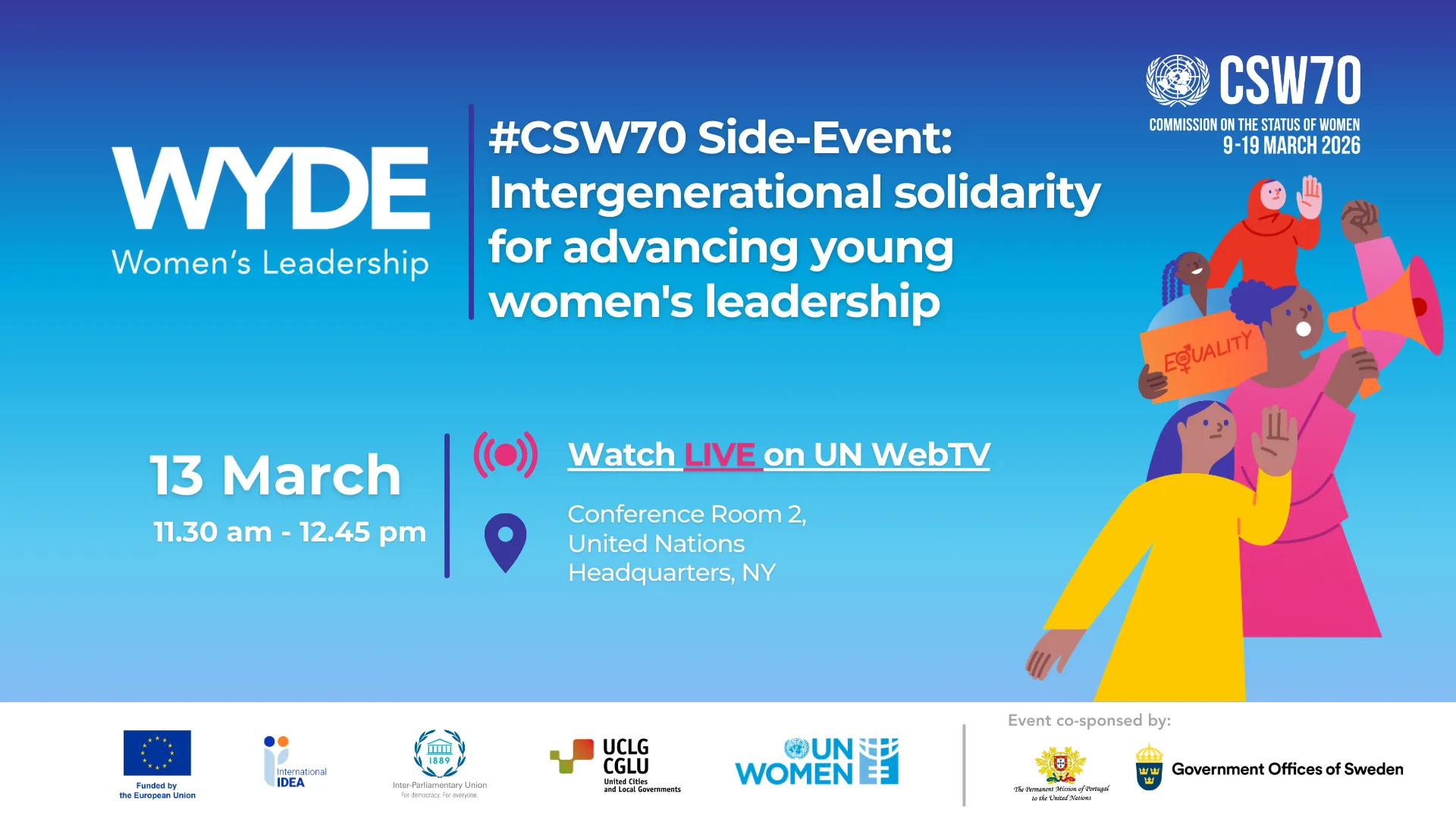
Organizers: Inter-Parliamentary Union, UN Women, International IDEA, United Cities and Local Governments
Co-sponsored by: European Union Delegation, Portugal and Sweden
Structural, socioeconomic and cultural barriers rooted in unequal power relations and discriminatory norms hinder women’s and, in particular, young women’s participation in public life. As of 1 January 2026, only 28 countries are headed by a woman. In 2025, women made up 22.9% of cabinet members heading ministries, 27.1% of national legislators and 35.6% of the local legislature. According to the IPU 2025 report Youth participation in national parliaments, the proportion of young women members of parliament (MPs) declined since 2023, with women aged 30 and under accounting for just 1.2% of MPs worldwide (down from 1.4%), and those aged 40 and under only 6.9% (down from 7.9%). Gender balance is stronger among younger MPs, with women making up 42.8% of MPs aged 30 and under, and 36.2% of those aged 40 and under, compared with just 27.2% across all ages and 21.1% for those over 40.
Organized in the context of the CSW70 Review theme which looks back at the 65th session of the CSW (2021) focused on the theme “Women's full and effective participation and decision-making in public life, as well as the elimination of violence, for achieving gender equality and the empowerment of all women and girls”, this side-event will focus on the topic of intergenerational engagement to support and increase the participation of young women in public life, leadership roles and politics. The CSW65 Agreed Conclusions recognized that “young women are particularly underrepresented in public life”, that “early exposure to women leaders as role models, as well as to legislative and policy-making spaces, motivates young women and girls, broadens networks and strengthens their opportunities to become fully engaged citizens”, and that “measures are needed to enable young women and girls to successfully grow into leadership positions in public and private spheres by ensuring their full and equal access to education, technology and skills development, leadership and mentorship programmes, increased technical and financial support, and protection from violence and discrimination”.
In direct response to these identified gaps and priorities, the European Union (EU) is funding an initiative implemented by UN Women, International IDEA, the Inter-Parliamentary Union (IPU) and United Cities and Local Governments (UCLG). Launched during CSW68 in 2024, the WYDE | Women’s Leadership initiative is a collaborative global effort working to advance women’s full and effective political participation, representation and decision-making at all levels, especially in those most often left furthest behind. Over three years, WYDE | Women’s Leadership is leveraging collective action, partnerships, coordination, knowledge and resources at the global level to advance women’s and young women’s political participation and decision-making through social norms change, networking and global advocacy. One of its key strategies is the rolling out of intergenerational dialogues and exchanges for building critical skills and facilitating networking of young women in politics and decision-making. These dialogues also strengthen intergenerational solidarity between women’s rights organizations and women in politics, encouraging an intersectional perspective to their respective work.
The side event will present an opportunity to hear first-hand about the successes and challenges of intergenerational engagement and to learn from the WYDE programme.
Speakers
- Abosede George-Ogan, Founder/Executive Director ∙ Women in Leadership Advancement Network, Nigeria (moderator)
- Julia Koch de Biolley, Head of Task Force for Equality, European External Action Service
- Sarah Hendriks, Director, Policy, Programme and Intergovernmental Division, UN Women
- H.E. Rui Vinhas, Permanent Representative of Portugal to the United Nations
- Ruth Cross-Kwansing, Minister for Women, Youth, Sports and Social Affairs, Member of Parliament, Kiribati
- Cynthia López Castro, Member of Parliament, President of the IPU Bureau of Women MP, Mexico
- María Eugenia Gay Rosell, Second Deputy Mayor of the Barcelona City Council and 6th Vice President of the Barcelona Provincial Council, Spain
- Bina Maseno, Executive Director, Badili Africa, Feminising Political Spaces, Kenya
- Lydia Korsgren, Chair for Save the Children Youth Organisation, Sweden
- Rumbidzai Kandawasvika-Nhundu, Principal Adviser, Democracy and Inclusion, International IDEA
Related Events

 Comments


