


When Aid Fades: Impact and Pathways for the Global Democracy Ecosystem


In January 2025, the United States government launched a far-reaching restructuring of its foreign assistance architecture, closing USAID, consolidating its functions into the State Department, and freezing all foreign aid programming. By March 2025, the review concluded with the termination of 86 percent of USAID awards and 41 percent of State Department awards, amounting to roughly USD 80.5 billion in cancelled funding. The reductions dismantled decades of US investment in humanitarian relief, health, education, agriculture, economic development and, most dramatically, in democracy, human rights, governance and peacebuilding (DRGP).
The speed and scale of these cuts have destabilized thousands of DRGP organizations across more than 120 countries, weakening civil society, silencing independent media, reducing protection for human rights defenders, and creating conditions that embolden authoritarian regimes. As the largest bilateral democracy donor effectively withdrew from global democracy support in a matter of months, other major OECD donors also announced reductions, widening an already severe funding gap. This shift represents a seismic reordering of the global development and democracy landscape with profound consequences for democratic institutions, human rights, and civic space worldwide.
To understand the impact of the US and other foreign aid cuts on the global democracy ecosystem, International IDEA and the International Foundation for Electoral Systems (IFES) under the umbrella of the Global Democracy Coalition undertook a review, based on two surveys of nearly 300 DRGP organizations worldwide, key informant interviews, testimonials and bringing together existing sub-sector studies. This is the most comprehensive report to date on the impact of the foreign aid cuts on the global democracy ecosystem and its broader landscape.
The report finds that nearly 70 percent of all US government–funded DRGP awards—more than 1,600 grants worth over USD 14 billion—have been terminated. Only a small number of governance and human-rights awards remain, most of which are set to end soon, without a clearly articulated continuation strategy. Cuts to other instruments of US soft power, including Voice of America and the United States Institute of Peace, have further compound the deterioration of democratic infrastructure for activists around the world.
Nearly half of surveyed organizations report that US funding made up half or more of their budgets, forcing widespread layoffs, programme suspensions, and, in some cases, closure. In fragile or repressive contexts, these losses directly erode civic and media resilience; in authoritarian settings, the cuts have emboldened governments to intensify repression and adopt restrictive “foreign agent” laws. The global democratic decline magnifies these effects, creating long-term risks for governance, human rights, and public trust. However, the report also shows how organizations across the world are navigating the new funding landscape, what resilience strategies they are using and presents recommendations for the way forward. The report seeks to help inform on-going discussions on the future of foreign aid and how to rethink democracy support in a new geopolitical landscape.
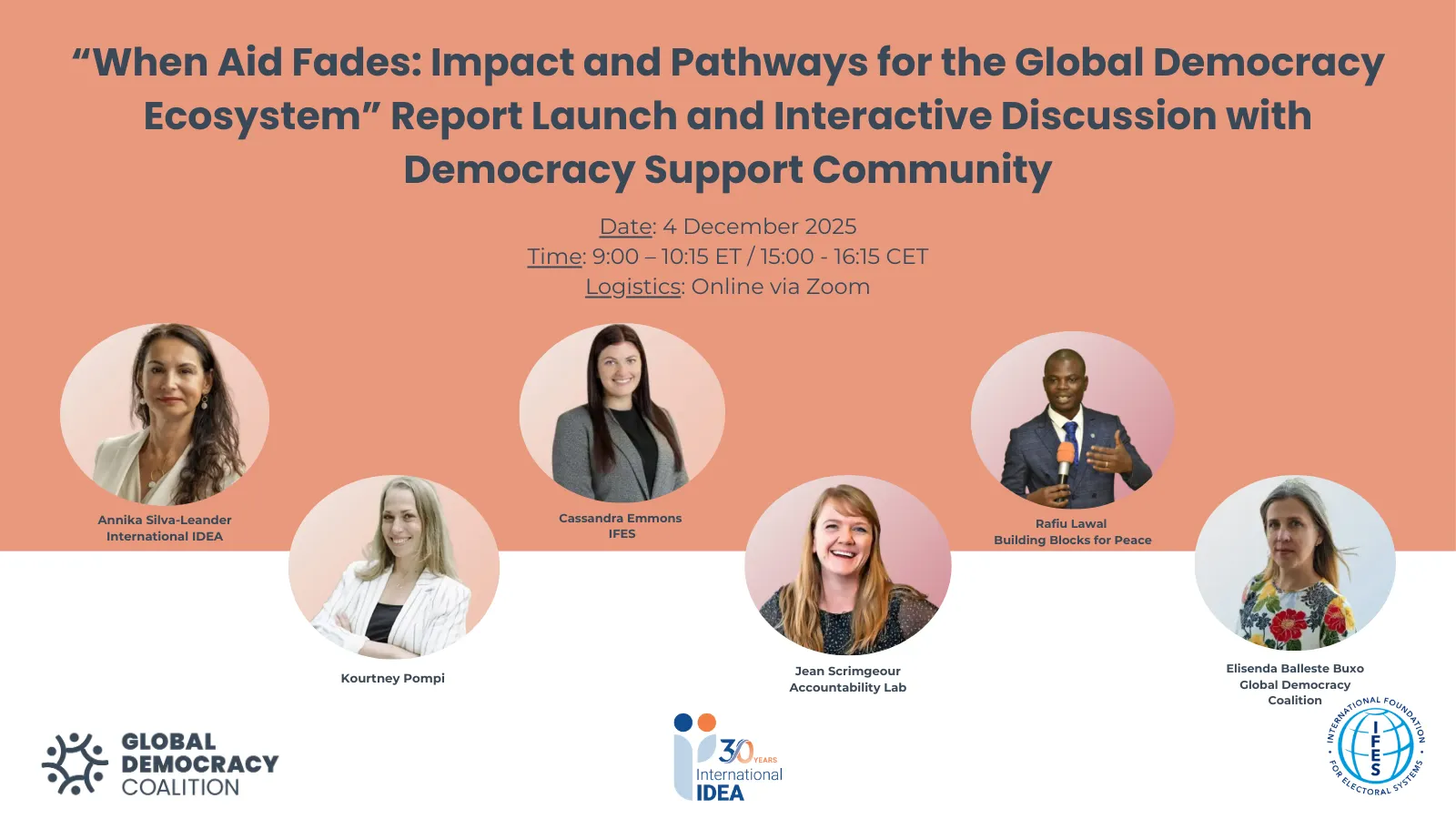
This event will present the report’s key findings and bring forward the voices of organizations directly affected by the cuts, with the aim of facilitating a conversation on the way forward for the democracy support community. Representatives of civil society, independent media, and DRGP-related initiatives will share how they have been impacted and how they are navigating this new reality. The webinar is designed to create an interactive space for democracy, human rights, governance and peacebuilding organizations across regions to exchange experiences, reflect collectively on a reshaped global assistance landscape, and explore how democracy support must be reimagined for the future.
Agenda
- 09:00 – Introduction and Moderation of Event
>Elisenda Balleste Buxo, Coordinator, Global Democracy Coalition, International IDEA
- 09:05 – Presentation of report findings by co-authors
>Annika Silva-Leander, Head of North America and Permanent Observer to the UN, International IDEA
>Kourtney Pompi, Consultant
>Cassandra Emmons, Global Democracy Data Advisor, Center for Applied Research and Learning, IFES
- 09:25 – Discussants
>Jean Scrimgeour, Co-CEO, Accountability Lab
>Rafiu Lawal, Executive Director, Building Blocks for Peace Foundation
- 09:45 – Q&A
- 10:10 – Closing
>Elisenda Balleste Buxo, Coordinator, Global Democracy Coalition, International IDEA
Related Events
 Comments


