What does Carney’s Davos speech teach us about promoting democracy?
Disclaimer: Opinions expressed in this commentary are those of the authors and do not necessarily represent the institutional position of International IDEA, its Board of Advisers or its Council of Member States.
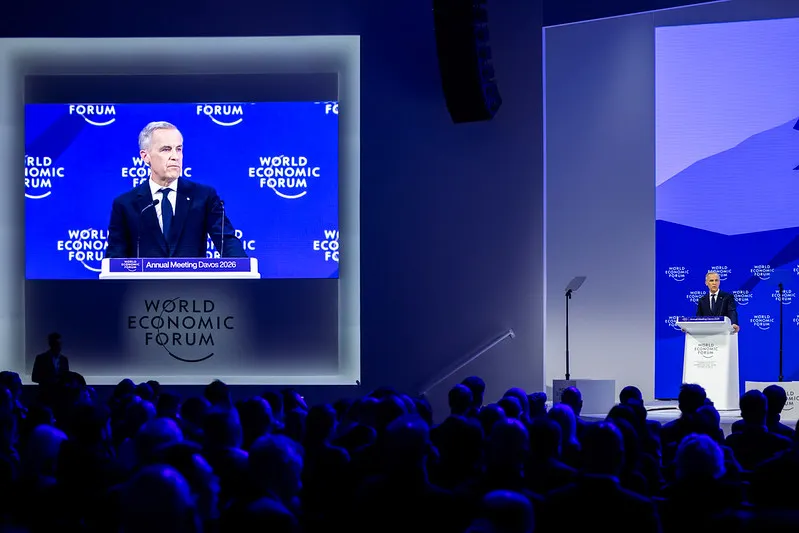
Canadian Prime Minister Mark Carney’s speech on Tuesday, 20 January 2026, at Davos, Switzerland, has drawn widespread praise, headlines and even rebuke from the United States’ President Donald Trump—increasingly a badge of honour for many democratic-leaning politicians. The speech message––a call for the not-so-powerful countries to work together in a new world order that requires a more proactive balance of values and realism—seemed perfectly timed amid the crisis over Greenland. A year ago, Canada stood quite alone in naming and facing existential concerns from the USA. No longer; that made the moment ripe for Carney’s message of unity.
The speech employed well-worn and effective rhetorical tools—catchy phrases such as ‘If we’re not at the table, we’re on the menu’, media-friendly words like ‘rupture’ made for headline writers, and verbal techniques from repetitions to metaphors.
But the speech also holds wider lessons for politicians, policymakers and activists trying to forge a strong message about that abstract, slippery but essential concept—democracy.
- It can be effective to champion democracy without mentioning it. In more than 2,000 words, Carney uses the word ‘democracy’ only once. Democracy is a generalization that can inspire (as it does on the streets of Myanmar or Iran) but it can also struggle to mobilize or grab emotions. Instead, Carney tells a story about the need for the smaller national players to band together, respect the rule of law, multilateralism and fight for justice. Carney talks about ‘human rights, sustainable development, solidarity, sovereignty and territorial integrity’, a smorgasbord of democracy’s constituent parts. People know democracy. People like democracy. Talking about the reasons people like democracy—its benefits—is more important than using the D-word.
- Don’t mention Trump. Trump is not mentioned once (nor, for that matter, are other major countries of concern for democracy, such as China and Russia). But we listeners know well to what Carney is referring. By avoiding the ‘T’ word, Carney breaks free from a cycle of news and analysis that exhausts readers, puts Trump at the top of the debate, and has liberal idealists on the defensive. Carney made headlines of his ideas, not Trump’s.
- Don’t pretend that democracy is the answer to all our ills. Carney quotes Finnish President Alexander Stubb’s term of ‘value-based realism’. Democracy supporters are often good on values, but less so on balancing and integrating these principles with pragmatic issues such as security, defence or trade deals (and in Carney’s speech, even tax cuts). Carney is unafraid of even showcasing ‘new strategic partnerships with China and Qatar’, usually issues that ardent democrats shy away from. Carney’s message is all the more convincing for this.
- Connect the personal with the global. This is perhaps the most perplexing task in messaging about democracy and a values-based political system. Carney first uses Vaclav Havel’s metaphor of a shopkeeper who, like all the other shopkeepers, ‘places a sign in his window: “Workers of the world, unite!” He does not believe it. No one believes it. But he places the sign anyway—to avoid trouble, to signal compliance, to get along. ... Havel called this “living within a lie”’. Carney hinges the whole speech on a story we can all visualize and feel—and why not rely on a great writer for that original story?
- Be honest. An argument is stronger by admitting to mistakes. Liberal democrats in the West have made many errors and recognizing them strengthens any argument that follows. ‘We knew’, says Carney, that ‘the story of the international rules-based order was partially false’. Indeed, we all knew, even though few of our leaders said it, that globalized democratic idealism has been mired in hypocrisy, whether it is overseeing rising inequality, accepting skewed global rules or supporting unjust wars. Advocates for democracy should be honest about this inconsistency, and only then move on with making their case. Like a pleasant smile, the technique can politely disarm your opponent.
- Have one ‘can-do’ idea, but don’t make it the only solution. Carney has a simple narrative arch. The world order has suffered a rupture that has proved to be the end of a fiction about how we thought of our comfortable world. A ‘values-based realism’ with like-minded countries banding together is a way forward, albeit messy and uncertain. Always end every message with ‘a solution’ not ‘the’ solution. That latter is what populists and autocrats propose. The former is what democracy is about: proposals are made in the public square, and then the people decide.


About the author