70th Session of the Commission on the Status of Women: General Debate
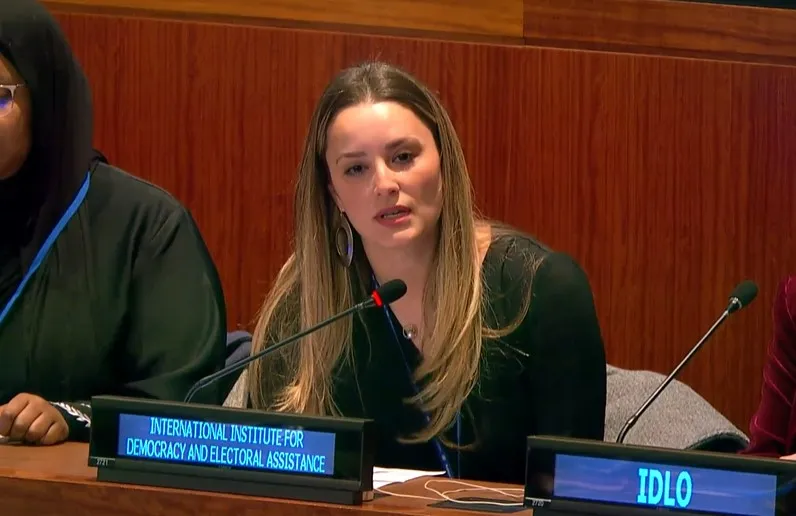
70th Session of the Commission on the Status of Women
“General Debate”
United Nations Headquarters, New York
Statement by the International Institute for Democracy and Electoral Assistance
Excellencies,
International IDEA reaffirms that gender equality and democracy are mutually reinforcing. Gender equality cannot thrive without democratic governance, and democracy cannot exist without the full and equal participation of women in political and public life.
The theme of this year’s Commission—ensuring and strengthening access to justice for all women and girls—speaks directly to the foundations of democratic governance. Inclusive and equitable legal systems, free from discrimination, are essential for enabling women to claim their rights, participate fully in public life, and hold institutions accountable. Without access to justice, gender equality and women’s empowerment remain a promise rather than a lived reality.
Over thirty years after the Beijing Declaration recognized gender equality as essential to democracy, progress is undeniable but incomplete. According to International IDEA’s Global State of Democracy Indices, global gender equality scores have improved significantly since 1995, but only marginally in the past decade. Women still hold only 27.5 per cent of parliamentary seats globally, and structural barriers—including discriminatory norms, violence and harassment in politics, and unequal access to resources—continue to limit women’s political participation and leadership.
These barriers also undermine women’s access to justice. Discriminatory laws, weak accountability mechanisms, and gender-blind institutions often prevent women and girls from seeking redress and exercising their rights fully. Ensuring justice requires not only legal reform but also gender-responsive democratic institutions capable of addressing discrimination and strengthening public trust.
International IDEA’s work consistently shows that democracies tend to perform better on gender equality indicators than non-democratic regimes. Democratic institutions, when inclusive, transparent and accountable, create pathways for women to influence laws, policies and judicial systems that shape their lives.
However, recent global trends provide cause for concern. Around the world, we are witnessing a backlash against gender equality and democratic values, alongside shrinking civic space and rising polarization. These trends threaten the progress achieved in advancing women’s rights and undermine efforts to build inclusive justice systems.
Excellencies,
Ensuring justice for women and girls requires addressing structural barriers at every level. This includes eliminating discriminatory laws and practices; strengthening judicial and constitutional frameworks that uphold equality; and ensuring that women are meaningfully represented in institutions responsible for law-making, governance, and oversight.
Women must not be seen merely as beneficiaries of justice systems, but as leaders and agents of change in shaping them. When women participate in decision-making, institutions become more responsive, inclusive and legitimate. But we must not forget that achieving access to justice for all also requires addressing violence against women in politics and public life, improving data and monitoring mechanisms, and investing in institutions capable of protecting their rights and ensuring accountability. Only through such comprehensive efforts can justice systems effectively serve all women and girls.
International IDEA calls on Member States to strengthen democratic institutions, promote gender-responsive governance, and remove legal and structural barriers that prevent women and girls from accessing justice. At a time of democratic backsliding and growing backlash against gender equality, progress will depend on our collective resolve to defend democratic principles and ensure that legal systems remain inclusive, accountable, and grounded in democracy and human rights.
International IDEA remains committed to working with the United Nations, Member States, and civil society partners to advance gender-responsive democratic institutions and ensure that justice systems truly serve all women and girls.
I thank you.


About the authors