


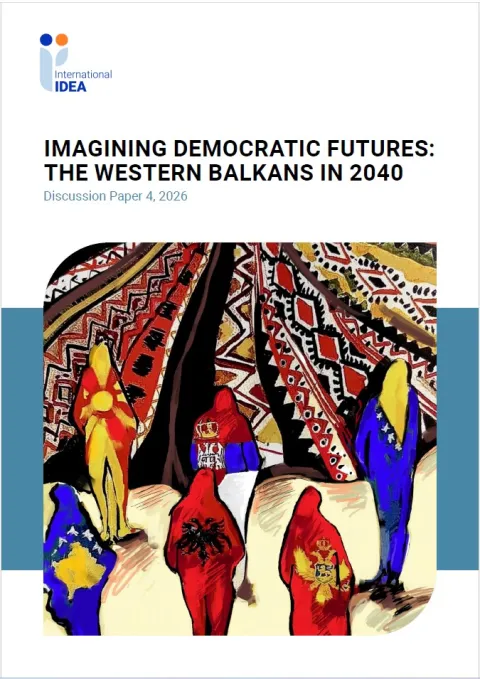
Imagining Democratic Futures: The Western Balkans in 2040
Discussion Paper 4, 2026

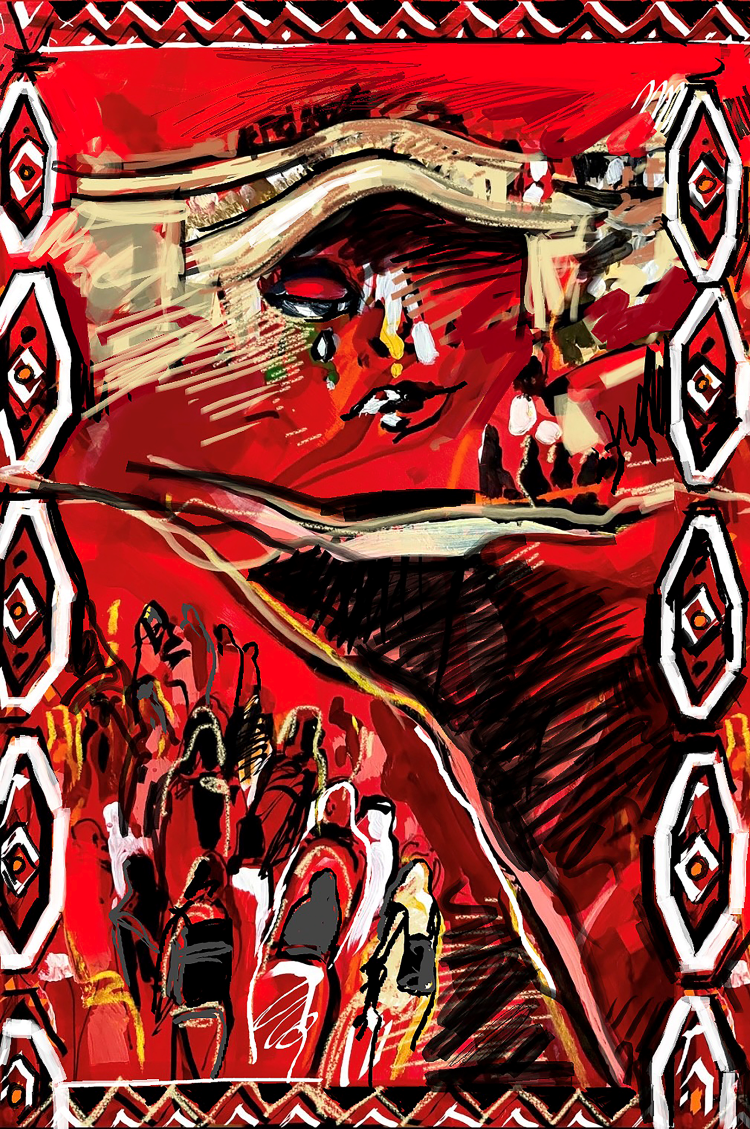
Image credit: Diella Valla, Absent Neighbours, 2025
Democracy is facing its most uncertain moment in decades. Global democratic anchors—including the United States and the European Union—are experiencing turbulence that is fragmenting alliances, weakening multilateralism and eroding long-standing assumptions about international stability (Ross 2026; The White House 2026). These shifts reverberate strongly in the Western Balkans, a region whose post-conflict democratic trajectory has long depended on Euro-Atlantic support, monitoring and integration prospects. Since the end of the 1990s conflicts, the Western Balkans has treated EU membership as its primary strategic and normative goal, despite varied support for EU membership across the countries of the region and weakened credibility of the EU due to stalled enlargement and years of unmet expectations. As the external anchors that once guided reforms become less predictable, the Western Balkans faces growing uncertainty about its democratic future, especially amid divergence in EU integration across the region.
Despite many promising political developments and progress, the region continues to grapple internally with unresolved legacies of the 1990s—populism, ethnic tensions, weak or captured institutions, and entrenched corruption. Performance on the Global State of Democracy Indices remains middling, with Rule of Law as a persistent weakness (International IDEA n.d.). As formal institutions struggle, informal institutions have increasingly stepped in. Civil society organizations, grass-roots movements and independent media have become internal anchors of democracy. Yet many of these actors have historically relied on support from the very democracy-supporting partners now facing crises of their own, raising questions about their sustainability and independence in the years ahead.
The Western Balkans is also diverse. Differences in ethnic composition, religious traditions, economic development and geopolitical orientation shape each country’s democratic trajectory and offer rich opportunities for growth and innovation. The region also sits at a strategic geographic crossroads where China, the EU, Russia and Türkiye compete for influence, while demographic decline, digital transformation and climate-related pressures add further complexity. This landscape is further shaped by the increasingly evident decline of direct US engagement, which has altered long-standing geopolitical dynamics.
To explore how these dynamics may shape the region’s democratic future, the International Institute for Democracy and Electoral Assistance (International IDEA)—supported by the Balkan Investigative Reporting Network in Albania—convened the Western Balkans Democratic Futures workshop in October 2025 in Albania. Through exercises involving strategic foresight, a diverse group of participants developed four plausible scenarios for how democracy in the region might evolve by 2040.
To a significant degree, even as they recognize the increasing uncertainties shaping the international order, the scenarios rest on two implicit baseline assumptions: (a) that the EU will still exist in 2040; and (b) that no new major armed conflict will have broken out in the Western Balkans or wider Europe.
The four scenarios are based on a set of core parameters and drivers of democratic change in the Western Balkans, including the strength of civil society, media freedom, the role of political elites, external influence (particularly the EU), economic and demographic trends, climate-related pressures and the transparency and accountability of public institutions. These drivers do not appear uniformly across all four scenarios. Instead, each scenario highlights a different configuration of actors, institutions and power dynamics to illustrate how democracy in the region could evolve under varying conditions. The scenarios should therefore be read not as exhaustive assessments of every dimension of democracy but as structured explorations of plausible futures shaped by distinct combinations of these underlying drivers. These scenarios are not predictions but tools to help policymakers, civil society and citizens reflect on emerging risks, identify opportunities and strengthen democratic resilience.
Scenario 1: Blossoming democracy supported by the EU
In this optimistic future, the Western Balkans experiences a genuine democratic consolidation, driven by principled and consistent EU engagement followed by EU membership for most of the region. Credible accession prospects and robust support for civil society empower a new generation of leaders committed to rule-of-law reforms, transparency and regional cooperation. Strong institutions and independent media reinforce stability, while economic modernization and green development help reverse demographic decline and integrate the region more deeply into Europe.
Scenario 2: Grass-roots movements driving political transformation
In this scenario, democratic renewal emerges from the bottom up. Following uneven and inconsistent progress in EU integration, civil society and grass-roots movements become the main drivers of accountability and political imagination. Mass protests, youth activism and cross-sector alliances push back against corruption and censorship, generating spillover effects across the region that foster stronger cooperation and networks, as well as solidarity. Although elites resist and institutions remain relatively weak, sustained civic pressure forces gradual reforms and strengthens a culture of participation. Progress is uneven, but citizens steadily reclaim agency and reshape democratic norms through persistent collective action.
Scenario 3: Stabilitocracy and democratic decline under elite rule
In this future, the Western Balkans remains stuck in the stagnation of the 2020s and sinks deeper into stabilitocracy, in which entrenched political elites and oligarchs, despite clear democratic deficits, retain power in exchange for some stability while blocking real reform and maintaining the status quo. Corruption, media capture and clientelism fuel inequality and public distrust. Economic and demographic decline reinforce elite dominance, EU accession loses momentum, and democracy exists only in leaders’ public statements, leaving institutions fragile and societies disillusioned.
Scenario 4: Authoritarian grip on a geopolitical battleground
In this darkest scenario, the Western Balkans falls under an entrenched authoritarian grip and full isolation. Leaders exploit crises to tighten control, criminalize dissent and build pervasive surveillance states. Life is governed by fear and repression. As institutions crumble and young people leave, the region drifts towards authoritarian global powers. Media freedom disappears, minorities become scapegoats, and geopolitical tensions turn the region into a destabilizing force in Europe where anxieties about renewed conflict remain ever-present.
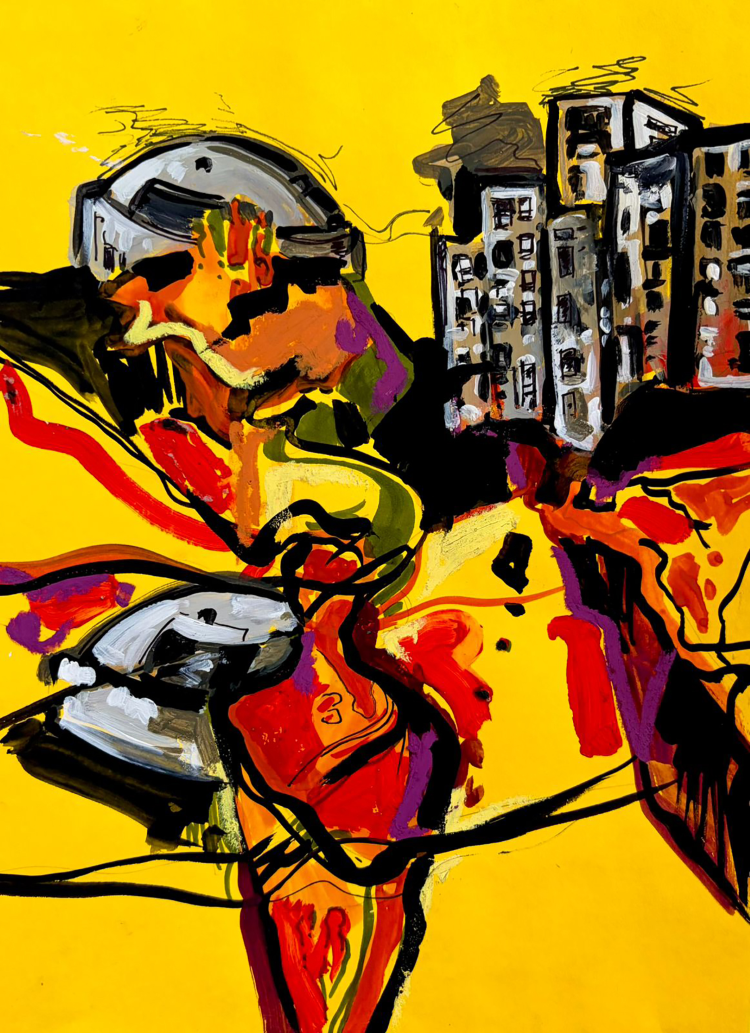
Image credit: Diella Valla, Tension Under Light, 2025
The Western Balkans—a region in Europe today understood to include Albania, Bosnia and Herzegovina, Kosovo, Montenegro, North Macedonia and Serbia—is anything but homogeneous. Differences in ethnic composition, religious traditions, economic development and political trajectories shape how each society experiences current pressures. Positioned at a cultural and geopolitical crossroads, the region is also a space where China, the European Union, Russia and Türkiye compete for influence.
Much of the Western Balkans emerged from the dual legacy of one-party rule and the violent breakup of Yugoslavia, while Albania transitioned from one of Europe’s most isolated and repressive communist regimes. Entering the 2000s under the shadow of the 1999 United States–led intervention by the North Atlantic Treaty Organization (NATO), hopes for economic prosperity and democratic development were largely tied to EU membership aspirations.
Today, EU accession negotiations are in progress with Albania, Montenegro (which recorded some of the most notable recent advances in the Global State of Democracy Indices in the region) and Serbia (which has seen the region’s sharpest declines) (European External Action Service 2025). North Macedonia is in the screening phase following its 2020 agreement to begin negotiations. Bosnia and Herzegovina holds candidate status, while Kosovo remains a potential candidate. The EU is also the region’s dominant trading partner, accounting for nearly 70 per cent of total trade (European External Action Service 2025). Other big economic actors in the region are China (particularly in Serbia), Russia (particularly in Montenegro), Türkiye, the United Arab Emirates and the USA (especially in Kosovo) (Ginter and Hildebrandt 2025).
For decades, established democracies and the EU served as external anchors and democratic guarantors in the region, guiding reforms and monitoring their progress, aware of its geopolitical importance—as UK Prime Minister Keir Starmer put it, ‘the place where the security of our continent is put to the test’ (Coffey 2025). Although these Western democratic powers do not enjoy uniform support in the region, most leaders have long pursued a Euro-Atlantic course and treated EU integration as its normative compass.
However, even among countries where support for the EU is at the highest, the EU’s commitment is in question (European Western Balkans 2025). Although the EU has confirmed that its enlargement remains central, years of stalled progress, member state vetoes, procedural fatigue and shifting political priorities have weakened the EU’s credibility (Council of the European Union 2025; Rasmussen and Benson 2025; Stoimenova 2025). At the same time, strained EU–US relations, a US retreat from multilateralism and a deteriorating European security environment threaten to lead to a dangerous downward spiral (Ross 2026; The White House 2026). These shifts challenge the countries and the institutions—the EU, NATO and the United Nations—that once served as democratic guarantors for the Western Balkans, leaving the region questioning its future at a moment when its external anchors feel less reliable (Caulcutt 2026; Collinson 2026).
International IDEA’s Global State of Democracy Indices show that all Western Balkan countries perform in the mid-range across the main categories of democratic performance: Representation, Rights, Rule of Law and Participation. While the region performs strongest in the areas of Rights and Representation, Rule of Law—a category that measures corruption, judicial independence and related factors—remains an Achilles heel. Recent developments in some countries, however, suggest potential openings for greater accountability. Albania’s Special Prosecutor’s Office against Corruption and Organized Crime has pursued several high-profile investigations, and mass protests in Serbia have kept even the most powerful political elites under pressure (International IDEA 2023c, 2025a).
To a different extent, all countries in the Western Balkans face challenges stemming from the unresolved legacies of the 1990s, populism and ethnic tensions (International IDEA 2023b; Kurtic, Tesija and Isufi 2024; Spasojević 2024; Sarajevo Times 2025). The region also faces long-standing demographic challenges and brain drain driven by outward migration; intensifying pressures related to air pollution and climate change; and the mixed impact of digitalization on civic space, expanding opportunities for engagement in public life even as it accelerates the spread of extremist content, gender-based online violence and harassment, disinformation and algorithmic bias (International IDEA 2022; Jovanovski 2024; Wankiewicz-Kłoczko 2025).
To explore how these dynamics may shape the region’s democratic trajectories, the International Institute for Democracy and Electoral Assistance (International IDEA), with support from the Balkan Investigative Reporting Network (BIRN) Albania, convened the Western Balkans Democratic Futures workshop. The event, held in Albania from 15 to 17 October 2025, brought together a multidisciplinary group of researchers, public servants, democracy practitioners and activists from across the region. Guided by Future Impacts, experienced foresight facilitators based in Germany, participants engaged in strategic foresight exercises designed to stimulate innovative thinking about potential democratic futures for the Western Balkans.
During the workshop, participants developed a set of plausible scenarios illustrating how democracy in the Western Balkans might evolve between now and 2040. These scenarios were built around four alternative pictures of the future. The exercises identified the trends most likely to shape the region’s democratic future, imagined how these trends might evolve under different projections and analysed the potential opportunities and challenges presented by each scenario. The scenarios then served as a foundation for discussions on the innovations required to improve preparedness for a variety of future possibilities, the actions needed to encourage positive pathways and the measures necessary to mitigate risks.
This report summarizes the four scenarios developed during these exercises. The scenarios do not necessarily reflect the views of individual participants or their organizations. Instead, they are intended to inspire and inform readers in their reflections and planning about how best to navigate uncertainty and strengthen and promote democracy in their own contexts.
1.1. What will democracy look like in 2040?
It is 2040 and the Western Balkans is a model of prosperity, built on genuine, EU-aligned reforms that required persistence and political will. Unlike past periods of superficial actions, today’s reforms are responsive and grounded in accountability. While reforms have not been linear, the region now benefits from strong institutions that function in practice, not just on paper, shaped by domestic accountability pressures rather than symbolic compliance. Public expectations of integrity and transparency are markedly higher. Albania, Montenegro, North Macedonia and Serbia are EU members; Bosnia and Herzegovina is closing its last accession chapters; and Kosovo has secured candidate status with a clear accession timeline.
A younger political generation that has lived through grass-roots movements like Ne Davimo Beograd1 is driven by public service rather than personal gain, and has gradually replaced the entrenched political elites (Vasiljević 2022; Antanasov 2024). They treat regional cooperation and EU reforms—such as the European Commission’s tougher rule-of-law monitoring—as tools to manage domestic challenges and nurture local democracy, not externally imposed obligations. The rule of law is no longer a dream but lived reality for most citizens, supported by ongoing reforms. Courts are increasingly impartial and legislatures have become more substantive forums for debate. Independent media and active civil society have created a culture of participation and institutional trust. Chambers of commerce have a regional board, universities run exchange programmes building on Erasmus+ and the Western Balkans Mobility Scheme, and once segregated neighbourhoods now resound with multiple languages. Festivals and cross-border artistic projects have expanded from initiatives like Mirëdita, Dobar Dan!2 and turned the region into a hub of cultural vitality (Mirëdita n.d.).
Progress is visible everywhere—for example, solar farms stretch across the hillsides, the result of early investments such as Albania’s Karavasta solar park (Todorović 2022). Villages thrive in the midst of cultivated farmland, and skyscrapers coexist with nature in green urban centres. Pedestrians and cyclists share smog-free cities with eco-friendly vehicles. Cities breathe freely now, and they increasingly belong to the citizens, not to oligarchs.
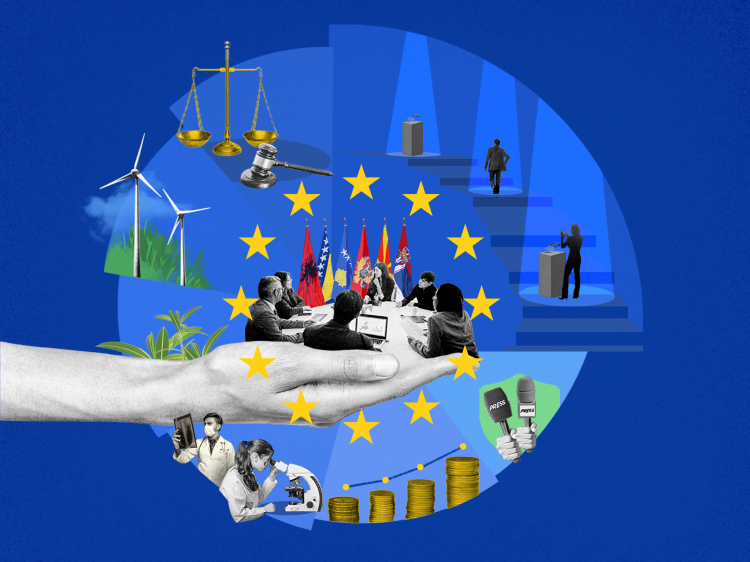
Image credit: Jurgena Tahiri, 2025
The region’s gross domestic product per capita, driven by innovation and digitalization, has risen significantly, narrowing the gap with EU averages. Brain drain has turned into brain gain with professionals returning home with global experience. Coworking hubs buzz with young entrepreneurs, and universities are tied into global research networks, building also on regional participation in Horizon Europe.3 Having moved beyond past conflicts, the region now speaks with a more confident global voice, shaped by steady progress and hard-won reforms.
1.2. How did we get here?
Threats to the rules-based international order in the 2020s compelled the EU to approach the region with newfound seriousness. Russian aggression and the retreat of the USA as a democratic power reignited fears of conflict and strengthened public pressure to anchor the region to the EU as a matter of survival. The EU, aware that neglect of the region threatened its own security and invited exploitation by non-democratic powers, reformed its approach to the Western Balkans. It built trust even among the sceptics through a slate of pro-democracy measures, including suspension of accession talks with authoritarian-leaning countries, conditional financial aid and market access, and direct support for civil society, particularly human rights defenders and groups mobilizing against corruption and environmental damage. As trust grew, more people who had migrated earlier chose to return, and circular migration became more common. Member states sometimes acted individually, imposing targeted sanctions, such as those against Milorad Dodik for undermining rule of law and advancing an illiberal agenda in Bosnia and Herzegovina (Huskić 2025). The entrenched political elites stood exposed, with stalled development no longer concealed by token reforms or photo ops with EU officials.
The changed geopolitical context energized leaders who prioritized self-sufficiency and were genuinely committed to the development of democratic societies. This new generation of leaders, shaped by years of lost opportunities under rampant corruption, helped drive forward an ambitious reform agenda. Many reform-minded leaders worked through existing political parties, leading to gradual internal reforms that improved candidate selection, transparency and basic accountability, helping parties regain credibility as essential institutions. EU conditionality also reshaped party incentives, as stricter scrutiny of party financing, alignment with European party families and evolving integrity rules made opaque practices harder to sustain and pushed parties towards greater internal democracy and credibility.
Public pressure, energized and sustained by local election watchdogs, drove key electoral process reforms, with no tolerance for manipulation and a commitment to accountability for abuses. Democratic change was reinforced by stronger institutions—from parliaments reclaiming oversight to more autonomous prosecutors and regulators—while improvements in local governance and service delivery helped rebuild trust at the community level. Increasingly credible elections eventually cultivated leaders who supported bolstering electoral processes as the central pillars of democratic change. They supported broader reforms, including professional and citizen-centred public administration, stronger electoral commissions, tightened campaign finance rules, improved voter registry oversight and increased transparency in party operations. The rigorous prosecution of electoral abuses reinforced these measures, establishing precedents that deterred future violations.
Local governments, operating with clearer mandates and stronger accountability, became the front line, where citizens experienced these reforms in their daily lives. Long-standing ethnic tensions, which had kept conflict looming, were gradually eased through this forward-looking leadership and civic energy. A regional reconciliation forum led to apologies, justice, reparations, cooperation on missing people and pledges to address minority rights. The reconciliation process evolved into biannual summits focused on regional integration, where countries forged practical agreements that improved citizens’ lives, including mutual recognition of documents and cross-border infrastructure projects. These agreements inspired genuine reconciliation, greater integration of ethnic minorities and a belief in common goals and shared futures.
The EU’s principled engagement offered a sense of possibility that citizens had never experienced before. Youth networks and digital activists mobilized to expose wrongdoing. Civil society was further empowered by the EU’s 2025 Civil Society Strategy, which gave them a formal role in the enlargement process and reinforced protections for civic space. This civic resolve eroded the influence of oligarch- and autocrat-controlled media, prompting public rejection of their coverage. Young journalists and independent media grew more assertive, amplifying transparency and public awareness, drawing on the investigative breakthroughs of platforms like the Crime and Corruption Reporting Network in Serbia or the Balkan Investigative Reporting Network (Civil Rights Defenders 2024; Amnesty International 2025). Their impact was amplified by courts, parliaments and regulators increasingly willing to act on their findings.
The push for a better quality of life made climate action central, emerging as a unifying issue across generations, especially for youth who experienced environmental harm as a present reality. Their sense of urgency helped propel protections that revitalized rivers and parks, encouraging communities to safeguard nature, including through participatory methods. Harmonization with EU environmental standards and aid in green technology led to growth in renewable energy and sustainable agriculture.
Enhanced EU support, free trade and mobility, and the region’s young population catalysed an economic boom anchored in innovation and foreign investment. Service-based IT outsourcing businesses grew alongside innovation hubs. The digital transformation of public services and the economy—already a defining strength in the 2020s—reduced disparities and improved quality of life (converge2eu n.d.; Vienna Institute for International Economic Studies 2025). Diaspora returnees, alongside immigrants and foreign professionals, revitalized rural areas and eased urban overcrowding.
2.1. What will democracy look like in 2040?
In 2040 the Western Balkans is experiencing a modest democratic revival, driven largely by grass-roots resistance to authoritarian threats. Historical marketplaces and streets are streaked with graffiti art and faded murals, now partially overgrown with vines, bearing slogans like ‘Social Justice’ and ‘Co-Exist’ and ‘Democracy has left the chat’, vestiges of the protest movements that paved the way for today’s uneven but growing prosperity and progress. The skyline hums with cranes, as a long-abandoned rail project is finally revived, promising high-speed connections across the region. The people are reclaiming their cities and feel empowered—artists and intellectuals gather in cafés, debating political ideas and livestreaming to thousands online, while universities host student hackathons.
A new generation of political leaders brings the will to implement reforms but lacks experience and remains constrained by the same systemic challenges that plagued their predecessors. Informal patronage networks persist: citizens who refuse to pay bribes face delays or denial of essential services, making honesty costly and corruption self-sustaining. Vested interests and underfunded institutions undermine reform, while EU paralysis—caused by enlargement fatigue and internal crises—limits external support, leaving structural transformation elusive.
Trusted by communities, civil society organizations increasingly compensate for weak formal institutions, often at the cost of burnout and dependence on at times short-term and uncertain funding. Charities and faith-based organizations provide social care for the elderly and people with disabilities. Youth-led initiatives run digital literacy courses for people to stay safe online. Citizen science platforms hosted by local environmental organizations publish real-time data on pollution levels, while neighbourhood associations plan community clean-ups and digital town halls.

Image credit: Jurgena Tahiri, 2025
Civil society is not only protesting; it is building by powering green infrastructure, rethinking governance and creating a culture where democracy thrives. At the same time, the continuing presence and power of the old guard limits civil society’s actions. Threats of funding cuts and barely veiled attacks restrict the space for broader change.
2.2. How did we get here?
In the 2020s overlapping crises ignited mass protests across the region, and a strong civil society harnessed the momentum. In Albania and Serbia, authorities temporarily blocked widely used social media apps, claiming the restrictions were necessary to protect young people from harmful content (International IDEA 2024c). Many young people saw the decision as an attack on freedom of expression. Student-led demonstrations, supported by digital rights groups, drew thousands and ultimately forced governments to reverse these measures. In North Macedonia, a nightclub fire that killed and injured hundreds fuelled outrage over corruption and negligence (International IDEA 2025b). The scandal prompted resignations and the prosecution of several public officials.
While these victories showed that citizens had power, entrenched patronage networks continued to dominate public procurement, and restrictive online content proposals resurfaced even after the protests. Eventually, frustration boiled over into a regional movement uniting diverse actors. Environmental organizations allied with anti-corruption campaigns after revelations of the misuse of carbon quotas. Artists, athletes and public figures strengthened morale and a sense of shared purpose, speaking out through videos posted on social media, collaborating with social movements and using their platforms to amplify emerging political ideas.
Even amid rampant corruption, civil society promoted an informed and engaged population, creating public spaces for inclusive debate through civic education programmes and youth councils. When the protests gained traction, civil society was ready and quickly became the backbone of democratic innovation. Instead of waiting for EU or foreign support, local groups took ownership of their future and launched new initiatives. Social audits, open data portals and community monitoring of public services and infrastructure projects reinforced accountability.
The wave of mobilization fostered practical cooperation and deepened solidarity among Western Balkan social movements. United against corruption and populism, citizens were able to drive dialogue and advance reconciliation within and between countries. Stronger economic cooperation began to take shape, with countries gradually working as joint partners, fostering endogenous growth and attracting a trickle of returning youth who demanded democratic reforms. These youth also worked with grass-roots movements formed by residents affected by river degradation and severe air pollution. Eventually, they amalgamated into bigger organizations dedicated to the green transition. In contexts where movements embraced political engagement, their influence proved far more durable, whereas those without organizational vehicles capable of contesting elections and governing more often saw their civic demands remain external to decision making.
Bottom-up pressure from weeks-long protests strengthened opposition movements and, in some countries, dislodged political elites. In some places, reform-oriented leadership emerged as officials resigned and old-guard figures were ousted in snap elections. Some protest leaders entered legislatures, only to encounter weak institutional support, procedural obstruction, strict party discipline and media hostility. A few succeeded in building cross-party alliances around oversight and transparency, while others became marginalized or returned to civil society, disillusioned by institutional inertia and short-term politics.
In other countries, grass-roots mobilization exposed deep fractures within political parties. Reformist factions emerged inside both governing and opposition parties, often clashing with entrenched leadership over candidate lists, coalition choices and responses to civic demands. Some parties were forced into internal reforms driven by progressive wings that valued democracy, replacing entrenched political elites with new faces. In contrast, some ruling parties were able to maintain control by offering opposition members positions in government, a tactic that appeared inclusive but effectively splintered the movement and prevented deeper change.
Open-government reforms began institutionalizing practices inspired by civil society, prioritizing citizen feedback and proactive disclosure of public data. Despite early gains, the continuing power of oligarchs and old structures of power stalled broader reform and institutional renewal, resulting in a lost opportunity for more radical democratic change. The EU, preoccupied by rule-of-law backsliding in member states and with a strained democracy support budget, struggled to provide sustained support to democratic consolidation. The underlying systems enabling corruption and censorship remained largely intact. Government officials wielded defamation laws against investigative journalists under the pretext of combating ‘fake news’ and targeted civil society organizations that were seen as threats. Public officials, business actors and law enforcement continued to rely on collusion and bribery to navigate bureaucracy.
Eventually, the momentum of the protests faded, but the infrastructure they created—networks, skills, local initiatives and watchdog practices—remained. Civil society became a permanent, if constrained, feature of governance—essential for accountability and quality of public service delivery, yet unable on its own to overcome entrenched power structures or deliver full democratic consolidation without functional, transparent and responsive institutions.
3.1. What will democracy look like in 2040?
In 2040 the Western Balkans remains locked in the status quo of the 2020s, a reality that has grown increasingly unbearable over time. Wealth and power are concentrated among a privileged few, while inequality and rising costs leave many struggling. Behind the façade of modern cities, pervasive corruption has weakened political and social institutions. Elderly workers take night shifts just to afford rent. Healthcare is beleaguered by staff shortages, while brain drain and an ageing population deepen hopelessness.
Political elites trade favours behind closed doors, while state-controlled and oligarch-owned media flood screens with talk of ‘stability’. EU funds, funnelled through public tenders, often end up in companies tied to political elites, reinforcing clientelist networks instead of serving public welfare. Institutions function asymmetrically based on status or connections.
Disinformation campaigns, amplified by Russia, mask elite failures, vilify opponents, drown out the few critical voices and deepen identity-based divides. As citizens are caught between EU promises and the influence of authoritarian powers, their sense of agency and satisfaction with democracy weaken, diminishing electoral participation and civic engagement while deepening polarization. Communal life fades and discussing politics feels futile. Conversations about politics are seen as a trigger for heated arguments, entangled with strong emotions, personal identity and deeply held beliefs.
Wealthy elites bankroll electoral candidates using funds derived from opaque business practices and illicit financial flows. Once in office, these leaders prioritize the interests of their benefactors, enabling oligarchs to further consolidate their wealth and influence. Campaigns promise ‘progress and EU integration’, clean energy, reliable infrastructure and social inclusion, but without concrete policies these visions remain hollow.
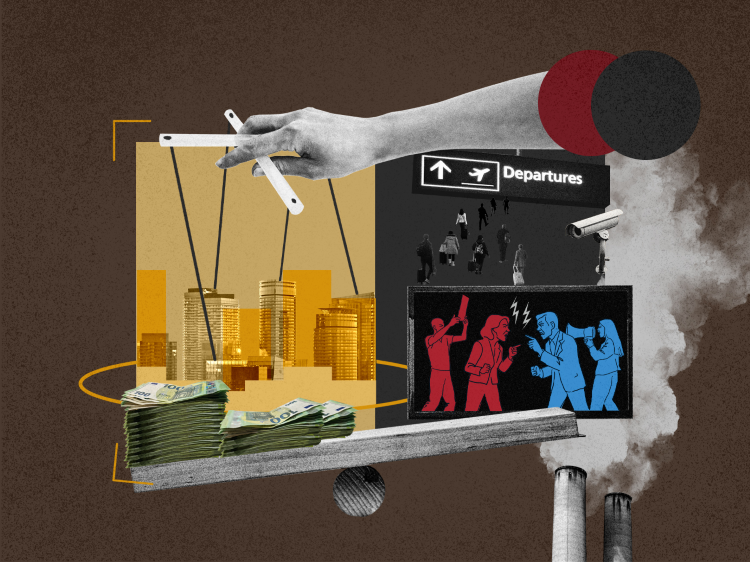
Image credit: Jurgena Tahiri, 2025
Climate disasters are recurring, including flash floods, landslides and smog, as environmental agencies atrophy under bribery and oligarchic control. Organized crime thrives in conditions of economic crisis and hyperinflation, while wealthy families retreat to gated communities guarded by surveillance infrastructure.
3.2. How did we get here?
Beneath the veneer of progress in the region’s capitals—where construction projects projected prosperity—lay hidden a real estate sector that had become a primary vehicle for money laundering. Real estate became one of several sectors hijacked by organized crime and corruption, alongside defence, energy and healthcare. Offshore companies and politically connected firms dominated, while political elites and business leaders used real estate as a convenient means to store illicit wealth and exchange favours.
Easy access to credit and loose lending standards created a bubble in the real estate market, and when it burst, the collapse unleashed a severe economic crisis. Inequality deepened, undermining public confidence in political institutions and democratic governance. While citizens still valued democratic choice, many increasingly questioned its tangible benefits, seeing democracy as ‘for sale’ in a system where wealth secured preferential treatment in courts, favourable media coverage and policy influence.
The oligarchs and politicians who profited from real estate speculation and corrupt deals remained insulated, passing privileges to their children—access to education abroad, lucrative jobs and even political power—while ordinary citizens bore the economic burden, suffering mass foreclosures, evictions and job losses.
The media served as a tool for elite manipulation, amplifying polarization instead of fostering debate. Alongside the lifting of North Macedonia’s moratorium on state-funded ads in private media, governments across the region increasingly rewarded loyal outlets through preferential spending and bought favourable coverage (Media Ownership Monitor 2023; International IDEA 2024a). Whether controlled by corrupt political leaders or owned by oligarchs, most outlets minimized the severity of the economic crisis, helping to deflect demands for elite accountability and preserving status quo power structures. Distinguishing between captured outlets and the few remaining trustworthy independent sources became challenging, fuelling distrust across social groups and deepening social fragmentation. State media framed issues along identity lines, turning political disagreements into existential conflicts.
As a result, the Western Balkans remained in limbo as full EU membership was repeatedly postponed. While the accession process continued on paper, officials avoided meaningful reforms, such as stricter money-laundering regulations and stronger anti-corruption institutions, which would expose them to prosecution. Instead, they feigned modernization to maintain ties with EU circles when convenient, while quietly deepening ties with authoritarian partners. They promoted technological advances and infrastructure projects to present themselves as architects of innovative solutions.
Meanwhile, foreign powers, particularly China, Russia and the United Arab Emirates, extended their influence through strategic investments and political leverage. Projects marketed as economic development or eco-tourism prioritized the interests of political elites and investors, not communities (Transparency International 2025). Hydropower plants in protected areas greenwashed corruption while causing ecological and social harm. Climate disasters, pollution and environmental neglect intensified the region’s struggles, devastating infrastructure, agriculture and tourism. Even initiatives aimed at advancing the green transition, such as lithium-mining projects in Serbia to supply Europe’s market for electric-vehicle batteries, came at the expense of local concerns and overlooked risks of land and water contamination (Balkan Green Energy News 2024; International IDEA 2024b).
Recession, inequalities and a declining quality of life triggered the emigration of young and skilled populations in search of economic opportunities, draining the region of potential agents of change. By 2040 the region’s total population fell to 15.1 million people, from 17.6 million in 2020 (United Nations Population Division 2024). One fifth of the region’s population—primarily from Albania and Bosnia and Herzegovina—was living abroad (Organisation for Economic Co-operation and Development 2022; de Silva 2024). Doctors, journalists and researchers abandoned hopes of transformation at home, leaving ageing communities struggling with dwindling labour forces. Policies to attract workers from outside the region were not implemented in response, nor did governments create incentives for highly skilled citizens to stay.
Superficial judicial and economic reforms and cosmetic leadership changes entrenched stabilitocracies, regimes that project an image of stability to maintain external legitimacy, while prioritizing order over democratic reform (Bieber 2017). The result was a predatory system resistant to change, trapping the region in survival mode.
4.1. What will democracy look like in 2040?
In 2040 the Western Balkans has descended into isolation and despotism. Absolutist rulers command the state, its apparatus serving only their political survival. Although the EU continues to monitor the region from afar and support its dissidents, formal ties have been severed, as the region has decisively turned towards an authoritarian bloc led by China and Russia. With mobility restricted and EU visa requirements being reinstituted, young people find their world narrowing even further. The region has become a Trojan horse within Europe, threatening democratic norms, regional stability and broader security. Amid this climate, an arms race has accelerated across the region, feeding a constant sense of looming destabilization.
A mass youth exodus has hollowed out the region, leaving the countries even more vulnerable and helpless. The youth that remain retreat into whatever escapism they can find for self-preservation, are forced to serve the system to survive or turn to resilient innovation—using digital tools to hack surveillance networks, building mesh systems when the Internet is throttled and running black market digital services to keep communities connected.
The air is thick with smog that stings the lungs. Police and soldiers occupy every corner, reminding everyone of the ruler’s iron authority and standing as stark symbols of control. Conversations are coded, words chosen not for truth but for survival. Citizens must denounce anything labelled ‘extremist’, from forbidden books to identities branded as threats—ethnic, religious, sexual or ideological.
With polarization both within and beyond the region—fuelled by disinformation, nationalism and rivalries of great powers—the Western Balkans has become a geopolitical battleground, where fears of regional and European wars remain omnipresent.
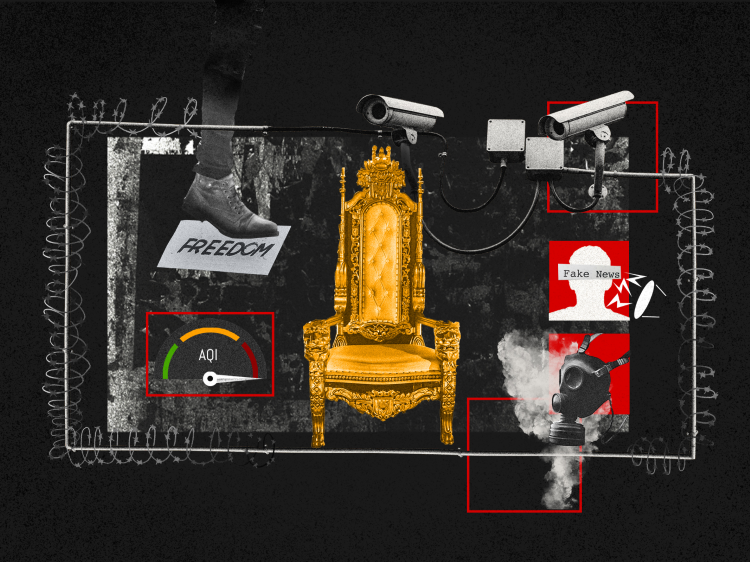
Image credit: Jurgena Tahiri, 2025
4.2. How did we get here?
A catastrophic failure at an old coal plant caused a deadly explosion in one country, despite years of warnings about ageing lignite plants in the region (Open Society Foundations Western Balkans 2024). Similar to the 2014 Stolice events4, a toxic spill from a mining tailings pond contaminated a major river in another country (Morrill 2021). At the same time, a regional currency crisis, triggered by political instability and mounting sanctions, pushed the economy into freefall. These shocks unleashed a mass exodus, leaving behind ageing societies with neither the strength nor the numbers to push for democracy.
While the EU was best placed to assist, EU enlargement fatigue at the time had left the region vulnerable to populist leaders. They used the slow EU responses as fodder for anti-EU and anti-Western narratives, as seen during Covid-19 vaccine diplomacy, exploiting a growing perception that democracy itself was no longer delivering on people’s expectations and framing it as a foreign imposition (Reuters 2021; Kokalari and Yeung 2025). Disillusioned and in response to efficient help from China and Russia in the wake of the disasters, many citizens embraced empty promises of order and decisive action.
The takeover began with public broadcasters, seized under the pretext of cleansing the influence of ‘extreme liberal’ ideologies. Other media soon followed: the state pressured outlets through targeted harassment, replaced independent leadership with loyalists and deployed intrusive spyware against journalists, echoing the Pegasus-style surveillance scandals of the 2020s (International IDEA 2024d). Critical reporting was recast as unpatriotic, helping the ruling elite delegitimize dissent and tighten its grip on the information space (International Federation of Journalists 2023; Gazeta Tema 2025), leaving citizens drowning in disinformation and deepfakes.
Free expression suffered across society, with lesbian, gay, bisexual, transgender and queer (LGBTQ+) communities especially targeted. State-supported violence marked protests for greater rights, leaving many injured and dead. Entrenched homophobia made such tactics easier to normalize and eventually led to such restrictions on other protests and acts of public expression. Regime-planted agents then staged provocations during protests to ‘prove’ that demonstrators were misusing peaceful gatherings to organize EU-backed coups. A handful of dissidents regrouped in political exile, but their reach was limited due to the growing centralization of power, restricted information environments and the targeting of dissidents abroad.
Soon enough, the rulers leveraged crises—from pandemics to isolated cases of foreign conflicts—to declare states of emergency or martial laws that were never lifted. New laws blurred the line between dissent and treason, silencing journalists, civil society and the opposition. Police powers expanded, compounded by foreign-trained paramilitaries and imported surveillance tools, used against anyone seen as unsupportive of official policies. By 2026 cooperation with foreign authoritarian powers was already visible, including reports of Serbian intelligence officers testing sound cannons on dogs with the help of Russia’s notorious security service (CNN 2025; Hajdari 2026). In response to mounting instability and broader security concerns, the EU tightened its own protective measures, reinstating visa requirements and sharply restricting mobility, which left the region increasingly cut off from Europe and deepened its isolation. In this context, it was easy to further suppress ethnic minorities, who were portrayed as risks to national security, given past inter-ethnic tensions. Threats to Women’s rights followed: childbirth incentives masked sexism, paving the way for abortion bans.
While massive highways funded by China through its Belt and Road Initiative were touted as signs of growth, rampant corruption collapsed the economy, which was already suffering due to frozen EU funds, sanctions and investor flight (García-Herrero 2025). As investors fled, growth stalled, with remaining economic activity concentrated in urban centres serving the regime. Elites retreated behind gates of luxury, from where they used their wealth and power to channel access to opportunities for their connections. Rural areas saw agriculture, schools and hospitals collapse, widening inequality. Streets lined with dimly lit apartment blocks, faltering electricity supplies, bread lines and ration cards became the new norm. Food, clothing and medicine were traded in whispers. The world grew increasingly foreign, and those with memories of more hopeful times saved packaging from Western mainstream food products as memorabilia.
To divert attention from domestic failures, legitimize authoritarian rule and preserve a fragile sense of unity, leaders also often exploited ethnic conflicts with neighbouring states. Governments accelerated military procurement—drones, surveillance systems and crowd‑control weapons—fuelling a regional arms race that heightened the risk of confrontation and pushed the spectre of war ever closer. Regional tensions that were present in the 2000s especially between Serbia and Kosovo intensified, and when reinforced by alignment with a non-democratic bloc, made war a looming possibility—whether erupting within the Balkans or escalating into a broader clash with NATO (International IDEA 2023a, 2023b; Gippert 2025).
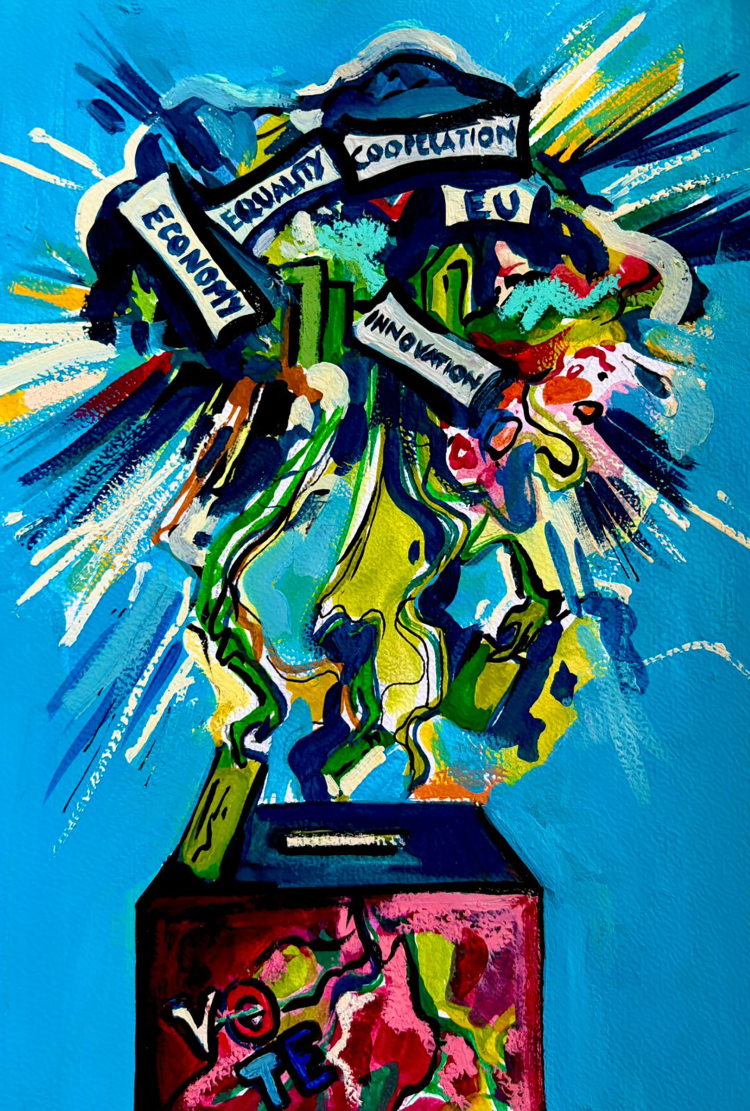
Image credit: Diella Valla, Blooming Future, 2025
The Western Balkans’ democratic resilience is being stress-tested in an era of geopolitical uncertainty. In this environment, exploring possible futures is essential for preparing, acting early and thinking strategically rather than reactively. These strategic foresight scenarios warn that the gap between democratic promise and democratic practice is becoming impossible to ignore.
They also remind us how the region’s path remains tied to geopolitics. Every Western Balkan country has, at least formally, committed to Euro-Atlantic values and EU membership, linking their long-term prospects to the strength of democracy within the EU and its partners. As the first scenario shows, principled EU support can help the region turn into a democratic success story. Yet the second scenario reminds us that the region’s future does not necessarily have to be decided solely in Brussels or Washington. Citizens, grass-roots movements and civil society may drive accountability and renewal from the bottom up.
The scenarios also map out darker paths—a continuation of the status quo defined by deepening stabilitocracy in which entrenched political elites and oligarchs, despite clear democratic deficits, retain power in exchange for some stability, using the EU integration process to simulate reform while dismantling democratic institutions. The bleakest scenario envisions a full authoritarian turn marked by isolation, repression, dismantled rule of law and a geopolitical drift towards authoritarian powers.
These are not abstract speculations, nor do they claim to predict the future. They highlight how today’s signals—from democratic stagnation, unresolved conflict legacies, demographic pressures and intensifying geopolitical competition—might interact, and how sudden shocks can rapidly redirect the region’s trajectory. And while the Western Balkans is far from uniform, the past shows that stability must be achieved across the whole region: turbulence in one corner can quickly spill across borders. History has shown, perhaps most clearly with the outbreak of World War I, that unrest in the Western Balkans rarely remains confined. How the future unfolds may rest on whether Balkan and European leaders take this lesson to heart.
We live in a world where the ‘unimaginable’ keeps happening. Events such as Covid-19 and today’s shifting world order show how quickly what we see as small, isolated signals can snowball into major disruptions that reshape realities. Reflecting on these plausible futures is critical to preparedness. Forward-looking analyses and strategic planning for the long term will help all of us contribute to a democratic future.
Amnesty International, ‘Serbia: BIRN journalists targeted with Pegasus spyware’, 27 March 2025, <https://www.amnesty.org/en/latest/news/2025/03/serbia-birn-journalists-targeted-with-pegasus-spyware>, accessed 3 February 2026
Antanasov, J., ‘From Protest to Parliament: The Political Emergence of Ne Davimo Beograd Ethnography of Entanglement of Individual Self-making and Identity Framing’, Master’s Thesis, Utrecht University, 2024, <https://studenttheses.uu.nl/handle/20.500.12932/45864>, accessed 4 February 2026
Balkan Green Energy News, ‘Jadar project timeline: A full overview of the most controversial investment in Serbia’s recent history’, 20 September 2024, <https://balkangreenenergynews.com/jadar-project-timeline-a-full-overview-of-the-most-controversial-investment-in-serbias-recent-history>, accessed 3 February 2026
Bieber, F., ‘What is a stabilitocracy?’, BiEPAG [blog], 5 May 2017, <https://www.biepag.eu/blog/what-is-a-stabilitocracy>, accessed 5 February 2026
Caulcutt, C., ‘France rejects Trump Gaza peace board invite over fears it wants to supplant UN’, POLITICO, 19 January 2026, <https://www.politico.eu/article/france-rejects-trump-gaza-peace-board-invite-over-fears-it-wants-to-supplant-un>, accessed 3 February 2026
Civil Rights Defenders, ‘Judicial pressure on KRIK is a threat to media freedom in Serbia’, 31 May 2024, <https://crd.org/2024/05/31/judicial-pressure-on-krik-is-a-threat-to-media-freedom-in-serbia>, accessed 3 February 2026
CNN, ‘Sonic weapon allegedly used on crowd protesting government corruption in Serbia’, 4 April 2025, <https://edition.cnn.com/2025/04/04/world/video/sonic-weapon-allegedly-used-on-crowd-protesting-government-corruption-in-serbia-digvid>, accessed 3 February 2026
Coffey, L., ‘Europe must keep focus on Western Balkans’, Hudson, 24 October 2025, <https://www.hudson.org/foreign-policy/europe-must-keep-focus-western-balkans-luke-coffey>, accessed 3 February 2026
Collinson, S., ‘Who can save NATO from Trump as he escalates bid to grab Greenland?’, CNN, 19 January 2026, <https://edition.cnn.com/2026/01/19/politics/nato-division-trump-greenland-threat-analysis>, accessed 3 February 2026
converge2eu, ‘Where the countries stand today – and how long they need to catch up with the EU – in the digitalisation area’, Interactive Database and Dashboard, Vienna Institute for International Economic Studies, [n.d.], <https://converge2.eu/area/digitalisation>, accessed 3 February 2026
Council of the European Union, ‘Statement by President António Costa following the EU-Western Balkans summit’, 17 December 2025, <https://www.consilium.europa.eu/en/press/press-releases/2025/12/17/statement-by-president-antonio-costa-following-the-eu-western-balkans-summit/>, accessed 3 February 2026
de Silva, S., Labour Migration in the Western Balkans: Consequences for the Region’s Democratic Life, Policy Brief (Brussels: Foundation for European Progressive Studies, 2024), <https://feps-europe.eu/wp-content/uploads/2024/04/The-Western-Balkans-labour-migration-1.pdf>, accessed 3 February 2026
European External Action Service, ‘The EU and the Western Balkans: Towards a common future’, 6 February 2025, <https://www.eeas.europa.eu/eeas/eu-and-western-balkans-towards-common-future_en>, accessed 3 February 2026
European Western Balkans, ‘Highest support for EU in Kosovo, lowest in Serbia’, 12 September 2025, <https://europeanwesternbalkans.com/2025/09/12/highest-support-for-eu-in-kosovo-lowest-in-serbia>, accessed 3 February 2026
García-Herrero, A., ‘The EU should have woken up long ago to China’s growing influence in the Western Balkans’, Bruegel [online newsletter], 3 February 2025, <https://www.bruegel.org/newsletter/eu-should-have-woken-long-ago-chinas-growing-influence-western-balkans>, accessed 3 February 2026
Gazeta Tema, ‘Brnabić under fire for racist outburst, calls opposition “Kurti’s heroes”’, 4 March 2025, <https://english.gazetatema.net/kosovo-region/brnabi-sparks-outrage-with-racist-outburst-calls-opposition-kurtis-i338784>, accessed 3 February 2026
Ginter, T. and Hilderbrandt, A., ‘Foreign investors in the Western Balkans: Have China and Russia crowded out the EU?’, Österreichische Nationalbank [blog], 12 February 2025, <https://www.oenb.at/Presse/oenb-blog/2025/2025-02-18-foreign-investors-in-the-western-balkans.html>, accessed 6 February 2026
Gippert, B. J., ‘Bosnia and Herzegovina in crisis as Bosnian-Serb president rallies for secession’, The Conversation, 17 July 2025, <https://doi.org/10.64628/AB.46n3j7uge>
Hajdari, U., ‘Serbia let Putin’s spies zap dogs with “sound cannons”’, POLITICO, 15 January 2026, <https://www.politico.eu/article/serbia-vladimir-putin-documents-intelligence-lrad>, accessed 3 February 2026
Huskić, A., ‘Dodik’s fall: The end of an era?’, Friedrich Naumann Foundation, 13 August 2025, <https://www.freiheit.org/western-balkans/dodiks-fall-end-era>, accessed 3 February 2026
International Federation of Journalists, ‘Serbia: Independent journalism faces biggest crisis in years’, 26 April 2023, <https://www.ifj.org/media-centre/news/detail/article/serbia-independent-journalism-faces-biggest-crisis-in-years>, accessed 3 February 2026
International IDEA, Global State of Democracy Indices, Democracy Tracker, [n.d.], <https://www.idea.int/democracytracker/gsod-indices>, accessed 3 February 2026
—, ‘Emergency measures introduced due to air pollution’, Democracy Tracker, North Macedonia, December 2022, <https://www.idea.int/democracytracker/report/north-macedonia/december-2022?pid=3938>, accessed 3 February 2026
—, ‘Tensions escalate in Serb-dominated northern part of the country’, Democracy Tracker, Kosovo, May 2023a, <https://www.idea.int/democracytracker/report/kosovo/may-2023?pid=4345>, accessed 3 February 2026
—, ‘Police officer killed as Serb gunmen storm Kosovo’, Democracy Tracker, Kosovo, September 2023b, <https://www.idea.int/democracytracker/report/kosovo/september-2023?pid=6796>, accessed 3 February 2026
—, ‘Parliament lifts immunity for former Prime Minister Sali Berisha’, Democracy Tracker, Albania, December 2023c, <https://www.idea.int/democracytracker/report/albania/december-2023?pid=6937>, accessed 3 February 2026
—, ‘Parliament passes amendments allowing state funded ads in private media’, Democracy Tracker, North Macedonia, February 2024a, <https://www.idea.int/democracytracker/report/north-macedonia/february-2024?pid=7096>, accessed 3 February 2026
—, ‘Revived lithium-mining project causes mass protest’, Democracy Tracker, Serbia, August 2024b, <https://www.idea.int/democracytracker/report/serbia/august-2024?pid=7476>, accessed 3 February 2026
—, ‘Prime Minister announces one-year TikTok ban’, Democracy Tracker, Albania, December 2024c, <https://www.idea.int/democracytracker/report/albania/december-2024?pid=7787>, accessed 3 February 2026
—, ‘Report reveals authorities’ use of spyware against journalists and activists’, Democracy Tracker, Serbia, December 2024d, <https://www.idea.int/democracytracker/report/serbia/december-2024?pid=7799>, accessed 3 February 2026
—, ‘Protests, road blockades and strikes against corruption; PM resigns’, Democracy Tracker, Serbia, January 2025a, <https://www.idea.int/democracytracker/report/serbia/january-2025?pid=7844>, accessed 3 February 2026
—, ‘Deadly Kočani nightclub fire sparks outrage over alleged systemic failures’, Democracy Tracker, North Macedonia, March 2025b, <https://www.idea.int/democracytracker/report/north-macedonia/march-2025>, accessed 3 February 2026
Jovanovski, B., ‘Brain drain in Western Balkans spikes amid absence of opportunities’, Euro News, 16 September 2024, <https://www.euronews.com/my-europe/2024/09/16/brain-drain-in-western-balkans-spikes-amid-absence-of-opportunities>, accessed 3 February 2026
Kokalari, A. and Yeung, T. Y.-C., ‘Selective reception of external strategic narratives: Vaccine diplomacy in the Western Balkans during the COVID-19 pandemic’, European Politics and Society, 26/4 (2025), pp. 899–917, <https://doi.org/10.1080/23745118.2024.2421909>
Kurtic, A., Tesija, V. and Isufi, P., ‘“Where are our loved ones?” Bosnia, Croatia, Kosovo mark Missing Persons Day’, BIRN, 30 August 2024, <https://balkaninsight.com/2024/08/30/where-are-our-loved-ones-bosnia-croatia-kosovo-mark-missing-persons-day>, accessed 3 February 2026
Media Ownership Monitor, ‘Pro-govt media make the biggest bucks’, BIRN Serbia, last updated 30 November 2023, <https://serbia.mom-gmr.org/en/findings/local-media-concentrations-below-the-radar>, accessed 5 February 2026
Mirëdita, About, [n.d.], <https://mireditadobardan.com/en/home>, accessed 3 February 2026
Morrill, J., ‘History of mine waste failures in Serbia sheds light on new threats’, Earthworks [blog], 25 February 2021, <https://earthworks.org/blog/history-of-mine-waste-failures-in-serbia-sheds-light-on-new-threats>, accessed 3 February 2026
Open Society Foundations Western Balkans, Decarbonization for Energy Security in the Western Balkans, 26 June 2024, <https://osfwb.org/project/decarbonization-for-energy-security-in-the-western-balkans/>, accessed 3 February 2026
Organisation for Economic Co-operation and Development, ‘Labour Migration in the Western Balkans: Mapping Patterns, Addressing Challenges and Reaping Benefits’, 16 May 2022, <https://www.oecd.org/content/dam/oecd/en/about/programmes/grc/grc-see/Labour-Migration-report.pdf>, accessed 3 February 2026
Rasmussen, R. and Benson, R., ‘Beyond participation trophies: The EU’s credibility crisis in the Western Balkans’, Euractiv, 6 October 2025, <https://www.euractiv.com/opinion/beyond-participation-trophies-the-eus-credibility-crisis-in-the-western-balkans>, accessed 3 February 2026
Reuters, ‘Serbia becomes first European country to use Chinese COVID vaccine for mass rollout’, Voice of America, 19 January 2021, <https://www.voanews.com/a/europe_serbia-becomes-first-european-country-use-chinese-covid-vaccine-mass-rollout/6200928.html>, accessed 3 February 2026
Ross, T., ‘Trump’s Greenland threats push Europe toward divorcing America’, POLITICO, 19 January 2026, <https://www.politico.eu/article/donald-trump-greenland-tariff-threats-tensions-push-europe-allies-toward-divorcing-america-transatlantic-power>, accessed 3 February 2026
Sarajevo Times, ‘Provocations in Srebrenica on the 30th anniversary of the genocide’, 12 July 2025, <https://sarajevotimes.com/provocations-in-srebrenica-on-the-30th-anniversary-of-the-genocide>, accessed 3 February 2026
Spasojević, D., ‘From radical to mainstream: The ruling populists in Serbia’, The Loop [European Consortium for Political Research blog], 6 February 2024, <https://theloop.ecpr.eu/from-radical-to-mainstream-the-ruling-populists-in-serbia>, accessed 3 February 2026
Stoimenova, M., ‘Neighbourly conflicts hinder North Macedonia at the gates of the EU’, Euronews, 31 October 2025, <https://www.euronews.com/2025/10/31/neighbourly-conflicts-hinder-north-macedonia-at-the-gates-of-the-eu>, accessed 3 February 2026
Todorović, I., ‘Voltalia breaks ground in Albania for biggest solar park in Western Balkans’, Balkan Green Energy News, 1 July 2022, <https://balkangreenenergynews.com/voltalia-breaks-ground-in-albania-for-biggest-solar-park-in-western-balkans>, accessed 3 February 2026
Transparency International, ‘Urgent concerns regarding the Montenegro–UAE agreement on tourism and real estate development’, 28 May 2025, <https://www.transparency.org/en/press/urgent-concerns-regarding-the-montenegro-uae-agreement-on-tourism-and-real-estate-development>, accessed 5 February 2026
United Nations Population Division, World Population Prospects 2024, 2024, <https://population.un.org/wpp/downloads?folder=Standard%20Projections&group=Most%20used>, accessed 3 February 2026
Vasiljević, J., ‘A shapeshifting movement’, Green European Journal, 28 September 2022, <https://www.greeneuropeanjournal.eu/a-shapeshifting-movement>, accessed 3 February 2026
Vienna Institute for International Economic Studies, ‘Bridging the gap: converge2eu tracks Western Balkans’ road to EU prosperity’, 9 October 2025, <https://wiiw.ac.at/bridging-the-gap-converge2eu-tracks-western-balkans-road-to-eu-prosperity-n-696.html>, accessed 4 February 2026
Wankiewicz-Kłoczko, P., ‘The vanishing Balkans: The region’s demographic crisis’, Centre for Eastern Studies, 5 March 2025, <https://www.osw.waw.pl/en/publikacje/osw-commentary/2025-03-05/vanishing-balkans-regions-demographic-crisis>, accessed 3 February 2026
White House, The, ‘Fact Sheet: President Donald J. Trump withdraws the United States from international organizations that are contrary to the interests of the United States’, 7 January 2026, <https://www.whitehouse.gov/fact-sheets/2026/01/fact-sheet-president-donald-j-trump-withdraws-the-united-states-from-international-organizations-that-are-contrary-to-the-interests-of-the-united-states>, accessed 2 February 2026
Ana Kovacevic Kadovic, National Democratic Institute Senior Director in Albania
Besar Likmeta, Editor in Chief, BIRN Albania
Blerta Hoxha, Programme Manager, Western Balkans, Regional Europe Programme, International IDEA
Bojana Pravilović, Researcher, Institute Alternative
Diella Valla, Visual Artist/Painter
Dobrica Veselinović, member of the Green Left Front (Zeleno-levi-front)
Dženeta Karabegović, Associate Professor, Department of Sociology and Human Geography, University of Salzburg
Eckhard Störmer, Futurist and Senior Foresight Manager, Future Impacts
Emily Bloom, Associate Programme Officer, Democracy Assessment, International IDEA
Gentiana Gola, Advisor, Democracy Assessment, International IDEA
Ilir Alimehmeti, Head of DP City Councillors of Tirana, Democratic Party of Albania
Jessica Prendergast, Foresight Lead, Future Impacts
Kristina Voko, Executive Director, BIRN Albania
Lura Limani, Team Lead/Kosovo Director, Open Society Foundations–Western Balkans
Lura Pollozhani, Researcher, Centre for Southeast European Studies, University of Graz
Massimo Toschi, International Relations Officer, Institutional Cooperation and EU Charter Unit, European Union Agency for Fundamental Rights
Michele Poletto, Advisor, Climate Change and Democracy, International IDEA
Seema Shah, Head of Democracy Assessment, International IDEA
Stefan Dimkovski, Project Assistant, European Movement North Macedonia
Zlatko Minic, Researcher and Board Member, Transparency International Serbia
- Ne Davimo Beograd is a grass-roots civic movement formed in 2014 that emerged from protests against the Belgrade Waterfront luxury development project and grew into a broader platform advocating for improved living and working conditions, natural resource conservation and sustainable urban development.
- Organized by the Youth Initiative for Human Rights in Belgrade annually since 2014, the festival aims to promote regional cooperation and peacebuilding by merging art, culture, advocacy and public debate and by bringing together artists, human rights and peace activists and opinion makers from Kosovo and Serbia. The festival was banned by Serbian authorities in 2024 and resumed in Prishtina in 2025.
- Horizon Europe is an EU funding programme for research and innovation.
- The Stolice mine in Serbia experienced a major failure of its mining waste storage facility following severe weather and flooding, releasing toxic material into the Kostajnicka River.
Abbreviations
| BIRN | Balkan Investigative Reporting Network |
|---|---|
| NATO | North Atlantic Treaty Organization |
The paper was written by Gentiana Gola and Emily Bloom and was reviewed by Katarzyna Gardapkhadze, Seema Shah, Alexander Hudson and Blerta Hoxha. Additional feedback was provided by Dženeta Karabegović and Ana Kovacevic Kadovic.
We are grateful to our colleagues in International IDEA’s Regional Europe Programme and at the Balkan Investigative Reporting Network Albania, whose support helped with the conceptualization of this paper.
The paper was developed as follow-up to the Western Balkans Democratic Futures workshop held in Albania in October 2025, which was organized by International IDEA with the support of the Balkan Investigative Reporting Network Albania, and facilitated by Future Impacts.
The paper is based on the insightful and creative contributions of the workshop participants (see Annex A for a list of participants). Their invaluable work and insights informed the paper, but the views expressed herein should not be understood as representing the participants’ opinions.
The paper also features original artwork by artists from the region: the paintings are by Diella Valla, and each scenario described in the paper is accompanied by a collage created by Jurgena Tahiri.
About the authors
Gentiana Gola is an Advisor for Europe in the Democracy Assessment team at International IDEA. Her role focuses on research and analysis, communication, outreach and coordination in support of the Global State of Democracy programme. Prior to joining International IDEA, Gentiana worked in the Democratization Department at the Organization for Security and Co-operation
in Europe’s Mission in Kosovo, where she focused on promoting representative participation, especially for women, youth and non-majority communities. She also has experience in the civil society sector, where she contributed to project management and coordination at the Kosovar Centre for Gender Studies and the Balkans Policy Research Group. Additionally, Gentiana served in the public sector at Kosovo’s Ministry for European Integration. During her studies, she worked in media and communications. Gentiana is a Swedish Institute scholar and holds an MSc in Political Science from the University of Gothenburg.
Emily Bloom is an Associate Programme Officer in the Democracy Assessment team at International IDEA. Her work focuses on providing research, analysis and communications support within the Global State of Democracy Programme. Emily has previous experience in the fields of sustainable development, trade policy and innovation. She worked as a consultant supporting technical cooperation contracts in the research and development department of a technology firm. She also worked as part of the fund management team for the Trade and Investment Advocacy Fund which supports participation in international trade negotiations. Emily also worked as a Project Officer at the International Centre for Trade and Sustainable Development in Geneva. She holds an MSc in Computer Science from Bristol University and an MSc in International Political Economy from the London School of Economics.


© 2026 International Institute for Democracy and Electoral Assistance
International IDEA publications are independent of specific national or political interests. Views expressed in this publication do not necessarily represent the views of International IDEA, its Board or its Council members.
With the exception of any third-party images and photos, the electronic version of this publication is available under a Creative Commons Attribution-NonCommercial-ShareAlike 4.0 (CC BY-NC-SA 4.0) licence. You are free to copy, distribute and transmit the publication as well as to remix and adapt it, provided it is only for non-commercial purposes, that you appropriately attribute the publication, and that you distribute it under an identical licence. For more information visit the Creative Commons website:
<http://creativecommons.org/licenses/by-nc-sa/4.0>.
International IDEA
Strömsborg
SE–103 34 Stockholm
SWEDEN
Tel: +46 8 698 37 00
Email: info@idea.int
Website: <https://www.idea.int>
Illustrations: Cover and pages 3, 7 and 27 by Diella Valla; pages 10, 15, 19 and 23 by Jurgena Tahiri.
Design and layout: International IDEA
Copyeditor: Curtis Budden
DOI: <https://doi.org/10.31752/16088>
ISBN: 978-91-8137-106-2 (PDF)
ISBN: 978-91-8137-107-9 (HTML)


