


Democracy as Engine of Social Development and Shared Prosperity
An Overview of Evidence and Pathways

This report was initially written to inform the World Summit for Social Development held in Doha in 2025. Its Political Declaration reaffirmed democracy as essential to social development 30 years after the Copenhagen Declaration was adopted in 1995. This report, drawing on data from International IDEA’s Global State of Democracy (GSoD) Indices and a review of scholarly work, finds that democracy remains a powerful enabler of inclusive and equitable social development and shared prosperity.
The report finds that:
- Democracies perform better than non-democracies on key social development and prosperity indicators. On average, measures of Political Equality, such as Gender, Economic and Social Group Equality (key to social development and shared prosperity), are around 40–47 per cent higher in democracies (across all levels of democratic performance); Basic Welfare is roughly 30 per cent higher; and corruption levels are about 50 per cent lower.
- The quality of democracy matters. In high-quality democracies, the differences are even starker: levels of Basic Welfare are about 66 per cent higher; levels of Gender Equality, Social Group Equality and Economic Equality are over twice as high; and levels of corruption are 90 per cent higher in non-democracies compared to high-quality democracies.
- Rule of law is essential for social development and prosperity. An analysis of the correlations between the 29 GSoD measures and social development outcomes shows that governance and rule of law are most strongly positively correlated with Basic Welfare and Economic Equality.
- Democratic representation matters for how inclusively those gains are shared. Procedural dimensions of democracy—elections and effective parliaments and rights protection—show stronger correlations with Gender and Social Group Equality, underscoring that governance may matter for basic welfare and fairness, but that democratic representation and rights are critical in determining how evenly and inclusively those prosperity gains are shared.
- Democratization drives progress in social development and prosperity, while democratic decline reverses these gains. Drawing on scholarly studies, the report shows that when societies democratize, they tend to experience stronger economic growth, increased social spending, and improved social development outcomes, while autocratization or democratic decline typically reverses these gains, eroding prosperity and social development progress.
- The evidence rejects the notion of an ‘authoritarian advantage’. Non-democratic regimes that have achieved substantial social development outcomes and prosperity are empirical outliers. Of 74 countries without democratic elections, only five have high Basic Welfare (Belarus, Kuwait, Qatar, Singapore, and the United Arab Emirates), two have high levels of Gender Equality (Cuba and Serbia), one exhibits low corruption (Singapore), and none reach high levels of Economic or Social Group Equality. Even China, often presented as an authoritarian success model, ranks only mid-range across all measures.
- Not all democracies deliver for their people. Despite strong correlations between specific dimensions of democracy and social development and prosperity outcomes, the relationship is neither deterministic nor uniformly causal. Democratic governance does not inherently or consistently guarantee positive development results. Empirical evidence shows that a number of democratically elected governments struggle to deliver social development and prosperity for their citizens.
- Perceived failure of democracies delivering is linked to declining trust in democracy. While democracy is an enabler of social development and shared prosperity, when it fails to deliver, trust in democratic institutions can erode, undermining the social contract and fuelling support for authoritarian alternatives. Public opinion data across regions shows that waning support for democracy often stems from perceptions of its failure to deliver social progress and shared prosperity.
In 1995, at the World Summit for Social Development in Copenhagen, global leaders affirmed that ‘democracy and transparent and accountable governance and administration in all sectors of society are indispensable foundations for the realization of social and people-centred sustainable development’ (United Nations 1995). This declaration enshrined democracy as a pillar of social development, asserting its intrinsic connection to inclusive governance and equitable progress.
Thirty years later, this vision has been reaffirmed with new urgency. In a groundbreaking step, the Political Declaration that was adopted at the 2025 World Summit for Social Development in Doha once again explicitly recognizes democracy as essential to social development. In the declaration, United Nations member states commit to ‘a political, economic, ethical and spiritual vision for social development that is based on human dignity, human rights, equality, respect, peace, democracy’. They further pledge to achieve social development for all by ‘upholding democracy, the rule of law, good governance and access to justice, combatting all forms of corruption’ (UN General Assembly 2025). This explicit reference to democracy, after years of absence in UN declarations, marks a historic reaffirmation that democracy is an indispensable foundation for people-centred, sustainable social development.
This recognition comes at a critical juncture. Democratic backsliding is accelerating globally, and Sustainable Development Goal (SDG) 16 on peace, justice and strong institutions remains off track in many regions (Silva-Leander and Sourek 2025; International IDEA 2025; UN General Assembly 2025). Progress on critical social development outcomes, such as health, education, poverty reduction, gender and social group equality, employment and economic equality, remains uneven and insufficient in many places, placing the achievement of the 2030 Agenda at serious risk (UN DESA 2025). Recent events, including massive foreign aid cuts, the United States’ withdrawal from the 2030 Agenda, and rising conflicts, risk further stalling progress (Global Democracy Coalition, International IDEA and IFES 2025).
This report argues that social development underpins prosperity by expanding human capabilities, reducing inequality, and fostering stable, productive societies where economic growth is both inclusive and sustainable. It takes the Copenhagen and Doha Declarations’ explicit recognition of democracy as its point of departure and demonstrates, through empirical evidence and analysis, why democracy is indispensable to social development and shared prosperity, thereby grounding the declarations in evidence. Drawing on International IDEA’s Global State of Democracy (GSoD) Indices and scholarly studies, the report analyses the correlations between democracy and social development outcomes and traces the pathways through which democracy enables social progress. The analysis applies International IDEA’s conceptual framework, which defines democracy through four interdependent building blocks:1 Representation, Rights, Rule of Law and Participation. These building blocks also underpin SDG 16.
The findings confirm that democracy is a powerful enabler of inclusive and equitable social development and shared prosperity. The analysis also highlights a reciprocal relationship: stronger democracies are more likely to guarantee equitable access to welfare and promote social inclusion. And public satisfaction with social development outcomes reinforces legitimacy and trust in democracy. Conversely, when social development falters, democratic legitimacy and trust tend to erode, undermining the social contract and fuelling support for authoritarian alternatives. Yet democracy is not a guarantee of social development, and outcomes vary significantly across contexts and income levels. Instances of non-democratic regimes achieving substantial social development outcomes are, however, empirical outliers. More commonly, such regimes fall short on these outcomes.
The report concludes that advancing democracy, social development and shared prosperity in tandem as part of the social contract is vital for carrying forward the legacy of Copenhagen, for honouring the landmark recognition of democracy in the Doha Declaration and for achieving the 2030 Agenda. The Doha Declaration’s explicit commitment to democracy provides a renewed normative and political foundation, reminding the international community that meaningful progress remains possible when democracy, social development and prosperity are advanced together.
1.1. Indicators of democracy, SDG 16 and social development
The 1995 Copenhagen Declaration states that sustainable development rests on three interdependent pillars—social development, economic development and environmental protection. It frames social development as both outcome and process— equitable gains in health and education, lasting poverty reduction and decent work for all, achieved via the fair distribution of opportunities and resources, accountable and transparent governance, democratic participation and inclusive, rights-based institutions (United Nations 1995).
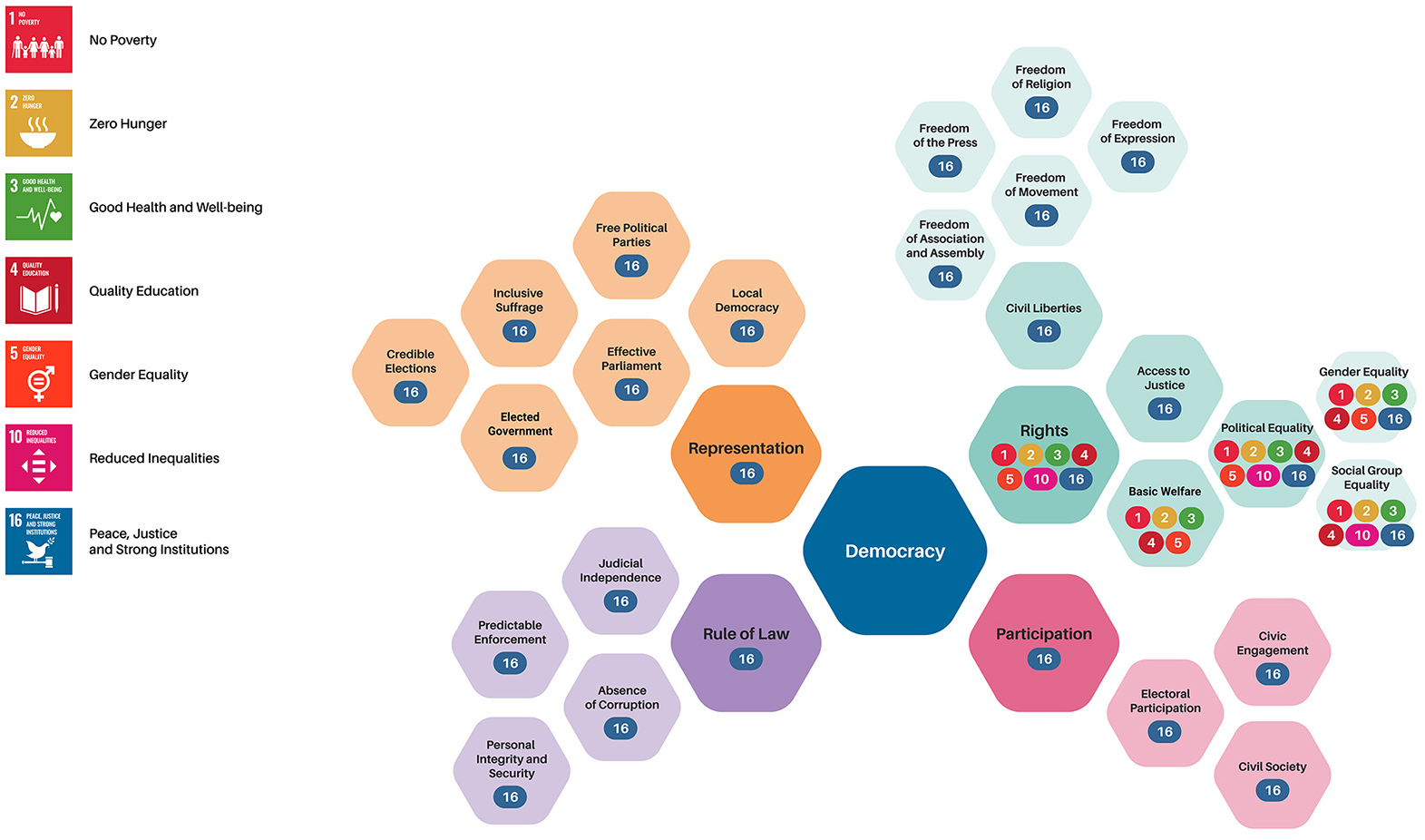
Grounded in the Universal Declaration of Human Rights, the GSoD framework considers social and economic rights a key dimension of democracy, therefore helping to assess democratic quality and some dimensions of social development and their relationship through the four democratic building blocks of Representation, Rights, Rule of Law and Participation (see Figure 1.1). The GSoD Indices measure progress on seven SDGs, all of which cover key dimensions of social development—poverty (SDG 1), hunger (SDG 2), health (SDG 3), education (SDG 4), gender equality (SDG 5), inequality (SDG 10), and six targets related to peace, justice and strong institutions (SDG 16) (see Figure 1.1 and Box 1.1) (International IDEA 2023).
Some of the GSoD Indices capture social development outcomes—notably the social rights–related measure of Basic Welfare, which aggregates data on health, education and nutrition. The Rights subfactors of the Political Equality factor (Gender, Social Group and Economic Equality) assess equality outcomes such as intergroup and gender equality and the degree of economic, social and political discrimination and exclusion based on gender, socio-economic status or social identity. Others measure social development–related processes or enablers such as Rule of Law and Absence of Corruption (Table 1.1).
This report uses these five measures as proxies for outcome and process-oriented social development indicators to assess their correlation strength with the 29 GSoD democracy indicators and identify the most significant relationships. This analysis is complemented with evidence from scholarly literature, which it also draws on to delineate the causal pathways underlying these associations. The literature extends the analysis to additional dimensions of social development not captured by the GSoD Indices, including broader access to social services, poverty reduction and economic growth.

Box 1.1. International Global State of Democracy Indices: Framework, SDG 16 and social development indicators
International IDEA’s Global State of Democracy (GSoD) Indices assess democratic performance across four building blocks—Representation, Rights, Rule of Law and Participation—based on 29 Indices aggregated from 154 source indicators and 22 data sources. The Indices cover 174 countries from 1975 through 2024 and score each dimension from 0 to 1, with three performance tiers—low (0.0–0.4), mid-range (0.4–0.7) and high (0.7–1.0).
The GSoD Indices provide data for 6 of the 12 targets of SDG 16 (16.1, 16.3, 16.5, 16.6, 16.7 and 16.10), across all four GSoD dimensions:
- Representation. Credible Elections, Inclusive Suffrage, Free Political Parties, Elected Government, Effective Parliament and Local Democracy (SDG targets 16.6 and 16.7). These measures focus on the quality of representative democracy.
- Rights. Civil Liberties, including Freedoms of Expression, Press, Assembly, Religion and Movement (SDG targets 16.3, 16.7 and 16.10).
- Rule of Law. Judicial Independence, Absence of Corruption, Predictable Enforcement, and Personal Integrity and Security (SDG targets 16.1, 16.3, 16.5, 16.6, 16.7 and 16.10). These measures assess governance-related dimensions: how power is exercised, how policies are made and how resources are managed.
- Participation. Citizen participation in elections and through civil society (SDG targets 16.6 and 16.7).
Social development outcome indicators in GSoD Indices | Sources and what they measure | SDGs | Other democracy measures in GSoD Indices (social development enablers) | What they measure | SDGs and targets |
|---|---|---|---|---|---|
(Social) Rights: Basic Welfare | Indicators on health equality, infant mortality, life expectancy, nutrition and years of schooling aggregated from United Nations, World Health Organization and Institute for Health Metrics and Evaluation data sets. | SDG 2: Nutrition SDG 3: Health SDG 4: Education | Representation | Credible Elections, Inclusive Suffrage, Free Political Parties, Elected Government, Effective Parliament and Local Democracy These measures focus on the quality of representative democracy. | SDG 16.6 SDG 16.7 |
Rights: Political and Economic Equality | Aggregated from eight different data sets to assess political equality between social groups and genders and the extent of discrimination and exclusion due to gender, economic status or social identity. | SDG 1: Poverty SDG 10: Inequality | Rights: Civil Liberties | Civil Liberties, including Freedoms of Expression, Press, Assembly, Religion and Movement | SDG 16.3 SDG 16.7 SDG 16.10 |
Gender Equality | The GSoD Gender Equality score draws on 11 indicators from six sources—including Varieties of Democracy | SDG 5: Gender Equality | Rights: Access to Justice | Gender-equal and effective access to justice, the incidence of judicial corruption, accountability for judicial misconduct, and the de facto realization of fair-trial guarantees, due process and civil rights protections | SDG 16.3 |
Social Group Equality | Measures intergroup equality in rights and power: whether civil liberties are enjoyed equally across social groups; the extent to which political power is structured by social identity (including sexual orientation); the degree of political exclusion by political or social group; and whether equal treatment under the law and equality of opportunity (in education, public office, employment and anti-discrimination protections) are effectively guaranteed. | SDG 10: Inequality | |||
Economic Equality | Captures socio-economic equality and exclusion in rights and politics—parity of civil liberties across classes, distribution of political power, political exclusion by class and urban–rural location, the structural depth of poverty and inequality, and overall income inequality. | SDG 10: Inequality | |||
Rule of Law: Absence of corruption | Assesses the incidence and systemic entrenchment of corruption—bribery, kickbacks, embezzlement and theft—across the public sector and the executive, the breadth of patronage and state–business collusion, the strength of institutional safeguards against official corruption, and the credibility of enforcement through prosecution and public accountability. | SDG 16.5 | Rule of Law | Judicial Independence, Predictable Enforcement, and Personal Integrity and Security | SDG 16.1 SDG 16.3 SDG 16.6 SDG 16.7 SDG 16.10 |
1.2. Democracy and social development: Evidence from the GSoD indices
There is both a normative and an empirical case that democracy matters for social development. Democracy, through representative institutions, rights protection, rule of law and citizen participation (all central to SDG 16), provides the foundation for advancing equitable access and outcomes in health, education, equality, poverty reduction and the Sustainable Development Goals (Cram 2024). The GSoD Indices empirically confirm that democracies are more likely to create the conditions necessary for inclusive social development compared with non-democratic regimes. On average, Gender, Economic and Social Group Equality is around
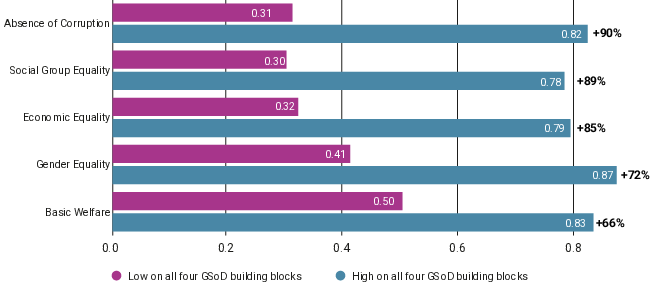
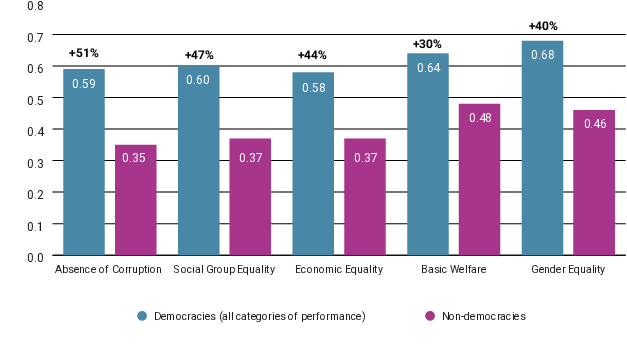
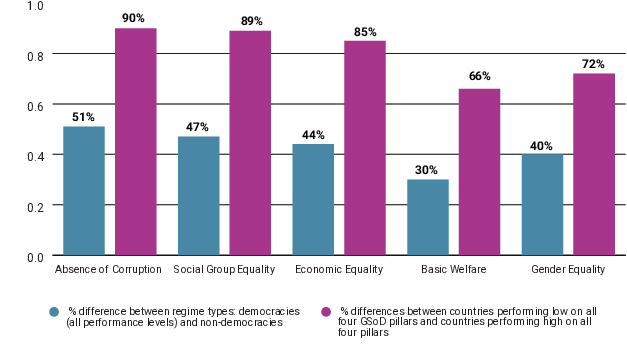
The evidence shows that democracies in general outperform authoritarian regimes on social development, with some exceptions. The data shows no support for the ‘authoritarian advantage’ narrative (Siegle 2024). High-performing autocracies are rare outliers, not the norm. Of the 74 countries without democratic elections, only five have high levels of Basic Welfare (Belarus, Kuwait, Qatar, Singapore and the United Arab Emirates), only two have high levels of Gender Equality (Cuba and Serbia), only one has low levels of Corruption (Singapore), and none have high levels of Economic or Social Group Equality. China, which often projects itself as an authoritarian governance success model (Siegle 2024), falls in the mid-range on all these indicators and is thus not a high performer by any of these measures.
Disaggregating the building blocks of democracy reveals that different aspects matter for different dimensions of social development. Analysis of the 29 GSoD measures reveals that governance and rule of law are most strongly linked to Basic Welfare and Economic Equality, with the highest positive correlations observed for Absence of Corruption (SDG target 16.5) (0.75 and 0.84 on a scale of 0 to 1) and Predictable Enforcement (0.72 and 0.84) (SDG target 16.3) (see Table 1.2). Procedural dimensions—elections, parliament and rights (SDG targets 16.7, 16.10)—show weaker correlations. This finding reflects the role of the rule of law in ensuring transparent and equitable resource allocation, safeguarding accountability and protecting service delivery from corruption or clientelism (Lo Bue, Sen and Lindberg 2021). However, Rule of Law, Representation and Rights indicators show strong positive correlations with Gender and Social Group Equality, highlighting that inclusive social development and shared prosperity depend not only on good governance but also on democratic institutions and rights protection. Table 1.2 illustrates this dual influence: Rule of Law indicators like Predictable Enforcement and Judicial Independence correlate strongly with Social Group Equality (0.88 and 0.84) and Gender Equality (0.78 and 0.72), while Rights and Representation indicators—such as Access to Justice (0.89 for Social Group Equality), Civil Liberties (0.84 for Social Group Equality), Credible Elections (0.76 for Gender Equality), and Elected Government (0.75 for both Social Group Equality and Gender Equality)—also show robust links.
| Basic Welfare | Social Group Equality | Economic Equality | Gender Equality | ||
|---|---|---|---|---|---|
| Representation | Credible Elections | 0.56 | 0.78 | 0.67 | 0.76 |
| Inclusive Suffrage | 0.31 | 0.49 | 0.39 | 0.56 | |
| Free Political Parties | 0.43 | 0.76 | 0.58 | 0.69 | |
| Elected Government | 0.51 | 0.75 | 0.63 | 0.75 | |
| Effective Parliament | 0.50 | 0.76 | 0.64 | 0.74 | |
| Local Democracy | 0.52 | 0.76 | 0.65 | 0.71 | |
| Rights | Access to Justice | 0.65 | 0.89 | 0.83 | 0.75 |
| Civil Liberties | 0.47 | 0.84 | 0.66 | 0.72 | |
| Freedom of Expression | 0.44 | 0.81 | 0.64 | 0.70 | |
| Press Freedom | 0.41 | 0.78 | 0.61 | 0.67 | |
| Freedom of Association and Assembly | 0.48 | 0.82 | 0.66 | 0.69 | |
| Freedom of Religion | 0.29 | 0.68 | 0.48 | 0.64 | |
| Freedom of Movement | 0.55 | 0.86 | 0.71 | 0.77 | |
| Basic Welfare | 1.00 | 0.69 | 0.79 | 0.63 | |
| Gender Equality | 0.63 | 0.85 | 0.79 | 1.00 | |
| Political Equality | 0.73 | 0.99 | 0.94 | 0.88 | |
| Social Group Equality | 0.69 | 1.00 | 0.89 | 0.85 | |
| Economic Equality | 0.79 | 0.89 | 1.00 | 0.79 | |
| Rule of Law | Judicial Independence | 0.54 | 0.84 | 0.72 | 0.72 |
| Absence of Corruption | 0.75 | 0.83 | 0.84 | 0.75 | |
| Predictable Enforcement | 0.72 | 0.88 | 0.84 | 0.78 | |
| Personal Integrity and Security | 0.67 | 0.88 | 0.80 | 0.76 | |
| Participation | Civil Society | 0.45 | 0.81 | 0.69 | 0.72 |
| Civic Engagement | 0.29 | 0.59 | 0.48 | 0.52 | |
| Electoral Participation | 0.37 | 0.42 | 0.33 | 0.47 |
Despite strong correlations between specific dimensions of democracy and social development outcomes, the relationship is neither deterministic nor uniformly causal. Democratic governance does not inherently or consistently guarantee positive development results. Empirical evidence shows that many democratically elected governments struggle to deliver social development for their citizens, including reducing corruption, advancing gender equality, addressing socio-economic and political inequalities, and fostering sustained employment and economic growth (Fukuyama, Dann and Magaloni 2025).
Public opinion data also shows that a lack of perceived delivery to citizens on social development and prosperity can contribute to declining trust in democracy (Fukuyama, Dann and Magaloni 2025). The 2024 Afrobarometer shows that, while a strong majority of Africans (66 per cent) continue to prefer democracy, satisfaction with its performance has declined sharply, with only 37 per cent expressing contentment. This erosion of trust is closely tied to perceptions of corruption, poor election quality and unresponsive governance. Although most Africans reject authoritarian rule in principle, many express conditional support for non-democratic alternatives when democratic leaders are perceived as failing to deliver (Afrobarometer 2024).
A 2023 study by the UN Development Programme suggests that rising support for coups in parts of Africa is driven by a deepening crisis of trust in governments, especially among youth, who see elected leaders as failing to deliver inclusive development, curb corruption or address insecurity. This disillusionment—amplified by economic hardship and global shocks—has fuelled a perception that authoritarian and military alternatives may be more effective in delivering results (UNDP 2023).
Similarly, a 2023 Americas Barometer study shows that support for democracy in Latin America and the Caribbean declined from 68 per cent in 2004 to 59 per cent in 2023 due to widespread distrust in political institutions, persistent corruption, worsening economic conditions and growing insecurity—leading many to doubt that democratic systems can effectively meet their needs or uphold justice (Lupu et al. 2023).
Even in high-income countries, satisfaction with democracy has declined (from 49 per cent in 2017 to 35 per cent in 2025). In the 12 countries studied by the Pew Research Center (Canada, France, Germany, Greece, Italy, Japan, the Netherlands, South Korea, Spain, Sweden, the United Kingdom and the USA), more people were dissatisfied with democracy (64 per cent) than satisfied. Perceptions about weak socio-economic performance drive this dissatisfaction (Wike, Fetterolf and Schulman 2025).
In a study conducted by the Center on International Cooperation, an absolute majority of respondents in all but one of the countries surveyed felt like not enough was being done to address societal divisions (Pathfinders for Peaceful, Just and Inclusive Societies and Center for International Cooperation 2021). When the Pew Research Center survey asked what would strengthen respondents’ support for democracy, they pointed to social development outcomes—more jobs, lower prices, better allocation of public funds and improved infrastructure such as roads, hospitals, water, electricity and schools (Wike et al. 2024). Hence, democracy is an enabler of social development, but when it is perceived as failing to deliver, trust in democratic institutions can erode, weakening the social contract and fuelling support for authoritarian alternatives.
There is robust scholarly evidence that democracy and democratization foster inclusive institutions that significantly improve social development outcomes and shared prosperity, such as health, education, employment, equality and economic growth (see also Tudor 2025 and V-Dem 2023). A key study by Acemoglu and Robinson (2012) shows that countries transitioning to democracy experience long-term economic growth—up to 20 per cent higher GDP per capita within 25 years, driven by increased investments in health, education and capital. Another study shows that democratic transitions lead to a doubling of social protection spending, improved government transparency and better targeting of welfare policies, which helps reduce inequality (Murshed et al. 2022; Pathfinders for Peaceful, Just and Inclusive Societies and Center for International Cooperation 2021). Evidence also shows that education outcomes in democratizing countries tend to rise, experiencing sharp increases in secondary school enrolment, with public spending shifting towards primary education, particularly benefiting rural and low-income populations (Acemoglu et al. 2015; Ansell 2008; Harding 2020; Stasavage 2005). The nexus between democracy and education quality is, however, less clear (Dahlum and Knutsen 2017).
Democracies tend to achieve lower infant and maternal mortality and longer life expectancy, especially in countries with sustained democratic governance (Gerring, Thacker and Alfaro 2012; Kudamatsu 2012; Bollyky et al. 2019; Wang, Mechkova and Andersson 2019). Gender equality and women’s empowerment also tend to advance significantly in democratic contexts, although progress is not automatic and depends on institutional design, policy choices such as gender quotas, and democratic consolidation and civic engagement (Fallon, Swiss and Viterna 2012; Zagrebina 2020; Hornset and de Soysa 2022).
In contrast, studies show that autocracies and autocratization correlate with negative development trajectories. For example, autocratizing countries face a 1.3 per cent drop in life expectancy and reduced health coverage, and non-electoral autocracies underperform on HIV prevention, healthcare access and financial protection (Wigley et al. 2020). Inequality, low education investment and weak service delivery tend to be more prevalent under authoritarian rule. Even within autocracies, the mere presence of multiparty elections correlates with improved development outcomes (Miller 2015). In sum, studies show that democracy and democratization tend to offer stronger foundations for equitable development, whereas autocracies and autocratizing countries often lack the institutional checks, transparency and accountability mechanisms critical for delivering inclusive and sustained social outcomes and prosperity. This is compounded by their more unreliable and frequently manipulated economic data (Magee and Doces 2015). A study shows that in the most authoritarian regimes, yearly GDP growth is overstated by roughly 30–35 per cent (Martínez 2022). Moreover, democracies generally deliver steadier, more predictable economic growth, whereas autocracies (with the exception of China) generally tend to swing between rapid booms and severe collapses (Knutsen 2019).
The rest of this chapter is dedicated to an analysis of the pathways through which democracies deliver better social development.
Effective rule of law—a key feature of robust democracies, which tend to have 62 per cent higher levels of rule of law than non-democracies—enables social development and prosperity by reducing corruption, ensuring that resources reach the most vulnerable, and fostering equal access to justice within a predictable and accountable legal framework. Empirical studies show that countries with stronger institutions and less corruption (generally democracies) tend to achieve better outcomes in poverty reduction, education and health. Studies also show that reducing corruption correlates with improved public service delivery, economic equality and lower levels of malnutrition (Jenkins 2021; Dwi Nugroho et al. 2022). Access to justice enables marginalized populations to claim entitlements, while legal identity facilitates access to formal employment and education (Mbise 2020). A study of the Covid-19 pandemic showed that democracies managed the pandemic more effectively and experienced fewer deaths than non-democratic regimes, largely because of lower levels of political corruption (McMann and Tisch 2023).
Conversely, weak rule of law undermines social development and prosperity. Studies show that high levels of corruption divert resources from health and education and incentivize rent seeking over human capital formation (Dridi 2014). Corruption in the health sector leads to inflated costs and the proliferation of counterfeit medical products (Mathur and Bate 2016). In education, it reduces enrolment rates and diverts public spending (Dridi 2014). Economic growth suffers as business environments become uncertain and unattractive for investment (World Justice Project 2022). Furthermore, corruption reinforces inequality by allowing powerful actors to monopolize benefits, often at the expense of vulnerable groups (UNDP 2015). The absence of legal protections limits gender equality and economic inclusion (UN Women et al. 2019).
Data shows that democracies, particularly those with a vibrant civil society, provide better conditions for sustainable peace than autocracies (Hegre, Bernhard and Teorell 2020; V-Dem 2023). The presence of violence and conflict directly impedes social development by destroying infrastructure, displacing populations and undermining public trust in institutions. Armed conflict correlates with reduced school attendance, lower human capital formation and long-term economic stagnation (Iqbal 2006; UNDP 2023; Mukombwe, du Toit and Hendriks 2024). Health outcomes deteriorate as systems break down, and communicable diseases spread (Iqbal 2006). Organized crime distorts public spending, diverting funds from education and health towards security (Reynolds and McKee 2010).
On the other hand, societies that prevent conflict and uphold peace benefit from more stable environments that are more conducive to investment and inclusive development. Participatory governance and women’s representation in peace processes are associated with longer-lasting peace and more equitable post-conflict recovery (Endeley and Molua 2024). Transparent institutions, by reducing opportunities for illicit activities and ensuring access to justice, are central to creating environments where development can thrive (Sohail and Savill 2008; Spyromitros and Panagiotidis 2022).
Elections and inclusive political participation are essential for ensuring accountability, responsiveness and equitable policy outcomes. Electoral competition drives investments in education and health, especially in underserved areas. Elections matter for development outcomes because they create incentives for governments to deliver public goods and social services—such as education, health, infrastructure and social protection—in order to gain or retain voter support. Empirical evidence shows that electoral dynamics, including the threat of being voted out of office, create pressure for redistributive policies, and reduced corruption, making elections a central mechanism through which democracy translates into improved social development outcomes (Ferraz and Finan 2011; Lizzeri and Persico 2004; Min 2015; Ofosu 2019).
Yet electoral processes are not universally effective. In weak democracies or manipulated elections, participation may not translate into real policy influence. Nonetheless, the introduction of multiparty elections in autocracies suggests that electoral dynamics—rather than full democratic transition alone—can be powerful levers for development (Miller 2015). However, as the correlation analysis showed, while elections can create accountability pressures, they do not guarantee social development, unless paired with a strong rule-of-law framework that ensures that public resources are not siphoned off, that rights are upheld, and that institutions remain transparent and responsive. In combination, these legal guarantees are more likely to enable electoral incentives to translate into sustained, equitable service delivery.
As International IDEA’s data showed in 1.2: Democracy and social development: Evidence from the GSoD Indices, fundamental rights—such as freedom of expression, association and access to information—are enablers of inclusive social development, particularly for Gender Equality and Social Group Equality. These rights also allow citizens to advocate for better services, hold leaders accountable and participate in decisions affecting their lives (Acuña-Alfaro 2024).
Where rights are suppressed, however, development and the gains from prosperity tend to be less inclusive, and a weak media and civil society are less able to hold powerholders to account and monitor the effectiveness of service delivery. Violations of rights, including gender-based violence and child abuse, contribute to long-term declines in health, educational attainment and income (UN Women et al. 2019). Environments that do not uphold rights are also less likely to implement redistributive policies or expand access to social services. These findings suggest that civil and political rights are not just intrinsic to democratic systems but also instrumental for achieving inclusive social development. While the rule of law provides the institutional backbone for development and guarantees that rights are upheld, it is rights that anchor inclusiveness, ensuring that the fruits of development are shared equitably across different social groups.
Policy recommendations
- Make democracy a development imperative. Embed democracy explicitly in the implementation frameworks of the Doha Political Declaration and 2030 Agenda (and its successor framework) as a prerequisite for sustainable social development and shared prosperity.
- Strengthen rule of law and anti-corruption. Ensure public resources reach those who need them by supporting independent judiciaries, robust anti-corruption frameworks and access-to-justice systems. Promote (fiscal) transparency, open government and citizen oversight of public budgets, procurement and service delivery.
- Boost delivery capacity and citizen trust. Engage citizens in developing ‘democracy delivery compacts’ linking government commitments to measurable improvements in jobs, public services and social protection, monitored through independent citizen feedback mechanisms.
- Protect rights and foster political participation and representation. Safeguard civic and political freedoms and foster inclusive representation, enabling citizens to hold policymakers accountable and ensure equitable development outcomes.
- Renew the social contract. Promote social dialogue and participation to ensure policies reflect public priorities and rebuild trust in democratic institutions. Bring together governments, civil society and the private sector to renegotiate the social contract around fairness, opportunity and equality.
- Integrate democracy into development frameworks. Treat democracy as central, not peripheral, by embedding democracy metrics into development policies, multilateral financing and debt-relief frameworks, rewarding governments that strengthen rule of law, reduce corruption and expand civic freedoms.
As global development ambitions hang in the balance, the evidence presented in this report affirms the instrumental role of democracy and democratic governance in driving inclusive and equitable social development and shared prosperity, as central to the social contract. The impact of democracy on social development and shared prosperity depends not only on the presence of institutions but on their representativity, integrity and inclusiveness. Effective rule of law and corruption control are essential for ensuring fair access to public goods and services. The prevention of violence and conflict provides the foundation for sustained growth and human development. Elections and participatory governance enable citizens to influence policies that affect their well-being and hold policymakers to account. Rights and freedoms ensure all rights are equally protected and create the enabling environment for civic space and inclusive dialogue. Hence, the core elements of democracy—elections and representation, rights, rule of law and inclusive participation—are mutually reinforcing components of the democratic ecosystem, each dependent on the others to generate the legitimacy, responsiveness and distributive capacity necessary to achieve social development and shared prosperity. The opposite is also true, as the erosion of democratic norms and institutions undermines the very conditions required to advance social development and achieve the 2030 Agenda.
We commend member states for preserving in the World Summit for Social Development Political Declaration 2025 a clear recognition of the intrinsic linkage between democracy and social development, and for accelerating urgent action on both fronts. The credibility of our collective efforts depends on upholding this commitment, ensuring that democracy, social development and shared prosperity are advanced together, with renewed resolve and concrete action.
Acemoglu, D. and Robinson, J. A., Why Nations Fail: The Origins of Power, Prosperity, and Poverty (New York: Random House, 2012)
Acemoglu, D., Naidu, S., Restrepo, P. and Robinson, J. A., ‘Democracy, redistribution, and inequality’, in A. B. Atkinson and F. Bourguignon (eds), Handbook of Income Distribution, vol. 2 (Amsterdam: Elsevier, 2015), pp. 1885–966
Acuña-Alfaro, J., ‘Democracy: A cornerstone for human development’, UNDP Latin America and the Caribbean Blog, 17 September 2024, <https://www.undp.org/latin-america/blog/democracy-cornerstone-human-development>, accessed 18 October 2025
Afrobarometer, African Insights 2024: Democracy at Risk – The People’s Perspective (Accra: Afrobarometer, 2024), <https://www.afrobarometer.org/feature/flagship-report>, accessed 19 September 2025
Ansell, B. W., ‘Traders, teachers, and tyrants: Democracy, globalization, and public investment in education’, International Organization, 62/2 (2008), pp. 289–322, <https://doi.org/10.1017/S0020818308080107>
Bollyky, T. J., Templin, T., Cohen, M., Schoder, D., Dieleman, J. L. and Wigley, S., ‘The relationships between democratic experience, adult health, and cause-specific mortality in 170 countries between 1980 and 2016: An observational analysis’, The Lancet, 393/10181 (2019), pp. 1628–40, <https://doi.org/10.1016/S0140-6736(19)30235-1>
Cram, S., SDG 16 as an Enabler of the 2030 Agenda, Policy Paper No. 32 (Stockholm: International IDEA, 2024), <https://doi.org/10.31752/idea.2024.47>
Dahlum, S. and Knutsen, C. H., ‘Do democracies provide better education? Revisiting the democracy–human capital link’, World Development, 94 (2017), pp. 186–99, <https://doi.org/10.1016/j.worlddev.2017.01.001>
Dridi, M., ‘Corruption and education: Empirical evidence’, International Journal of Economics and Financial Issues, 4/3 (2014), pp. 476–93, <https://dergipark.org.tr/en/download/article-file/362879>, accessed 27 June 2025
Dwi Nugroho, A., Cubillos Tovar, J. P., Bopushev, S. T., Bozsik, N., Fehér, I. and Lakner, Z., ‘Effects of corruption control on the number of undernourished people in developing countries’, Foods, 11/7 (2022), <https://doi.org/10.3390/foods11070924>
Endeley, A. N. and Molua, E. L., ‘Gender and conflict in Africa: Beyond stereotypes to analytical reflections’, in S. O. Ehiane, L. S. Shulika and C. H. Vhumbunu (eds), Engagement of Africa in Conflict Dynamics and Peace Architectures (Singapore: Palgrave Macmillan, 2024), <https://doi.org/10.1007/978-981-99-8235-6_15>
Fallon, K. M., Swiss, L. and Viterna, J., ‘Resolving the democracy paradox: Democratization and women’s legislative representation in developing nations, 1975 to 2009’, American Sociological Review, 77/3 (2012), pp. 380–408, <https://doi.org/10.1177/0003122412443365>
Ferraz, C. and Finan, F., ‘Electoral accountability and corruption: Evidence from the audits of local governments’, American Economic Review, 101/4 (2011), pp. 1274–311, <https://doi.org/10.1257/aer.101.4.1274>
Fukuyama, F., Dann, C. and Magaloni, B., ‘Delivering for democracy: Why results matter’, Journal of Democracy, 36/2 (2025), pp. 5–19, <https://doi.org/10.1353/jod.2025.a954557>
Gerring, J., Thacker, S. C. and Alfaro, R., ‘Democracy and human development’, Journal of Politics, 74/1 (2012), pp. 1–17, <https://doi.org/10.1017/S0022381611001113>
Global Democracy Coalition, International IDEA and International Foundation for Electoral systems (IFES), ‘When Aid Fades: Impacts and Pathways for the Global democracy Ecosystem’, November 2025, <https://globaldemocracycoalition.org/wp-content/uploads/2025/11/When-Aid-Fades-Impacts-and-Pathways-for-the-Global-Democracy-Ecosystem-Report.pdf>, accessed 25 November 2025
Harding, R., ‘Who is democracy good for? Elections, rural bias, and health and education outcomes in sub-Saharan Africa’, Journal of Politics, 82/1 (2020), pp. 241–54, <https://doi.org/10.1086/705745>
Hegre, H., Bernhard, M. and Teorell, J., ‘Civil society and the democratic peace’, Journal of Conflict Resolution, 64/1 (2020), pp. 32–62, <https://doi.org/10.1177/0022002719850620>
Hornset, N. and de Soysa, I., ‘Does empowering women in politics boost human development? An empirical analysis, 1960–2018’, Journal of Human Development and Capabilities, 23/2 (2022), pp. 291–318, <https://doi.org/10.1080/19452829.2021.1953450>
International IDEA, The Sustainable Development Goals and the GSoD Indices: Revised Edition, GSoD In Focus No. 15 (Stockholm: International IDEA, 2023), <https://doi.org/10.31752/idea.2023.103>
—, The Global State of Democracy 2025: Democracy on the Move (Stockholm: International IDEA, 2025), <https://doi.org/10.31752/idea.2025.53>
Iqbal, Z., ‘Health and human security: The public health impact of violent conflict’, International Studies Quarterly, 50/3 (2006), pp. 631–49, <https://doi.org/10.1111/j.1468-2478.2006.00417.x>
Jenkins, M., ‘Tracking corruption across the Sustainable Development Goals’, Transparency International (blog), 25 March 2021, <https://www.transparency.org/en/blog/tracking-corruption-across-the-sustainable-development-goals>, accessed 27 June 2025
Knutsen, C. H., ‘Democracy, Autocracy and Economic Development’, Policy Brief No. 20,
Kudamatsu, M., ‘Has democratization reduced infant mortality in sub-Saharan Africa? Evidence from micro data’, Journal of the European Economic Association, 10/6 (2012), pp. 1294–317, <https://doi.org/10.1111/j.1542-4774.2012.01092.x>
Lizzeri, A. and Persico, N., ‘Why did the elites extend the suffrage? Democracy and the scope of government, with an application to Britain’s “Age of Reform”’, Quarterly Journal of Economics, 119/2 (2004), pp. 707–65, <https://doi.org/10.1162/0033553041382175>
Lo Bue, M. C., Sen, K. and Lindberg, S. I., ‘Clientelism, Public Goods Provision, and Governance’, Working Paper No. 125,
N. Lupu, M. Rodríguez, C. J. Wilson and E. J. Zechmeister (eds), Pulse of Democracy (Nashville, TN: Latin American Public Opinion Project, 2023), <https://www.vanderbilt.edu/lapop/ab2023/AB2023-Pulse-of-Democracy-final-20231127.pdf>, accessed 19 September 2025
Magee, C. S. P. and Doces, J. A., ‘Reconsidering regime type and growth: Lies, dictatorships, and statistics’, International Studies Quarterly, 59/2 (2015), pp. 223–37, <https://doi.org/10.1111/isqu.12143>
Martínez, L. R., ‘How much should we trust the dictator’s GDP growth estimates?’, Journal of Political Economy, 130/10 (2022), pp. 2731–69, <https://doi.org/10.1086/720458>
Mathur, A. and Bate, R., ‘Corruption and Medicine Quality in Latin America: A Pilot Study’, AEI Economics Working Paper No. 904719, American Enterprise Institute, October 2016, <https://www.aei.org/research-products/working-paper/corruption-and-medicine-quality-in-latin-america-a-pilot-study>, accessed 1 November 2025
Mbise, A. T., ‘Birth certificates, birth registration and the denial of human rights: Evidence from Tanzania National Panel Data 2010/11’, International Journal of Children’s Rights, 28/2 (2020), pp. 243–57, <https://doi.org/10.1163/15718182-02802002>
McMann, K. M. and Tisch, D., ‘How Lower Levels of Corruption in Democracies Prevented COVID Deaths’, Working Paper No. 139, V-Dem Institute, May 2023, <https://doi.org/10.2139/ssrn.4494233>
Miller, M. K., ‘Electoral authoritarianism and human development’, Comparative Political Studies, 48/12 (2015), pp. 1526–62, <https://doi.org/10.1177/0010414015582051>
Min, B., Power and the Vote: Elections and Electricity in the Developing World (Cambridge: Cambridge University Press, 2015), <https://doi.org/10.1017/CBO9781316272121>
Mukombwe, J. S., du Toit, A. and Hendriks, S. L., ‘Sustainable Development Goal 16: Peace, Justice and Strong Institutions’, in S. L. Hendriks and S. C. Babu (eds), Handbook on Public Policy and Food Security (Cheltenham: Edward Elgar Publishing, 2024), <https://doi.org/10.4337/9781839105449.00041>
Murshed, S. M., Bergougui, B., Badiuzzaman, M. and Pulok, M. H., ‘Fiscal capacity, democratic institutions and social welfare outcomes in developing countries’, Defence and Peace Economics, 33/3 (2022), pp. 280–305, <https://doi.org/10.1080/10242694.2020.1817259>
Ofosu, G. K., ‘Do fairer elections increase the responsiveness of politicians?’, American Political Science Review, 113/4 (2019), pp. 963–79, <https://doi.org/10.1017/S0003055419000479>
Pathfinders for Peaceful, Just and Inclusive Societies and Center for International Cooperation, From Rhetoric to Action: Delivering Equality and Inclusion (New York: Pathfinders for Peaceful, Just and Inclusive Societies and Center for International Cooperation, 2021), <https://530cfd94-d934-468b-a1c7-c67a84734064.filesusr.com/ugd/6c192f_c734a9b63bb14e3bb3ea4d596efffd6d.pdf>, accessed 19 September 2025
Reynolds, L. and McKee, M., ‘Organised crime and the efforts to combat it: A concern for public health’, Globalization and Health, 6/21 (2010), <https://doi.org/10.1186/1744-8603-6-21>
SDG 16 Data Initiative, Promoting Progress on SDG 16 and SDG 5 as Pathways to Inclusive Social Development (2025), <https://www.idea.int/un-and-democracy/library/sdg-16-data-initiative-report-2025>, accessed 10 February 2026
Siegle, J., Winning the Battle of Ideas: Exposing Global Authoritarian Narratives and Revitalizing Democratic Principles (Washington, DC: National Endowment for Democracy, 2024), <https://www.ned.org/wp-content/uploads/2024/02/NED_FORUM-Authoritarianism-Narratives.pdf>, accessed 14 October 2025
Silva-Leander, A. and Sourek, A., Assessing a Decade of Action: SDG 5 and 16 in Focus (Stockholm: International IDEA, 2025), <https://doi.org/10.31752/idea.2025.42>
Sohail, M. and Savill, S., ‘Water for the poor: Corruption in water supply and sanitation’, in D. Zinnbauer and R. Dobson (eds), Global Corruption Report 2008: Corruption in the Water Sector (Cambridge: Cambridge University Press and Transparency International, 2008), <https://www.wasser-in-buergerhand.de/untersuchungen/Transpar_Int_2008_3_Water_and_sanitation.pdf>, accessed 28 June 2025
Spyromitros, E. and Panagiotidis, M., ‘The impact of corruption on economic growth in developing countries and a comparative analysis of corruption measurement indicators’, Cogent Economics & Finance, 10/1 (2022), <https://doi.org/10.1080/23322039.2022.2129368>
Stasavage, D., ‘Democracy and education spending in Africa’, American Journal of Political Science, 49/2 (2005), pp. 343–58, <https://doi.org/10.1111/j.0092-5853.2005.00127.x>
Tudor, M., ‘What democracy does … and does not do’, Journal of Democracy, 36/4 (2025), pp. 5–19, <https://doi.org/10.1353/jod.2025.a970345>
United Nations, ‘Copenhagen Declaration on Social Development’, A/CONF.166/9, 14 March 1995, <https://www.un.org/en/development/desa/population/migration/generalassembly/docs/globalcompact/A_CONF.166_9_Declaration.pdf>, accessed 14 October 2025
—, ‘Doha Political Declaration – Agreed Text’, 5 September 2025, <https://social.desa.un.org/world-summit-2025/documents/doha-political-declaration-agreed-text-090525>, accessed 14 October 2025
United Nations Department of Economic and Social Affairs (UN DESA), The Sustainable Development Goals Report 2025 (New York: United Nations, 2025), <https://unstats.un.org/sdgs/report/2025/The-Sustainable-Development-Goals-Report-2025.pdf>, accessed 3 September 2025
United Nations Development Programme (UNDP), Corruption and Development: A Primer (New York: UNDP, 2015), <https://www.undp.org/publications/corruption-and-development-primer>, accessed 1 November 2025
—, Soldiers and Citizens: Military Coups and the Need for Democratic Renewal in Africa (New York: UNDP, 2023), <https://www.soldiersandcitizens.org/assets/UNDP_Soldiers_and_citizens_ENG.pdf>, accessed 19 September 2025
United Nations General Assembly, ‘Doha Political Declaration of the “World Social Summit” under the title “the Second World Summit for Social Development”’, A/RES/80/5, 4 November 2025, <https://social.desa.un.org/sites/default/files/documents/2025/n2529763.pdf>, accessed 6 March 2026
UN Women, International Development Law Organization, World Bank and Pathfinders for Peaceful, Just and Inclusive Societies, Justice for Women: High-Level Group Report (2019), <https://www.idlo.int/sites/default/files/pdfs/publications/Justice%20For%20Women%20Report%20FINAL.pdf>, accessed 27 June 2025
Varieties of Democracy (V-Dem) Institute, Case for Democracy (C4D) (Gothenburg: V-Dem Institute, University of Gothenburg, 2023), <https://www.v-dem.net/documents/34/C4DReport_230421.pdf>, accessed 4 November 2025
Wang, Y., Mechkova, V. and Andersson, F., ‘Does democracy enhance health? New empirical evidence 1900–2012’, Political Research Quarterly, 72/3 (2019), pp. 554–69, <https://doi.org/10.1177/1065912918798506>
Wigley, S., Dieleman, J. L., Templin, T., Mumford, J. E. and Bollyky, T. J., ‘Autocratisation and universal health coverage: Synthetic control study’, BMJ, 371 (2020), <https://doi.org/10.1136/bmj.m4040>
Wike, R., Fetterolf, J. and Schulman, J., ‘Dissatisfaction with Democracy Remains Widespread in Many Nations’, Pew Research Center, 30 June 2025, <https://www.pewresearch.org/short-reads/2025/06/30/dis>, accessed 3 September 2025
Wike, R., Fetterolf, J., Smerkovich, M., Austin, S., Gubbala, S. and Lippert, J., ‘Representative Democracy Remains a Popular Ideal, but People Around the World Are Critical of How It’s Working’, Pew Research Center, 28 February 2024, <https://www.pewresearch.org/global/2024/02/28/representative-democracy-remains-a-popular-ideal-but-people-around-the-world-are-critical-of-how-its-working>, accessed 6 September 2025
World Justice Project, ‘The business case for rule of law’, 11 December 2022, <https://worldjusticeproject.org/news/business-case-rule-law>, accessed 18 October 2025
Zagrebina, A., ‘Concepts of democracy in democratic and nondemocratic countries’, International Political Science Review, 41/2 (2020), pp. 174–91, <https://doi.org/10.1177/0192512118820716>
Annika Silva-Leander, PhD, is Head of North America at International IDEA where she oversees International IDEA’s outreach in the region, including relations with North American stakeholders, its engagement with the United Nations and coordination of the Global Democracy Coalition. She is also International IDEA’s Permanent Observer to the United Nations, representing International IDEA at the UN General Assembly as a leading voice and advocate on democracy.
- Based on International IDEA’s GSoD Indices framework.
- Note that International IDEA no longer uses the regime-type classification.
This report was written by Annika Silva-Leander. It is based on Chapter 4 of the 2025 SDG 16 Data Initiative Report Promoting Progress on SDG 16 and SDG 5 as Pathways to Inclusive Social Development.
Chapter 1 on correlations draws on correlation calculations generated by the Democracy Assessment team of the International Institute for Democracy and Electoral Assistance (International IDEA). Chapter 2 draws from a literature review commissioned by the Swiss Agency for Development and Cooperation (SDC) and carried out by the Institute of Development Studies at the University of Sussex in 2025 and from the International IDEA publication SDG 16 as an Enabler of the 2030 Agenda. A summarized version of this report is published as a Policy Brief From Copenhagen 1995 to Doha 2025: Democracy as Engine of Social Development and Shared Prosperity, published with the support of Switzerland. It was reviewed by the Democracy Assessment team of International IDEA and members of the SDG 16 Data Initiative.


© 2026 International Institute for Democracy and Electoral Assistance
International IDEA publications are independent of specific national or political interests. Views expressed in this publication do not necessarily represent the views of International IDEA, its Board or its Council members.
With the exception of any third-party images and photos, the electronic version of this publication is available under a Creative Commons Attribution-NonCommercial-ShareAlike 4.0 (CC BY-NC-SA 4.0) licence. You are free to copy, distribute and transmit the publication as well as to remix and adapt it, provided it is only for non-commercial purposes, that you appropriately attribute the publication, and that you distribute it under an identical licence. For more information visit the Creative Commons website: <http://creativecommons.org/licenses/by-nc-sa/4.0>.
Design and layout: International IDEA
Cover illustration: Generated with ChatGPT
DOI: <https://doi.org/10.31752/99949>
ISBN: 978-91-8137-125-3 (HTML)
ISBN: 978-91-8137-124-6 (PDF)


