


The Absent Voters of South Asia
Challenges and Prospects for the Enfranchisement of Migrants

In an era of unprecedented human mobility, the challenge of safeguarding democratic rights amid mounting migration has gained prominence in electoral policy debates. It was for this reason that International IDEA chose to use our Global State of Democracy 2025 report to highlight the relationship between migration and political inclusion. That report underscores the widening gap between increasingly mobile populations and territorially bounded electoral frameworks. It cautions that, in the absence of well-considered reforms large numbers of citizens are likely to remain politically excluded, in both their countries of residence and their countries of citizenship.
The Absent Voters of South Asia situates South Asia within this global picture. It represents the first region-wide, empirically grounded assessment of how electoral frameworks across the eight countries of South Asia enable, or fail to enable, the participation of mobile citizens. Drawing on country case studies, comparative regional analysis and international experience, the report examines the legal, procedural, administrative, political and financial factors that can limit the ability of citizens living abroad to participate in the national elections of their country of origin. In doing so, the study offers regional evidence regarding an issue now recognized as central to the inclusiveness and resilience of democracy worldwide.
South Asia offers a particularly salient case for this analysis. Despite being characterized by some of the world’s largest internal and international migration flows, electoral frameworks across much of the region continue to anchor the right to vote to a fixed place of residence. For millions of citizens living, studying or working away from their place of registration, this rigidity creates substantial and often insurmountable barriers to participation. The result is a systemic pattern of exclusion that undermines equal and universal suffrage, narrows political representation and erodes the perceived legitimacy of elected institutions.
This exclusion of absent citizens is not unavoidable. As this report makes clear, exclusion reflects policy and design choices, such as restricting voter eligibility to residency, underinvesting in absentee voting options and overlooking citizens who have moved away from their place of registration. It is possible to make different choices. A growing body of global experience shows that well-designed special voting arrangements,1 whether through post, proxy, diplomatic mission, secure online system or other means, can safeguard both integrity and inclusiveness. In South Asia, several electoral management bodies have begun to explore ways to expand remote participation, while others are taking initial steps to introduce such systems. Meanwhile, civil society has intensified dialogue and advocacy aimed at reform.
In line with International IDEA’s comparative, non-prescriptive approach, this report offers analysis and recommendations to support national and regional actors in recognizing emigrants as legitimate members of their political communities, while accounting for the diversity of legal frameworks, electoral systems, administrative and operational capacities, political contexts and migration patterns across South Asia. I hope that policymakers, electoral administrators, legislators and citizens will use this report as a resource for shaping reforms that bridge the gap between the dynamic realities of human mobility and the static rules that have for so long governed electoral participation.
Democratic inclusion is a process, not an end state. Democracies must continuously evaluate whether their systems and institutions are fit for purpose. In South Asia, as elsewhere, this requires responding to changes in human behaviour, including migration. The Absent Voters of South Asia is both a guide and a call to ensure that electoral frameworks keep pace with the people they serve.
Dr Kevin Casas-Zamora
Secretary-General, International IDEA
The right to take part in public affairs, and above all, the right to vote, is a cornerstone of democratic governance. Yet for millions of citizens whose lives are shaped by internal or transnational mobility, this right remains unrealized. Too many are denied a meaningful opportunity to participate in the political life of their country.
This challenge is especially evident in South Asia, home to some of the world’s largest migrant populations, where electoral frameworks have long struggled to adapt to the realities of mobility. As a result, countless citizens remain excluded from the decisions that affect their lives and communities.
This report is the product of a regional research initiative by International IDEA. It builds on the findings of eight country case studies, regional analysis and comparative international experience to examine the nexus between mobility and electoral participation. The research explores the legal, institutional, operational, political and financial dimensions that shape whether, when, where and how absent citizens are able to vote.
The study is grounded in International IDEA’s sustained commitment to inclusive participation and electoral integrity. The Institute’s Special Voting Arrangements Handbook (Barrat et al. 2023) offers authoritative practical guidance on designing and implementing voting mechanisms that broaden access without compromising electoral integrity, transparency or public trust. Comparative evidence demonstrates that the imperatives of human mobility and the principle of universal suffrage are not inherently in tension. Where sound legal frameworks are in place, robust safeguards are enforced, and stakeholder engagement is genuine and sustained, the two imperatives can be effectively reconciled and, crucially, mutually reinforced.
Applying this knowledge to the South Asian context, the report generates evidence-based insights to inform reform and advance policy dialogue. It presents an empirically grounded account of the scale and nature of migrant political exclusion across the region, tracing the structural and practical barriers that sustain it, and identifying viable pathways towards more inclusive and representative electoral processes.
The research draws on sustained engagement with electoral management bodies, policymakers, civil society representatives and experts across the region, reflecting International IDEA’s conviction that durable democratic solutions emerge through dialogue and shared ownership rather than technical prescription alone.
Ultimately, the enfranchisement of mobile citizens is not merely a question of electoral design, but a test of democratic legitimacy. Rising to this challenge requires vision, political will and the sustained institutional commitment necessary to translate principle into practice. The returns are significant: democracies that reflect the lived realities of their societies, democratic institutions that are genuinely representative and accountable, and electoral processes in which no citizen is left behind.
Leena Rikkilä Tamang
Director for Asia and the Pacific, International IDEA
As a defining feature of the 21st century, human mobility is reshaping societies, economies and political systems across the globe. In South Asia, millions of people relocate each year, whether internally, across the region or overseas, driven by employment, education, family circumstances, safety concerns or environmental pressures. Yet, electoral frameworks across the region continue, by and large, to condition the right to vote, or its exercise, on physical presence at the assigned polling station on election day. The effect is to impose significant barriers on those citizens who are away from their constituencies of registration when elections are held, effectively excluding a substantial share of the electorate from meaningful participation.
The Absent Voters of South Asia examines how residence-based models of participation, compounded by political constraints, financial and logistical obstacles, infrastructural and technological limitations, restrictive eligibility criteria and the unavailability of secure and sustainable absentee voting arrangements, generate enduring forms of exclusion. Addressing these entrenched patterns of exclusion requires, first, recognizing the centrality of migration to South Asia’s development and governance, and then approaching the region’s democratic challenges and opportunities through that lens. The movement of people, whether voluntary, forced, internal, regional or international, reshapes constituencies, redistributes political voice, and recalibrates the relationship between citizens and the state. Situating electoral reform within this context is therefore essential. Only by engaging with the structural dynamics of human mobility can policymakers design frameworks capable of safeguarding universal suffrage and strengthen the legitimacy, inclusivity, representativeness and accountability of the resulting democratic institutions themselves.
While this report focuses primarily on the right of suffrage and its exercise by migrant populations, the democratic implications of human mobility extend well beyond electoral participation. Absent citizens are affected not only in casting ballots, but in standing for elected office, engaging with political parties and participating in civil society. A comprehensive understanding of these implications therefore needs an examination of how mobility intersects with the broader ecosystem of political participation.
In this context, Chapter 1 situates migration at the centre of South Asia’s demographic and political landscape, highlighting its relevance for democratic inclusion. It examines the region’s internal, intra-regional and international mobility, driven by labour demand, education, displacement, conflict and climate change related pressures, and analyses how these flows influence economic structures, societal dynamics and governance arrangements. The chapter highlights South Asia’s position as a major migration hub, characterized by extensive rural–urban mobility and established labour corridors to the Gulf Cooperation Council (GCC) countries, where remittances are vital to both household income and national revenue. It also considers gendered dimensions of migration, noting the concentration of men in temporary overseas labour and of women in domestic and care work abroad.
Chapter 2 reviews the state of migrant enfranchisement across the eight South Asian countries, revealing one of the least developed regional frameworks for absentee voting worldwide. Where provisions exist, they are narrow, strictly or inconsistently applied or limited to specific categories of voters. Internal migrants, diasporas and displaced persons all face persistent obstacles to the electoral franchise. Across the region, reform initiatives have been sporadic, fragmented and politically constrained, producing little substantive progress. The chapter underscores the widening gap between South Asia’s scale of mobility and the limited availability of inclusive and accessible absentee voting arrangements which leaves millions of its mobile citizens effectively without a political voice.
Building on the preceding analysis, Chapter 3 examines South Asia through lens of ‘mobility without representation’. It identifies four defining features of the regional experience: the scale and cyclical nature of migration; the governance-related factors that make mobility a necessity rather than a choice for many; the systemic electoral exclusion of migrant populations; and the limited political incentives for reform, shaped in part by the weak linkage between migration, remittances and electoral accountability. The chapter also explores how exclusion intersects with class, gender and social status, with consequences for already marginalized groups. It concludes by making the case for migrant enfranchisement, noting that migrants’ enduring socio-economic and political ties to their countries of origin point to the need for electoral frameworks better aligned with contemporary patterns of mobility and their implications for democratic inclusion and legitimacy.
Chapter 4 turns from diagnosis to reform, outlining prospects and entry points for advancing migrant enfranchisement in South Asia: reframing the extension of voting rights to migrants as a democratic imperative, building political consensus, strengthening evidence and capacity within electoral management bodies (EMBs), and securing the financial commitments needed to design and sustain absentee voting. The chapter stresses the importance of diversifying absentee voting options, improving inter-agency coordination and promoting civic education among migrants and resident populations alike. In essence, it contends that aligning electoral frameworks with mobility is essential for advancing inclusion, participation, accountability and the long-term resilience of democratic processes and institutions in South Asia.
The concluding chapter situates migrant political exclusion within the broader challenge of sustaining democratic legitimacy amid mass mobility. It argues that when large segments of citizens are excluded due to their physical absence from their registered constituencies, representation could be narrowed, undermining the responsiveness of democratic outcomes to the diverse realities of increasingly mobile populations. The systematic exclusion of absent voters undermines the universality and equality of suffrage, weakens democratic accountability and representation, erodes public trust and ultimately diminishes the resilience of democratic institutions. The chapter contends that inclusive and accessible absentee voting arrangements, sustained legal reforms and adaptive electoral governance constitute necessary institutional responses to human mobility as a permanent structural feature of modern societies, to be embedded in electoral frameworks accordingly. It further emphasizes that enfranchisement of citizens who move within and beyond national borders is not just a technical adjustment but a constitutive dimension of democratic renewal, grounded in the principle that political rights are attached to citizenship rather than territory and must therefore follow their holders across jurisdictional boundaries, irrespective of their place of residence. In this light, the analysis advances the position that extending the franchise to mobile populations constitutes both a normative imperative and a structural precondition for the integrity, resilience and sustainability of electoral and democratic governance. This imperative acquires particular urgency in a context where accelerating demographic and societal transformation increasingly exposes the adaptive limitations of established legal and institutional frameworks.
Drawing on regional evidence and comparative international insights, the report concludes that the political exclusion of migrant populations is neither inevitable nor insurmountable. It frames the enfranchisement of mobile citizens as both a realizable policy objective and a critical condition for democratic renewal across South Asia. In doing so, the report provides policymakers, EMBs, practitioners, civil society actors and human rights advocates with an evidence base and practical guidance necessary to support the development of electoral frameworks more closely aligned to the realities of contemporary human mobility. Above all, The Absent Voters of South Asia reaffirms a foundational democratic principle: that all citizens, irrespective of where they reside, work, study or seek refuge beyond their place of registration, are entitled to an equal voice in shaping the political future of their countries. That principle applies without exception.
In this publication, electoral enfranchisement is therefore understood not as a singular legal act but as a composite democratic construct comprising three interdependent dimensions—inclusion, participation and representation. This tripartite framework reflects International IDEA’s analytical approach to electoral integrity and democratic participation and provides the conceptual lens through which the electoral inclusion and political engagement of migrant populations and other mobile voters in South Asia are examined.
From an International IDEA perspective, enfranchisement acquires substantive meaning only when these three dimensions operate in coherence: inclusion establishes membership in the political community and defines legal entitlement to vote. Yet inclusion, in the absence of effective participation, remains largely formal: legal eligibility alone does not constitute enfranchisement where eligible individuals are unable in practice to access and exercise the electoral process. Conversely, participation that does not translate into meaningful representation risks reducing voting to a symbolic act, enabling expression without corresponding political effect. Where institutional arrangements constrain the extent to which votes shape representation or influence decision making, the connection between participation and governance is correspondingly attenuated.
These dimensions are neither sequential nor discretionary but mutually contingent and, where conditions allow, mutually reinforcing. Weakness in any single dimension undermines the coherence of the others and gives rise to democratic deficits. Legal inclusion, for example, may be fully recognized in formal terms yet remain ineffective where practical access to the electoral process is not ensured, resulting in formal equality without substantive participation. In such instances, the absence of accessible absentee voting arrangements, such as requirements that voters be physically present in their constituency of registration despite mobility or residence abroad, renders the right to vote conditional in practice. The entitlement persists in normative terms but fails to translate into effective participation or meaningful representation. Conversely, where all three dimensions operate in concert, they produce cumulative democratic gains: legal recognition enables meaningful access, meaningful access sustains active participation, and sustained participation consolidates the representative standing of mobile citizens within the political community (see Table A.1).
| Dimension | core question | Substantive meaning | Typical democratic deficit in its absence |
|---|---|---|---|
| Inclusion | Who is entitled to vote? | Legal and normative recognition of membership in the political community, defining who qualifies as an elector under constitutional and statutory provisions. | Legal exclusion: specific categories of citizens are wholly or partially denied voting rights, for example through citizenship restrictions, loss of rights after extended residence abroad, or explicit exclusion of non-resident citizens. |
| Participation | Can eligible citizens effectively vote? | Practical capacity of eligible voters to access and exercise the franchise through available, accessible and administratively feasible voting arrangements. | Entitlement without access: legal eligibility exists, but the absence of absentee voting arrangements, burdensome procedures or mobility constraints prevent effective participation. |
| Representation | Do votes meaningfully count? | Effective translation of votes cast into political outcomes through aggregation, seat allocation mechanisms and accountable institutions. | Constrained impact: votes are formally counted, but institutional design features such as limited seat allocation, high thresholds or segregated constituencies reduce their influence on representation and policy outcomes. |
Understood in this integrated manner, electoral enfranchisement functions both as a foundational component of democratic governance and as an indicator of its quality. This construct is applied throughout The Absent Voters of South Asia as the working definition of electoral enfranchisement. It provides a structured framework for analysing how mobility, migration, displacement and physical absence intersect with electoral frameworks, and for identifying where and why citizens who are formally entitled to vote encounter barriers in practice or experience limited representational impact. By applying this three-dimensional lens, the report moves beyond a narrow focus on formal eligibility and assesses enfranchisement in terms of its substantive democratic effect: whether citizens are able to belong to the political community, participate effectively in elections and see their votes reflected in representation on equal terms.
South Asia stands out globally for the scale of its migration flows, both internal and international, but for the most part its electoral systems are largely unresponsive to the realities of the mobility of its population. Across Afghanistan, Bhutan, India, the Maldives, Nepal, Pakistan and Sri Lanka, and with the exception of only Bangladesh, millions of citizens, whether moving within national borders or residing abroad, are, for the most part, unable to exercise their right to vote. Their exclusion stems from residence-based voting eligibility rules and is compounded by administrative, logistical and financial constraints and persistent difficulties in securing sustained political commitment required for reform.
Across the region, the exclusion of migrants from electoral processes generally manifests in two principal ways. De jure exclusion occurs where electoral legislation links the right to vote to local residence, thereby limiting the ability of citizens who are absent on polling day to exercise suffrage. De facto exclusion arises where citizens retain formal voting rights but lack practical avenues through which to participate. These dynamics contribute to a condition of ‘mobility without representation’. In most South Asian democracies this pattern reflects enduring gaps between the principle of equal and universal suffrage and its practical realization for mobile populations.
The implications of this widespread exclusion are considerable. Internal migrants, seasonal workers and displaced persons encounter significant obstacles to voting where they reside, while diaspora communities from the region, among the largest in the world and substantial contributors to national economies through remittances, retain limited avenues for meaningful participation in the political life of their countries of origin. Where such patterns persist, disparities in political access tend to widen over time, undermining perceptions of electoral inclusivity. Prolonged constraints on diaspora participation can not only diminish transnational civic ties but also narrow the spectrum of political contestation, thereby constraining prospects for inclusive governance and comprehensive electoral reform.
Comparative experience demonstrates that exclusion is not an inevitable outcome. Across various regions, special voting arrangements (SVAs) illustrate that the disjunction between human mobility and electoral participation can, in practice, be mitigated. Yet their effectiveness depends on far more than the technical design of the voting mechanism itself. SVAs perform effectively only when situated within coherent and enforceable legal frameworks, supported by institutions endowed with adequate technical capacity and resources, designed to ensure genuine accessibility for the heterogeneous populations they are meant to serve. Crucially, their successful implementation requires a foundation of political consensus, procedural transparency, and institutional accountability sufficient to foster public confidence and broad acceptance of electoral outcomes. In the absence of this broader enabling architecture, even well-conceived reforms risk remaining largely symbolic. Pursued without adequate preparation, or where reform ambitions outpace prevailing institutional capacities and timelines, SVAs can prove counterproductive, generating setbacks that erode institutional credibility and inflict lasting reputational damage on both the electoral management body and the reform process itself. In South Asia, absentee voting reforms have, to date, been tentative and fragmented, rarely advancing beyond pilot initiatives or policy deliberation. Bangladesh stands as a partial exception: in the context of the 2026 parliamentary election, it took concrete steps towards enfranchising its large diaspora through the introduction of postal voting, making a notable, if still initial, departure from the regional pattern.
These challenges point to the importance of coherence and coordination in shaping reform trajectories. Across contexts, SVAs that are embedded in clear legal frameworks, supported by commensurate institutional capacity and situated within a stable political settlement have demonstrated greater consistency in implementation and durability over time. Effectiveness is also closely linked to design: where absentee voting arrangements are accessible and genuinely responsive to the varied circumstances and specific enfranchisement needs of mobile and absent citizens, formal eligibility is far more likely to translate into effective enfranchisement.
Beyond its immediate corrective purpose, the enfranchisement of absent voters can achieve considerably more than closing an existing participation gap. By ensuring that mobility no longer equates to political silence, South Asian countries have an opportunity to convert a structural weakness into a democratic asset: widening inclusion, restoring confidence in electoral processes and affirming the foundational principle that citizenship endures even beyond physical residence and across borders.
The ability to cast a ballot away from one’s designated polling station has long represented a critical yet complex dimension of electoral policymaking, system design and administration. Adopting remote, unsupervised voting mechanisms that are simultaneously inclusive, accessible, secure and trusted presents considerable challenges, particularly in contexts characterized by high levels of internal and cross-border mobility or where political stakes are high. As global migration intensifies, electoral frameworks face mounting pressure to reconcile two fundamental imperatives: the democratic obligation to guarantee that all eligible citizens have an equal opportunity to participate in elections, and the parallel requirement to uphold the highest standards of transparency and electoral integrity. Reconciling these two objectives while guaranteeing equal access to suffrage for mobile populations remains an unresolved challenge across a significant number of jurisdictions worldwide.
Experience from a growing number of countries demonstrates that territorial presence need not be a precondition for meaningful electoral participation. As documented in International IDEA’s Voting from Abroad Handbook (Ellis et al. 2007), well-designed special voting arrangements (SVAs) can effectively enfranchise citizens unable to attend their assigned polling station, demonstrating that inclusiveness and integrity are not mutually exclusive and that, with appropriate design and institutional support, they tend to reinforce one another.
The SVAs take diverse forms, encompassing remote voting methods (such as postal, electronic or online), proxy arrangements and voting facilitated through diplomatic missions (whether in person or by post). In some jurisdictions, alternative innovations such as telephone voting have also been introduced.2 When embedded in sound political, legal, institutional, operational and technical frameworks where public trust is high, these mechanisms have proved capable of safeguarding integrity and transparency while upholding the principles of equal and universal suffrage, even amid the complexities of human mobility. As International IDEA’s Special Voting Arrangements Handbook (Barrat et al. 2023) illustrates, voting accessibility and electoral integrity are reconcilable objectives, provided that SVAs are designed and implemented within coherent legal, procedural and operational frameworks.
Notwithstanding important advances in extending the franchise to absent voters, many jurisdictions worldwide confront significant challenges in facilitating the participation of mobile and geographically dispersed electorates. Migrants, whether moving within national borders or across them, remain among the most systematically excluded groups in electoral processes. They frequently find themselves trapped between two disenfranchising worlds: that of their country of origin, where they are citizens but no longer residents; and that of the host country, where they are residents but not yet citizens. The result is a form of political statelessness that existing electoral frameworks have been slow to address in either form.
Despite their steadily growing numbers worldwide, millions of migrants face significant barriers to participating in national elections in their countries of origin. This exclusion reflects a structural misalignment between the realities of human mobility and the design of electoral frameworks, manifest in restrictive eligibility criteria or the limited, and in some cases non-existent, provision of absentee voting arrangements. This exposes a structural paradox at the heart of contemporary electoral frameworks: the very mobility that migrants undertake, whether in pursuit of better livelihoods, education or personal safety, generates physical absence, while electoral participation remains anchored in assumptions of stability, territoriality and in-person presence at the ballot box. In many jurisdictions, no absentee voting arrangements exist to enable participation away from the designated constituency. Even where such arrangements are in place, they are often narrowly applied, unevenly accessible or insufficiently responsive to the enfranchisement needs of mobile populations. Political considerations, legal restrictions, administrative limitations, financial constraints and operational obstacles frequently combine to render the right to vote a formal entitlement that, in practice, remains beyond the reach of many absent citizens.
In this context, South Asia stands out as a region where the political exclusion of migrants not only is prevalent but has also been persistently overlooked in national electoral policy debates and reform agendas. Despite constituting a major hub of global migration, with substantial international, intra-regional and internal mobility, most countries in the region, among them Afghanistan, Bhutan, India, the Maldives, Nepal, Pakistan and Sri Lanka, have yet to undertake the electoral reforms necessary to establish functional absentee voting systems capable of effectively enfranchising their large and increasingly mobile populations. Bangladesh remains the sole, albeit partial, exception.
Millions of South Asians move, reside and work across the world’s major regions, including the Gulf Cooperation Council (GCC) countries, South East Asia, Europe, North America and Australia. Their continued exclusion from national elections in their countries of origin reflects a significant gap between formal democratic commitments and effective political inclusion across the region.
This gap is particularly evident given the substantial remittances that South Asian migrants send home, which are not only central to household livelihoods but also critical to the region’s macroeconomic stability, fiscal resilience and development financing. Despite these enduring socio-economic links between migrants and their countries of origin, most electoral frameworks across the region have remained largely unresponsive to the demographic and political realities of the region’s large-scale migration. By contrast, numerous countries in other regions have progressively adapted their voting systems to enfranchise citizens residing abroad, acknowledging both their rights and their continued stake in national decision making.
Progress in South Asia, however, has been limited in both respects: extending voting rights to citizens residing abroad and establishing effective, durable absentee voting arrangements for those who relocate within national borders. Seasonal labourers, rural-to-urban migrants, displaced persons and others who move within the country for reasons of employment, education or security regularly encounter barriers to voting in their constituencies of origin. In many cases, corresponding provisions enabling them to vote from their current place of residence remain either absent or inadequate.
These gaps point to mobility, whether across borders or within them, as a continuing factor shaping patterns of electoral exclusion in the region. While the need for both out-of-country voting (OCV) and more inclusive absentee voting arrangements for inter- and intra-constituency voting3 (ICV) to accommodate the enfranchisement needs of internally mobile citizens has featured prominently in policy discussions, implementation has consistently remained limited. Across South Asia, comprehensive legal reform and the establishment of secure, accessible and viable absentee voting arrangements have yet to materialize. As a result, electoral frameworks in the region do not adequately reflect the scale and complexity of its mobile societies, limiting the effective realization of equal and universal suffrage.
Although the scale of the political exclusion of migrants is reflected in the number of those affected, limitations on their participation persist in part because electoral frameworks remain closely linked to residence-based eligibility requirements. These provisions are based on long-standing policy assumptions that electorates are relatively stable and geographically anchored, rather than fully accommodating mobility as a structural feature of present societies, including in South Asia. Such assumptions narrow the scope of reform discussion and contribute to limit progress in the development of more inclusive absentee voting arrangements. The persistence of this situation represents a structural gap in democratic inclusion that does not reflect the scale and complexity of South Asia’s internal and international migration dynamics. As a result, millions of citizens remain effectively outside the reach of political participation. Even among those who are formally eligible to vote, the practical exercise of that right frequently depends on their ability to return to their place of registration in their country of origin on election day, a requirement often prohibitive in terms of both cost and time. For internal migrants, additional barriers arise from the difficulty of updating electoral registration at a new place of residence, including documentary requirements, administrative procedures and re-registration deadlines that many are unaware of or unable to meet. For those residing abroad, consular registration requirements and the difficulty of obtaining or renewing electoral identity documents from a distance hinder their meaningful political participation. The exclusion of internal and international migrants sits in tension with international commitments, notably article 25 of the International Covenant on Civil and Political Rights (ICCPR), which affirms the right of every citizen to participate in public affairs and to vote in genuine, periodic elections. It also contrasts with the constitutional guarantees of universal and equal suffrage found across South Asia, where the principle of political equality is broadly recognized in law but remains unevenly reflected in practice.
In South Asia, the exclusion of migrants from national elections in their home country tends to take two distinct but interconnected forms:
- De jure exclusion arises where eligibility to vote is explicitly conditioned on physical presence or local residency, with the effect of disqualifying citizens who are absent from their constituency of registration on election day.
- De facto exclusion, by contrast, affects citizens who remain formally eligible but face obstacles to exercise their vote in practice. This may reflect the absence of viable mechanisms for voting from outside the constituency, whether through in country (ICV) or out of country (OCV) absentee voting arrangements, or the fact that existing arrangements are limited in reach, inaccessible, inconsistently applied or not well suited to the circumstances or enfranchisement needs of mobile populations.
These barriers, whether embedded in law or arising in practice, have long limited the ability of millions of absent citizens to exercise their right to vote. The scale of political exclusion among mobile populations in South Asia is extensive, reflecting a combination of institutional, normative, political, procedural, operational, financial and infrastructural constraints that continue to impede meaningful electoral reform for their inclusion across the region.
Systematic and substantial in scale, this exclusion has produced consequences that extend across multiple dimensions of democratic governance and public policy:
- Entrenchment of inequality and underrepresentation. Migrants, and particularly women and those from rural, low-income and socially marginalized backgrounds, are systematically denied effective political voice. Their continued exclusion reinforces established patterns of discrimination and underrepresentation. Without viable channels for influencing decisions that impact their rights, livelihoods and access to social protection, these mobile populations continue to be politically and electorally invisible within the democratic systems that purport to represent them.
- Erosion of diaspora engagement. Migrants are not only potential voters but active participants in the economic, social and political life of their countries of origin, sustaining transnational networks, through their remittances, civic engagement and international advocacy. Their systematic exclusion from political and electoral processes weakens these broader forms of engagement, progressively alienating diaspora communities, with potential consequences for their long-term willingness to invest in and contribute to their country of origin. Left unaddressed, such disengagement is likely to translate into reduced remittance flows, diminished philanthropic contributions and the gradual erosion of the skills, networks and international influence that diaspora communities would otherwise channel towards their country of origin.
- Impediment to policy responsiveness. The exclusion of large migrant populations diminishes governmental incentives to address the issues that affect them most, including labour rights, reintegration policies for returnees and protections for internal migrants. Without an electoral stake, the concerns of these groups are readily de-prioritized within policymaking processes, weakening the capacity of public policy to respond effectively to the structural realities of large-scale human mobility.
- Weakening of electoral participation and legitimacy. Several South Asian democracies are already contending with stagnant or declining voter turnout.4 The continued exclusion of millions of absent voters from their country’s national elections compounds this trend, exerting additional pressure on the perceived legitimacy of electoral outcomes, the representativeness of political institutions and the broader foundations of democratic accountability. Even modest improvements in migrant participation could contribute to the legitimacy of electoral outcomes and foster greater institutional accountability and public confidence in the region’s democratic institutions.
- Distortion of political competition. The exclusion of migrants from national elections is not solely a matter of political equality and fairness but also one with measurable consequences for electoral outcomes. In a region where electoral contests are frequently decided by narrow margins,5 the systematic exclusion of large and economically significant population segments undermines the representative legitimacy of elected institutions and distorts the conditions of political competition. Extending voting rights to even a portion of South Asia’s migrant population could diversify policy agendas and strengthen the pluralism of its democratic systems.
- Constraints on institutional and operational development. Persistent limitations in addressing the enfranchisement needs of mobile populations across much of South Asia have constrained efforts to modernize electoral frameworks and strengthen the institutional capacity of their electoral management bodies (EMBs) to meet those needs. The establishment of adequate, trusted and sustainable absentee voting arrangements could serve as a catalyst for broader institutional, procedural, operational and technological advancements, possibly leading to more accurate voter registration, more effective use of technology and greater transparency, ultimately benefiting entire electorates, not just migrants or other mobile voters.
- Vulnerability to politicization and manipulation. In contexts where migrant enfranchisement is debated but unrealized, the issue is susceptible to political instrumentalization. Parties across the political spectrum have exploited the question of migrant enfranchisement rhetorically, either by advancing reform commitments without follow-through or by framing migrant participation as a challenge to national identity and electoral integrity. These dynamics sustain a cycle in which genuine policy deliberation is displaced by partisan positioning, public trust in the reform process is progressively eroded, and substantive legislative action is indefinitely deferred. Where enfranchisement becomes a marker of political identity rather than a democratic principle, prospects for consensual and durable reform are diminished.
- Limitations on opportunities for regional cooperation. Given the scale of intra-regional migration in South Asia, the exclusion of migrants from electoral participation constitutes a shared challenge with cross-border dimensions. Coordinated regional responses could open pathways to harmonize policies, facilitate the exchange of comparative experience and deepen collaboration among EMBs and governments. Such efforts would not only strengthen citizen trust in the integrity of electoral processes across borders but also demonstrate to states that extending the franchise need not carry destabilizing consequences for electoral integrity. Conversely, continued inaction stands to deepen existing disparities, erode the normative foundations of regional democratic cooperation and heighten tensions in a migration landscape that is unlikely to diminish in scale or complexity.
- Constraints on resilience in the face of natural hazards. South Asia is among the world’s most disaster-prone regions, where floods, cyclones, earthquakes and droughts frequently force citizens to relocate temporarily or permanently from their usual place of residence. Without inclusive and accessible absentee voting arrangements, such displacement often results in disenfranchisement. Failure to embed resilience to environmental shocks within electoral frameworks risks amplifying the democratic costs of climate vulnerability and disaster-induced mobility.
- Reduction in democratic accountability in a mobile future. The continued political exclusion of South Asia’s large internal and international migrant populations presents serious challenges to the future of democratic accountability. As mobility expands, territorially bound electoral frameworks will become increasingly disconnected from the populations they are meant to include and represent. In the absence of meaningful reform, trust in political institutions is likely to erode, civic disengagement is likely to intensify, and the foundational principles of equal and universal suffrage, while formally recognized, are progressively weakened in practice.
The long-standing exclusion of South Asia’s vast mobile populations from national electoral processes is not an inevitable consequence of migration, but the outcome of enduring structural choices and consistent policy inaction that have maintained restrictive, residence-based electoral frameworks and associated in-person only voting methods. The widespread political exclusion of migrants across South Asia endures despite compelling demographic, social, economic, legal and normative evidence, as well as binding human rights obligations under constitutional guarantees and international instruments such as the ICCPR, all of which underscore the imperative for long-awaited, meaningful electoral reform.
Against this context, the continued marginalization of migrant voters reflects not only policy inertia, but also a constrained understanding of electoral participation that has remained misaligned with contemporary patterns of mobility. Across much of the region, the inclusion of mobile citizens has tended to be framed as an exceptional or secondary concern, frequently reduced to questions of administrative feasibility or cost. This narrow framing tends to marginalize the broader democratic implications of sustained exclusion, particularly in contexts where absent voter populations represent a sizeable and enduring segment of the electorate.
Reframing migrant enfranchisement within electoral system design brings into focus considerations that extend beyond technical adjustment: it touches directly on foundational principles of democratic representation and equal suffrage, as articulated in article 25 of the ICCPR. Comparative experience from other regions indicates that electoral systems have adapted to incorporate mobile and external populations without compromising electoral integrity where such approaches are grounded in enabling legal frameworks and introduced incrementally, supported by appropriate institutional capacity, sustained political consensus and adequate resourcing. From this perspective, migrant electoral inclusion is closely intertwined with the broader capacity of democratic institutions to remain legitimate and responsive in contexts characterized by large‑scale and sustained human mobility.
Prospects for reform span legal, political, institutional, procedural, operational and financial dimensions, but are contingent, in the first instance, on a foundational reorientation in perspective: acknowledging migrants as full political stakeholders with enduring ties to their countries of origin, rather than transient or marginal actors whose exclusion from electoral processes is treated as inconsequential. Such reorientation enables electoral frameworks and institutions to evolve in closer alignment with the demographic and mobility realities that increasingly define South Asia’s political landscape. Within this broader context, emerging approaches point towards the development of absentee voting models that are inclusive, accessible, cost-effective, secure and trusted, extending opportunities for electoral participation beyond traditional polling stations both within and across national borders.
Without such a transformation, South Asia’s democratic processes and institutions stand to become increasingly detached from the societies they are mandated to represent, with potential consequences for their inclusivity, legitimacy and long-term resilience. Advancing reform, by contrast, carries the potential to bring electoral processes and practice into closer alignment with democratic principles, narrow the structural divide between human mobility and electoral participation, and reinforce the social contract by affirming that no citizen, nor any group of citizens, is excluded from the inalienable right to participate in shaping the political future of their community.
1.1. A region on the move
South Asia is defined both geographically and ethno-culturally as the southern region of the Asian continent, comprising the territories of Afghanistan, Bangladesh, Bhutan, India, the Maldives, Nepal, Pakistan and Sri Lanka.6 Its combined population of nearly two billion represents approximately one-fifth of the global total and makes South Asia the most densely populated region in the world (UN DESA 2024a).
This population density reflects the depth and richness of its historical roots and cultural complexity. For centuries, South Asia has been a cradle to ancient civilizations and a crossroads for trade, cultural exchange and religion, generating and attracting waves of migration that have profoundly influenced and shaped it as a region of exceptional diversity. In fact, despite some commonalities, such as widespread poverty and high population density,7 South Asia is characterized by vast differences within and between its countries, in language, ethnicity, levels of democratic and economic development, political systems and, not least, migratory patterns.
South Asia’s diverse geography has profoundly shaped migration. From the Himalayan highlands to Bangladesh’s flood-prone deltas, and from fertile plains to arid deserts and long coastlines, terrain has determined settlement, livelihood and mobility. These landscapes underpin distinct agricultural systems and localized flows of people. Porous borders, particularly between India and Bangladesh, Nepal and India, and Afghanistan and Pakistan, enable frequent informal crossings, although they remain politically sensitive and contested. Coastal areas, especially in Bangladesh and eastern India, face mounting climate risks, which drive recurrent displacement and environmental migration. Meanwhile, the region’s rapidly expanding cities, notably in Bangladesh, India and Pakistan, continue to draw rural populations seeking better opportunities.
Migration has long defined South Asia’s socio-economic and political landscape. In pre-colonial times, movement was driven by trade, conquest, pilgrimage and the expansion of empires reliant on mobile artisans, soldiers and labourers. Under British colonial rule, millions, particularly Indians, were sent overseas as indentured labourers to plantations in the Caribbean, Africa, South East Asia and the Pacific, establishing diasporic communities with lasting cultural and economic ties. The 1947 Partition of British India marked a watershed, triggering one of the largest and most violent forced migrations in modern history, as millions of Hindus, Muslims and Sikhs were uprooted across the new India–Pakistan border. Post-independence, migration increasingly took the form of large-scale labour flows to the GCC states, North America and Europe, spurred by global demand, state policies promoting overseas employment and the growing reach of diaspora networks.
In recent years, internal migration in Bangladesh, India and Pakistan has accelerated, driven by rural–urban disparities, economic opportunities, environmental degradation and climate-related disruptions. Temporary and circular migration are widespread, as a vital livelihood strategy for millions. Cumulatively, historical and contemporary movements, internal, intra-regional and international, have profoundly reshaped South Asia’s demographic, economic and political landscape. Today, the region is one of the world’s principal migration corridors (Rojas Coppari and McAuliffe 2021), marked by high levels of internal mobility (Chowdhury and Wadood 2023) and large-scale outward migration (McAuliffe and Khadria 2019). As global mobility continues to increase (McAuliffe and Oucho 2024), South Asia is projected to remain a major source of and destination for migrants, with flows increasingly shaped by economic imperatives, demographic pressures, environmental stressors and regional inequalities (de Bruin et al. 2024).
1.2. Patterns of mobility in South Asia
Migration in South Asia is a multidimensional and evolving phenomenon shaped by structural, institutional and environmental factors. Its complexity stems from the region’s geographic scale and diversity, the fluidity of both internal and international flows and persistent weaknesses in data collection. Significant shortcomings in the quality, comparability and timeliness of migration data continue to hinder accurate assessments of movement volumes and trends. These shortcomings are further compounded by the absence of comprehensive regulatory frameworks, including coherent border management policies, labour migration laws and effective bilateral agreements, as well as by weak enforcement, which fuels irregular migration routes and the large-scale movement of undocumented migrants, much of which is unrecorded (Global Migration Data Portal 2022).8
Patterns of migration in South Asia are diverse across countries and over time, often shifting abruptly in response to economic downturns, political instability, armed conflict, public health crises,9 natural disasters or climate change events.10 Such volatility can rapidly alter the volume and direction of migration flows, complicating migration policies and efforts to produce the data required for evidence-based strategies and regional cooperation.
Within this fluid context, migration can be broadly divided into three dimensions: internal migration within national borders, intra-regional migration between neighbouring states and international migration to destinations outside the region. Each dimension reflects distinct drivers and impacts, but all three are deeply interconnected, which poses challenges to coordinated governance.
Internal migration is the dominant form of mobility in South Asia, far exceeding international flows and contributing substantially to domestic remittances.11 It is primarily rural–urban, driven by poverty, lack of services, environmental stress and social unrest, alongside the pull of employment, education and access to services. Internal migration takes multiple forms: some relocate permanently to escape entrenched inequalities, while others engage in seasonal or circular migration, particularly in labour-intensive sectors such as agriculture, construction and textiles. These cycles blur the distinction between temporary and permanent relocation (McAuliffe and Khadria 2019).
The socio-economic impact of internal migration is profound. It fuels rapid urbanization and strengthens interdependence between rural and urban economies. It also generates major challenges for governance, such as overcrowding and housing shortages, inadequate sanitation, environmental degradation and traffic congestion. Many migrants reside in informal settlements, excluded from legal protections and access to basic services.
A vulnerable subset are internally displaced persons (IDPs), uprooted by conflict, disasters and climate change. South Asia is one of the world’s most disaster-prone regions. Floods, cyclones, earthquakes, drought and sea-level rise displace millions every year. Protracted conflicts, such as in Afghanistan and Kashmir, have created further mass displacement. IDPs often gravitate to urban peripheries, and face precarious conditions with limited access to shelter, education, healthcare and employment.
Despite its scale and significance, internal migration is poorly understood and under-researched. Studies are often geographically narrow and hindered by the absence of comprehensive, cross-national data (Deshingkar and Grimm 2005). Unlike international migration, internal migration rarely requires documentation, leaving many movements unrecorded. The lack of registration mechanisms at origin and destination further obscures internal migrants in statistics and policy debates (Chowdhury and Wadood 2023).
Based on the available data, Table 1.1 offers an overview of the principal internal migratory flows across South Asian countries, including estimated volumes and a summary of the key push and pull factors driving the movement of millions within the region.
| Country | Estimated percentage of internal migrants | Drivers | Source/year |
|---|---|---|---|
| Afghanistan | 4.6 million internally displaced persons (IDPs), representing approximately 12 per cent of the population | Internal migration largely driven by conflict, insecurity and displacement linked to environmental factors | Migration Data Portal, 2020 |
| Bangladesh | Internal migrants constituted approximately 22.5 per cent of the Bangladesh population | Significant rural-to-urban migration; Dhaka a key destination for job seekers and displaced populations | 2022 Population and Housing Census |
| Bhutan | 45.2 per cent of the resident population migrated from place of birth to another location within Bhutan | Predominantly rural-to-urban migration; Thimphu and Phuentsholing are the main destinations for internal migrants seeking economic opportunities and access to services | 2017 Population and Housing Census |
| India | 455.8 million individuals, or 37.8 per cent of India’s population, were classified as internal migrants | Predominantly rural-to-urban migration; major metropolitan cities such as Mumbai, Delhi and Bengaluru attract millions. The estimate includes both inter-state and intra-state movements | 2011 Census of India |
| The report recorded an all-India migration rate of 28.9 per cent in July 2020 to June 2021 | 2020–21 Report ‘Migration in India’, Ministry of Statistics and Programme Implementation | ||
| The Maldives | Approximately 38 per cent of the Maldivian population was residing in a different island from their place of birth | Small-scale internal migration primarily involves movement to the capital, Malé, and nearby islands for economic opportunities | 2022 Population and Housing Census |
| Nepal | In 2021, approximately 20 per cent of Nepal’s population was residing outside the district of birth | Migration largely driven by rural poverty and environmental challenges; Kathmandu a key destination | National Population and Housing Census 2021 |
| Pakistan | Approximately 13 per cent of the population moved between cities and districts within the country | Major rural-to-urban migration towards Karachi, Lahore and Islamabad; also affected by climate-induced displacement | 2019 Survey on Drivers of Migration, Regional Evidence for Migration Analysis and Policy,12 IOM |
| Sri Lanka | In 2001, 20 per cent of the population had migrated internally; during the separatist conflict, people were constantly on the move to find safety | Accurate and recent statistics on internal migration in Sri Lanka are limited. Urbanization and employment opportunities in Colombo drive much of the internal migration | Ministry of Foreign Employment Promotion and Welfare (MFEPW), Sri Lanka’s Migration Profile (MFEPW 2013) |
Intra-regional migration, both regular and irregular, is a significant feature of mobility in South Asia. Anchored in shared histories, geographic proximity and enduring cultural and kinship ties (McAuliffe and Khadria 2019), it reflects the region’s deep socio-cultural interconnectedness. Population flows concentrate along key migration corridors, identified in Table 1.2, which are categorized by estimated volume (IOM 2021).
| Migration corridor | Description |
|---|---|
| Bangladesh–India | Large numbers of Bangladeshi workers migrate to India for low-wage jobs in urban areas. |
| Afghanistan–Pakistan | Many Afghans migrate to Pakistan seeking refuge and employment opportunities due to ongoing conflict and instability. |
| India–Pakistan | Despite political tensions, some migration occurs between India and Pakistan, particularly in the border regions. |
| Nepal–India | Many Nepalese workers migrate to India for employment in construction, hospitality and domestic services. |
Although legally permitted, intra-regional migration in South Asia is largely shaped by kinship ties, porous borders and treaties that enable movement without passports or visas (Khadria 2005). These flows underpin economic, social and cultural exchange, especially through seasonal labour migration. Their informal character limits state oversight, as border controls, registration, work permits and data-sharing are seldom applied, making migration volumes difficult to estimate and complicating efforts to manage or respond to mobility across the region.
International migration defines South Asia’s role in the global migration landscape, even as internal and intra-regional mobility remain numerically significant. Over the past two decades, mobility has expanded beyond regional frontiers, reflecting deeper integration into global labour, education and security networks and the influence of wider socio-economic and geopolitical forces.
Estimates by the United Nations Population Division underscore the scale of this outward movement and offer significant insight into migration trends in Southern Asia.13 According to the United Nations Department of Economic and Social Affairs, about 43.4 million people born in South Asia were living abroad in 2020, while 13.9 million international migrants, over three-quarters of them (10.9 million) from within the region, were residing in South Asia (UN DESA 2020). By mid-2024, the global stock of international migrants was estimated at around 304 million (UN DESA 2024b), and South Asians accounted for roughly 15 per cent of this number, equivalent to over 45 million individuals.
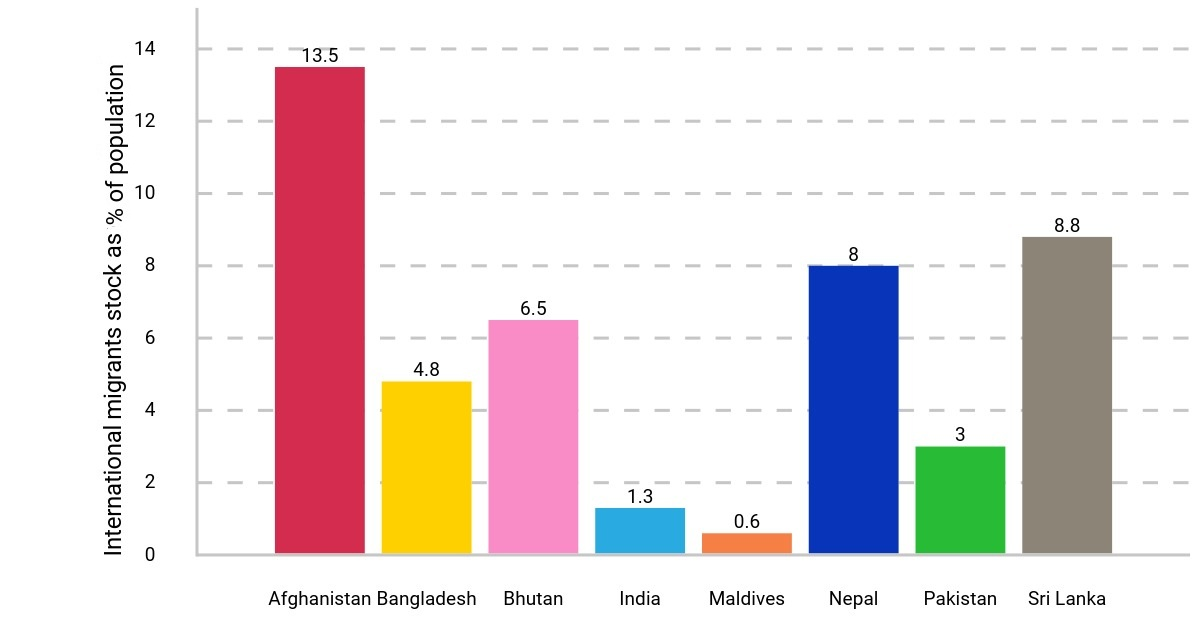
India, at around 18 million emigrants, is the world’s largest origin country, followed by Bangladesh, Pakistan and Afghanistan (Rojas Coppari and McAuliffe 2021), but the share of emigrants varies sharply (Figure 1.1): from 13.5 per cent of Afghanistan’s population to less than 1 per cent in the Maldives (UN DESA 2020).
These patterns underscore South Asia’s pivotal role in global migration systems. More than half of Asia’s 20 largest migration corridors originate here, including four intra-regional routes and five high-volume channels to the GCC, led by India–UAE, India–Saudi Arabia, and Pakistan–Saudi Arabia (McAuliffe and Khadria 2019). Other major streams include India–United States, driven by skilled professionals and students, and Afghanistan–Iran, shaped by protracted instability.

Three dominant trends characterize South Asia’s international migration (Khatri 2007):
- Contract labour migration to the GCC, which is the largest cluster, drawing millions into construction, domestic work and related sectors, but also exposing them to weak labour protections, high recruitment fees, restrictive sponsorship regimes and the risk of abuse and deportation.
- Permanent migration to North America, Europe, Australia and parts of South East Asia, often involving skilled professionals and students seeking long-term settlement, reinforced by diaspora networks and family reunification.
- Cross-border and seasonal migration within South Asia itself, sustained by cultural and kinship ties alongside persistent regional inequalities.
Beyond the GCC, Malaysia and Singapore are important hubs, particularly for Bangladeshi and Nepalese workers in manufacturing, construction and domestic work, but also attract skilled and semi-skilled labour from across the subcontinent. At the higher end, destinations such as Australia, Canada, the United Kingdom and the United States are magnets for Indian and Pakistani migrants working in technology and healthcare, and pathways to permanent residence further reinforce these flows.
Viewed as a whole, these outward movements highlight both the economic opportunities and the vulnerabilities in South Asia’s international migration. They confirm the region’s centrality to global labour markets while exposing gaps in protection and governance that demand stronger bilateral, regional and international frameworks.
Another critical dimension of migration in South Asia is its gendered characteristics. Gender fundamentally shapes the patterns, drivers and consequences of migration across South Asia (Rahman and Tiwari 2020). In a region marked by entrenched socio-cultural hierarchies and gendered divisions of labour, mobility is both constrained and enabled by the intersection of gender with class, caste, ethnicity and geography (Kunduri 2018). Men and women experience migration differently, whether as migrants themselves or as those left behind, and these experiences are mediated by unequal access to resources, legal protections and decision-making power (Uddin 2022).
Women migrants from South Asia are disproportionately concentrated in informal and low-wage sectors such as domestic work, caregiving and garment production (Kapilashrami and John 2023). These sectors are characterized by weak regulatory oversight, limited labour protections and heightened vulnerability to exploitation. Migration under such conditions, further shaped by patriarchal norms and restrictive recruitment practices, exposes women to significant risks, such as abuse, trafficking and gender-based violence (South Asia Women’s Fund 2016). Mobility also has transformative potential, however: when women gain access to remittances and transnational networks or assume new roles in households and communities, migration can enhance their economic autonomy and social agency.
At the same time, gender norms decisively shape migration pathways. Male-dominated labour flows, particularly in construction, agriculture and security, tend to attract greater institutional attention and policy support, while the distinct vulnerabilities and contributions of women remain marginalized (Hennebry, Holliday and Moniruzzaman 2017). For the women who remain behind, migration frequently entails taking on expanded domestic and community responsibilities, often without institutional support or social recognition (Desai and Banerji 2008).
Legal and policy frameworks across the region have struggled to address these gendered realities. Too often, laws and policies are either gender-blind, ignoring the differentiated experiences of men and women, or overly protectionist, restricting women’s mobility in the name of safety (World Bank 2023). The lack of sex-disaggregated and intersectional data further obscures women’s participation in migration, limiting the evidence base for responsive policymaking.
Gender is thus not peripheral but central to understanding migration in South Asia. It shapes who migrates, under what conditions and with what consequences. Integrating a gender perspective into migration governance is essential not only to capture the full complexity and contradictions of mobility, but also to ensure that policies advance equity, intersectionality and rights-based approaches.
1.3. Drivers of migration within and beyond the region
Migration in South Asia, whether internal, intra-regional or international, is shaped by a complex interplay of push and pull factors that reflect the region’s socio-economic, political and environmental dynamics (Table 1.3). Push factors are circumstances that compel people to leave their home areas, while pull factors act as incentives that draw them to destinations that offer, or are perceived to offer, better opportunities.
| Push factors | Pull factors |
|---|---|
| Economic hardship. High unemployment, underemployment and low wages in rural and underdeveloped areas | Better employment opportunities. Higher wages, greater job availability and improved working conditions in urban centres and abroad |
| Poverty and inequality. Widespread poverty and economic disparities between regions | Higher living standards. Access to better housing, healthcare and education in developed regions or foreign countries |
| Political instability. Conflict, ethnic tensions, political repression and governance failures | Political stability and security. Safer environments and political freedoms in more stable countries or regions |
| Environmental degradation. Natural disasters, climate change impacts and land degradation | Safer environmental conditions. Resettlement in areas less prone to natural disasters or environmental risks |
| Lack of educational opportunities. Limited access to quality education and skills development in rural areas | Access to quality education. Availability of better schools, universities and vocational training in urban centres and abroad |
| Social discrimination. Caste-based, ethnic and religious discrimination, as well as gender-based inequalities | Social inclusion and diversity. More inclusive and tolerant societies offer social mobility and personal freedom |
| Poor infrastructure and services. Inadequate healthcare, transportation and social services in rural areas | Improved infrastructure and services. Better access to healthcare, public services and modern infrastructure in cities and developed countries |
| Limited agricultural productivity. Land scarcity, crop failure and lack of modern farming techniques | Industrial and service sector growth. Expansion of industries and services in urban economies creates more diverse job opportunities |
| Forced displacement. Internal displacement linked to armed conflict, insurgency and persecution | Peace, tolerance and security. Safer environments in neighbouring or distant countries offer refuge and asylum |
| Population pressure. Overpopulation leading to resource scarcity and competition in densely populated areas | Demographic needs abroad. Ageing populations and labour shortages in foreign countries create demand for migrant labour |
South Asia’s migration patterns are shaped by the constant interplay of push and pull forces, as populations move in response to a combination of factors.
1.3.1. Conflict, political instability and ethnic and religious tensions
Key political events have decisively shaped South Asia’s migration landscape, repeatedly compelling individuals and families to abandon their homes in search of safety, survival and stability in the region. The Partition of British India (1947) triggered one of the largest forced migrations in modern history, displacing up to 15 million Hindus, Muslims and Sikhs across the new India–Pakistan border. The Kashmir conflict (since 1947) has generated recurrent waves of displacement within and across borders. The Bangladesh Liberation War (1971) drove nearly 10 million refugees into India and displaced millions more internally. In north-eastern India (1979–1985), ethnic and communal violence uprooted an estimated one million people. The Sri Lankan civil war (1983–2009) created hundreds of thousands of refugees and IDPs, while sectarian and political violence in Pakistan (since the 1980s) has fuelled further large-scale displacement. Political instability in the Maldives (2000s) and the Nepalese civil conflict (1996–2006) also forced significant internal and cross-border movements. Finally, decades of war in Afghanistan (1979–2021) produced one of the world’s most protracted refugee crises, displacing millions to Pakistan, Iran and beyond. Collectively, these upheavals have fuelled vast and often protracted forced migrations, reshaping demographic patterns and creating enduring diasporas.
1.3.2. Economic imperatives
Economic factors constitute perhaps the most enduring and pervasive drivers of migration from South Asia. Persistent underdevelopment, structural inequalities and limited employment opportunities operate as powerful push factors, compelling individuals and families to seek livelihoods beyond their immediate localities or even national borders. Conversely, the promise of higher wages, more stable employment and improved living standards abroad act as a powerful pull, drawing millions into global labour markets.
The dynamics of globalization have further intensified these patterns. The integration of South Asia’s economies into global production chains, coupled with evolving international labour demands, has created new avenues for mobility while at the same time exposing migrants to new vulnerabilities. Established transnational networks have lowered the costs and risks of movement by providing social, logistical and financial support, thereby institutionalizing migration as a livelihood strategy in many communities. Nonetheless, these opportunities remain contingent on the volatility of global economic cycles and policy environments. Economic recessions in destination countries or the imposition of restrictive immigration and labour policies frequently disrupt these flows and expose migrants to precarity and exploitation.
Within South Asia, rural–urban migration reflects the structural transformation of economies in which agrarian livelihoods can no longer sustain growing populations. Workers from rural areas increasingly gravitate towards metropolitan centres, both domestically and internationally, to find employment in labour-intensive sectors such as construction, agriculture, manufacturing and domestic service. Alongside these streams of unskilled and semi-skilled workers, significant numbers of skilled professionals also migrate to more advanced economies, particularly to work in information technology, healthcare and engineering, where they find pathways to long-term settlement and integration.
For many South Asians, migration is not only an economic strategy but also a mechanism for social mobility and household resilience. The remittances they generate have become a cornerstone of regional economies. At the micro level, they provide households with a critical financial lifeline, covering essential needs from food and housing to education and healthcare, and often enabling small-scale investment in land, property or business ventures. At the macro level, they constitute a vital source of foreign exchange, contributing to national balance-of-payments stability and ranking among the largest inflows of external revenue in several South Asian countries. In states such as Bangladesh, Nepal, Pakistan and Sri Lanka, remittances not only sustain economic growth, but also buffer governments against external shocks, although they also entrench structural dependencies on overseas labour markets.
Thus, economic drivers of migration in South Asia are best understood as part of a complex interaction between local underdevelopment, global labour demand and the transnational networks that facilitate movement. Migration in this sense is both a response to entrenched inequalities and a constitutive element of South Asia’s integration into global economic systems, with implications that are developmental, distributive and deeply political.
1.3.3. Socio-cultural and gendered dynamics
Beyond economic imperatives, socio-cultural factors play a significant role in shaping South Asia’s migration patterns. Education, marriage, diasporic networks and cross-border family ties drive and sustain mobility, often intersecting with shared cultural, linguistic and religious identities along corridors such as Bangladesh–India, Nepal–India and Afghanistan–Pakistan. Educational migration has become increasingly prominent, as large numbers of students seek higher education in the region and abroad, particularly in Western countries, as a pathway to upward mobility. Marriage-related migration, which is deeply rooted in cultural norms and traditions, predominantly affects women, and includes cross-border matrimonial ties between India and Pakistan. Diasporic communities further reinforce migration by lowering the costs and risks of movement and providing support systems that foster chain migration across generations.
A gendered dimension cuts across these dynamics. While men are more likely to migrate for education or employment, women’s mobility is often linked to marriage or family reunification. These patterns reflect broader structural inequalities but also underscore the different ways in which men and women experience and contribute to migration flows.
1.3.4. Demographic pressures
Urbanization in South Asia is driven by a complex interplay of local and global dynamics that together produce profound demographic, socio-economic and cultural transformations. Localized drivers, most notably rural–urban migration and shifting labour demands, intersect with global forces such as economic globalization, transnational networks and climate-induced displacement. This convergence is reshaping demographic structures, altering labour markets and redefining cultural identities, governance frameworks and regional connectivity.
Bangladesh, India and Pakistan illustrate the rapid pace of urbanization fuelled by large-scale internal migration. Rural populations, motivated by aspirations for improved livelihoods, education and access to services, continue to gravitate towards metropolitan centres, accelerating their expansion. This movement generates acute socio-economic challenges involving severe housing shortages, overburdened infrastructure, entrenched urban poverty and the proliferation of informal settlements. Declining rural livelihoods, structural changes in labour markets and widening disparities between rural and urban areas are major push factors that contribute to the persistence and expected growth of seasonal and circular migration across the region (Srivastava and Pandey 2017; ILO 2018a).
The region’s exceptionally high population density compounds these pressures. Limited resources, high unemployment, strained health and education systems, environmental stress and social tensions amplify both drivers and consequences of mobility. These demographic pressures not only fuel migration but also challenge the capacity of South Asian states to ensure sustainable urban development, equitable service provision and social cohesion in an increasingly mobile and densely populated region.
1.3.5. Environmental factors
Climate change has emerged as a critical driver of migration in South Asia, which is one of the world’s most disaster-prone and environmentally vulnerable regions (IOM 2016). The region’s densely populated and geographically diverse landscape exposes it to sudden-onset natural disasters and to slow-moving environmental degradation, both of which compel large-scale population movements.
Sudden-onset disasters, such as floods, glacial lake outburst floods, cyclones, storm surges, heavy precipitation, droughts, earthquakes and tsunamis, repeatedly disrupt lives, livelihoods and ecosystems. Such events often force communities to relocate temporarily or permanently in search of safety and stability.
Slow-onset processes, such as salinity intrusion, coastal erosion, groundwater depletion and sea-level rise, are progressively displacing communities, particularly in low-lying deltas and river basins. These dynamics exacerbate existing vulnerabilities, as those most affected are often among the poorest and most marginalized populations, which lack the resources to adapt or recover.
Country-level evidence underscores the severity of these challenges. Bangladesh, with its densely populated low-lying delta, is acutely threatened by sea-level rise and intensified storm surges, making many areas uninhabitable. India faces an array of climate-related risks, such as heatwaves, erratic monsoons, rising seas and glacial retreat, alongside recurring floods, droughts and cyclones that devastate agriculture and infrastructure. As a low-lying island state, the Maldives is facing existential risks from coastal erosion, saltwater intrusion and sea-level rise, raising concerns about long-term territorial integrity. Nepal and Pakistan are increasingly affected by glacial melt, floods and extreme heat, which produce recurrent displacements in both rural and urban areas.
Beyond displacement, climate change is also reshaping migration strategies. For many households, mobility has become a form of adaptation, and seasonal and circular migration serve as coping mechanisms by diversifying incomes and reducing exposure to environmental risks. Such movements frequently transfer vulnerabilities, however, as migrants often encounter overcrowded cities, precarious employment, inadequate housing and limited access to health, education and basic services in receiving areas.
The intersection of climate change and migration presents South Asia with both immediate humanitarian challenges and profound long-term development dilemmas.14 Intensifying climate impacts are expected to accelerate displacement, place increasing pressure on already strained urban centres and complicate efforts to ensure sustainable livelihoods. The scale of this challenge is starkly illustrated by the nearly 10 million new internal displacements recorded in 2019 alone (IDMC 2020).
1.4. Remittances as a driver of migration in South Asia
Remittances play a pivotal role in shaping migration patterns in South Asia, functioning both as a primary economic driver and as a stabilizing force for households across the region. The financial linkages between migrants and their countries of origin are profound: remittances now constitute one of the largest external sources of income for many South Asian economies. In 2023, South Asia overtook East Asia and the Pacific to become the world’s leading recipient region. Inflows estimated at USD 189 billion represent a 7.2 per cent increase on the previous year (World Bank 2023). India alone accounted for USD 125 billion, retaining its position as the world’s top recipient. Pakistan and Bangladesh are also heavily reliant on remittances to sustain economic growth, household consumption and social welfare systems.
At the household level, remittances serve as critical lifelines. They provide for essential needs such as food and housing, as well as healthcare and education, while also enabling investments in property, small enterprises and community infrastructure. The visible improvement in living standards among recipient families creates a powerful demonstration effect, normalizing migration as a livelihood strategy and reinforcing its cyclical nature: migration generates remittances, which in turn incentivize further migration.
At the societal level, migration and remittances alleviate labour market pressures in origin countries by absorbing excess labour supply, thereby easing unemployment and reducing the strain on limited domestic job creation. In rural and economically marginalized regions, where wages and employment opportunities are scarce, migration, whether internal or international, becomes an indispensable pathway to financial security and upward mobility.
At the national level, remittances form a substantial share of gross domestic product (GDP) in several South Asian economies, particularly Bangladesh, Nepal, Pakistan and Sri Lanka (Figure 1.2). Their importance extends beyond macroeconomic stability: remittances bolster foreign exchange reserves, reduce poverty rates and, in many cases, underpin social contracts between governments and citizens. The widespread social acceptance of migration as a cornerstone of economic survival and progress has entrenched South Asia’s status as one of the world’s foremost suppliers of migrant labour. Accordingly, most countries in the region consistently rank among the top 20 remittance recipients globally (Rajan 2016), underscoring both the developmental benefits and the structural dependencies generated by remittance-led economies.
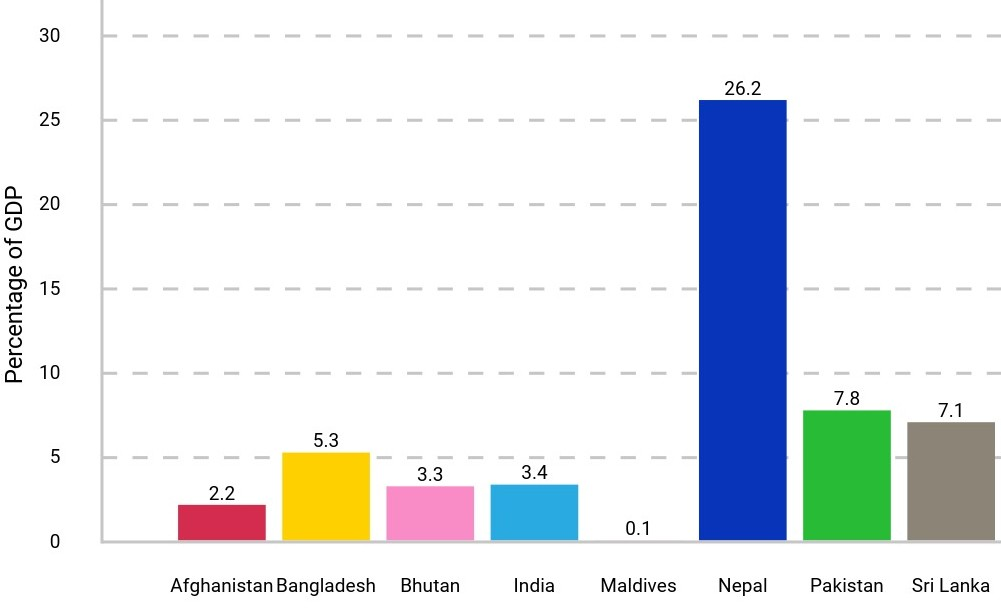
In Bangladesh, remittances now exceed the country’s foreign exchange reserves, while in Nepal labour migration has become so entrenched that remittances are regarded as the backbone of the national economy. In Afghanistan, remittances have historically played a crucial role in post-conflict reconstruction, at times surpassing humanitarian assistance in financial volume. For households across the region, particularly in remote or economically marginalized areas where alternative income opportunities are scarce, the stability of remittance flows provides a reliable lifeline. These funds are not only used for basic consumption but also invested in future livelihoods through small business development, land acquisition or the financing of children’s education.
Despite their scale and importance, tracking remittance flows in South Asia is fraught with challenges. A substantial proportion of transactions continues to move through informal and unregulated channels (Prokhorova 2024). Estimates suggest that up to two-thirds of remittance recipients rely on such networks (ILO 2018b), making it difficult to assess the full financial volume. This reliance on informal systems not only undermines data accuracy but also constrains the ability of formal banking and financial institutions to channel remittances into broader development gains.
Beyond their economic significance, remittances shape social norms and expectations in migration-driven economies. In many communities, migration is no longer merely a choice but a societal expectation, and families are pressured to send members abroad to ensure a steady financial contribution. This dynamic reinforces the centrality of migration as a household and community survival strategy, embedding it further into the socio-economic fabric of South Asia.
The World Bank (Ratha et al. 2023) clusters South Asian states according to their degree of reliance on remittances as a share of GDP. This reveals stark regional disparities between countries with high, moderate and low dependence (see Table 1.4). This variation underscores how migration has become not only a developmental asset, but also a structural vulnerability, binding economies to external labour markets and the uncertainties of global demand.
| Impact | Description |
|---|---|
| High | Nepal (27 %): Significantly reliant on remittances, reflecting the country’s heavy dependence on migration and foreign employment as a critical economic pillar. Nepal dominates South Asia in terms of GDP contribution from remittances. |
| Pakistan (7.8 %): The second highest in the region. Remittances play a vital role in balancing the country’s foreign reserves and supporting domestic consumption. | |
| Sri Lanka (7.1 %): Shows a high level of reliance, indicative of its labour export policies and the importance of remittances in a challenging political and economic environment. | |
| Moderate | Bangladesh (5.2 %): Has a substantial volume of remittances relative to its GDP, driven by a strong workforce abroad, particularly in the GCC states. |
| India (3.4 %): While India receives the highest absolute remittance inflows globally, its large GDP dilutes the percentage impact. India is estimated to have received more than USD 111 billion in 2022, making it by far the largest recipient of international remittances in the world and the first country to ever reach that figure (Author’s analysis from multiple sources). | |
| Low | Bhutan (3.3 %): Lower reliance indicates fewer citizens working abroad compared to the other South Asian countries. |
| Afghanistan (2.2 %): Reflects a limited flow of formal remittances. | |
| The Maldives (0.1 %): A negligible impact due to its small population and limited outward migration for employment. |
2.1. A bleak enfranchisement outlook
Globally, efforts to enhance electoral inclusion increasingly revolve around extending the franchise, both as normative commitment and through practical measures facilitating voting access, to citizens unable to vote in person, whether within their country of origin or abroad, due to mobility circumstances. Achieving genuine inclusion in this context depends on the coordinated efforts of multiple institutional and societal actors. Each has a distinct but interdependent role in ensuring that the principles of universal suffrage and equality of participation are translated into real, functioning practice. The dynamics between policy design, administrative capacity and citizen engagement ultimately determine whether extended enfranchisement becomes a durable feature of democratic resilience or remains an aspirational goal.
For governments and policymakers, the principal challenge lies in creating the enabling conditions for inclusive and equal participation. This entails balancing ensuring political will and financial feasibility, anchoring reforms within coherent and sustainable legal frameworks, and ensuring coherence between policy intent, implementation practice and resulting processes in line with broader democratic commitments. The objective is not only to expand access but to do so in a manner that strengthens institutional legitimacy and public trust.
For EMBs, the task is primarily one of effective operationalization. They must design, adapt and institutionalize absentee voting arrangements that are contextually appropriate, procedurally sound, accessible and resilient across successive electoral cycles. EMBs are also accountable, both upward—to legislatures and oversight institutions—and outward—to voters, international and domestic observers, and the media—for ensuring these mechanisms are implemented transparently and efficiently.
For citizens, effective enfranchisement is determined not only by the formal availability of absentee voting mechanisms, but by their confidence in the integrity, accessibility and relevance of the electoral process. Participation among mobile and external populations is influenced by awareness of available voting options, clarity of procedures, perceptions of security and secrecy, and trust that votes cast from outside the traditional polling station environments are counted accurately and impartially. Patterns of citizen engagement are also shaped by broader political and social factors, including the strength of their ties to the country of origin, prior experiences with public institutions, and the role of intermediary actors such as civil society organizations (CSOs), diaspora associations and community networks in facilitating engagement, information and outreach.
The credibility of absentee voting reflects the extent to which institutional roles, regulatory frameworks and citizen engagement converge around shared commitments to electoral integrity and equal suffrage, ultimately determining whether such arrangements strengthen democratic legitimacy or remain contested over time.
A growing number of countries have made tangible progress by acknowledging the enfranchisement needs of increasingly mobile electorates and institutionalizing reforms that redefine the relationship between citizenship, mobility and electoral participation. These reforms signal a gradual but significant shift from the traditional model of bringing voters to the ballot box—anchored in election-day, in-person participation at fixed polling stations designed for sedentary electorates—towards approaches that effectively bring the ballot box to the voter. By de-territorializing the act of voting, such measures have expanded accessibility, convenience and inclusion, challenging the long-standing assumption that mobility inevitably leads to political exclusion, finally marking an important step towards more adaptable and resilient democratic practice.
In South Asia, however, the tension between the right to move and the right to vote remains largely unresolved. Despite a few notable exceptions, electoral frameworks across this region continue, albeit to different extents, to exclude substantial segments of their migrant populations. This exclusion persists even as South Asia stands among the world’s largest regions of both emigration and internal mobility. Compared with other regions, South Asia’s record on migrant enfranchisement remains among the least inclusive, marked by fragmented reform efforts, weak political prioritization, and the absence of sustainable institutional mechanisms enabling mobile citizens to exercise their right to vote.
Despite wide variations in political systems, electoral management capacities, levels of democratic and economic development, and patterns of migration, most South Asian countries share a common challenge: ensuring that their mobile and globally dispersed citizens can participate meaningfully in national elections through inclusive, accessible, secure and trusted absentee voting arrangements. Progress towards this objective has been uneven, characterized by stalled initiatives, incremental advances and partial reforms that could not address the structural gap between contemporary mobility trends and the normative, practical and operational demands of viable electoral participation.
Within this bleak enfranchisement outlook, however, Bangladesh stands out in South Asia for having taken a tangible step towards facilitating, for the first time, diaspora participation. The Bangladesh Election Commission (BEC) has introduced a dedicated voter registration mechanism and associated absentee voting services for citizens residing abroad. First implemented during the national elections in February 2026, this initiative enabled expatriate Bangladeshis to register digitally and obtain smart National Identity Cards through online platforms and consular offices, thereby allowing participation via postal voting (Bangladesh Election Commission n.d.). This development marks a significant procedural milestone in extending voting access to non-resident citizens, signalling both a notable national advancement and a broader regional shift towards aligning electoral participation frameworks with enfranchisement needs stemming from mobility. Beyond Bangladesh’s recent and still limited experiment with diaspora participation, a regional review of legal frameworks and electoral practices reveals that broadly inclusive, sustainable and institutionalized absentee voting systems have yet to take root in South Asia. Where provisions exist, they are often restrictive, covering only specific categories of voters or proving extremely limited or ineffective in practice. In several countries of the region, legal frameworks formally authorize absentee voting but remain unimplemented, leaving millions of absent citizens without practical means to exercise their franchise. Elsewhere, where such arrangements do not exist, effective electoral participation is limited to those able to return home, a prospect that is frequently constrained by economic costs, logistical challenges or political barriers.
Table 2.1 provides an overview of absentee voting arrangements across the eight countries of South Asia. It outlines applicable eligibility criteria and available voting methods where such provisions exist, while assessing the degree to which these systems are inclusive, selective or exclusionary. The table further identifies key enfranchisement gaps and structural constraints that continue to hinder the adoption, institutionalization and effective implementation of absentee voting mechanisms throughout the region.
| Eligibility for absentee voting | None |
|---|---|
| Absentee voting method(s) | N/A |
| Enfranchisement status | Exclusionary |
| Notes | Elections are no longer held under the Taliban regime. |
| Eligibility for absentee voting | Citizens residing abroad and other select categories |
|---|---|
| Absentee voting method(s) | Postal voting |
| Enfranchisement status | Inclusive (emerging) |
| Notes | While the Representation of the People Order 1972 formally introduced out-of-country voting, logistical and procedural barriers effectively prevented its use in practice for decades. A 2013 amendment specifically mentioned postal ballots for expatriates, but the system was first fully operationalized by the interim government in the first general election following the 2024 uprising. |
| Eligibility for absentee voting | Restricted categories of voters |
|---|---|
| Absentee voting method(s) | Postal voting Facilitation booths were discontinued in 2023 |
| Enfranchisement status | Selective/exclusionary |
| Notes | Eligibility for overseas voters is limited to diplomats and government officials posted abroad, as well as their dependants, who may vote by post. The so-called ‘facilitation booths’ were previously introduced to support postal voting within Bhutan for those located outside their constituency of registration. Access was limited to specific groups, including civil servants, armed forces personnel, election officials on duty and students studying outside their home districts. These facilitation booths were discontinued in 2023. |
| Eligibility for absentee voting | Restricted categories of voters (service voters) |
|---|---|
| Absentee voting method(s) | Proxy/in person/postal |
| Enfranchisement status | Selective/partially inclusionary |
| Notes | Proxy voting is selectively granted to members of the armed forces, central armed police forces and certain government officials posted outside their constituencies. Eligible service voters may appoint a registered elector from their home constituency as a proxy, who is authorized to vote on their behalf at the polling station. Postal voting is also extended to voters on election duty, electors above a prescribed age threshold, persons with specified disabilities and individuals in preventive detention, subject to eligibility criteria and procedural safeguards. Non-resident Indians (NRIs) are eligible to be registered as voters in the constituency corresponding to their place of residence in India, provided they have not acquired the citizenship of another country. However, they are required to vote in person at the polling station in that constituency, on election day. |
| Eligibility for absentee voting | All eligible voters |
|---|---|
| Absentee voting method(s) | Voting in person at diplomatic missions |
| Enfranchisement status | Selective |
| Notes | Out-of-country voting is available only in locations hosting a Maldivian diplomatic mission and where a minimum threshold of 150 registered voters is met. This framework limits access for migrants residing in countries without diplomatic representation or outside major urban centres. |
| Eligibility for absentee voting | None |
|---|---|
| Absentee voting method(s) | No absentee voting (neither in country nor from abroad) |
| Enfranchisement status | Exclusionary |
| Notes | Nepal currently lacks a legal or regulatory framework that enables voters who are away from their constituency of registration, whether abroad or elsewhere within the country, to participate in elections through absentee voting. Consequently, voting remains restricted to in‑person participation at designated polling stations on election day. This arrangement effectively excludes internal migrants, overseas workers and members of the diaspora from exercising their right to vote. |
| Eligibility for absentee voting | None |
|---|---|
| Absentee voting method(s) | No absentee voting (neither in country nor from abroad) |
| Enfranchisement status | Exclusionary |
| Notes | Proposals to introduce Internet-based remote voting for overseas Pakistanis have been explored but not implemented, primarily due to technical, legal, security and electoral integrity concerns. Under the current legal framework, voting remains limited to in-person participation at the voter’s designated polling station, effectively preventing participation from outside the constituency of registration, whether within the country or from abroad. |
| Eligibility for absentee voting | Only citizens physically present in the country can vote |
|---|---|
| Absentee voting method(s) | No absentee voting (neither in country nor from abroad) |
| Enfranchisement status | Exclusionary |
| Notes | Sri Lanka has no legal or regulatory framework that enables citizens who are abroad or away from their constituency of registration on election day to vote from their current location. As a result, voters residing overseas, those who moved internally or temporarily absent are required to return to their designated polling station in order to cast their ballot. |
This regional review confirms that both the adoption and effective implementation of absentee voting remain limited across South Asia. In contrast to the diverse comparative practices documented in International IDEA’s Voting from Abroad Handbook, which emphasize the importance of enabling legislation, host-country agreements and sustained administrative capacity (Ellis et al. 2007), the region’s electoral frameworks remain comparatively underdeveloped in terms of absentee voting. Where mechanisms do exist, available evidence indicates that legal, procedural, operational and institutional arrangements have largely remained rigid and slow to adapt to South Asia’s growing patterns of mobility, migration and displacement. As a result, persistent gaps continue to constrain electoral access, democratic inclusion and representational equity for significant numbers of citizens across the region whose mobility places them outside their constituencies of registration, whether internally or abroad.
2.2. Summaries of International IDEA’s country case studies
The next part of this chapter presents a summarized version of the eight The Absent Voters of South Asia case study series developed by International IDEA, providing empirical evidence that illustrates and contextualizes the challenges to migrant enfranchisement across South Asia discussed above. The summaries presented in the following pages also reflect updates introduced since the case studies were originally developed by each author, incorporating more recent developments, and analysis, where relevant. The case studies highlight the diversity of national experiences while also revealing common patterns and structural barriers that continue to hinder normative inclusion, practical access and meaningful political representation for substantial segments of the electorates across the region.
The Absent Voters of South Asia case study series, produced by International IDEA, offers a comprehensive comparative overview of migrant enfranchisement across the region. Each summary provides a concise analysis of the national migration context and the status of absentee voting, mapping prevailing migration trends, outlining the legal frameworks governing non-resident voting rights and describing the mechanisms, where they exist, for remote electoral participation. While documenting the recent progress achieved in Bangladesh, where expatriate voters were able to participate for the first time in the 13th parliamentary elections, held in February 2026, the series as a whole underscores the persistence of legal, procedural, operational and institutional barriers throughout South Asia and assesses the prospects for advancing urgently needed electoral reforms.
For a more comprehensive analysis, the full case studies on (Migration and Elections) offer detailed examinations of migrant enfranchisement in the eight countries covered.
Note: Online citations and references have been omitted from the following case study summaries but can be found in the full versions linked above.
Box 2.1. The absent voters of Afghanistan
Existing legal framework
- Prior to 2021, Afghanistan had established a legal framework that formally recognized equal political rights for all citizens. The 2004 Constitution guaranteed the right to vote and to be elected without distinction, including for citizens residing outside their place of habitual residence.
- Building on this constitutional basis, the 2010 Election Law mandated the now abolished Independent Election Commission (IEC) to take the necessary measures to facilitate electoral participation for refugees, internally displaced persons (IDPs) and other categories of absent voters.
- Following the Taliban return to power in 2021, the 2004 Constitution was abrogated. As a result, the legal framework underpinning elections and absentee voting was effectively suspended, electoral processes have since ceased to operate and the IEC was dismantled.
Eligibility criteria
- Under the 2004 Constitution and subsequent election laws, all Afghan citizens were formally eligible to vote, irrespective of their status as refugees, IDPs, or migrants. In practice, however, the exercise of this right was highly constrained.
- Most Afghan refugees, IDPs and migrants encountered significant administrative, logistical and security-related barriers that limited their ability to participate effectively in electoral processes.
Absentee voting methods
- Out-of-country voting (OCV) was implemented on a single occasion, during the 2004 presidential election, enabling Afghan refugees residing in Pakistan and Iran to vote. This initiative was facilitated by United Nations Assistance Mission in Afghanistan (UNAMA) and constituted one of the largest refugee-focused OCV operations ever undertaken globally.
- Due to numerous barriers, absentee voting mechanisms were not introduced in all subsequent electoral cycles. Voting thereafter reverted exclusively to in-person participation within Afghanistan, only on election day, at the assigned polling station in the constituency of registration.
Key challenges affecting adoption and implementation
- Political and institutional barriers: the collapse of democratic institutions following the Taliban return to power in 2021 effectively brought all electoral activities to a halt; in the absence of a functioning EMB, no institutional capacity to administer elections has been left.
- Financial and logistical constraints: the financial and operational costs associated with OCV proved prohibitive. The cost of conducting OCV in Pakistan and Iran alone was estimated at approximately USD 50 million, making it financially unsustainable; limited and short-term international funding further constrained the feasibility of extending OCV beyond the 2004 presidential election.
- Security and electoral integrity barriers: concerns regarding electoral fraud and weak oversight mechanisms in neighbouring host countries also discouraged the continuation of OCV after 2004. Previous electoral processes were affected by significant irregularities, including large-scale over-registration of voters, which affected electoral integrity, also undermining, in turn, public confidence in the legitimacy and credibility of results.
- Lack of identification documents: many displaced Afghans lacked the national identity card (Tazkira) required for voter registration; IDPs were often unable to obtain new Tazkiras due to legal and administrative requirements obliging them to apply in their province of origin, locations to which they no longer had practical or secure access.
- Limited political representation: no reserved parliamentary seats were established for Afghan migrant or displaced populations; while a small number of former migrants contested elections, their participation remained selective and limited. IDPs faced inconsistent voter registration practices, frequently linked to the absence of government-issued identification. In some IDP settlements, targeted voter manipulation was also reported, including the provision of short-term financial incentives by candidates in exchange for electoral support.
Current outlook
Following the Taliban’s dissolution of the IEC and their explicit rejection of electoral and democratic processes, there is currently no prospect for the introduction or resumption of absentee voting in Afghanistan. With no elections taking place, provisions for migrant, refugee or internally displaced voter participation remain of no practical effect under the prevailing political order. Afghanistan therefore stands among the most restrictive contexts globally for democratic elections and political participation.
Should a democratic system be re-established in the future, any credible reform agenda would need to prioritize the reintroduction of a legal and institutional framework for elections, including explicit guarantees for absentee voting rights. This would require the establishment of functioning electoral institutions capable of facilitating migrant and displaced voter participation, alongside sustained international engagement to support financing, technical assistance and independent oversight. Without such reforms, the structural exclusion of Afghanistan mobile and displaced populations from political participation is likely to endure.
Box 2.2. The absent voters of Bangladesh
Existing legal framework
- Bangladesh has had for over a decade an established legal basis for the electoral participation of citizens residing abroad. The 1972 Representation of the People Order (Presidential Order No. 155) recognized the voting rights of expatriate Bangladeshi citizens and the 2013 Representation of the People (Amendment) Act explicitly provided for postal voting by overseas voters.
- Ahead of the 2018 parliamentary elections, the Bangladesh Election Commission (BEC) introduced procedural provisions for out-of-country voting. In practice, however, absentee voting remained largely unimplemented due to procedural complexity and operational constraints.
- The 2024 student-led uprising in Bangladesh, which ousted authoritarian Prime Minister Sheikh Hasina, elevated the enfranchisement of the large diaspora to a top priority for the interim government under Muhammad Yunus, culminating in its first-time operationalization by the BEC for the 13th parliamentary election and referendum in February 2026.
Eligibility criteria
- The legal framework governing eligibility for overseas voting in Bangladesh is premised on an inclusive conception of citizenship, though the operationalization of that framework is necessarily mediated by administrative verification procedures. Under the applicable electoral legislation, Bangladeshi nationals who have attained the age of 18 and are resident abroad are entitled to register as overseas voters, with eligibility determined primarily by possession of a valid National Identity Card as the principal instrument of civic documentation.
- The framework further extends coverage to dual nationals and to citizens born outside Bangladesh, on condition that Bangladeshi citizenship is either retained or demonstrable through established criteria of origin; such individuals are, however, barred from candidacy for elected office unless any concurrently held foreign citizenship has been formally and irrevocably renounced. A distinct category of entitlement applies to personnel serving the state in an overseas capacity, including diplomatic staff, government officials stationed abroad and election officials deployed outside their home constituency in the discharge of official duties, all of whom are accommodated within the postal voting provisions of the framework.
Absentee voting methods
- Bangladesh’s 2026 general election marked the country’s first operational deployment of an overseas postal voting system, representing a substantive expansion of the franchise to citizens residing abroad. Eligibility under the framework is premised on an inclusive conception of citizenship: nationals aged 18 and over who hold a valid National Identity Card are entitled to register, with provision extending to dual nationals and citizens born outside Bangladesh, subject to retention or demonstration of Bangladeshi citizenship. Diplomatic personnel, government officials serving abroad and election officials deployed outside their home constituencies are separately accommodated within the postal provisions.
- The system adopted a hybrid model combining digital identity verification with physical ballot transmission. Voters were required to authenticate their identity through biometric facial recognition and QR code scanning via the Postal Vote BD app before marking and returning a paper ballot by post to their respective returning officer, with a statutory deadline. End-to-end digital tracking was built into the process, though the legal validity of each ballot remained contingent on physical receipt within the prescribed period.
Key challenges affecting adoption and implementation
- Implementation was, however, constrained by a range of operational and contextual factors. The compressed timeframe between symbol allocation and polling day meant that only approximately 20 to 21 days remained for ballots to circulate through international postal networks. Concurrent issues with diaspora voter verification, mailing infrastructure and ballot return mechanisms raised concerns that procedural failures could undermine public confidence in the integrity of the process (IRI 2025). The absence of robust independent oversight, combined with difficulties in ensuring private ballot completion, placed both administrative impartiality and ballot secrecy under strain, while the legal vulnerability of voters in restrictive host-country jurisdictions, particularly where participation in foreign political activity may result in visa revocation or deportation, represented a risk the framework did not adequately address (Islam 2025). These limitations notwithstanding, the 2026 exercise established a foundational precedent as the first general election in Bangladesh in which expatriates voted through postal ballot.
Current outlook
The political transition that began in August 2024 enabled the first nationwide postal voting for migrant and in‑country voters, culminating in the 12 February 2026 parliamentary election and referendum (Bangladesh Sangbad Sangstha 2026; India Today 2026). According to Election Commission data, 1,528,131 approved voters registered through the Postal Vote BD app, of whom 1,224,188 cast their ballots, giving an overall postal turnout of 80.11 per cent.
Box 2.3. The absent voters of Bhutan
Existing legal framework
- The 2008 Constitution of Bhutan guarantees the right to vote and establishes the legal framework governing elections, including the establishment of the Election Commission of Bhutan (ECB).
- Over time, the ECB introduced and expanded absentee voting arrangements, notably for the 2018 National Council and National Assembly elections and during the Covid-19 pandemic, using postal voting and facilitation booths. In 2023, however, many of these expanded measures were scaled back, with postal voting eligibility restricted to narrower groups of voters.
Eligibility criteria
- The Elections Act of Bhutan 2008 establishes that citizens must be at least 18 years of age and registered in the civil registry of a constituency for a minimum period of one year to be eligible to vote. Voter eligibility is therefore closely linked to civil registration rather than to place of residence.
- Postal voting is now limited to clearly defined categories of voters including civil servants, members of the armed forces, government trainees and students, officials on election duty and their spouses, persons with disabilities, long-term hospital patients and prisoners. Since 2023, employees in the tourism sector and state-owned enterprises have also been included, primarily to avoid disruption to essential services on election day.
- Citizens working abroad who are not employed in the civil service are not eligible for postal voting. Internal migrants who move away from their place of civil registration are required to return to their original constituency to vote, as voter registration remains tied to household registration, often corresponding to place of birth, rather than to current residence.
Absentee voting methods
- Postal voting: available only to a limited and clearly defined group of voters, as specified in the Elections Act. Bhutanese working abroad without official government assignments are not eligible for this voting modality.
- Facilitation booths for internal migrants: introduced in 2018 to enable voters to cast their ballots from their place of residence rather than their constituency of registration; this arrangement was discontinued in 2023, thereby reducing access for many internal migrants.
- Electronic voting machines (EVMs) in mobile booths: EVMs were piloted during the Covid-19 pandemic, primarily to facilitate voting by elderly persons and voters with underlying health conditions.
- There are no provisions for in-person overseas voting at diplomatic missions or online voting: Bhutanese embassies do not facilitate voting for citizens abroad and online voting has not been pursued as a policy option.
Key challenges affecting adoption and implementation
- Restrictive eligibility framework: civil registration–based eligibility limits the ability of internal migrants and many urban residents to vote where they effectively reside. The narrow scope of postal voting further excludes most Bhutanese citizens working abroad who are not employed in government service.
- Geographical and logistical barriers: mountainous terrain and the absence of a comprehensive address system exacerbates administrative complexity and costs, limiting the practicality of postal voting and requiring some voters in remote areas to travel long distances to cast their ballots.
- High election costs: over the years, election-related expenditures have risen substantially, constraining the sustainability of facilitation booths, mobile voting arrangements and the international mailing of ballots for overseas voters.
- Administrative and awareness barriers: reluctance to update civil registration, combined with burdensome registration procedures and uneven levels of political awareness, continues to discourage participation, particularly among mobile populations.
- Lack of alternative voting methods: Bhutan has not pursed voting through diplomatic missions or online modalities. The discontinuation of facilitation booths and the limited expansion of postal voting have further narrowed access for absent and migrant voters.
Current outlook
Bhutan’s absentee voting system has narrowed in scope following the rollback of several temporary measures introduced in 2018 and during the Covid-19 pandemic. Initiatives that had expanded access, including facilitation booths and broader use of mobile voting arrangements, have since been discontinued, resulting in a more restrictive overall system.
Among the reforms that merit consideration is the expansion of postal voting eligibility to all Bhutanese working abroad, the reinstatement of facilitation booths for internal migrants, and an assessment of the feasibility of online voting or voting through diplomatic missions considering the country’s growing diaspora. In the absence of such policy reforms, Bhutanese migrants, both internal and international, are likely to continue to face significant barriers to meaningful political participation.
Box 2.4. The absent voters of India
Existing legal framework
- The Constitution of India 1950 guarantees universal suffrage for all citizens aged 18 and above under the principle of ‘ordinary residence’.
- The Representation of the People Act 1951 requires voters to be registered in their constituency of ordinary residence, which limits the ability of mobile populations to vote from outside their registered location.
- Over the years, the Election Commission of India (ECI) has proposed a range of reforms aimed at expanding absentee voting, reflecting a degree of institutional responsiveness to the electoral needs of mobile populations. These initiatives have not, however, yet translated into a system-wide framework sufficiently comprehensive to address the enfranchisement of India’s large internal and international migrant populations.
Eligibility criteria
- The 2009 Amendment extended voting rights to non-resident Indians (NRIs), allowing them to register using the address recorded in their passports. NRIs are required to return to India to cast their ballot in person at their assigned polling station, as no remote voting arrangement is available; this requirement has resulted in consistently low participation rates among registered overseas voters. In the 2019 elections, only a minority of those registered ultimately voted.
- Internal migrants are required to vote in their constituency of registration unless they formally re-register at their new place of residence. In practice, re-registration is administratively burdensome and therefore infrequently undertaken. Voters with high mobility, such as seasonal and circular workers, face additional constraints, as electoral timelines are often not aligned with their movement patterns.
- Members of the armed forces, armed police forces stationed outside their home state and government employees on election duty abroad may vote through electronically transmitted postal ballots or proxy voting. Postal voting is also available to select categories, including persons under preventive detention, elderly voters and voters with disabilities.
Absentee voting methods
- Postal voting is restricted to service voters, certain categories of government employees, elderly voters aged 80 and above, and persons with disabilities; it is not available to NRIs or to internal migrants voting outside their constituency of registration.
- Service voters may additionally appoint a registered elector from their home constituency to cast a vote on their behalf through proxy voting. Special polling stations have been established for internally displaced Kashmiri migrants, enabling them to vote from designated relief camps rather than returning to their original constituencies.
- No provisions exist for online voting or for voting at diplomatic missions, and NRIs are therefore required to be physically present in India to participate in elections.
Key challenges affecting adoption and implementation
- The ordinary residence requirement limits voting outside the constituency of registration, while re-registration procedures are administratively demanding and present practical difficulties for many migrants. The absence of absentee voting options for mobile voters temporarily away from their place of registration for work, education or other short-term purposes leaves them with little alternative but to travel back to their constituency or to abstain.
- Progress on reform has been shaped by limited political consensus. Although the ECI has proposed several changes, concerns about fraud and operational feasibility have tempered legislative momentum; the 2018 proxy voting bill for NRIs, for instance, was not sustained. The scale and geographic dispersion of India’s electorate further add to the complexity of administering any expanded absentee voting framework at a national level.
- Awareness and accessibility gaps present additional considerations. Many migrants remain insufficiently informed about voting procedures or encounter practical obstacles to participation, while travel requirements place a notable burden on NRIs and on internal migrants with limited resources to return to their home constituency on election day. Concerns about ballot secrecy, coercion and fraud, particularly in relation to online and expanded postal voting, have encouraged a measured institutional approach to extending absentee voting beyond a limited set of voter categories.
Current outlook
India has not yet adopted a comprehensive absentee voting framework, and internal and international migrants continue to face practical limitations in exercising their voting rights, with participation among mobile segments of the electorate remaining correspondingly low.
Looking ahead, a range of reform options remains under active consideration, including the extension of postal voting to NRIs and internal migrants, the possibility of overseas voting through diplomatic missions and further assessment of remote or electronic voting solutions.
Given the sheer scale of India’s mobile population, even incremental progress in extending absentee voting arrangements to a fraction of those currently excluded would be likely to produce a measurable increase in voter turnout. The ECI has undertaken pilot initiatives and technical assessments in this area, reflecting sustained institutional engagement with the question of electoral inclusion. Considerations of logistical feasibility, security and electoral integrity nonetheless continue to temper the pace of change, and the development of a more comprehensive absentee voting framework is likely to remain incremental.
Box 2.5. The absent voters of the Maldives
Existing legal framework
- Article 26 of the 2008 Constitution of the Maldives guarantees every citizen aged 18 and above the right to vote and to stand for election. The General Elections Law (Law No. 11/2008) provides that voters wishing to cast their ballot outside their place of registration must notify the Elections Commission of the Maldives of their intention to do so within a prescribed timeframe.
- Out-of-country voting (OCV) was initially limited to presidential elections but was extended to parliamentary elections in 2008. In accordance with the law, the Elections Commission publishes a voter register no later than 45 days prior to election day, identifying eligible voters who have successfully registered to vote remotely.
Eligibility criteria
- Internal migrants: voters wishing to cast their ballot outside their constituency of registration are required to re-register with the Elections Commission of the Maldives before each election. In practice, a significant proportion of internal migrants remain registered in their place of birth despite having resided elsewhere for extended periods and are consequently compelled to travel back to their constituency of origin to vote.
- Maldivian citizens residing abroad may vote at designated overseas polling stations, subject to a minimum threshold of 150 registered voters per location. In recent electoral cycles, OCV was facilitated in Colombo, Kuala Lumpur, London and Thiruvananthapuram; for the 2023 presidential elections, the Elections Commission expanded the arrangement to five countries, establishing polling stations in India, Malaysia, Sri Lanka, the United Arab Emirates and the United Kingdom.
- Employees in the tourism sector, particularly those working on resort islands, face practical constraints in exercising their voting rights. While employers are legally obliged to allow staff time to attend polling stations, they are not required to provide transport, and the distances involved in travelling from resort islands to registration constituencies frequently render the legal entitlement difficult to exercise in practice.
Absentee voting methods
- OCV is conducted exclusively through in-person voting at polling stations established in a limited number of overseas locations. No provisions exist for postal or online voting and the absence of such alternative absentee voting arrangements renders participation structurally contingent upon physical accessibility to a limited number of designated locations.
- For internal migrants, voting outside the constituency of registration requires in-person re-registration. This process involves biometric verification, including fingerprint authentication, and can be administratively demanding, limiting its accessibility for many voters. A fully online re-registration process, first introduced for the 2023 presidential elections, was subsequently maintained for the 2024 parliamentary elections, suggesting a durable procedural shift.
Key challenges affecting adoption and implementation
- Limited accessibility of OCV requirement that a minimum of 150 registered voters be present in a given location before an overseas polling station may be established restricts access for a significant proportion of Maldivians residing abroad. Voters in cities or countries not meeting this threshold are frequently compelled to travel considerable distances, in some cases across national borders, to reach the nearest designated polling station.
- Constraints affecting internal migrants: a significant proportion of Maldivian citizens remain registered in their place of birth despite long-term residence elsewhere. The re-registration process, which requires in-person applications and biometric verification, places an administrative burden on voters that, in practice, depresses uptake among those with limited time, resources or proximity to the relevant facilities.
- Barriers for tourism sector employees: workers in the tourism sector, particularly those based on resort islands, face structural difficulties in accessing polling stations on election day. While legislation provides for voting leave, the absence of any obligation on employers to arrange or fund transport means that the statutory entitlement frequently cannot be exercised in practice.
- Financial and logistical costs: overseas voters frequently bear substantial personal expenses in travelling to designated polling locations. The establishment and operation of overseas polling stations is similarly resource intensive for the Elections Commission, a factor that constrains the geographical expansion of OCV provision.
- Lack of alternative absentee voting arrangements: no postal or online voting systems are currently in place, leaving absentee voting entirely dependent on in-person participation. The adoption of alternative absentee voting modalities based on remote participation has been constrained by concerns relating to cost, security and public confidence in electoral processes.
Current outlook
While absentee voting is in place in the Maldives, its arrangements currently remain limited in scope, with uneven effects across the principal affected groups: internal migrants, overseas voters and workers in the tourism sector. Access to the franchise for these mobile voters continues to be conditioned largely by physical proximity to polling stations and by the administrative demands of re-registration procedures, rather than by the eligibility criteria established in law. One area in which measurable progress has been recorded concerns the re-registration process for internal migrants. The introduction of a fully online re-registration portal, first made available for the 2023 presidential elections and subsequently maintained for the 2024 parliamentary elections, represents a substantive reduction in the procedural burden previously placed on voters wishing to cast their ballot outside their constituency of registration.
The trajectory of broader reform, however, remains uncertain. Potential avenues include the expansion of overseas polling locations, assessment of the feasibility of postal or electronic voting, and the further simplification of re-registration procedures for internal migrants. Each of these raises distinct questions of cost, operational capacity and institutional trust that would require careful, evidence-based assessment. Broader progress is likely to depend on sustained engagement between the Elections Commission, political parties and affected communities, as well as on the development of greater public familiarity with absentee voting modalities, given that the Maldives’ transition to multiparty democracy remains relatively recent.
Box 2.6. The absent voters of Nepal
Existing legal framework
- Voting rights in Nepal are governed by the Constitution of Nepal 2015, the Citizenship Act 2006, relevant electoral legislation and decisions of the Election Commission of Nepal (ECN).
- Nepal’s legal framework does not recognize dual citizenship. Non-resident Nepalis (NRNs) are accorded a form of citizenship that does not carry political rights, and are accordingly excluded from voting and from standing for public office.
- In 2018, the Supreme Court of Nepal issued a directive instructing the ECN to prepare a register of eligible Nepali citizens abroad, design an appropriate voting mechanism including pilot testing if needed, ensure the secrecy and integrity of the ballot, coordinate diplomatically with host countries and bring the necessary legislation before Parliament without delay.
Eligibility criteria
- To be eligible to vote, a Nepali citizen must be at least 18 years of age and have permanent residence registered in a ward within a municipality or village development committee in an electoral constituency. In practice, these requirements exclude the great majority of Nepali citizens residing abroad, as electoral eligibility is conditioned on permanent residence within the country rather than on citizenship alone.
Absentee voting methods
- Electoral legislation requires voters to cast their ballots in person at their place of registered residence and makes no provisions for absentee voting modalities of any kind.
- No legal provisions exist for out-of-country voting (OCV), and Nepali citizens residing abroad are unable to exercise their voting rights unless they return to their constituency of registration on election day.
- For internal migrants, the position is similarly restrictive: voters are required to cast their ballots in the constituency where they are registered, and no arrangements exist for inter- or intra-constituency voting (ICV). Citizens who have relocated away from their place of registration cannot vote from their current place of residence, and re-registration in a new location is administratively complex, with the consequence that a significant proportion of mobile voters do not change or update their registration details and, hence, they are effectively excluded from electoral participation.
- In-person voting at the registered constituency on election day therefore remains the sole available method for exercising the right to vote, a constraint that falls disproportionately on the large and growing share of the population engaged in internal or international migration.
Key challenges affecting adoption and implementation
- Absence of a legal framework: no provisions exist for OCV or ICV, and electoral legislation confines participation to voters physically present in their registered constituency on election day. The absence of enabling legislation constitutes the primary structural barrier to the enfranchisement of Nepal’s absent voters, and any reform to introduce absentee voting arrangements would require prior legislative action.
- Political and institutional constraints: political consensus on extending voting rights to migrants remains limited. Concerns relating to electoral integrity, the potential effects of diaspora participation on domestic electoral outcomes, administrative complexity and fiscal cost have collectively constrained the space for reform, notwithstanding the Supreme Court’s 2018 directive.
- Voter registration barriers: biometric voter registration requires physical presence, preventing most international migrants from registering or updating their details without returning to Nepal. This requirement effectively compounds the legal exclusion, as even those who might otherwise qualify to vote face procedural obstacles to establishing or maintaining their registration.
- Limited access for mobile voters: the absence of ICV arrangements restricts participation by internal migrants. Citizens deployed on election duty are similarly affected, as they are frequently unable to vote outside their registered constituencies, a gap that raises distinct questions about the equitable application of voting rights to those engaged in the administration of elections.
- Capacity and logistical challenges: Nepal’s institutional capacity to administer absentee voting at scale remains limited. The establishment of overseas voting arrangements would require diplomatic coordination, complex logistical infrastructure and secure ballot-handling procedures, none of which are currently in place.
- Financial constraints: the ECN has indicated that implementing OCV would entail a level of financial resources not currently available to it, a consideration that places the question of enfranchisement in direct tension with institutional and budgetary realities.
Current outlook
The Rastriya Swatantra Party’s landslide victory in the 5 March 2026 general elections, securing an outright parliamentary majority, the first since 1999, may alter the political calculus on diaspora enfranchisement. The party’s manifesto, framed as a ‘Citizen Contract’, explicitly committed to online voting rights for Nepalis abroad, making diaspora enfranchisement a named electoral pledge. Notably, the party’s campaign drew substantial financial support from the Nepali diaspora, particularly from communities in the USA, establishing a constituency relationship with NRNs that preceding administrations lacked. The political conditions for revisiting the long-delayed question of diaspora enfranchisement appear, for the first time in several years, more favourable than at any previous point in Nepal’s democratic consolidation.
Box 2.7. The absent voters of Pakistan
Existing legal framework
In Pakistan, the voting rights of overseas citizens were recognized in a 1993 Supreme Court ruling, though that recognition has not translated into sustained legislative or operational implementation.
- The Elections Act 2017 provides a limited legal basis for absentee voting. Section 93 permits voting by postal ballot, but only for narrowly defined categories, comprising government employees, election officials on duty, persons with disabilities and prisoners. Section 94 further mandates the Election Commission of Pakistan to develop mechanisms enabling overseas Pakistanis to vote, with technical support from the National Database and Registration Authority (NADRA). Neither provision has, to date, resulted in a fully operational or inclusive framework for out-of-country voting (OCV), leaving the legal framework without the operational infrastructure required to give it effect.
Voter eligibility criteria
- To be eligible to vote in Pakistan, a citizen must be at least 18 years of age, be registered on the electoral roll of a specific constituency and not have been declared of unsound mind by a court. Under the current legal framework, neither internal nor international migrants are entitled to vote through OCV or inter- or intra-constituency voting modalities.
Absentee voting methods
- Postal voting is available only to a limited set of voters, comprising government employees, election staff on duty, prisoners and persons with disabilities.
- Internet voting was piloted during the 2018 by-elections but was subsequently suspended following concerns relating to security and electoral integrity.
- Electronic voting machines were introduced in 2021 as part of broader electoral reform efforts, but their deployment was discontinued in 2022 before large-scale implementation, primarily on grounds of feasibility and security.
Key challenges affecting adoption and implementation
- Political barriers: political parties remain divided on the extension of absentee voting. Concerns about its potential effects on electoral outcomes frequently shape legislative positions. Although judicial decisions have been broadly supportive of OCV, translating these rulings into sustained policy has remained contested across successive governments.
- Legal constraints: the existing legal framework requires voters to be physically present in their constituency of registration, with no accommodation made for internal or international migrants. Absent legislative reform, the statutory basis for broader absentee voting arrangements remains limited to the narrow categories currently specified under the Elections Act 2017.
- Economic barriers: many internal migrants lack the financial means to travel to their constituency of registration on election day. For overseas Pakistanis, the requirement to return to the country renders electoral participation impractical for the great majority, effectively conditioning the exercise of the franchise on the capacity or willingness to bear significant travel costs.
- Operational and logistical challenges: administering absentee voting for a large and geographically dispersed electorate, encompassing millions of overseas and internal migrants, would place substantial demands on institutional capacity and administrative infrastructure. The Election Commission of Pakistan’s current resources are not configured to support the necessary large-scale absentee voting arrangements.
- Security and infrastructure concerns: cybersecurity risks, identity verification challenges and limited technological infrastructure have constrained the adoption of Internet-based or electronic voting modalities. Concerns relating to fraud and electoral integrity continue to inform a cautious institutional approach, as evidenced by the suspension of the Internet voting pilot and the discontinuation of electronic voting machines.
- Historical and institutional context: Pakistan has maintained a consistently restrictive approach to absentee voting, extending exceptions only to narrowly defined categories of voter. Previous reform efforts have been reversed in the context of political instability, undermining policy continuity and reinforcing institutional inertia.
Current outlook
The extension of voting rights to international and internal migrants in Pakistan remains the subject of ongoing legal and political contestation and the prospects for reform are uncertain. Persistent political resistance, combined with the structural constraints of the existing legal framework, continues to limit progress towards the adoption both of OCV or other forms of in-country absentee voting. Any substantive reform would require a degree of political consensus that has thus far proved elusive, as well as targeted amendments to electoral legislation, adequate budgetary allocations and a strengthening of the Election Commission’s operational capacity.
Potential pathways forward include aligning electoral legislation more closely with international good practice on absentee voting, enhancing the institutional capacity required to administer absentee voting arrangements at scale, and undertaking a careful, evidence-based assessment of secure, cost-effective and sustainable voting technologies. Equally important would be the development of sustained stakeholder engagement and public dialogue, without which the confidence necessary to support absentee voting reform is unlikely to be established.
Box 2.8. The absent voters of Sri Lanka
Existing legal framework
- The Constitution of Sri Lanka 1978 guarantees universal suffrage to citizens aged 18 and above, subject to registration in an electoral constituency. Voter registration and electoral procedures are governed by the Registration of Electors Act (No. 44 of 1980) and the Parliamentary Elections Act (No. 1 of 1981), both of which restrict voting to the voter’s registered constituency.
- Postal voting is provided for under existing legislation but is limited to specific categories of voters: members of the armed forces, election officials, public servants on election duty and certain categories of transport sector workers. No provisions exist for out-of-country voting (OCV) for citizens residing abroad or for intra- or inter-constituency voting for internal migrants or people who have moved outside their registered constituency.
- Sri Lanka ratified the International Convention on the Protection of the Rights of All Migrant Workers and Members of Their Families in 1995, an instrument that recognizes migrants’ political rights, including participation in public affairs in their country of origin. No corresponding legal provisions have been adopted to give effect to these obligations in the electoral framework. Repeated recommendations from parliamentary committees and presidential commissions to introduce such reforms have not been enacted, reflecting a persistent gap between normative commitment and legislative action.
Eligibility criteria
- Internal migrants are required to return to their constituency of registration to vote, as no provisions exist for re-registration based on a change of residence.
- Citizens residing abroad are not entitled to vote from overseas and must return to Sri Lanka to participate in elections. While some members of the Tamil diaspora remain on the electoral register, practical and logistical constraints significantly limit their capacity to exercise that entitlement in practice.
- Members of the armed forces, the police and certain essential public services are eligible to vote by postal ballot. Other categories of workers, including medical professionals and employees in essential industries, are not covered by the current postal voting framework.
Absentee voting methods
- Postal voting is only available to members of the armed forces, the police, certain essential public services and election officials on duty. It is not available for migrant workers, overseas citizens or internal migrants.
- No provisions exist for OCV, and Sri Lanka’s diplomatic missions do not facilitate voting abroad.
- Despite periodic deliberations, alternative voting modalities, such as online, proxy or electronic voting, have not been explored or implemented within the existing electoral framework, leaving the arrangements for absent voters among the most restrictive in the region.
Key challenges affecting adoption and implementation
- Restrictive legal and administrative framework: the electoral legal framework, distributed across multiple pieces of legislation, restricts voting to the voter’s registered constituency. No provisions exist enabling citizens abroad to vote from overseas, and no mechanism allows migrants to update their registration based on a change of residence. Successive parliamentary recommendations on absentee voting have not resulted in legislative reform.
- Limited political consensus and electoral integrity concerns: absentee voting reform has stalled repeatedly amid concerns relating to fraud, ballot security and the potential influence of diaspora communities on domestic electoral outcomes. While most electoral stakeholders have expressed nominal support for reform, the issue has consistently been accorded low parliamentary priority, and the political consensus necessary to translate that support into legislation has not materialized.
- Logistical and administrative constraints: the establishment of overseas voting arrangements would require intergovernmental negotiations with host countries, new administrative infrastructure and secure ballot-handling procedures. For migrants in the Gulf Cooperation Council states and the broader Middle East, physical access to diplomatic missions is further constrained by employer practices, including the retention of identity documents.
- Awareness and accessibility gaps: migrant communities abroad require broad access to independent election information. Leaving this function to political parties, not all of which maintain offices overseas, risks privileging wealthier parties and candidates and exposing voters to partisan rather than civic information.
- Financial constraints: an OCV system would require dedicated overseas registration, civic education and the distribution of electoral materials to voters dispersed across many countries. Sri Lanka’s multi-tier electoral calendar, encompassing presidential, parliamentary, provincial and local government elections, further compounds the financial burden of any such arrangement.
Current outlook
Sri Lanka remains without dedicated absentee voting arrangements for either its international or internal migrant populations, placing it among the more restrictive electoral frameworks in the region. In the absence of legislative reform, neither group has access to voting modalities that allow participation without returning to the constituency of registration on election day.
Any substantive progress would require amendments to the relevant electoral legislation, whether to expand postal voting eligibility, introduce OCV or establish re-registration mechanisms for internal migrants. CSO and international actors have sustained advocacy on this issue for several decades and it has been systematically examined by multiple parliamentary committees and a presidential commission. That sustained attention has not translated into legislative action, reflecting a persistent gap between normative recognition of the problem and the political consensus required to address it.
2.3. Challenges to the enfranchisement of South Asia’s migrants
The eight country case studies that form the analytical core of this report examine, within a regional frame, how human mobility, and migration in particular, affects the exercise of voting rights across South Asia. The analysis first traces the range of legal, institutional and operational conditions under which the region’s migrant populations are, or are not, able to participate in elections in their countries of origin and then moves on to identify the structural factors that determine whether population mobility translates into political inclusion or exclusion. The summaries underscore a common thread across otherwise diverse national contexts: where electoral frameworks have failed to adapt to the demographic realities of mobile populations, significant segments of the national electorate have been left unable to exercise their voting rights (see Boxes 2.1 to 2.8). These are South Asia’s absent voters.
The challenges of enfranchising non-resident citizens are not unique to South Asia; they are encountered, in varying configurations and to differing degrees, across democratic systems worldwide. What distinguishes the region, however, is the scale and persistence of the political exclusion involved. Across the region, millions of citizens residing abroad remain unable to exercise their right to vote, partly as a result of formal legal disqualification, and partly owing to the absence, or inadequacy, of absentee voting arrangements that would make their remote participation meaningful and practicable. While the forms and degrees of this disenfranchisement differ considerably from one jurisdiction to another, reflecting the particular configurations of each country’s legal framework, administrative and operational capacity, and political context, the aggregate pattern is one of sustained political exclusion that raises concerns for democratic inclusion, representation and accountability throughout the region.
Across successive electoral cycles, the limitations of existing absentee voting arrangements and, in several cases, the inability to established them at all, have remained largely unaddressed throughout the region, pointing to a broader pattern of institutional inertia in the adaptation of electoral frameworks to South Asia’s evolving demographic realities.
The continued political exclusion of the region’s non-resident citizens, numbering in the tens of millions, reflects not only legal or administrative deficiencies but a wider tendency to treat population mobility as peripheral to electoral system design, with tangible consequences for the inclusiveness, representativeness and legitimacy of democratic institutions and for the development of electoral frameworks capable of reflecting the full scope of the demos they are intended to serve. The degree to which South Asia’s democratic systems retain their capacity to fulfil their representative function is, in considerable measure, contingent upon their ability to adapt—structurally, normatively and operationally—to the conditions under which a growing proportion of their electorates reside. The assumptions embedded in existing electoral frameworks, built for populations whose political and physical presence broadly coincide, sit in growing tension with the realities of societies shaped by sustained and diverse patterns of mobility. Dominant narratives tend to depict migrant enfranchisement as administratively complex, financially demanding, politically sensitive or potentially detrimental to electoral integrity and such framings have, in several national contexts, constrained the scope of reform debates.
Where such adaptation is deferred or resisted, the consequences extend beyond the individual denial of voting rights. A democratic system that consistently and structurally excludes significant segments of its own electorate from electoral participation produces distortions in political representation, weakens the accountability relationship between elected institutions and the populations they govern, and over time erodes the legitimacy of electoral outcomes as expressions of collective will. The risk, in this context of widespread exclusion, is not only one of gradual institutional divergence between the formal boundaries of the demos and the social realities of increasingly mobile and transnationally dispersed populations, but of a deeper disconnection between the stated principles of democratic governance and the lived experience of citizens whose political membership is formally recognized but practically denied. The risk is of a deeper disconnection between democratic governance principles and the lived experience of citizens whose political membership is formally recognized but practically denied. In a region where migration is both structurally embedded in national economies and deeply consequential for the welfare of millions of families, the continued treatment of population mobility as marginal to electoral system design represents a tension that South Asia’s democratic institutions are finding increasingly difficult to sustain.
The case study summaries in this report illustrate how a range of intersecting normative, operational and other barriers continue to constrain the ability of migrants to participate in electoral processes on equal terms to those available to resident citizens. These constraints are not reducible to the absence of formal legal recognition; they extend across the broader architecture of electoral participation, encompassing the legal conditions, administrative mechanisms and practical arrangements that determine whether, how, where, when and under what circumstances eligible non-resident citizens can exercise their right to suffrage.
The country case study findings point to a range of factors shaping migrant political exclusion across South Asia that, while varying in form and intensity across national contexts, can be clustered into four interrelated analytical dimensions spanning the political, legal, operational and individual levels at which exclusion is determined, produced and sustained across the region, as shown in Table 2.2.
| Dimension | Determinant of migrant political exclusion |
|---|---|
| Political economy and political will | Insufficient recognition of migrants as legitimate political stakeholders |
Political ambivalence and electoral reform inertia | |
The absence of regional frameworks for migrant electoral inclusion | |
| Legal and institutional architecture | Restrictive legal frameworks and normative barriers |
Systemic governance gaps in advancing migrant political inclusion | |
Domestic and international coordination challenges | |
| Operational and technical implementation | Design complexity and trade-offs of absentee voting modalities |
Infrastructural and operational constraints on absentee voting | |
Security and electoral integrity concerns | |
Financial constraints and concerns over the sustainability of absentee voting | |
| Individual-level access barriers | Voter registration barriers |
Limited awareness and voter education considerations | |
Digital divides and data protection risks | |
Gendered and intersectional barriers in migrant enfranchisement reform |
While distinct in analytical terms, these four dimensions interact in practice: political conditions shape the legal architecture, legal frameworks constrain operational design, and operational arrangements determine whether, and to what extent, individual voters can access the electoral franchise.
The first dimension of migrant electoral exclusion in South Asia relates to the political economy of enfranchisement and the limited political will to advance it as a reform priority. It captures the structural conditions that have systematically relegated migrants to the margins of political consideration, the ambivalence of political actors towards reform, and the absence of regional normative frameworks that might otherwise generate incentives for policy alignment and convergence across the region’s electoral systems.
2.3.1. Insufficient recognition of migrants as legitimate political stakeholders
Across South Asia, migrants are valued primarily for their economic contribution rather than acknowledged as political stakeholders. Governments in the region have actively promoted emigration to secure remittance inflows and reduce unemployment, while investing far less in developing the legal, procedural, operational and institutional frameworks that would enable migrant citizens to participate remotely in their country’s political life.
This imbalance reflects a prevailing assumption that geographic distance leaves migrants too detached from domestic affairs to justify electoral inclusion. Such assumptions overlook the enduring financial, social and cultural ties that migrants maintain with their countries of origin. Even when abroad, most of them remain deeply affected by policies that shape their families’ well-being, their property rights and their prospects for return.
Migration policy continues to be dominated by macroeconomic priorities, ranging from reducing domestic unemployment to generating foreign exchange or alleviating poverty through remittances. Labour ministries focus on bilateral employment agreements and overseas-worker welfare funds, while central banks prioritize remittance facilitation.
By contrast, the political and electoral dimensions of migration, particularly the enfranchisement of migrant populations, have received comparatively limited attention. Few institutional and political mechanisms genuinely recognize migrants as a distinct political constituency with legitimate claims to inclusion, participation and representation. Where such recognition exists, it rarely translates into meaningful opportunities for genuine political inclusion: constitutional provisions are narrow or ambiguous; political parties seldom empower their diaspora chapters, or integrate migrant concerns into their structures; parliamentary committees formed to consider electoral reform rarely consult migrant representatives; election manifestos offer limited commitments on external voting; and citizenship laws continue to impose restrictive conditions on their voting rights.
The political economy shaping migrant exclusion across South Asia reflects a set of structural incentives. Remittance flows tend to remain robust regardless of migrants’ formal political inclusion, reducing immediate pressures to extend suffrage. Within this context, migrant enfranchisement is often perceived as politically sensitive, as it may introduce new and less predictable electoral dynamics that interact with existing political alignments and patronage structures. Incumbent governments may therefore approach such reforms cautiously, particularly where there are concerns that overseas voters, shaped by adverse economic, social or political experiences at home, could influence domestic electoral outcomes.
These dynamics help to explain why the enfranchisement of migrants has remained a low policy and reform priority despite its democratic significance, contributing to the persistence of their large-scale and prolonged exclusion across multiple electoral cycles. This outcome is closely linked to prevailing governance arrangements, in which migration is largely managed through labour and foreign affairs portfolios. As a result, regional governance structures tend to reinforce a ‘remittance-without-representation’ dynamic, whereby migrants contribute substantially to national economies while remaining largely excluded from shaping the political decisions that affect their communities. In the absence of stronger inter-ministerial coordination and a reframing of migration as a democratic, rather than solely an economic issue, migrants are likely to continue to be treated primarily as sources of revenue rather than citizens with equal political rights.
2.3.2. Political ambivalence and electoral reform inertia
The limited progress on migrant enfranchisement in South Asia reflects not only administrative and logistical hurdles, but also a lack of sustained political prioritization. While governments often express rhetorical support for diaspora engagement, migrant electoral inclusion has tended to remain low on policy agendas, overshadowed by more immediate political and economic considerations. Policymakers frequently approach reforms cautiously, particularly when absentee voting is perceived as electorally marginal, administratively complex, politically sensitive or offering limited immediate returns.
This pattern is reinforced by political ambivalence towards migrant enfranchisement which is frequently viewed as introducing new and less predictable dynamics into established electoral systems. As a result, debates on migrant voting rights are commonly addressed in a reactive or ad hoc manner rather than through comprehensive, long-term policy planning. Reform initiatives that do emerge are often prompted by external factors, such as court rulings, civil society advocacy or diaspora mobilization. In the absence of cross-party consensus or sustained legislative momentum, however, such initiatives frequently fail to progress to implementation.
Often, prevailing legal and institutional arrangements further entrench this inertia. While EMBs are central to the administration of absentee voting, they frequently operate within constrained mandates and lack the enabling legislation, executive direction or budgetary authority required to initiate or expand reforms proactively and autonomously; they are also rarely positioned to act unilaterally, without corresponding political commitment from the broader institutional environment within which they must function. The dispersion of relevant responsibilities across foreign ministries, labour departments, interior ministries and EMBs further compounds this constraint, generating coordination gaps in which no single institution is clearly mandated to lead broader reform efforts.
Finally, the absence of reliable data on migrant voter preferences, coupled with the logistical challenge of reaching mobile and geographically dispersed populations, has tended to foster caution among political actors. Migrant constituencies, particularly those residing abroad or concentrated in urban centres, are often perceived as less embedded in local political networks and more difficult to mobilize through conventional campaign strategies. In the absence of cross-party consensus or clear prospects for reciprocal political gain, hesitation has tended to prevail over reform.
2.3.3. The absence of regional frameworks for migrant electoral inclusion
The limited progress on migrant enfranchisement in South Asia reflects not only the constraints particular to individual countries but also the absence of a shared regional architecture for policy exchange, comparative learning and the gradual convergence of electoral standards. Where absentee voting mechanisms have matured most extensively in other parts of the world, that maturation has generally been supported by regional institutional frameworks that provided common reference points, facilitated the transfer of experience across jurisdictions and, in some instances, established normative expectations against which national practice could be assessed. South Asia has not, to date, developed a comparable architecture, and the consequences of this absence are visible in the fragmentation of electoral policies across the region, the unevenness of legal and operational frameworks and the limited opportunities for institutionalized knowledge exchange.
The experience of other regions illustrates the range of forms that such frameworks may take and the role they have played in advancing migrant electoral inclusion. In Europe, where OCV is most widespread, the Venice Commission15 of the Council of Europe16 has over several decades produced a body of comparative standards and advisory guidance on remote voting modalities, including postal voting, proxy voting and electronic voting, that has informed national legislative and administrative practice across its member states (Venice Commission 2004, 2011). This body of work has not operated as a binding legislative instrument but has nonetheless provided a sustained point of reference for reform debates at the national level, contributing to greater convergence in approaches to absentee voting across the continent. In Latin America, a different but comparably significant regional dynamic has shaped the expansion of OCV: from the 1990s onwards, the number of countries with legal provisions for external voting grew substantially, supported by comparative regional analysis, technical assistance from international organizations and the gradual accumulation of shared experience across EMBs in the region (INE and UNDP 2016; Ellis et al. 2007). In both cases, regional frameworks, whether normative, technical or both, played a role in creating conditions that were conducive to reform at the national level.
South Asia’s trajectory differs from both experiences in ways that are relevant to understanding the persistence of the region’s challenges in this area. The region does not possess a normative or legal instrument at the regional level that articulates political participation rights for mobile citizens or establishes shared expectations regarding absentee voting arrangements. The South Asian Association for Regional Cooperation17 (SAARC) and the Bay of Bengal Initiative for Multi-Sectoral Technical and Economic Cooperation18 (BIMSTEC) have, to date, not substantively addressed questions of electoral inclusion within their formal agendas, concentrating instead on areas such as economic integration, connectivity, security cooperation and labour mobility. Neither organization has developed dedicated platforms for electoral policy dialogue or established mechanisms through which member states might share experience on the design and administration of absentee voting. The electoral participation of the region’s mobile populations has accordingly not featured prominently within regional policy discussions, and the governance of absentee voting has remained largely within the domain of national policymaking, with limited integration into broader regional processes.
The contrast with regions that have developed binding normative instruments in related areas is instructive, even if the comparison is necessarily partial. For the European Union, regional law embeds political participation rights within the broader framework of union citizenship: under article 20 of the Treaty on the Functioning of the European Union, EU citizens enjoy rights that include participation in municipal and European Parliament elections in their member state of residence on the same basis as nationals, with these rights further elaborated in articles 39 and 40 of the Charter of Fundamental Rights of the European Union (European Union 2012). This codification creates an enforceable regional standard for political participation, including for mobile citizens exercising rights across member states, and has shaped domestic legislative frameworks in ways that extend beyond what purely national reform processes might have produced. In the African Union, member states have adopted the African Charter on Democracy, Elections and Governance, a binding instrument intended to promote democratic principles, good governance and the conduct of participatory elections across the continent (African Union 2007). While the charter does not prescribe specific absentee voting modalities, it establishes a regional normative framework that situates electoral inclusiveness within a broader continental commitment to democratic standards. Neither instrument offers a direct template for South Asia, where regional integration and institutional architecture differ considerably, but both illustrate how regional frameworks, even where their provisions are general rather than prescriptive, can shape the normative environment within which national reform debates take place.
The absence of comparable frameworks in South Asia has had practical consequences for the scope and pace of reform. Without shared reference points or regionally articulated benchmarks, states have pursued nationally determined approaches to migrant enfranchisement where such reforms have been considered at all, resulting in considerable variation in legal provisions and administrative arrangements across the region and limited incentives for convergence. Innovation has tended to be episodic and isolated, and lessons from pilot initiatives have rarely been institutionalized or made systematically available to other countries in the region. The cumulative effect has been a policy landscape in which each country navigates broadly similar challenges largely in isolation, with restricted access to the comparative evidence and institutional experience that a more structured regional dialogue might generate.
Cross-border mobility within South Asia itself further underscores the implications of this gap. Significant migratory movements take place within the region, including between Nepal and India and between Afghanistan and Pakistan, yet these populations are generally not covered by coordinated electoral arrangements between origin and destination states. In the absence of bilateral or multilateral cooperative frameworks addressing electoral rights, mobile citizens within the region face exclusion on two fronts: they do not hold political rights in their host countries and simultaneously encounter legal or procedural barriers to exercising their rights in their countries of origin. The development of even modest cooperative arrangements in this area, whether through existing regional bodies or through bilateral diplomatic channels, could represent a practical starting point for addressing forms of political exclusion that are, in considerable measure, a direct product of the region’s own internal mobility patterns.
The second dimension of migrant political exclusion in South Asia focuses on the legal and institutional architecture within which enfranchisement reform must take place. It encompasses the restrictive legal frameworks that define electoral eligibility, the institutional and governance gaps that hinder coherent policy design and implementation, and the coordination challenges that emerge both within states and across national boundaries.
2.3.4. Restrictive legal frameworks and normative barriers
Across South Asia, electoral laws continue to impose substantial normative barriers to the political inclusion of migrants. Most constitutions and statutory frameworks largely remain grounded on territorially bound conceptions of voting, thereby requiring citizens to cast ballots in person at designated polling stations, on election day. These arrangements are premised on assumptions of stable, residence-based electorates and do not adequately reflect the scale, diversity and fluidity of population mobility whether internal to individual countries or extending across the region and beyond.
Efforts to extend voting rights to migrant populations are further constrained by layers of legal and procedural rigidity. In many contexts, the introduction of absentee voting modalities necessitates amendments to primary legislation or, in some cases, even constitutional change. Such reforms typically require coordination among multiple institutional actors, including parliaments, EMBs, regulatory authorities and courts, each operating under distinct mandates, procedures and timelines. Overlapping jurisdictions and unclear division of responsibilities often compound this complexity, resulting in legal uncertainty and protracted reform processes.
In practice, reform proposals are further constrained by the absence of explicit legal mandates and limited clarity regarding institutional responsibilities. EMBs, while tasked with administering electoral processes, typically operate with narrow statutory powers, constrained autonomy and limited financial resources. In the absence of clear legislative or executive authorization, they are generally unable to autonomously initiate procedural innovations, even where technical capacity and institutional interest exist. This institutional uncertainty has often resulted in caution, delay and, in some cases, inaction, across the region.
Uneven and fragmented legal definitions of voter eligibility have frequently compounded these constraints. Ambiguities relating to residency requirements, documentation standards and civil registration systems produce inconsistencies in the determination of eligibility across and within jurisdictions. Migrants with irregular status, or those lacking formal proof of citizenship or residence, tend to be excluded from voter registers despite meeting substantive citizenship criteria for electoral enfranchisement. The resulting disconnect between legal definitions and lived realities constitutes an additional barrier to the participation of South Asia’s mobile and transnational populations.
These normative and legal constraints sustain a restrictive environment for the development and implementation of viable absentee voting arrangements. Interacting with broader institutional and political factors, they continue to limit the prospects for meaningful electoral inclusion of the region’s diverse and mobile electorates.
2.3.5. Systemic governance gaps in advancing migrant political inclusion
Beneath the more visible barriers to migrant enfranchisement in South Asia, deeper governance constraints continue to limit the political inclusion of its mobile populations. Inconsistent policy priorities, insufficient coordination across government agencies and the absence of sustained institutional engagement with diaspora communities have each contributed to the persistence of migrant political exclusion. Financial, technical and operational obstacles are considerable; however, their recurrence points to a more structural condition, namely, the absence of a coherent and sustained approach to migrant electoral inclusion that is anchored in the rights and realities of mobile populations rather than in assessments of administrative or political convenience. Migrant enfranchisement tends, in this context, to be approached primarily as an administratively complex, resource-intensive or politically sensitive undertaking, rather than as a democratic obligation aligned with the demographic realities of increasingly mobile societies, a framing that prioritizes questions of feasibility and cost while deflecting attention from the underlying need for structural and legal reform.
.
Attempts to operationalize migrant voting also reveal broader governance shortcomings that extend beyond the electoral sphere. Data on migrant stocks and flows are fragmented across labour ministries, civil registration systems, national identity authorities and consular services, and are frequently maintained in formats that prevent interoperability and limit information sharing across institutions. This fragmentation constrains the development of accurate voter registers and hampers the design of targeted outreach and communication strategies. Engagement with diaspora communities remains uneven and largely ad hoc, in the absence of permanent, institutionalized consultative mechanisms capable of systematically informing electoral policy and planning.
These governance gaps are further compounded, across South Asia, by intersectional inequalities that disproportionately affect particular categories of migrants. Women employed in domestic work, low-caste labourers in sectors such as construction and workers in irregular employment arrangements face distinct and compounding constraints, among them employer-imposed restrictions on movement, the confiscation of identity documents and informal contractual arrangements that fall outside standard labour protections. Such factors are rarely addressed by standard electoral reform measures which tend to be designed with the assumption that migrants have secure legal status and unimpeded access to standard administrative processes. Where initiatives to expand enfranchisement fail to account for gender, caste and legal status, they risk replicating, rather than remedying, the patterns of exclusion they are intended to address.
2.3.6. Domestic and international coordination challenges
In South Asia, efforts to enable electoral participation for migrant populations are shaped by complex coordination challenges arising from fragmented institutional responsibilities, diverse migration patterns and evolving diplomatic relationships. With millions of citizens residing and working abroad, particularly in the GCC, South East Asia and other destination regions, governments and EMBs often face difficulties in translating formal legal or policy commitments to enfranchisement into operational, sustainable and consistently applied arrangements.
Domestically, coordination between EMBs, line ministries and other state institutions is frequently fragmented. Responsibility for citizens residing abroad is commonly dispersed across multiple actors, including ministries of foreign affairs, interior ministries and labour or foreign employment authorities, which rarely operate within a coherent or integrated framework. In some of these South Asian contexts, the institutional mandates and technical capacities required to manage migrant-related affairs remain limited or unevenly developed, constraining the development of the legal, administrative and operational frameworks necessary to support absentee voting. Civil society and diaspora organizations are also an underutilized resource, notwithstanding their potential to contribute to voter outreach, the strengthening of institutional trust and logistical facilitation in both origin and host countries. The absence of sustained consultation and structured engagement with these actors not only restricts information flows but can also reinforce perceptions of absentee voting as a technocratic or externally driven intervention, rather than as a domestically anchored and inclusive democratic reform.
International coordination introduces an additional, and in many cases, decisive, layer of complexity. Large numbers of South Asian migrants reside in host countries with restrictive political or regulatory environments, where domestic laws, administrative requirements or political sensitivities place constrains on the conduct of foreign electoral activities, for example banning political parties and limiting or excluding organized political participation. Implementing absentee voting arrangements in such settings typically requires formal consent from host governments, which is not always acknowledged19 (Aman 2019) or granted. Even where voting activities are limited to diplomatic or consular premises, related processes such as voter registration, ballot distribution or the conduct of polling may be subject to protracted negotiation, un-acknowledgement, restrictive conditions or refusal, depending on host states’ legal frameworks and broader political considerations.
These diplomatic and legal constraints are particularly pronounced in host countries where large numbers of South Asian migrants are employed under temporary, sponsorship-based or otherwise precarious labour arrangements. Migrant workers in such contexts often reside in heavily regulated environments characterized by restricted freedom of assembly, limited mobility or uneven access to consular services. These conditions complicate not only the organization of voting, but also the outreach, registration and information efforts required to ensure that voter participation is both meaningful and inclusive. In such contexts, in the absence of reliable and sustained channels of engagement, substantial segments of the diaspora, particularly low-income, irregular and undocumented workers, often remain beyond the reach of reforms that are formally intended to expand electoral inclusion.
The third dimension of migrant political exclusion in South Asia examines the operational and technical challenges associated with implementing absentee voting arrangements. It encompasses the inherent complexity of selecting and combining appropriate absentee voting modalities, the infrastructural and institutional capacity constraints surrounding their introduction and deployment, the security and integrity risks they entail, and the financial pressures that shape their viability and long-term sustainability.
2.3.7. Design complexity and trade-offs of absentee voting modalities
The design of absentee voting systems is conditioned by country-specific factors, among them the scope of constitutional and legal frameworks, the character of political institutions, the degree of political consensus, the limits of administrative capacity, the state of the electoral infrastructure and the availability of resources. These structural conditions intersect with characteristics specific to migrant populations, including the size and geographic distribution of those populations, patterns of mobility, employment conditions, literacy levels, access to digital technologies and gender dynamics. The interaction of these factors shapes both the feasibility and the appropriateness of different absentee voting modalities, pointing to the need for context-sensitive approaches rather than uniform solutions.
The comparative literature on absentee voting reflects this complexity. Each absentee voting modality presents a distinct configuration of advantages and constraints, and none is universally applicable across the range of demographic, infrastructural and institutional contexts in which migrant enfranchisement challenges arise (Ellis et al. 2007; Barrat et al. 2023).
Postal voting is the most widely practised modality and benefits from established legal and procedural precedents in many jurisdictions. It requires no technology on the part of the voter, permits participation at a time and place of the voter’s choosing and can serve geographically dispersed populations where in-person voting options are impractical. Its effectiveness is, however, contingent on reliable postal networks, stable residential addresses and secure systems for the transmission, storage and tracking of ballots. Where postal infrastructure is weak or addresses are irregular, as is common among low-income migrant workers in many receiving states, these conditions cannot be assumed. Literacy requirements further narrow its reach among certain migrant populations.
Online or Internet voting reduces dependence on postal infrastructure and can extend participation to highly mobile and dispersed electorates with the additional advantage of faster transmission and counting of results. Its principal constraints are of a technical and political nature. Effective deployment demands robust cybersecurity measures, independent audit capacity, sustained public awareness efforts and a degree of stakeholder trust that has proved difficult to establish in most contexts. Few binding deployments have been attempted at scale, and identified weaknesses in security, auditability and voter verification have constrained wider adoption.
Proxy voting, by contrast, requires no postal or digital infrastructure and is comparatively simple to administer, making it accessible in contexts where other modalities are operationally impractical. Its fundamental limitation is the incompatibility with the principle of the secret ballot: the voter must disclose their preference to another individual, and no procedural arrangement can fully guarantee that the proxy acts in accordance with the voter’s stated intent. Susceptibility to coercion and misrepresentation is heightened in hierarchical institutional or employment settings, and the modality is accordingly regarded in the comparative literature as a mechanism of last resort rather than a primary instrument of enfranchisement.
In-person voting at diplomatic or consular missions preserves ballot secrecy, supports direct voter verification and aligns with familiar domestic electoral procedures. It is, however, geographically limited and its accessibility depends on the voter’s freedom of movement, proximity to a mission and the quality of intergovernmental coordination between the origin and receiving states. Low-wage workers in sectors characterized by employer-controlled mobility, such as domestic work and construction, are disproportionately excluded by this modality, as are migrants in remote locations or irregular employment.
Mobile polling, whereby polling teams travel to voters rather than requiring voters to travel to fixed stations, extends electoral access to internal migrants and populations in underserved or remote locations while preserving in-person verification and ballot secrecy. It is operationally demanding, requiring significant logistical coordination, trained field staff and secure ballot handling across dispersed and sometimes difficult terrain. Where populations are highly mobile or settlements are temporary, coverage may remain incomplete, and the operational frameworks governing this modality remain less developed in the comparative literature than those for more established methods.
Early voting, which enables eligible voters to cast their ballots at designated polling stations during a defined period preceding election day, extends the temporal window for participation without altering the physical requirements of in-person voting. It is particularly relevant for internal migrants, shift workers and others whose employment patterns make attendance on a single election day impractical. Where advance polling centres are established in accessible locations and staffed over an extended period, early voting can materially increase participation among mobile and time-constrained populations. Its principal limitation as an absentee mechanism is that it remains dependent on physical proximity to a polling location and does not address the barriers faced by voters residing abroad or in remote areas beyond the reach of advance polling infrastructure.
Telephone voting, employed in binding national elections only in Australia and New Zealand, represents a distinct approach to accessibility for specific categories of voter, including those with visual impairments or those located in extremely remote settings. Under the Australian Electoral Commission’s model, voter anonymity is preserved through PIN-based identification, and the integrity of the process is protected through a witnessed vote-taking protocol (Spinelli 2024). The modality is comparatively low cost and technically less complex than Internet voting and has demonstrated scalability under exceptional circumstances. Its structural constraint is the delegation of ballot recording to a voting assistant, which creates a dependency on operator integrity that procedural safeguards can mitigate but not fully eliminate. Given its rarity in comparative practice, telephone voting is unlikely to be viable in contexts characterized by low institutional trust or contested electoral environments.
The modality-level analysis presented above underscores a broader point of practical significance: the diversity of migrant experiences within and across countries rarely maps onto a single voting arrangement. Addressing the full range of these circumstances within a single electoral framework is inherently demanding, and the evidence suggests that effective absentee voting provision tends to rely on a combination of modalities rather than on any one solution applied uniformly. In South Asia, these challenges are compounded by the particular heterogeneity of migrant populations, the unevenness of administrative and infrastructure capacity across the region and the cumulative weight of the normative and operational constraints identified in the case study summaries.
2.3.8. Infrastructural and operational constraints on absentee voting
An additional factor constraining the introduction or expansion of viable absentee voting mechanisms in South Asia relates to institutional capacity limitations and the significant administrative, logistical, financial and integrity-related demands associated with designing and sustaining such systems. While EMBs across the region have demonstrated the ability to administer in-country elections, extending the franchise to non-resident and highly mobile citizens requires substantial adaptations to existing electoral frameworks. These adaptations include developing appropriate legal provisions, specialized procedures, cross-border coordination arrangements and credible oversight mechanisms to ensure that absentee voting is secure, accessible, transparent and trusted both domestically and abroad.
The operational requirements of absentee voting are substantial. EMBs must manage a complex and frequently transnational logistics chain, encompassing the controlled printing of ballots; their secure dispatch through diplomatic pouches or trusted courier services; the establishment of overseas electoral operations; the recruitment and training of poll workers conversant with applicable legal frameworks and procedures; and the timely integration of external voting results into national tabulation processes in accordance with legally prescribed timeframes. These tasks require sustained coordination across multiple jurisdictions and institutions, notably foreign ministries, diplomatic missions, civil registries and data protection authorities. At the same time, stringent procurement regulations can delay the acquisition of essential materials, while legislated expenditure ceilings constrain investment in durable overseas infrastructure. Even when budgetary allocations are approved, funds are frequently released late in the fiscal year, further compressing already limited operational timelines.
The global geographic dispersion of South Asia’s migrant populations further compounds these challenges. In many host countries, legal restrictions or diplomatic protocols can limit the establishment of foreign electoral infrastructure, or the conduct of electoral operations, confining voting opportunities to a small number of diplomatic premises that are typically concentrated in major urban centres and remain inaccessible to low-wage or undocumented migrants residing in secondary cities or remote areas. Internal migrants face comparable barriers, as voter registration systems remain closely tied to permanent residence, and updating details often entails complex procedures, financial costs or travel requirements that mobile and precariously employed citizens are unable to meet.
Infrastructural constraints further undermine the feasibility of absentee voting. Several South Asian countries do not possess integrated national identity systems and continue to rely on incomplete, outdated or poorly synchronized voter registers, complicating voting eligibility verification, timely record updates and the prevention of duplicate registration. Fragmented civil registration and data population systems exacerbate these challenges. In some of these contexts, the introduction of absentee voting mechanisms has been often impeded by existing levels of institutional capacity, including the limited availability of technical infrastructure, digital systems and specialized staff. Weak postal services and logistics networks increase the risk of delayed, compromised or lost ballots, while low levels of digital access, uneven connectivity and underdeveloped cybersecurity frameworks constrain the viability of electronic voting alternatives.
2.3.9. Security and electoral integrity concerns
In South Asia, concerns over security and electoral integrity have played a significant role in shaping attitudes towards absentee voting, contributing to its limited adoption and institutionalization. Evidence drawn from pilot initiatives implemented in the region and from related policy debates suggests that these concerns extend beyond abstract or hypothetical vulnerabilities. Practical challenges include the verification of voter identity across borders, the secure custody of ballots, the timely transmission and counting of votes, and the availability of adequate mechanisms for adjudicating electoral disputes. These issues reflect ongoing challenges in the administration and oversight of absentee voting that continue to inform risk assessments and policy choices in the region.
Where absentee voting pilots have been attempted in the region, questions have arisen regarding transparency, system reliability and voter verification. In Pakistan, a Supreme Court-appointed Internet Voting Task Force audit identified security vulnerabilities and weaknesses in auditability of the proposed Internet voting system which ultimately prevented its implementation in the 2018 general elections (Kamran and Ismail 2025). In Bangladesh, although postal voting had long been provided for in law, concerns related to ballot handling, chain of custody and monitoring capacity have long constrained its practical implementation until early 2026 (Azad 2024). These experiences have reinforced institutional caution and informed more conservative approaches to the adoption of absentee voting across the region.
These concerns are typically further exacerbated by long-standing administrative and infrastructural limitations. Uneven or limited postal infrastructure in rural and remote areas, limited interoperability between national identity systems and voter registries, and the absence of ballot-tracking mechanisms undermine the secure transmission and receipt of ballots. In India, proxy voting, legally available to service voters, has raised questions regarding the confidentiality of the voter’s choice (Chaturvedi 2016) and the adequacy of safeguards against coercion or misrepresentation (Jha Bhaskar 2018), particularly within hierarchical institutional settings such as the armed forces.
Capacity constraints within EMBs also restrict their ability to establish parallel voting channels with effective oversight. Few EMBs have dedicated cybersecurity capabilities or electoral protocols tailored to digital risks. In addition, coordination gaps between EMBs, civil registration authorities and consular services have impeded the development of secure and integrated absentee voting arrangements.
Furthermore, public trust in South Asia’s EMBs is not only uneven but also fluctuates with political developments, and concerns related to electoral integrity are frequently invoked by political actors to resist or delay necessary reform. The absence of consistent, consolidated and demonstrably secure absentee voting experiences in the region has hindered the ability of EMBs and policymakers to cultivate the stakeholder confidence required to expand or sustain such mechanisms. These constraints are deeply rooted in the political and administrative realities of South Asia, fostering a cautious, and occasionally hesitant, approach towards the enfranchisement of migrant populations.
2.3.10. Financial constraints and concerns over the sustainability of absentee voting
Financial constraints constitute one of the major impediments to the introduction and consolidation of absentee voting in South Asia, affecting both initial implementation and long-term sustainability. Such constraints shape both the scope and sequencing of reform across the region, influencing whether pilot initiatives can be scaled up and whether adopted mechanisms can be institutionalized beyond a single electoral cycle. Establishing and maintaining secure and accessible absentee voting arrangements, whether through postal systems, online platforms or in-person modalities, requires sustained investment in electoral infrastructure, administrative capacity, cybersecurity safeguards, and national and transnational logistical coordination. In this context, the ability of EMBs to integrate absentee voting into existing electoral frameworks is closely tied to the availability, predictability and adequacy of financial resources, which in several South Asian countries is often uncertain or subject to shifting political priorities.
Financial pressures also constrain the durability and scalability of reform efforts in South Asia. Beyond the initial costs of adoption, the credibility of absentee voting arrangements depends on sustained expenditure for system maintenance, staff training, voter registration processes and outreach activities aimed at informing and mobilizing eligible citizens. In practice, EMBs across the region frequently operate within constrained public expenditure environments, where electoral expenditures compete with pressing national priorities such as health, education and security. This environment has contributed to the systematic de-prioritization of migrant enfranchisement, particularly in contexts where the anticipated political returns are limited or migrant populations are perceived as electorally peripheral. In several cases, funding for overseas voting is further undermined by delayed budget releases, leaving EMBs with compressed timelines that affect planning, procurement and operational readiness.
Considerations of cost-effectiveness introduce an additional layer of complexity. In contexts where turnout among eligible overseas voters remains low, the financial viability of absentee voting arrangements is frequently questioned. Policymakers and EMBs may be reluctant to allocate significant public resources to initiatives that do not yield commensurate levels of participation, generating a self-enforcing dynamic in which constrained investment limits accessibility and outreach, thereby further supressing turnout. Where such assessments prevail, they tend to generate a self-enforcing dynamic: constrained investment limits accessibility and outreach, which further suppresses turnout, which in turn reinforces institutional reluctance to commit to the recurring expenditure that consolidation would require.
These financial constraints and related cost concerns underscore that absentee voting is not solely a matter of technical feasibility but fundamentally one of fiscal prioritization. The development of cost-sustainable absentee voting solutions, whether through the phased introduction of modalities calibrated to available infrastructure, the consolidation of administrative functions across existing electoral and consular systems, or the reallocation of resources within existing electoral budgets, is a necessary condition for reform that endures beyond a single electoral cycle. Unless migrant enfranchisement is systematically incorporated into medium- and long-term budgetary planning and supported across successive electoral cycles, reform efforts are likely to remain piecemeal, temporary and vulnerable to reversal.
The fourth dimension of migrant political exclusion in South Asia examines the access barriers encountered by migrants in practice. These include restrictive or complex voter registration procedures, limited access to information, digital divides and the compounded constraints arising from gender, caste, legal status and other intersectional factors that affect the capacity of migrants to exercise electoral rights.
2.3.11. Voter registration barriers
Electoral participation among both internal and international migrants in South Asia is often constrained by structural and procedural features of voter registration systems. In contexts where registration is neither automatic nor compulsory, many internal migrants remain registered in their place of origin after relocating, which limits their ability to vote at their current place of residence. These challenges are particularly pronounced for temporary and seasonal migrants, whose patterns of mobility make it difficult to comply with administrative requirements for updating or transferring registration which are frequently complex and time-consuming.
Multiple structural and socio-economic factors contribute to these forms of political exclusion. Migrants often have limited access to information about voter registration procedures, face administrative inefficiencies or choose not to re-register due to the temporary or uncertain nature of their residence. Legal and procedural requirements, including proof of residence, further constrain registration, particularly for migrants living in informal or precarious housing arrangements, where the necessary documentation is often unavailable or difficult to obtain.
For some migrants, however, the decision not to transfer registration reflects a deliberate attachment to the community of origin rather than an administrative or informational barrier. In South Asia’s electoral landscape, where mobilization frequently operates through caste, ethnic and kinship networks, maintaining registration in the home constituency preserves access to community-based support structures and sustains a claim to political belonging that relocation does not extinguish. Party organizations and local political actors may further reinforce this tendency, given their interest in retaining the votes of out-migrant populations within constituencies where their influence is established. Registration in the place of origin may also carry material significance: in rural contexts across the region, electoral enrolment is often linked, formally or informally, to land records, entitlement to local public services and eligibility for government schemes, creating fiscal and property-related incentives to retain home-constituency registration that are distinct from questions of identity or political affiliation.
In much of South Asia, international migrants face structural exclusion from electoral processes, as overseas absentee voting arrangements either are not available, remain limited in scope, or while being normatively established, have not been operationalized in practice. Even where legal provisions for absentee voting exist, registration is often not automatic and requires completion of time-bound procedures that are complex and insufficiently communicated, frequently involving in-person interaction with diplomatic missions. These requirements can further constrain participation, particularly for migrants residing far from consular facilities or working in conditions that restrict mobility.
2.3.12. Limited awareness and voter education considerations
In several South Asian contexts where international migrants are not legally entitled to vote from abroad, questions of awareness regarding overseas voting procedures do not presently arise. However, should legal frameworks be amended to permit external voting, ensuring adequate voter information and education would become a central component of effective implementation.
Efforts to deliver systematic voter education to migrant populations have been sporadic and uneven, hindered by logistical difficulties, political hesitance or calculations, and financial constraints. Extending voting rights to citizens residing abroad would require more than granting legal enfranchisement; it would also entail the development of clear, accessible and well-coordinated outreach and communication strategies to inform eligible voters of their rights, the procedures governing registration requirements and the modalities through which their vote can be cast, including the documentation required, the timelines that apply and the steps involved in exercising their suffrage from outside the country. Reaching geographically dispersed and transnational populations with the information they require for a meaningful vote would necessitate sustained institutional coordination, dedicated financial resources and cooperation across jurisdictions, including with diplomatic missions and, where relevant, host-country authorities.
Experience from contexts20 that have introduced OCV on a restricted or phased basis, whether by limiting eligibility to specific categories of voter or by confining initial implementation to pilot constituencies, suggests that, without targeted outreach and consistent voter education efforts, participation rates remain limited despite formal entitlement. Ensuring that any newly adopted arrangements are accompanied by comprehensive information strategies would therefore be essential to support meaningful access and uptake.
These constraints are further shaped by the limited presence of sustained civil society engagement on migrant enfranchisement. While isolated initiatives have highlighted the large-scale political exclusion of migrant populations across the region, these efforts have not generally evolved into broader, coordinated transnational mobilization or consistent policy advocacy aimed at advancing inclusive reform. The absence of a well-organized constituency advocating for migrant voting rights, combined with uneven institutional dialogue, has contributed to the limited prioritization of the issue within national and regional democratic agendas.
In contexts where migrants are not legally entitled to vote, exclusion is primarily normative rather than informational. However, even where partial or selective absentee voting arrangements exist, or reforms are under consideration, the absence of coordinated advocacy and adequately resourced voter education strategies is likely to limit policy momentum and implementation effectiveness. Over time, limited institutional attention and low political salience can contribute to policy inertia, thereby slowing progress towards more inclusive approaches to electoral participation for mobile populations in South Asia.
2.3.13. Digital divides and data protection risks
In South Asia, proposals to utilize technology to facilitate migrant enfranchisement—such as online registration, digital voter registration or Internet-based voting modalities—would need to account for structural variations in digital access, literacy and institutional capacity. While such tools are often viewed as potentially efficient means of engaging geographically dispersed populations in electoral processes, their effectiveness is shaped by broader socio-economic and infrastructural conditions. Access to reliable broadband connectivity, digital devices and secure communication networks remain uneven across the region. Migrants employed in low-wage sectors, women migrants and those residing in rural, remote or informal settings are likely to face additional constraints in accessing or navigating digital platforms. In the absence of alternative offline voting mechanisms and targeted outreach, technology-enabled approaches could risk generating unequal participation outcomes.
The introduction of digital systems would also require clear legal frameworks governing data protection, cybersecurity standards and institutional oversight. Ensuring that personal data are securely managed and that systems are resilient to interference would be essential considerations in maintaining public confidence in any future technology-supported voting arrangements.
Gaps in digital literacy may further affect the accessibility of technology-enabled absentee voting arrangements. Migrants with limited formal education, older migrants or, in some contexts, women migrants may face additional challenges in navigating online platforms or complying with technical requirements to access and use online voting. Without clear and simple guidance, accessible interfaces and alternative offline voting arrangements, digital solutions may not be equally usable across all segments of the eligible population.
Data protection and cybersecurity considerations would also be central to any technology-based reform. Across the region, the institutional capacity of EMBs in these areas varies, and legal frameworks governing personal data protection are at different stages of development. The introduction of digital voter registration or absentee voting systems would therefore require clear regulatory standards, technical safeguards and oversight mechanisms to ensure the secure handling of sensitive information. Data governance arrangements may present additional implementation considerations. Information relevant to migrant populations is often held by multiple institutions, including labour authorities, civil registries, national identification agencies and consular services. Limited interoperability or coordination across these systems can complicate efforts to establish accurate and up-to-date voter registration records. For migrants with irregular status, clarity regarding how personal data would be used, shared or protected would be important to minimize potential deterrent effects on engagement.
2.3.14. Gendered and intersectional barriers in migrant enfranchisement reform
In much of South Asia, international migrants are not currently entitled to vote from abroad, and internal migrants who have temporarily relocated without re-registering in the new constituency are similarly unable to exercise their suffrage. Questions of gendered and intersectional access to absentee voting arrangements accordingly do not yet arise within most of the region’s electoral frameworks. However, should legal provisions in any of the countries of the region be extended to establish absentee voting, the design and implementation of any such arrangement would need to account for the significant variation in the conditions under which different categories of migrant experience political exclusion. Formal enfranchisement, where it is eventually established, does not automatically produce equitable participation across the full diversity of migrant populations. Barriers to electoral participation do not affect all migrant populations in the same way, and structural and identity-based factors, including gender, caste, religion, age, disability and legal status, as well as displacement-related vulnerabilities, often interact with administrative and logistical requirements in ways that produce differentiated access outcomes. Attending to these dimensions at the design stage, rather than as corrective afterthoughts, would be a necessary condition for ensuring that any future arrangements do not replicate, within their operational architecture, the inequalities they are formally intended to redress.
Women migrants face specific structural and socio-cultural constraints that could affect their ability to register and participate under future arrangements. Employment conditions that restrict freedom of movement, limited access to independent identity documentation, and prevailing social norms that circumscribe women’s engagement in public life may all limit how effectively new absentee voting mechanisms are accessed in practice. In certain labour migration corridors, including those linking parts of South Asia to destination countries in the Gulf region and South East Asia, women migrants are frequently employed in domestic work or other highly regulated and isolated settings, with limited access to voter information, consular services or independent administrative processes. Many such workers reside within employer households, with constrained freedom of movement and limited access to telecommunications or public services, conditions that would severely restrict engagement with registration procedures or polling arrangements under most foreseeable absentee voting modalities. Comparable considerations arise for internal migrant women employed in informal or insecure sectors, where economic precarity and restricted mobility combine to produce similar patterns of effective exclusion, even where formal entitlement exists.
These structural constraints are further reinforced by socio-cultural dynamics that shape women’s engagement in public and political life more broadly. In many South Asian contexts, prevailing gender norms and family expectations condition women’s access to information, their ability to act on administrative requirements independently and their overall participation in civic and electoral processes. Where voter education and outreach strategies are not specifically designed to reach women migrants through accessible and trusted channels, and where documentation requirements assume a degree of administrative autonomy that many women migrants do not in practice possess, the effect may be to reproduce, within formally inclusive arrangements, the exclusions that characterized the preceding legal framework. The intersection of employment precarity, restricted mobility and social norms thus constitutes a compounding set of barriers that standard electoral reform measures, designed with the assumption of migrants possessing stable legal status and unimpeded access to administrative processes, are unlikely to address without deliberate adaptation.
Intersectional considerations extend beyond gender. Migrants belonging to historically marginalized caste, ethnic or religious communities may face cumulative disadvantage in both origin and destination contexts, with their access to administrative processes, information channels and institutional interlocutors shaped by deeply embedded structural inequalities that electoral reform alone cannot dissolve. In destination countries, discrimination in housing, employment and public services can limit migrants’ effective access to consular facilities or voter registration infrastructure, even where no formal legal barrier exists. In origin countries, the same communities that face barriers to political inclusion domestically are likely to encounter comparable constraints in their engagement with processes governing overseas participation. For migrants with irregular or undocumented status, concerns regarding exposure to administrative surveillance, immigration enforcement or legal consequences may further discourage any engagement with state institutions, including electoral authorities, even where formal voting rights are granted. The deterrent effect of perceived institutional risk is a well-documented phenomenon in the comparative literature on marginalized populations and electoral participation, and there is no reason to expect that it would operate differently in the context of absentee voting arrangements for South Asia’s migrant populations.
Refugees and IDPs represent additional groups for whom the prospect of enfranchisement depends heavily on the legal and policy framework adopted and the specific arrangements put in place. Comparative research by International IDEA indicates that the political exclusion of displaced populations is not an inherent consequence of displacement itself but is largely determined by the presence or absence of SVAs and enabling legal provisions (Bekaj et al. 2018). Where such arrangements are designed without explicit reference to the conditions of displacement, including the absence of identity documents, interrupted civil registration records, or residence in temporary or informal settings, displaced populations are likely to remain effectively excluded regardless of their formal eligibility.
These gendered and intersectional dimensions collectively underscore that the extension of formal suffrage rights, while a necessary condition for broader electoral inclusion, may not be sufficient to produce equitable participation outcomes across the diversity of South Asia’s migrant populations. The risk of replicating, within new electoral arrangements, the patterns of exclusion that characterize the current framework is real and has precedent in comparative experience. Where reforms are eventually pursued, the degree to which they succeed in broadening participation will depend in significant measure on the extent to which differentiated vulnerabilities are systematically accounted for at the design stage and in the structure of registration procedures, outreach strategies, documentation requirements and voting modalities, and sustained through implementation.
3.1. Mobility without representation: South Asia’s distinctive case
The summaries of The Absent Voters of South Asia case study series provide a comprehensive assessment of the ways in which migration, and human mobility more broadly, shape both the formal legal entitlement to vote and the practical ability of migrants to exercise that right across this region. By examining the intersection between human mobility and electoral enfranchisement, the full versions of the eight country case studies, available electronically on International IDEA’s website, document the persistent and systemic barriers that continue to constrain migrant political participation in South Asia.
When examining patterns of systematic migrant political exclusion, South Asia emerges as a particularly distinctive case of mobility without representation, shaped by four interrelated structural features. These findings point to a defining characteristic of the region’s electoral participation landscape: persistently high levels of population mobility that are not accompanied by commensurate institutional mechanisms of political inclusion. The resulting disjuncture between mobility and enfranchisement has significant implications for democratic inclusion and representative governance across South Asia.
South Asia’s condition of mobility without representation can be understood through four interrelated features that structure the analysis that follows: the scale and intensity of migration originating from the region; governance-related factors that contribute to sustained population mobility; the limited extension of electoral participation mechanisms to migrant populations; and the comparatively weak linkage between diaspora engagement, including financial remittances, and the expansion of political rights.
3.1.1. The scale and diversity of South Asia’s migration
A central feature shaping the region’s experience of mobility without representation is the scale and diversity of migration originating from South Asia. The region constitutes one of the world’s largest areas of human mobility, encompassing extensive patterns of internal migration, including rural-to-urban, seasonal, circular and economic/distress-driven movement, alongside significant levels of international migration, particularly temporary and contract-based labour mobility. These migration dynamics are influenced by a combination of structural factors, including labour market demand, demographic pressures, displacement and cross-border movement. Over time, these dynamics have contributed to notable shifts in demographic distribution, labour markets and socio-economic structures across the region, with corresponding implications for governance and political participation.
Much of this mobility is cyclical or temporary, reflecting long-established patterns of labour migration that have contributed significantly to household livelihoods and national economies across the region. Notwithstanding the demographic scale and economic relevance of these mobile populations, electoral frameworks across most of the region remain structured primarily around residence-based models of political participation, with limited or no adaptation to patterns of sustained internal and cross-border mobility.
The scale and persistence of these migration flows highlight the importance of examining whether existing electoral arrangements are aligned with contemporary mobility patterns. Where reforms are contemplated, the development of accessible and context-sensitive absentee voting mechanisms may warrant consideration to better reflect the realities of South Asia’s diverse and dynamic population movements.
3.1.2. Governance-related drivers of migration in the region
A second feature shaping patterns of migrant political exclusion in South Asia relates to the governance context within which migration occurs. In several country contexts, mobility is influenced not only by labour market dynamics but also by broader institutional, political and socio-economic conditions.
Findings from the case study summaries indicate that migration in the region is often associated with a combination of structural pressures, including economic vulnerability, political instability, constraints on civic space, insecurity, environmental stress and climate-related events. In some settings, uneven development and gaps in social protections contribute to migration becoming less a matter of individual choice than a strategy of income diversification, risk management or personal security. While many migration decisions involve elements of agency and aspiration, these broader structural factors shape the context in which choices are made and influence the scale and direction of mobility.
At the same time, labour and migration policies in several South Asian countries have, in varying degrees, facilitated, or even incentivized, overseas employment as part of broader economic development strategies. Several governments in the region have tended to support outward migration for its fiscal benefits, especially remittances, while devoting less attention to the political inclusion and electoral participation of their migrant populations. Migrants are widely acknowledged for their economic contributions, particularly through remittances and labour market participation, yet their status as equal political stakeholders is less consistently reflected in electoral frameworks. This imbalance reflects a broader regional policy dynamic in which economic engagement with diaspora and mobile populations is more developed and actively prioritized than the establishment of viable and sustainable mechanisms for their political inclusion. These considerations underscore the extent to which migration in South Asia is embedded within governance structures, policy choices and institutional capacities. This indicates that patterns of mobility are shaped not only by individual decision making but also by the regulatory, economic and political environments within that condition, or constrain, those decisions.
This dynamic has generated debate on whether, and to what extent, remittance flows should be considered in discussions of political rights. Proponents argue that the financial contributions that migrants provide sustain households, support national economies and, in certain contexts, contribute to recovery and reconstruction efforts, thereby reinforcing claims for their political inclusion. Critics, by contrast, emphasize that most migrants depart voluntarily and that remittances constitute private transfers rather than civic obligations. From this perspective, linking political rights to financial contributions risks entrenching inequalities, distorting political competition and intensifying concerns regarding external influence in domestic politics.
In the South Asian context, however, migration decisions are rarely the outcome of fully voluntary choice, as they are frequently shaped by intersecting economic, institutional and policy-related factors. While many migrants pursue opportunity, patterns of mobility also reflect structural constraints, uneven development and limited livelihood options. From this perspective, remittance flows are more appropriately understood not as a basis for political entitlement, but as an indicator of the continued social and economic ties between migrants and their countries of origin, as well as of the enduring relevance of state accountability towards citizens residing abroad.
Although migration can create pathways for social and economic advancement, it also frequently constitutes a response to governance and development deficits. In South Asia, a defining dimension of systemic migrant political exclusion lies in the fact that mobility is driven not only by aspiration, but also by necessity. These patterns underscore the importance of addressing the multiple structural, institutional and policy‑related factors that shape migration decisions, rather than treating mobility solely as an individual choice detached from broader governance contexts.
3.1.3. The systematic exclusion of South Asia’s migrant populations from electoral participation
A third defining feature shaping the migration–democracy nexus in South Asia concerns the persistent and large-scale exclusion of migrant populations from formal electoral participation. Despite their growing demographic significance and substantial contributions to national economies, large segments of both internal and international migrants across the region face legal, administrative or practical barriers in exercising their right to vote. For many migrants, electoral inclusion is not merely constrained but effectively unattainable.
This enduring pattern of disenfranchisement reflects a broader structural misalignment between contemporary patterns of population mobility and the design of political participation and representation systems in South Asia. Electoral frameworks across the region remain largely grounded in territorial assumptions of stable residence and fixed citizenship, offering limited flexibility to accommodate increasingly mobile, circular or transitory populations.
In addition, political actors across South Asia have exhibited persistently low levels of political will to reform exclusionary electoral arrangements affecting migrant populations. Migrant enfranchisement is commonly perceived as electorally marginal, administratively complex or politically risky, leading to its systematic de-prioritization within reform agendas. In several country contexts, extending voting rights to migrants is viewed as resource intensive and operationally demanding, with uncertain or difficult‑to‑anticipate electoral consequences. These perceptions have contributed to policy inertia, even where legal or technical pathways for inclusion are available.
In the case of diaspora voters, these political‑economy considerations translate into particularly limited institutional and party‑political engagement. EMBs and political parties often lack reliable data on diaspora electorates, while uncertainties regarding turnout, voting preferences and geographic dispersion complicate strategic and operational planning. As a result, political parties have rarely integrated diaspora voters into core electoral strategies or platforms, treating them instead as peripheral or residual constituencies. This strategic disengagement has reduced incentives for investment in inclusive electoral infrastructure and reinforced the continued exclusion of diaspora populations from formal political participation.
The limited progress observed in extending electoral participation to migrant populations in South Asia is also closely linked to the pace and scope of electoral reform more broadly. In contrast to other regions that have adopted a range of absentee voting arrangements—including postal, proxy, and in some cases, online voting modalities—reforms in South Asia have generally proceeded in a gradual, fragmented and uneven manner. Where initiatives have been introduced, they have often remained limited in scale, applied narrowly to specific categories of voters, or have not been systematically institutionalized within electoral frameworks. This fragmentation is further reinforced by the absence of a regional legal or normative framework on migrant enfranchisement. Unlike in other contexts where regional standards or peer‑learning mechanisms have facilitated policy diffusion and institutional convergence, South Asia lacks structured avenues for cross‑border cooperation, shared learning or policy alignment on electoral inclusion. As a result, reform trajectories remain highly country‑specific and contingent, with limited cumulative momentum at the regional level.
Comparative experience nonetheless suggests that residence-based restrictions are not immutable features of electoral systems. A global review of OCV arrangements indicates that numerous jurisdictions have amended primary legislation or, in some cases, constitutional provisions to extend voting rights to non-resident citizens (Ellis et al. 2007). Viewed in this light, the persistence of restrictive and unadaptive legal frameworks in South Asia reflects policy choices shaped by specific political, institutional and administrative contexts rather than insurmountable structural or legal constraints.
Patterns of exclusion also vary across socio-economic and identity dimensions. Migrant political exclusion intersects with factors such as income level, gender, education, caste and religious affiliation, thereby constraining electoral participation in differentiated ways. Migrants from lower-income or rural backgrounds, women migrants and individuals with limited literacy often face additional administrative or informational constraints in accessing electoral processes. Among internal migrants in particular, many retain strong social and political ties to their constituencies of origin. However, procedural requirements related to voter registration, or registration updates, combined in some cases with temporary living arrangements or limited integration in destination areas, can discourage or impede decisions to transfer registration.
3.1.4. The limited linkage between diaspora finance and electoral engagement
A further feature shaping South Asia’s condition of mobility without representation concerns the limited integration between diaspora engagement and the political economy of electoral competition. While remittances constitute a significant component of national economies in several countries of the region, they are predominantly framed as private household transfers rather than as resources for collective political mobilization. In contrast to other regions where diaspora communities have emerged as organized actors in electoral financing and campaign support, financial engagement by South Asian diaspora communities has not consistently translated into structured influence within party strategies or electoral funding cycles.21 This weak linkage has reduced incentives for political actors to prioritize migrant enfranchisement within broader reform agendas.
This relative absence of organized diaspora lobbies and institutionalized campaign-finance linkages has further shaped political incentives surrounding the extension of voting rights to non-resident citizens. In contexts where diaspora communities play a visible role in political fundraising or advocacy, governments and political parties often have clearer strategic motivations to recognize, and engage, them as electoral constituencies.
In South Asia, by contrast, diaspora engagement has been more frequently articulated through an economic lens, with policy attention focused on remittances, investment and development contributions rather than on formal political participation. As a result, financial transfers from migrants tend to operate primarily at the household or macroeconomic level and are rarely embedded within collective political mobilization or electoral bargaining strategies.
Consequently, diaspora finance has not functioned as a significant intermediary between migrant communities and political elites in the region. Unlike in settings where financial engagement has facilitated sustained political dialogue and the development of inclusive electoral arrangements, economic linkages in South Asia have remained largely decoupled from formal political processes. Governments have generally prioritized the economic dimension of migration, particularly remittances, while political inclusion of citizens residing abroad has advanced more slowly and unevenly. This separation has contributed to the gradual and limited development of absentee voting arrangements, despite the scale and persistence of population mobility across the region.
The absent voters country case study series indicates that mobility without representation constitutes a recurring feature of South Asia’s migration–democracy nexus. A persistent gap remains between its evolving patterns of population mobility and the institutional design of the region’s electoral systems. Where electoral frameworks continue to rely heavily on residence-based participation, sustained, circular or temporary mobility is insufficiently accommodated.
In several contexts, the limited provision for absent, non-resident citizens raises broader questions concerning the effective realization of core democratic principles, including equal suffrage, inclusive participation and representative governance. Expanding electoral access for mobile populations, where legally and institutionally feasible, may therefore warrant consideration as part of wider efforts to strengthen democratic inclusion and adapt electoral systems to contemporary mobility realities.
More broadly, patterns of migrant political exclusion in South Asia reflect underlying structural tensions between citizenship, residence and political participation. These tensions are shaped by institutional design choices, uneven and incremental reform trajectories, identity-based inequalities, and the absence of regional coordination on electoral inclusion. These factors have produced a regional configuration in which extensive population mobility coexists with electoral systems that have only partially adapted to contemporary demographic and human mobility realities.
3.2. Advancing the enfranchisement of South Asia’s migrants
Prevailing policy narratives primarily frame migrants as economic actors rather than as citizens with political rights and civic agency. Advancing the enfranchisement of migrant populations in South Asia is most sustainable when embedded within broader governance and institutional reform processes. Migration patterns in the region are closely linked to structural conditions, including economic inequality, uneven development, political instability and environmental stress. Addressing migrant political exclusion therefore extends beyond the procedural expansion of voting arrangements themselves and requires a more integrated approach to democratic inclusion.
From a policy perspective, this entails strengthening institutional responsiveness and accountability, investing in equitable and accessible public services, enhancing the portability of rights and entitlements across jurisdictions, and creating meaningful avenues for political engagement that extend beyond electoral cycles. It also calls for a recalibration of prevailing policy narratives that primarily frame migrants as economic actors, towards a more comprehensive recognition of migrants as citizens with political rights and civic agency.
Approached in this manner, enfranchisement is not limited to access to the ballot but forms part of a broader commitment to participatory governance that reflects the social, economic and political realities shaping mobility in the region. As South Asia continues to undergo significant economic, social and political transformation, democratic institutions will need to evolve in parallel to remain inclusive, responsive, trusted and legitimate.
The region’s increasingly interconnected mobility patterns point to the need for a reassessment of how political membership and electoral participation are defined and operationalized. Strengthening pathways for migrant citizens to exercise their political rights may contribute not only to addressing long-standing participation gaps, but also to reinforcing the inclusiveness and resilience of democratic governance across South Asia.
Although the extension of voting rights to non-resident citizens remains limited in practice across much of South Asia, it continues to be the subject of sustained scholarly and policy debate. Some theorists question whether political participation should be contingent upon physical presence within the territory of the state, or upon demonstrable day-to-day involvement in domestic affairs. Others contend that citizenship, rather than residence alone, constitutes the primary basis of political membership and the foundation of electoral rights.
In the South Asian context, migrants frequently maintain enduring transnational ties with their countries of origin. Advances in communication technologies, alongside dense social, economic and political networks, facilitate ongoing engagement with political life despite physical absence. As Luis López-Guerra (2005) observes, migrants who remain actively connected to national developments and contribute to the economic and social fabric of their countries of origin can plausibly claim a continued stake in political decision making. The economic and social linkages maintained by migrant populations suggest that territorial absence does not necessarily equate to disengagement from national life.
Migration within and from South Asia is also characterized by circular and temporary labour mobility. Large numbers of contract workers and seasonal migrants move both within and across national borders in search of livelihood opportunities that are unavailable to them in their places of origin. For many, migration is not conceived as permanent relocation but rather as a time-bound strategy linked to income generation and eventual return. Migrants commonly retain strong socio-economic, familial and emotional ties with their communities of origin, and long-term settlement abroad is not always the primary objective, as mobility is often undertaken with the explicit intention of return once their livelihood conditions improve.
These mobility patterns reinforce the continued relevance of political engagement with countries of origin, even in the absence of permanent residence. At the same time, they highlight the need to assess whether existing electoral participation frameworks are adequately calibrated to accommodate temporary and circular forms of human mobility, rather than being premised primarily on assumptions of stable and long-term residence.
The economic significance of South Asia’s migrant populations is well documented. Migration has had a significant impact on the region’s economies, particularly through remittance inflows, which in several countries constitute an important component of national income and foreign exchange earnings. These transfers contribute to household consumption, support access to education and healthcare, stimulate local economic activity and, in some contexts, underpin broader development objectives. Beyond its direct financial contribution, outward labour mobility can also ease domestic labour-market pressures in certain sectors and regions; by leaving, migrants create more employment opportunities for those who remain.
The sustained volume of remittances further illustrates the persistence of transnational linkages between migrants and their countries and communities of origin. Continued financial transfers signal ongoing economic interdependence and durable social and familial ties. While the motivations for remitting are diverse and primarily private in nature, these flows nonetheless reflect enduring connections that extend beyond purely temporary or detached engagement. The economic and social linkages maintained by migrant populations suggest that territorial absence does not necessarily equate to disengagement from national life. For policymakers, this raises important questions about how electoral and governance frameworks might more effectively recognize and respond to the continued relevance of mobile citizens within the political community.
3.3. Reconciling South Asia’s migration with commitments to democratic inclusion
Migration in South Asia is frequently influenced by structural socio-economic and governance conditions that influence mobility decisions. While individual agency and aspiration remain important, patterns of movement across the region are closely linked to economic inequality, limited employment opportunities, uneven regional development and, in some contexts, concerns relating to security and environmental stress. For many individuals, migration represents a response to constrained livelihood options in the places of origin rather than a purely discretionary choice.
In addition to economically motivated mobility, movement within or across borders is, in certain contexts, driven by insecurity, political instability, armed conflict or environmental pressures. These dynamics have posed complex policy and governance challenges for several countries in the region, particularly with respect to anticipating, managing and responding to displacement and other forms of involuntary or semi-involuntary mobility. These patterns suggest that migration should be understood not solely as an outcome of personal decision making, but also as a reflection of broader systemic, institutional and governance challenges that induce and sustain human mobility across the region.
Across South Asia, governments have devoted sustained policy attention to the economic dimensions of migration. Several countries have established dedicated ministries or agencies responsible for overseas employment and migrant affairs and have adopted policies to facilitate labour mobility and attract investment and capital from diaspora communities (Ozaki 2012). These initiatives reflect growing recognition of the developmental relevance of migration, particularly through remittance inflows and associated financial contributions.
However, this emphasis on economic engagement has not consistently been matched by equivalent attention to the political participation of migrants. While labour migration is often integrated into national development strategies, electoral frameworks across the region largely remain structured around residence-based participation. In some of the region’s contexts, these frameworks have adapted only partially to the enfranchisement needs of large, mobile and geographically dispersed electorates. As a result, migrants are widely acknowledged as economic actors, yet their status as political stakeholders is less consistently reflected in institutional and electoral arrangements.
South Asia’s current landscape of absentee voting arrangements illustrates this underlying asymmetry. In several countries, absentee voting mechanisms remain limited in scope, restricted to specific categories of voters or not yet operationalized. This asymmetry highlights a gap between policies that actively facilitate outward mobility and the pace of electoral reforms designed to accommodate the political participation of non-resident citizens.
This gap has important democratic implications. Where access to elections is constrained for absent citizens, opportunities to strengthen democratic inclusion and accountability are correspondingly reduced. The Principles for Democratic Electoral Reform Processes developed by the Global Network for Securing Electoral Integrity (GNSEI) provide a useful normative benchmark in this regard, emphasizing inclusivity, accessibility, transparency, accountability and sustainability (GNSEI 2024).22 Measured against these standards, South Asia’s continued reliance on residence bound models of electoral participation warrants further policy reflection on how its electoral framework might evolve in response to the sustained and large-scale mobility of its populations.
From a policy perspective, this suggests the value of more closely aligning migration governance with democratic inclusion objectives. Just as governments have identified economic incentives to facilitate labour mobility and diaspora engagement, there may also be grounds to assess the feasibility, design and implications of expanding voting arrangements for migrant citizens. Where carefully calibrated to legal, institutional and administrative contexts, such measures could contribute to strengthening institutional responsiveness and maintaining long-term political engagement between migrants and their countries of origin.
Addressing this current disjuncture between mobility and political participation would require sustained dialogue, broad-based political consensus, coherent policy development, adequate institutional resourcing and meaningful engagement with civil society, diasporas and migrant communities. Progress in this area is likely to be incremental and context-specific, reflecting differing legal, institutional, economic and political conditions across the region. Nevertheless, careful examination of options to enhance electoral inclusion forms an integral part of wider efforts to ensure that democratic systems in South Asia remain responsive, inclusive, accountable and legitimate in the context of evolving patterns of human mobility.
The analysis presented thus far indicates that the systemic political exclusion of migrants across South Asia is neither incidental nor peripheral but a recurring feature of the region’s political and democratic landscape. While migration has become an integral element of South Asia’s socio-economic development strategies, electoral frameworks have not evolved at a comparable pace with patterns of human mobility. Consequently, substantial gaps in political inclusion persist for citizens who reside or work away from their place of registration, whether they are internally mobile or living abroad.
Although migrant exclusion from electoral processes continues to present challenges in the region, there are emerging indications of progress towards broader inclusion. Migration is increasingly acknowledged as a defining socio-economic feature of South Asia, and public discussion concerning participation and representation is gradually expanding. This evolving context is creating greater space for reflection, dialogue and consideration for reform that may support more inclusive electoral frameworks and processes.
With the exception of Bangladesh, which has enfranchised its absent voters through postal voting, no comprehensive or transformative absentee voting reforms have yet been implemented across the region. Nonetheless, comparative analysis from the eight case studies reveals several noteworthy, albeit still limited, developments. These include targeted legal adjustments intended to clarify or slightly expand eligibility for remote voting, gradual policy refinements, small-scale pilot initiatives and an increasingly visible public and institutional debate among EMBs, CSOs and other stakeholders. While these measures remain modest in scope and impact, they represent early important steps. They provide the practical foundations upon which more structured, coherent and incremental approaches to migrant enfranchisement could be developed over time. If strengthened and sustained, such efforts may eventually help bridge the long-standing gap between South Asia’s evolving mobility patterns and its still largely residence‑bound electoral frameworks.
4.1. Key policy recommendations on migrant enfranchisement
Looking ahead, this report outlines a set of key policy recommendations designed to more effectively align electoral frameworks and voter enfranchisement mechanisms with the complex and dynamic realities of contemporary human mobility. These recommendations emphasize the need to adapt electoral systems to the growing scale and diversity of migration, whether internal, circular, temporary or international, so that citizens are not disadvantaged simply because their livelihoods require mobility. At the same time, the recommendations reaffirm the region’s long-standing commitments to political participation, equal representation and universal suffrage, underscoring that the right to vote must remain accessible, meaningful and secure for all citizens, irrespective of where they live or work. By integrating mobility‑responsive approaches into electoral design and administration, South Asia can take pragmatic steps towards closing its persistent gaps in political inclusion and further strengthening the democratic legitimacy of its electoral processes (see Table 4.1).
| Position migrant enfranchisement as a core democratic issue |
|---|
| Consolidate political commitment to migrant enfranchisement through inclusive consensus building |
| Build a robust evidence base for migrant enfranchisement policies |
| Enhance EMB capacity for sustainable absentee voting administration |
| Modernize voter registration systems to reflect population mobility patterns |
| Embed migrant enfranchisement within sustainable financing frameworks |
| Leverage regional cooperation for learning and policy adaptation |
| Design equitable, context specific approaches to electoral reform |
| Broaden absentee voting modalities to match diverse mobility patterns |
| Institutionalize inter-agency coordination for absentee voting |
| Strengthen civic education and targeted voter outreach |
| Integrate migrant enfranchisement into wider governance reform |
A more detailed explanation of each recommendation is provided below.
Policy recommendation 1: Position migrant enfranchisement as a core democratic issue
Progress towards greater political inclusion of migrants requires a recalibration of perspective, reframing the extension of electoral rights to mobile citizens as a core democratic issue, connected to integrity, inclusion, representation and equality, rather than being treated primarily as an administrative, logistical, technical and financial matter. In South Asia, cross-border and internal mobility continues to shape the social and economic landscape and is likely to remain a defining feature in the years ahead. Against this reality, facilitating opportunities for political participation beyond the place of registration becomes a priority loosely linked to the credibility and inclusiveness of the region’s electoral systems.
In this context, physical absence from an assigned polling station appears increasingly insufficient, on its own, to explain the continued exclusion of substantial segments of South Asia’s electorates. In a region where human mobility is both long-standing and expanding, such entrenched patterns of exclusion stand in growing tension with established normative, legal, political and human rights commitments that support democratic governance and equal political voice.
A reconsideration of migrant enfranchisement involves moving beyond a strictly procedural interpretation of voting rights towards a broader understanding of democratic inclusion that recognizes mobility as a structural and enduring feature of the region’s societies. Such a perspective supports a systematic review of existing electoral frameworks to identify structural barriers to participation, encourages the use of reliable data on mobility patterns in electoral reform processes, and facilitates an inclusive dialogue that reflects the perspectives and lived experiences of migrant communities. This approach contributes to a more comprehensive appreciation of how mobile populations relate to democratic institutions and how electoral arrangements respond to changing social realities.
This framing does not imply a single reform model. Rather it encourages adaptive and context-sensitive approaches that seek to balance feasibility, electoral integrity and voter accessibility. It creates space for pragmatic and incremental measures, including pilot initiatives, strengthened voter registration systems and procedures, and phased extension of absentee voting arrangements. These types of measures remain consistent with democratic principles while responding to prevailing patterns of mobility across South Asia and to the diverse circumstances faced by mobile citizens.
Policy recommendation 2: Consolidate political commitment to migrant enfranchisement through inclusive consensus building
Advancing the political inclusion of migrants depends on sustained political commitment, supported by broad based consensus developed through informed and inclusive deliberation. Political dynamics inevitably influence the timing, scope and direction of reform, and measures related to electoral inclusion are frequently deferred in favour of other policy priorities. Reforms addressing the enfranchisement needs of mobile populations are often viewed as administratively demanding, politically sensitive or lacking immediate political incentives for decision makers. A recurrent concern, sometimes amplified in public debate, relates to the perceived influence that votes cast from abroad could have on domestic electoral outcomes. Policymakers are often concerned that the electoral outcome of external voting is difficult to predict and hence could reshape national dynamics in unexpected ways. Comparative evidence indicates that these concerns are not generally reflected in practice. According to data compiled by International IDEA in 2022, globally, participation levels in OCV for national elections remain relatively modest in most contexts, typically accounting for well under 10 per cent of total voter turnout.23
A review of electoral practice and patterns of party engagement across South Asia indicates that, despite the scale of outward and internal migration, political parties have invested limited effort in engaging migrants as an electoral constituency. In other regions, politically excluded groups are often approached in light of their potential relevance for electoral competition and representation. In contrast, the limited mobilization of migrants in South Asia reflects a degree of institutional inertia and a preference among incumbent political actors to retain existing arrangements. These dynamics contribute to the continued perception of migrants as a constituency situated at the margins of formal political processes, even in contexts where their demographic and economic significance is substantial.
One possible avenue for reform concerns citizens who are displaced by natural hazards. Unlike labour migrants or members of diasporas residing abroad, whose inclusion is sometimes viewed as introducing new and unpredictable electoral variables, disaster-displaced citizens originate from constituencies in which they already held voting rights. Enabling them to exercise these rights from their place of temporary relocation is therefore less likely to be interpreted as altering established patterns of political competition, as their voting preferences generally correspond to those of their areas of origin. From the perspective of incumbent political actors, such arrangements are more readily understood as sustaining continuity rather than introducing uncertainty. Over time, mechanisms developed to facilitate the participation of disaster-displaced citizens can provide a practical foundation for extending comparable voting rights and access to other categories of mobile voters. This approach creates opportunities for gradual, evidence‑informed adaptation of electoral frameworks in response to evolving mobility patterns, while maintaining attention to integrity, feasibility and public confidence.
Ultimately, progress is more credible and sustainable when political commitment is grounded in inclusive and informed consensus building and supported by structured dialogue. Framing migrant enfranchisement as a shared democratic responsibility, rather than a politically contested or divisive issue, contributes to creating space for deliberative processes that draw on consultation, evidence and cross-party engagement. Approaches built on this foundation are more likely to generate reforms that are transparent, proportionate and recognized across a broad political spectrum.
Policy recommendation 3: Build a robust evidence base for migrant enfranchisement policies
A solid evidence base is essential for the development of targeted, effective and sustainable approaches to migrant enfranchisement. Across South Asia, initiatives to build more inclusive electoral frameworks are frequently constrained by limited, fragmented or outdated information on migrant populations. Key knowledge gaps often relate to the size of migrant groups, their mobility patterns, geographic distribution, demographic characteristics and the specific barriers they encounter when seeking to participate in electoral processes. Without reliable baseline data, EMBs and policymakers encounter significant challenges in designing absentee voting systems that reflect the realities of migration while remaining administratively, procedurally and operationally viable.
The development of comprehensive and disaggregated data sets on both internal and international migrants, incorporating variables such as gender, socio-economic status, duration and frequency of movement, and geographic location, provides a stronger foundation for needs assessments, feasibility studies and evidence-informed policy design. Establishing such data ecosystems requires coordinated engagement among EMBs, national statistical authorities, ministries responsible for labour and migration, academic and research institutions, and CSOs. Structured collaboration of this kind and breadth supports improved data quality, comparability and continuity of data collection and reporting over time, thereby contributing to the design and implementation and ongoing refinement of absentee voting mechanisms.
Evidence-based policymaking strengthens transparency, supports the monitoring of pilot initiatives and contributes to public confidence in electoral reform processes encompassing the examination of electoral laws, the adjustment of administrative and procedural arrangements, the piloting of new voting options and the assessment of practical implications for election management. Over time, a more robust empirical foundation also helps temper political hesitation by illustrating both the scale of demand for migrant political participation and the practical feasibility of extending enfranchisement to mobile populations. By grounding deliberations in verifiable information rather than assumptions, an evidence‑driven approach contributes to more informed dialogue, clearer assessments of options and greater credibility in decisions related to absentee voting arrangements.
Policy recommendation 4: Enhance EMB capacity for sustainable absentee voting administration
A central element in advancing the political inclusion of migrants is the strengthening of EMBs so that they are positioned to design, implement and sustain absentee voting arrangements across successive electoral cycles. While many EMBs in South Asia generally hold extensive experience in managing large-scale, in-country electoral operations, absentee voting introduces additional layers of legal, technical, procedural and logistical requirements. These include systems for verifying voter eligibility from abroad or from within internal points of displacement, secure transmission of ballots, tailored voter information services and mechanisms for safeguarding integrity throughout the absentee voting process. Such requirements often go beyond existing institutional mandates, legal frameworks, operational capacities and available financial resources. They underscore the importance of targeted capacity development, procedural refinement and adjustments to organizational arrangements.
A strengthened and better-resourced EMB is an essential component of advancing migrant enfranchisement. Developing the institutional capacity to administer absentee voting can be approached through a range of complementary measures. These include reinforcing the technical infrastructure for secure voter registration; enhancing safeguards for ballot transmission and return of ballots; and consolidating expertise in electoral law, remote voting methods and electoral security. Strengthening operational planning also supports coordination across jurisdictions and with public authorities for civil registration, consular services or postal systems. Adequate and timely financial resourcing is a key factor in ensuring that such functions can be sustained over successive electoral cycles.
One avenue for embedding this capacity within the institutional structure involves establishing a dedicated unit, or permanent specialized team, within the EMB, responsible for the development, implementation and oversight of absentee voting arrangements. Functioning as a focal point of expertise, such a structure can promote continuity across electoral cycles, preserve organizational knowledge, integrate lessons learned from pilot initiatives or earlier absentee voting deployments, and contribute to longer term strategic planning. Over time, the consolidation of such capacities can support more coherent and sustainable approaches to migrant enfranchisement while contributing to gradual institutional adaptation in line with broader democratic commitments across South Asia.
Policy recommendation 5: Modernize voter registration systems to reflect population mobility patterns
Voter registration frameworks that have not kept pace with the region’s high levels of mobility continue to limit and, in some cases, to prevent, the electoral inclusion of both internal and international migrants. The effects are felt most acutely by internal migrants, who constitute the largest share of mobile citizens in South Asia. In many contexts, they encounter practical obstacles when attempting to update or transfer their registration after relocating, limiting their exercise of electoral rights and resulting in reduced participation.
In this context, adapting voter registration systems to conditions of sustained mobility can be understood as a structural reform priority aimed at facilitating inclusive participation rather than a solely technical adjustment. Relevant efforts include streamlining procedures for updating registration details, reviewing residency requirements that inadvertently restrict mobile populations, and progressively introducing automatic and online registration, where conditions allow. Linking registration processes to national identity systems can also improve accuracy and reduce administrative burdens.
Within this broader focus on practicability and administrative feasibility, more flexible and portable voter registration arrangements offer a particularly relevant response to the challenges posed by internal mobility. Such arrangements seek to reduce the extent to which electoral participation is conditioned on continuous residence in a single constituency, recognizing mobility as a common and enduring feature of contemporary citizenship rather than an exceptional circumstance that cannot be accommodated and therefore results, by default, in disenfranchisement. By allowing registration records to be updated and recognized across administrative jurisdictions, portability would reduce the procedural burden on citizens who relocate for employment, education or other reasons, and lessen the need for them to return to their original constituency on election day in order to vote.
From an institutional perspective, portable registration does not require a departure from existing constituency‑based electoral systems. Rather, it involves adapting registration frameworks so that eligibility and registration status can be maintained across locations, supported by timely updates to voter records and their validity nationwide. In doing so, EMBs would be better positioned to accommodate patterns of internal mobility while limiting risks associated with duplication or loss of records. Where designed and implemented with appropriate safeguards, such arrangements have the potential to reduce practical barriers faced by mobile populations without altering the fundamental structure of electoral competition. They therefore represent a means of enhancing access and continuity of participation while preserving the coherence, integrity and institutional logic of the existing voting framework.
Policy recommendation 6: Embed migrant enfranchisement within sustainable financing frameworks
Ensuring the financial sustainability of migrant enfranchisement constitutes an important dimension of strengthening electoral inclusion. In several South Asian contexts, concerns regarding the costs associated with adopting, implementing and maintaining absentee voting arrangements have contributed to delayed decisions or to cautious, incremental approaches to reform. Such considerations are often framed in terms of administrative feasibility and budgetary constraints, even where outward migration is a long-standing and structurally significant feature of national development.
These concerns exist alongside the broader economic reality that migrant communities generate substantial and sustained financial inflows for their countries of origin. Across the region, remittances account for significant proportions of national GDP and, in some cases, exceed revenues from major export sectors. While these resources are primarily private transfers, they form a central pillar of macroeconomic stability and public revenue generation, underscoring the extent to which states already benefit materially from migrant mobility.
Within this broader context, allocating a measured and predictable share of these public resources to support absentee voting represents a pragmatic investment, modest in fiscal terms, in inclusive democratic participation. Whether incorporated into regular budgetary processes, supported through dedicated financing lines, or complemented by carefully structured partnerships with development actors, predictable and sustained provision strengthens administrative viability and consistency of absentee voting across electoral cycles, reducing reliance on ad hoc arrangements that can undermine credibility and uniformity.
Such arrangements also contribute to reinforcing the recognition of migrants as full participants not only in economic life but also in civic and political processes. Over time, embedding the financial dimension of migrant enfranchisement within regular institutional planning helps strengthen the credibility, continuity and resilience of electoral arrangements that respond to contemporary mobility patterns shaping South Asia. This approach further embeds migrant enfranchisement within the ordinary administrative and financial functions of the electoral system, supporting more sustainable resource allocation instead of reliance on temporary or extraordinary funding arrangements.
Policy recommendation 7: Leverage regional cooperation for learning and policy adaptation
Efforts to advance migrant enfranchisement in South Asia benefit from strengthened cross-country learning, peer exchange and regional cooperation. While political, legal and institutional frameworks vary across the region, many of the operational and policy challenges associated with absentee voting are shared. These include the negotiation of host-country agreements, the administration of voter registration for mobile populations, the organization of ballot transmission and security, cost considerations, and outreach to globally dispersed electorates. Drawing on comparative regional and international experience with absentee voting, including examples of both effective practice and implementation challenges, provides useful reference points for policymakers and EMBs. Such comparative insights help clarify what is technically, financially, operationally and institutionally feasible within specific national contexts, while supporting informed and context-sensitive approaches to reform.
The EMBs play a central role in this process through structured peer learning, knowledge exchange and mutual technical support. Regional EMB forums and networks, such as the Forum of Election Management Bodies of South Asia24 (FEMBoSA), offer platforms for collaboration, enabling election officials to examine common challenges, identify contextually adaptable practices, learn from one another’s experience and, where appropriate, pursue greater alignment in approaches. A more coordinated regional perspective on absentee voting strengthens the institutional capacities of individual EMBs while fostering a shared understanding of migrant enfranchisement as a collective democratic concern that benefits from peer support, joint learning, sustained dialogue and political engagement across borders.
Policy recommendation 8: Design equitable, context-specific approaches to electoral reform
Efforts to advance migrant enfranchisement benefit from approaches that are both grounded in national contexts and guided by principles of equity. Migration in South Asia takes diverse forms, ranging from short-term seasonal mobility within national borders to longer-term overseas employment, and the barriers to electoral participation vary accordingly. This diversity underscores the importance of reforms that reflect specific mobility patterns, legal frameworks and governance arrangements in each country rather than applying uniform solutions to distinct forms of migration.
An important starting point is the development of a stronger evidence base on the scale, distribution and circumstances of migrant populations, both internal and international. Reliable, appropriately disaggregated data support the design of absentee voting arrangements that are technically and administratively workable, while also responsive to the lived realities of mobile citizens. Careful consideration of groups whose mobility experiences and access to political participation are influenced by intersecting social, economic and structural factors contributes to a more inclusive and proportionate approach to electoral reform. By recognizing how these overlapping conditions affect the ability to register and vote, reform processes can better reflect differentiated needs within mobile populations and promote equitable access to the franchise.
Ensuring equitable participation also requires a clear understanding of the specific barriers to the exercise of voting rights encountered by groups that are often disadvantaged in practice, including low-income internal migrants, women and displaced persons. The ability to register and vote is often shaped by the interaction between mobility, socio-economic inequality and patterns of political marginalization. Where these dynamics are not adequately examined, reform efforts can unintentionally reproduce or entrench existing forms of exclusion. Approaches informed by empirical evidence, structured stakeholder engagement and comparative practice contribute to the development of absentee voting arrangements that are better aligned with the diverse circumstances of mobile populations. This helps ensure that reforms consider national realities while recognizing that different groups experience distinct obstacles in accessing their voting rights.
Policy recommendation 9: Broaden absentee voting modalities to match diverse mobility patterns
Advancing migrant enfranchisement in South Asia can be supported by expanding the range of available absentee voting options in ways that reflect the diverse circumstances, capacities and constraints of mobile populations. All remote voting modalities, including postal, electronic, online, proxy or in-person absentee voting, entail distinct advantages as well as specific operational, legal, logistical, practical and security considerations. In contexts characterized by high levels of mobility and socio-economic inequality, reliance on a single absentee voting method is unlikely to address the full spectrum of accessibility, integrity and logistical requirements associated with inclusive participation.
Expanding the available voting options can enhance the adaptability and responsiveness of electoral systems, enabling them to respond more effectively to the diverse enfranchisement needs of voters, including internal migrants whose mobility is often temporary or circular, long-term overseas workers residing in varied regulatory and technological environments, or displaced persons whose access to documentation and stable residence may be limited, while maintaining the integrity and transparency of the electoral process and the needed levels of public confidence in it. A diversified approach also enables electoral authorities to mitigate the limitations of individual modalities by allowing voters to select options that align more closely with their circumstances, while maintaining procedural safeguards, transparency and public confidence in the electoral process.
Comparative practice offers useful reference points. The Australian Electoral Commission provides, in addition to election day in-person voting at polling stations, a range of alternative modalities, spanning early voting, postal voting, telephone voting (Spinelli 2024), mobile polling and overseas voting through diplomatic missions. This diversified framework of voting options allows the system to accommodate a wide variety of voter circumstances, both domestic and international, within a regulated and coherent structure that emphasises integrity and consistency.
Similarly, to facilitate participation for its citizens working or residing overseas, New Zealand combines postal voting with in-person voting at consular offices. The Philippines enables overseas voters to select among in-person voting at diplomatic missions, postal voting and online voting (Mendoza and Spinelli 2025), subject to host-country conditions and available infrastructure. Mexico’s Instituto Nacional Electoral has introduced online voting for citizens abroad, enabling registered external voters to cast their ballot online during an advance voting period. This system operates alongside postal voting as part of a multi-channel external voting system for non-resident citizens.
These experiences underscore the potential value of designing absentee voting frameworks that combine multiple, well-regulated modalities rather than relying on a single solution. For South Asian contexts, such an approach highlights the importance of aligning voting options with patterns of mobility, legal frameworks, administrative capacity and available resources, while ensuring that the expansion of modalities is accompanied by clear eligibility criteria, robust oversight mechanisms and sustained voter information efforts.
Policy recommendation 10: Institutionalize inter-agency coordination for absentee voting
Strengthening inter-agency coordination and institutional collaboration constitutes an important dimension of addressing the logistical, administrative and operational considerations often associated with the design and implementation of absentee voting. Effective migrant enfranchisement, particularly across multiple transnational settings, extends beyond the sole remit and direct mandate of an EMB. It requires structured and sustained engagement with a range of public institutions, including civil registration and identification authorities, ministries responsible for foreign affairs, labour and migration departments, consular and diplomatic services, and national statistical agencies.
A whole-of-government approach contributes to a clearer distribution of responsibilities, strengthens shared accountability and supports the coordination of procedures across institutions. Such arrangements respond to the complex requirements of absentee voting, including accurate voter identification, secure and timely ballot transmission and collection, and coherent public information efforts, within an integrated institutional structure.
The Covid-19 pandemic demonstrated the capacity of governments across the region to mobilize coordinated institutional and adaptive responses under significant pressure. Temporary arrangements introduced to safeguard electoral processes under emergency conditions highlighted the potential value of cross-institutional collaboration. Building on these experiences, the establishment of more structured and sustained inter-agency coordination mechanisms can enhance the feasibility, efficiency and resilience of absentee voting arrangements. Over time, improved data sharing, policy alignment and joint planning can support more inclusive enfranchisement approaches, reduce administrative duplication and contribute to the consistent and sustainable implementation of electoral reforms.
Policy recommendation 11: Strengthen civic education and targeted voter outreach
The long-term sustainability of migrant enfranchisement is shaped not only by institutional and legal reform, but also by sustained public engagement and civic education, both among the broader electorate and within migrant communities. In several contexts, limited public awareness, entrenched misconceptions and, at times, political indifference have contributed to the continued marginalization of migrants within electoral processes. Strengthening understanding of migrant inclusion therefore involves communication approaches that situate such reforms within established democratic principles, including equal representation and the universality of political rights.
Ensuring that migrants themselves have timely, accurate and accessible information on how and when to participate in elections constitutes an equally important dimension of effective enfranchisement. Many potential voters remain unaware of their eligibility, or, where awareness exists, uncertainty persists about voter registration procedures, applicable timelines, documentary requirements or the availability of absentee voting arrangements, where these exist. Addressing these information gaps supports the practical exercise of political rights and the ability of migrants to cast an informed vote, beyond their formal legal recognition.
Targeted civic education and voter outreach initiatives, aligned with the linguistic, cultural and socio-economic realities of mobile populations, can help respond to these challenges.25 Collaboration among EMBs, CSOs, diaspora networks and media actors supports the development and dissemination of clear, inclusive and trusted information. The combined use of digital platforms, community-based networks and traditional communication channels can broaden outreach and contribute to more informed and confident participation in electoral processes.
Policy recommendation 12: Integrate migrant enfranchisement into wider governance reform
Efforts to advance migrant enfranchisement tend to be more credible and sustainable when they are embedded within wider processes of governance and institutional reform. Migration patterns in South Asia reflect long-standing structural dynamics, including economic inequality, uneven territorial development, climate and environmental pressures, exposure to natural hazards and, in some contexts, political instability. Against these dynamics, expanding electoral participation for migrants extends beyond procedural adjustments and intersects with broader questions of democratic inclusion, political membership, and institutional responsiveness and accountability.
Situating migrant enfranchisement within a governance reform perspective highlights the interdependence between electoral participation and the functioning of public institutions more broadly. From a policy perspective, this involves strengthening accountability relationships between citizens and state institutions, improving the eligibility, accessibility and portability of voting rights and entitlements across administrative and territorial jurisdictions, and reducing barriers that limit the continuity of political participation for mobile populations. It also draws attention to the importance of avenues for political engagement that extend beyond periodic elections, including consultative mechanisms, representation through political parties and opportunities for civic participation at both national and subnational levels.
Such an approach also invites a reassessment of prevailing policy narratives that primarily frame migrants in economic terms, for example as workers or remittance senders, rather than as right holders and active members of the political community. Recognizing migrants as political actors reinforces the normative foundations of democratic citizenship and underscores the relevance of enfranchisement as part of a broader effort to sustain democratic legitimacy in contexts of high mobility.
Approaching migrant enfranchisement through this wider governance lens shifts the focus from access to the ballot alone to the inclusiveness, quality and continuity of participation in democratic institutions across South Asia. It highlights how electoral inclusion is connected to trust in public institutions, perceptions of state responsiveness and the ability of democratic systems to reflect the experiences and interests of increasingly mobile societies.
As South Asia continues to undergo rapid economic, social, cultural and political transformation, its democratic institutions face sustained pressure to adapt in ways that preserve inclusiveness, legitimacy and public confidence. Changing patterns of internal and cross-border mobility invite renewed reflection on how political membership and electoral participation are defined and operationalized within national legal and institutional frameworks. As mobility becomes an increasingly structural feature of the region’s socio-economic landscape, enabling migrant citizens to exercise their political rights forms part of a broader effort to strengthen inclusive, participatory and resilient democratic governance across the region.
This report has examined the persistent barriers that continue to constrain the political inclusion of South Asia’s substantial migrant populations. The findings indicate that this exclusion is not incidental but is both quantitatively significant and structurally embedded in the region’s legal, institutional and political systems. Large numbers of citizens continue to lack normative or practical access to the ballot, even as migration remains central to sustaining South Asia’s economies, shaping its societies and contributing to broader development outcomes. This disconnect reveals a clear paradox: while migration is systematically integrated into national development agendas and widely acknowledged for its economic and social contributions, migrants themselves are not consistently recognized as political stakeholders with legitimate claims to equal electoral participation in their country of origin. In this context, the continued blanket exclusion of millions of citizens on the move, South Asia’s absent voters, constitutes a democratic wrong. Righting this wrong requires renewed attention not only as a question of political equality, but also as an essential element of democratic inclusion, accountability and the long-term integrity of the relationship between migrants and their home countries.
While the persistence of migrant political exclusion in South Asia remains particularly pronounced when compared with other regions, several potential entry points for reform are nonetheless beginning to emerge. The region is witnessing important transformations, including political transitions, institutional reforms, judicial rulings and legal reinterpretations, policy debates and civil society advocacy, which reflect a growing recognition that migrant enfranchisement can no longer be indefinitely deferred. Although varied in form and scope, these developments are gradually converging to create opportunities for electoral frameworks to evolve towards greater inclusiveness, adaptability, responsiveness and accountability, enabling them to more effectively recognize and uphold the voting rights of South Asia’s highly mobile populations.
While such developments are still emerging, uneven, fragmented and at times contested, if effectively leveraged, they nonetheless hold potential to serve as foundations for extending the right to vote in ways that respond to the complex realities of transnational mobility, helping to ensure that electoral frameworks remain both inclusive and institutionally resilient. Reforms initiated within a single national context can also yield transferable insights, generate reform momentum, and exert both normative and practical influence across borders. Over time, successful initiatives in one country could inspire corresponding efforts in neighbouring countries, and contribute to a broader regional shift towards the long-deferred goal of meaningful political participation for millions of South Asia’s absent voters.
It is important to recognize, however, that there is no single roadmap or universally applicable model for migrant electoral inclusion, whether in South Asia or elsewhere. Absentee voting arrangements are inherently context-specific and, as such, they require careful design that aligns with national legal frameworks, institutional capacities, administrative and technical feasibility, security considerations, financial sustainability, and overall trust in electoral processes and the institutions that administer them. These mechanisms are best understood not as temporary measures or ad hoc responses to specific elections, but as durable arrangements intended to operate effectively and evolve across successive electoral cycles. No single approach to absentee voting can serve as a one-size-fits-all solution; rather, the development and implementation of such systems depend on continuous refinement, learning and adaptation to changing domestic and international conditions.
Existing practices within and beyond the region nonetheless offer valuable reference points for developing more deliberate, adaptable and sustainable strategies to enfranchise migrant populations.
Building on this recognition, the conclusions of this report turn to a central policy question:
In what ways can democratic systems be reconfigured to remain normatively grounded and institutionally, procedurally and operationally responsive to the complex and rapidly evolving realities of human mobility?
As global mobility intensifies and individuals increasingly live, work, study and participate in societies beyond their countries of origin, the limitations and growing anachronism of a strictly state-centric model of democratic participation become more apparent. The steady expansion of human mobility makes it a clear policy imperative to adapt electoral frameworks, voting methods and broader democratic practices to more de-territorialized and mobility-responsive forms of political participation that more effectively reflect the transnational realities of contemporary citizenship. These evolving patterns of movement expose the constraints of electoral frameworks designed in an era when mobility was more linear, more predictable, less extensive and largely contained within national borders. Today, as individuals more frequently move and maintain political affiliations across multiple jurisdictions, the territorial rigidity of traditional voting arrangements sits increasingly uneasily with the changing nature of democratic engagement.
The evidence examined in this report points to a deep and persistent structural disjuncture, across South Asia, as in other regions, between the realities of contemporary human mobility and the territorially bounded assumptions on which most of the region’s electoral frameworks continue to rest. Premised on exclusive territorial jurisdiction, singular conceptions of national identity and the assumption that voting must occur solely within the fixed locality of formal registration, traditional voting arrangements are increasingly proving inadequate to accommodate the scale, frequency, heterogeneity and complexity of contemporary mobility.
This inadequacy becomes particularly evident in the context of dual citizenship.26 Where states formally recognize the legitimacy of individuals holding more than one nationality, there is a corresponding responsibility to ensure that such citizens are able to enjoy and exercise the full spectrum of political rights attached to both memberships. Dual citizenship is not just a legal status, but an affirmation of belonging to two political communities. As such, it should logically entail the opportunity to participate in, and contribute to, the democratic processes of both. Denying these rights risks reducing dual citizenship to a merely symbolic or economic construct, while recognizing them affirms the principle that political inclusion should extend across borders in a world shaped by mobility and plural political membership. As Bauböck (2007) argues, citizenship should be conceived as a form of stakeholding, grounded in the enduring ties and obligations that migrants maintain with multiple political communities.
The broad geographic dispersion, fluid mobility patterns and overlapping political affiliations characteristic of transnational migrants and diasporas are challenging the narrow assumptions of territorially bound democratic participation. Cross-border and circular migration, transnational livelihoods, diasporic networks and the long-term residence of millions beyond their countries of origin are unsettling the foundations of traditional, state-centric models of democratic participation. As people increasingly move across borders while maintaining social, economic and political ties in more than one country, traditional assumptions about residence, national belonging and political membership are being fundamentally redefined. The rigid spatial boundaries that once narrowly determined citizenship, democratic inclusion and electoral participation have become untenable and normatively outdated in a world increasingly shaped by mobility. This reflects the need to move ‘beyond bounded citizenship’ towards regimes that acknowledge overlapping memberships and transnational forms of belonging (Bauböck 2010).
At the same time, the traditional importance of fixed geographic borders has been steadily diminished by the growing recognition of extraterritorial citizenship, the expansion of transnational social and political affiliations and rapid advances in global transport networks, as well as advances in digital communication technologies (Spiro 2006). The widening gap between where individuals reside and seek to exercise their political rights and the jurisdictions in which those rights are instead bound and formally recognized has brought to the fore the need for a critical policy and practice imperative: the democratic inclusion of mobile populations should be treated as a core component of electoral system design, rather than as a marginal or exceptional concern.
In essence, migration has challenged what Barry (2006) describes as the ‘tidy conceptions’ of nation states, as territorially delimited entities with stable citizenries, while also reshaping what Spiro (2006: 101) calls ‘the geography of human community’. Citizenship, once a symbol of rootedness, exclusivity and permanence, has come to be understood as a status that is ‘portable, exchangeable, and increasingly multiple’ (Barry 2006: 18). By contrast, traditional voting arrangements remain anchored in rigid legal and procedural frameworks, static in design and unable to accommodate the transnational mobility that is reshaping citizenship. As prevailing models of electoral participation remain misaligned with contemporary mobility patterns, they weaken the inclusiveness, participatory and accountable foundations of democratic representation.
Shifts in global mobility are transforming the boundaries of political community and the relationship between citizenship and the state. A widening disjuncture is evident between transnational modes of belonging and territorially anchored electoral models, raising normative and theoretical questions about how political inclusion is defined and sustained. Emerging debates increasingly explore the potential of de-territorialized approaches to electoral participation, which could better capture the multidirectional, fluid character of contemporary human mobility. Comparative research, including International IDEA’s Special Voting Arrangements Handbook (Barrat et al. 2023), illustrates that a growing number of jurisdictions are introducing reforms and institutional innovations that extend participation beyond the act of voting abroad. Among these are: reserved parliamentary seats for diaspora communities, as in France, Italy and Tunisia; consultative councils that give emigrants a voice in policymaking, as in Mexico’s Instituto de los Mexicanos en el Exterior and Senegal’s High Council of Senegalese Abroad; and other institutional arrangements, such as diaspora ministries (e.g. the Philippines Department of Migrant Workers, Senegal’s Ministry of Foreign Affairs and Senegalese Abroad) and external candidate lists or nomination processes (e.g. in Tunisia and Cabo Verde), all of which enable cross-border civic and political engagement.
Set against these international experiences, however, the situation in South Asia reveals a more entrenched gap. As this report has highlighted, the root causes of the disconnect between human mobility and electoral participation are both normative and practical. On the normative side, a persistent reluctance to legally recognize migrants as legitimate political stakeholders has been difficult to overcome. On the practical side, this gap is reflected in the non-existence, limited scope or inaccessibility of existing absentee voting mechanisms. In this context, addressing the electoral inclusion of mobile populations, in South Asia and globally, has consequently become an increasingly visible policy challenge that EMBs and policymakers have been hesitant or slow to address despite decades of solid evidence. The continued political exclusion of millions of absent voters represents a significant departure from the democratic principle of universal suffrage, the premise that all citizens are entitled to an equal voice in shaping the political decisions that affect their lives. The protracted, mass-scale denial of voting rights to migrants should therefore not be viewed merely as a logistical or administrative shortcoming, but as a structural violation of the right to effective representation within the institutions of governance of states to which they remain socially, economically and politically connected.
When millions of migrants and other citizens on the move are systematically denied the opportunity to participate in elections in their countries of origin, they are, in effect, deprived of what Hanna Arendt (1951) seminally described as the ‘right to have rights’.27 This concept captures the foundational condition of political membership: the right to be recognized as a political subject within a community of equals, and thereby to access the rights, protections and obligations that flow from such membership. It is this recognition that underpins the ability of individuals to claim and exercise wider legal and political rights. Where such recognition falters, where individuals are excluded from a political community that guarantees rights, they are left without the institutional framework necessary to assert or enjoy those rights, with direct consequences for democratic accountability.
Within this foundational idea, disenfranchisement, the denial of the right to vote, represents more than political exclusion. It constitutes a violation of human dignity, undermining international human rights norms that enshrine participation in public life and the principle of equal and universal suffrage as intrinsic to personhood. Denial of access to the ballot is thus not only the withdrawal of a procedural right, but also a withholding of formal membership of the political community and the substantive protections and recognitions that stem from it.
Ultimately, righting this enduring democratic wrong extends beyond legal, procedural or technical adjustments to voting arrangements. Given the scale, durability and structural nature of migrant political exclusion, a fundamental reconsideration is needed of how democratic inclusion and electoral participation are conceptualized, institutionalized and practised, particularly in contexts characterized by sustained, multidirectional and complex mobility patterns. Such a shift entails a critical reassessment of the territorially bound assumptions that continue to underpin the franchise in many electoral frameworks, alongside a rethinking of prevailing conceptions of political representation. As contemporary citizenship is increasingly shaped by transnational ties, overlapping affiliations and multiple sites of economic, social and political attachment, the rights, identities and participatory claims of mobile populations can no longer be adequately understood or governed within strictly national or territorially fixed models of democracy. Recognizing and responding to this reality forms part of a broader effort to ensure that democratic institutions remain inclusive, legitimate, accountable and responsive in societies where mobility has become a defining and enduring feature of civic life.
A transnational interpretation of representative democracy offers both a normative and practical alternative to electoral disenfranchisement. It builds on and extends debates on transnational citizenship by emphasizing inclusiveness, flexibility, adaptability, responsiveness and accountability, echoing Rainer Bauböck’s (2005) conception of transnational citizenship regimes in which rights and obligations are no longer confined to a single polity. It reflects the legitimate political interests of millions who move, reside and participate socially, economically, civically and politically across and within borders. This principle of transnational democracy articulates a form of political engagement that transcends the territorial confines of the nation state, affirming that rights, and political rights in particular, should not be contingent on geographic location. Instead, such rights are anchored in a person’s enduring membership of a political community, irrespective of physical presence, shifting the basis of belonging from where individuals happen to reside to how they remain socially, economically and politically connected. In doing so, transnational democracy unsettles the conventional equation between citizenship and fixed territorial residence, opening space to ask whose voices are systematically excluded when borders operate as barriers to inclusion, participation representation.
In today’s highly globalized world, where decisions taken in one jurisdiction routinely shape lives far beyond its borders, democratic legitimacy increasingly rests on the capacity to include, rather than exclude, all those with a stake in political outcomes. Exclusion may appear normatively, operationally, politically and institutionally simpler, as it demands no adjustment to existing frameworks and requires no procedural, operational follow-up or cross-party consensus difficult to obtain. However, democratic legitimacy derives from the much more demanding task of creating, refining and sustaining inclusive, accessible and accountable electoral systems that reflect contemporary patterns of mobility and interconnection. In this context, the notion of transnational interdependence is critical: remittance flows, cross-border labour markets, environmental challenges and security dynamics all bind migrants, refugees, IDPs and other mobile populations, and the communities they remain connected to, to the political choices made at home. Whether moving for work, study, safety or survival, people on the move are not distant observers but integral participants in these interdependent systems. Though physically absent, they continue to contribute economically and socially to their communities of origin, while remaining directly affected by domestic political decisions. This dual role challenges the logic of disenfranchisement, positioning their political inclusion as essential to the coherence of transnational democratic practice. Reimagining democratic institutions through this lens points directly to the importance of absentee voting and other mechanisms of transnational enfranchisement, arrangements that extend the franchise across borders and ensure that political rights accompany citizens wherever they move, reside or shelter. This also entails recognizing the realities of internal mobility and the need for ICV arrangements, so that citizens who relocate within their own countries are also not effectively excluded from electoral participation.
Conceived in this way, the reconfiguration of democratic participation is not simply a pragmatic response to large-scale mobility but a logical, inevitable evolution in the theory and practice of democracy itself. Addressing the exclusion of tens of millions of absent voters strengthens democratic systems by broadening representativeness, enhancing accountability and reinforcing resilience. It affirms that the right to participate is not constrained by territorial presence but defined by enduring membership, connection and a shared political destiny.
Seen from this perspective, democratic participation emerges as a fluid, adaptive and inclusive process that transcends geography and physical presence. Transnational democracy provides a conceptual and normative framework more closely aligned with the realities of a globalized world shaped increasingly by mobility and interdependence. Such a reconfiguration would not only mitigate the political exclusion of migrants but also revitalize the foundations of democracy itself by reaffirming that, in Hannah Arendt’s sense, the right to have rights is not contingent on physical location but grounded in enduring membership of a political community. At its core, political participation is a personal and inalienable right, rooted in human dignity, rather than a conditional, revokable privilege confined by borders or personal circumstance. The principle of mobility with dignity implies that citizenship and political rights follow their holders wherever across jurisdictions, rather than remaining fixed to a territory of origin or a point of departure. In this sense, democratic inclusion beyond the state is indispensable if rights are to retain their value and substance in an era defined by mass mobility.
- International IDEA defines special voting arrangements as ‘a range of mechanisms that enable eligible voters to cast a ballot when they are unable to attend their designated polling station in person on election day’.
- While rare in practice, telephone voting has been successfully employed by Australia and New Zealand to enfranchise specific, limited categories of electors, including those with visual impediments and citizens working in Antarctica or on a ship in transit to or from the continent. For more information: <https://doi.org/10.31752/idea.2024.74>.
- Inter- and intra-constituency voting arrangements refer to mechanisms that allow voters to cast a ballot at a location other than their assigned polling station. Intra-constituency voting enables participation from another polling location within the same constituency, while inter-constituency voting allows a voter to cast a ballot from a different constituency within the country. These arrangements are intended to respond to patterns of internal mobility and to reduce barriers associated with absence from the place of registration on election day.
- Despite encompassing some of the world’s largest electorates, South Asian countries have recorded uneven and frequently declining voter participation rates. Pakistan’s 2024 elections recorded a turnout of 48 per cent; Nepal’s 2022 parliamentary polls fell below 61 per cent; and India’s 2024 Lok Sabha elections declined to approximately 66 per cent. These trends point to deepening electoral disengagement, particularly among youth, urban and mobile populations.
- Electoral contests in South Asia are frequently decided by slender margins. In India and Nepal, constituencies are often won by a few hundred or thousand votes, while in Bangladesh, the Maldives and Sri Lanka, tight contests or hung parliaments are recurring features of their political landscape.
- South Asia is commonly referred to as a region in its own right; however, the term subregion is also appropriate, particularly when situated within the broader context of the Asian continent or the Indian subcontinent. It is one of the four principal regions of Asia, alongside East Asia, South East Asia and Central Asia.
- India, Pakistan and Bangladesh are three of the world’s 10 most populous countries.
- Particularly between Bangladesh and India, India and Pakistan and India and Nepal.
- Human migration patterns are the recurring trends in people’s movement across local, national or international scales. They are shaped by economic opportunities, conflict, environmental change and social dynamics, and can reflect both major historical events—industrialization, colonization and global conflicts—and contemporary forces such as urbanization, globalization and climate change.
- The Covid-19 pandemic, for instance, significantly disrupted the region’s migration patterns, as millions of South Asian migrants returned home from overseas and urban centres, further complicating data collection.
- India, for example, in its most recent census in 2011, reported 18 million international migrants and over 450 million internal migrants (corresponding to 37.8 per cent of its population), confirming the significant scale of internal movement in the country.
- Regional Evidence for Migration Analysis and Policy (REMAP) is a project developed by the International Organization for Migration (IOM) to enhance the evidence-based formulation and implementation of humanitarian and development policies related to migration and forced displacement. It focuses on Afghanistan, Bangladesh, Iran, Iraq and Pakistan.
- UN DESA uses the geographically broader regional definition of Southern Asia, which includes nine countries, incorporating the Islamic Republic of Iran. In contrast, the term South Asia typically defines the region excluding Iran.
- In 2018, the International Organization for Migration reported an estimated 3.3 million displacements in South Asia due to sudden-onset hazards affecting Afghanistan, Bangladesh, India and Sri Lanka.
- The Venice Commission is an advisory body of the Council of Europe, composed of independent experts in the field of constitutional law. It was created in 1990 after the fall of the Berlin Wall, at a time of urgent need for constitutional assistance in Central and Eastern Europe.
- Founded in 1949, the Council of Europe is Europe’s oldest intergovernmental organization, with a mandate to uphold human rights, democracy and the rule of law across its member states.
- Founded in 1985, SAARC is a regional organization for promoting economic, social, cultural and technological development in South Asia.
- BIMSTEC is a regional organization founded in 1997, comprising Bangladesh, Bhutan, India, Myanmar, Nepal, Sri Lanka and Thailand. It focuses primarily on fostering regional cooperation in areas such as trade, transport, energy, security and technology, but has not developed a substantive mandate in the field of democratic governance or electoral inclusion.
- The experience of Indonesia’s 2019 general elections in Malaysia, where the Malaysian authorities did not respond to Indonesia’s request to establish polling stations outside embassy premises, illustrates how the absence of host–state cooperation can materially constrain the reach and integrity of overseas voting arrangements, even where the origin country has well-established legal and administrative frameworks for out-of-country voting (Aman 2019).
- Mexico’s first overseas voting exercise in 2006, which attracted only 41,000 registered voters out of an estimated 12 million eligible overseas citizens, prompted a subsequent shift towards dedicated digital outreach strategies in later electoral cycles, illustrating both the scale of the challenge and the scope for improvement where communication strategies are deliberately developed (INE and UNDP 2016).
- The Dominican Republic illustrates this dynamic, where political parties systematically court diaspora donations in New York and other hubs, making them a predictable feature of campaign financing cycles (Itzigsohn 2000; Østergaard-Nielsen and Ciornei 2019). Türkiye shows a similar pattern, as certain parties cultivate transnational patronage networks in Germany and elsewhere in Western Europe, where fundraising and mobilization are closely intertwined (Østergaard-Nielsen 2003; Yanasmayan and Kasli 2019).
- The GNSEI published Principles for Democratic Electoral Reform Processes in October 2024. These principles offer guidance on conducting electoral reform in ways that reinforce trust, inclusivity, transparency, long-term vision and accountability, in line with global best practices.
- International IDEA (2022), Figure 13: OCV turnout compared to overall turnout.
- The Forum of Election Management Bodies of South Asia (FEMBoSA) is a regional association established to promote cooperation and share best practices among the electoral authorities of South Asian nations.
- The importance of targeted voter education is illustrated by the experience of the Philippines’ 2025 mid-term elections, the first nationwide deployment of an online voting and counting system for overseas voters. Despite the technical implementation proceeding as planned, overall overseas turnout remained at 18.36 per cent, broadly consistent with previous elections, in part because of uneven enrolment and information campaigns and gaps in public trust arising from limited transparency. An analysis by International IDEA identifies inclusive design and sustained community engagement as essential preconditions for improving voter participation in future electoral cycles (Mendoza and Spinelli 2025).
- Most countries in the region maintain restrictive stances on dual citizenship, limiting or denying the ability of migrants and their descendants to retain political ties with their countries of origin once they naturalize elsewhere. Bhutan, India, Nepal and Sri Lanka prohibit dual citizenship altogether, while Bangladesh and Pakistan allow only limited forms of it.
- Hannah Arendt articulated this concept in The Origins of Totalitarianism (1951).
Abbreviations
| BEC | Bangladesh Election Commission |
|---|---|
| CSO | Civil society organization |
| ECB | Election Commission of Bhutan |
| ECI | Election Commission of India |
| ECN | Election Commission of Nepal |
| EMB | Electoral management body |
| GCC | Gulf Cooperation Council |
| GDP | Gross domestic product |
| GNSEI | Global Network for Securing Electoral Integrity |
| ICCPR | International Covenant on Civil and Political Rights |
| IDP | Internally displaced person |
| IEC | Independent Election Commission of Afghanistan |
| ICV | Inter- and intra-constituency voting |
| NRI | Non-resident Indian |
| NRN | Non-resident Nepali |
| OCV | Out-of-country voting |
| SVA | Special voting arrangement |
The author extends heartfelt gratitude to the eight national experts whose case studies form the backbone of this report: Ashraful Azad (Bangladesh), Ali Imran (Pakistan), Shahinda Ismail (the Maldives), M. Bashir Mobasher (Afghanistan), Banasmita Bora (India), Siok Sian Pek-Dorji (Bhutan), Paikiasothy Saravanamuttu (Sri Lanka) and Gopal Krishna Siwakoti (Nepal). Their contextual knowledge, rigorous research and thoughtful analysis brought depth and nuance to the regional perspective.
Special thanks are also owed to Sakuntala Kadirgamar, whose commitment, feedback and editorial work, grounded in her long-standing association with the International Institute for Democracy and Electoral Assistance (International IDEA), contributed to the quality and clarity of this work.
Within the Institute, the development of this report benefited greatly from the strategic guidance, encouragement and support of colleagues in the Asia and the Pacific Regional Office. The author is grateful to Leena Rikkilä Tamang for her vision and patience through the long drafting process of this report, and to Adhy Aman and Billie Phillips for their encouragement, support and invaluable advice.
Particular appreciation is also extended to colleagues at International IDEA’s headquarters, namely Seema Shah and Michael Runey, from the Institute’s Democracy Assessment team, and to Therese Pearce Laanela and Julia Tallin, Electoral Processes team, whose reviews, advice and contributions helped the analytical direction and policy relevance and ensured the quality and depth of the report.
The author also wishes to thank Professor Sarah Birch (King’s College London) for her thoughtful comments on the final draft. Her long-standing research on electoral integrity, brought great depth to her observations, which were valuable in refining both the report’s analysis and its recommendations.
The author further acknowledges Dr Kevin Casas-Zamora, Secretary-General of International IDEA, whose intellectual and institutional commitment to advancing the political rights of migrants has been instrumental in shaping the Institute’s engagement with the intersection of migration and electoral participation. His consistent support for this line of research and the strategic direction he has provided over the course of its development, created the conditions within which this regional report became possible.
African Union, ‘African Charter on Democracy, Elections and Governance’, Addis Ababa, Ethiopia, 2007, <https://au.int/en/treaties/african-charter-democracy-elections-and-governance>, accessed 11 February 2026
Aman, A., ‘The Perils of Out-of-Country Voting: The Case of Indonesia’, International IDEA, 16 April 2019, <https://www.idea.int/news/perils-out-country-voting-case-indonesia>, accessed 21 March 2026
Arendt, H., The Origins of Totalitarianism (Harcourt Brace, 1951), <https://cheirif.wordpress.com/wp-content/uploads/2014/08/hannah-arendt-the-origins-of-totalitarianism-meridian-1962.pdf>, accessed 27 July 2025
Azad, A., The Absent Voters of Bangladesh: Challenges and Prospects for the Enfranchisement of Migrants (Stockholm: International IDEA, 2024), <https://www.idea.int/publications/catalogue/html/absent-voters-bangladesh-challenges-and-prospects-enfranchisement>, accessed 11 February 2026
Bangladesh Election Commission, ‘Ensuring Inclusive Diaspora Voter Registration for Bangladesh’ (Dhaka: Bangladesh Election Commission, n.d.), <https://asset.ecs.gov.bd/media/uploaded_files/package/filemanager/2025/04/Ensuring%20Inclusive%20Diaspora%20Voter%20Registration%20for%20Bangladesh.pdf>, accessed 26 January 2026
Bangladesh Sangbad Sangstha, ‘Postal ballots record 80.11 percent turnout’, 12 February 2026, <https://www.bssnews.net/national-parlament-election-2026/360319>, accessed 15 March 2026
Barrat, J., Ellis, A., Orr, G., Vashchanka, V. and Wolf, P., Special Voting Arrangements: The International IDEA Handbook (Stockholm: International IDEA, 2023), <https://doi.org/10.31752/idea.2023.84>
Barry, K., ‘Home and away: The construction of citizenship in an emigration context’, New York University Law Review, 81/1 (April 2006), <https://nyulawreview.org/issues/volume-81-number-1/home-and-away-the-construction-of-citizenship-in-an-emigration-context>, accessed 18 August 2025
Bauböck, R., ‘Expansive citizenship: Voting beyond territory and membership’, Political Science & Politics, 38/4 (2005), pp. 683–87, <https://doi.org/10.1017/S1049096505050341>
—, ‘Stakeholder citizenship and transnational political participation: A normative evaluation of external voting’, Fordham Law Review, 75/5 (2007), pp. 2393–447, <https://ir.lawnet.fordham.edu/flr/vol75/iss5/4/>, accessed 21 September 2025
—, ‘Studying citizenship constellations’, Journal of Ethnic and Migration Studies, 36/5 (2010), pp. 847–59, <https://doi.org/10.1080/13691831003764375>
Bekaj, A., Antara, L., Adan, T., Arrighi de Casanova, J.-T., El-Helou, Z., Mannix, E., Mpeiwa, M., Otieno Opon, C., Ragab, N. J., Sharifi, S. and Zakaryan, T., Political Participation of Refugees: Bridging the Gaps, RASAD Project (Stockholm: International IDEA, 2018), <https://doi.org/10.31752/idea.2018.19>
Chaturvedi, A., 'Standing Committee Report Summary: Proxy and Postal Voting by Defence Services Personnel', PRS Legislative Research, 26 December 2016, <https://prsindia.org/files/policy/policy_committee_reports/1482750224_SCR%20Summary%20Proxy%20and%20Postal%20Voting%20by%20Defence%20Personnel.pdf>, accessed 26 March 2026
Chowdhury, M. and Wadood, S. N., ‘Internal and forced migration and economic development in South Asia’, in S. I. Rajan (ed.), Migration in South Asia (Cham: Springer, 2023), <https://doi.org/10.1007/978-3-031-34194-6_2>
de Bruin, S., Hoch, J., de Bruijn, J., Hermans, K., Maharjan, A., Kummu, M. and van Vliet, J., ‘Scenario projections of South Asian migration patterns amidst environmental and socioeconomic change’, Global Environmental Change, 88 (September 2024), pp. 1–12, <https://doi.org/10.1016/j.gloenvcha.2024.102920>
Desai, S. and Banerji, M., ‘Negotiated identities: Male migration and left-behind wives in India’, Journal of Population Research, 25/3 (2008), pp. 337–55, <https://doi.org/10.1007/BF03033894>
Deshingkar, P. and Grimm, S., Internal Migration and Development: A Global Perspective, Overseas Development Institute, International Organization for Migration, Migration Research Series No. 19 (United Nations, 2009), <https://doi.org/10.18356/00e90d72-en>
Ellis, A., Navarro, C., Morales, I., Gratschew, M. and Braun, N., Voting from Abroad: The International IDEA Handbook (Stockholm and Mexico City: International IDEA and Federal Electoral Institute of Mexico, 2007), <https://www.idea.int/publications/catalogue/voting-abroad-international-idea-handbook>, accessed 17 September 2025
European Union, ‘Consolidated Versions of the Treaty on European Union and the Treaty on the Functioning of the European Union, and the Charter of Fundamental Rights of the European Union’, Official Journal of the European Union, C 326 (2012), <https://eur-lex.europa.eu/legal-content/EN/TXT/?uri=OJ:C:2012:326:TOC>, accessed 11 February 2026
Global Migration Data Portal, Data strengths and limitations, ‘Irregular Migration’, updated 29 September 2022, <https://www.migrationdataportal.org/themes/irregular-migration>, accessed 31 July 2025
Global Network on Electoral Integrity (GNSEI), Principles for Democratic Electoral Reform Processes (Stockholm: GNSEI, 2024), <https://www.idea.int/sites/default/files/2024-09/gnsei-principles-for-democratic-election-reform-processes.docx%20(002).pdf>, accessed 20 October 2025
Hennebry, J., Holliday, J. and Moniruzzaman, M., At What Cost? Women Migrant Workers, Remittances and Development, (New York: UN Women, 2017), <https://www.unwomen.org/sites/default/files/Headquarters/Attachments/Sections/Library/Publications/2017/women-migrant-workers-remittances-and-development.pdf>, accessed 10 May 2026
India Today, ‘Bangladesh Election Sees 60.69% Turnout as Authorities Praise Free and Fair Polls’, 12 February 2026, <https://www.indiatoday.in/world/story/bangladesh-election-strong-voter-turnout-bnp-leads-postal-vote-high-participation-glbs-2867496-2026-02-13>, accessed 15 March 2026
Instituto Nacional Electoral (INE) and United Nations Development Programme (UNDP), Voting from Abroad in 18 Latin American Countries: Electoral Studies in Compared International Perspective (Mexico City: INE and UNDP, 2016), <https://www.undp.org/sites/g/files/zskgke326/files/publications/Voting%20from%20Abroad%20in%2018%20Latin%20American%20Countries%20web%20version%20ENG.pdf>, accessed 26 March 2026
Internal Displacement Monitoring Centre (IDMC), ‘Global Report on Internal Displacement 2020’, April 2020, [n.d.], <https://www.internal-displacement.org/global-report/grid2020/>, accessed 11 June 2025
International IDEA, ‘Unravelling Out-of-Country Voting: A Deeper Look into OCV Practices, the Use of Technology and Turnout’, 2022, <https://www.idea.int/data-tools/data/ocv-technology-turnout>, accessed 21 August 2025
International Labour Organization (ILO), International Labour Migration Statistics in South Asia: Establishing a Subregional Database and Improving Data Collection for Evidence-based Policy-making (New Delhi: ILO, 2018a), <https://www.ilo.org/sites/default/files/wcmsp5/groups/public/@asia/@ro-bangkok/@sro-new_delhi/documents/publication/wcms_645286.pdf>, accessed 1 August 2025
—, Remittances in South Asia: The Persistence of Informal Channels (Bangkok: ILO Regional Office for Asia and the Pacific, 2018b), <https://www.ilo.org/media/308181/download>, accessed 8 September 2025
International Organization for Migration (IOM), ‘Assessing the Climate Change, Environmental Degradation and Migration Nexus in South Asia’, December 2016, <https://publications.iom.int/system/files/pdf/environmental_degradation_nexus_in_south_asia.pdf>, accessed 12 October 2025
—, Asia-Pacific Migration Data Report 2020 (Bangkok: IOM Asia-Pacific Regional Data Hub, 2021), <https://publications.iom.int/system/files/pdf/Asia-Pacific-Migration-%20Data-Report-2020.pdf>, accessed 14 August 2025
International Republican Institute (IRI), ‘Statement of Findings and Recommendations: IRI Pre-Election Assessment Mission to Bangladesh’s 2026 Parliamentary Elections’, 5 November 2025, <https://www.iri.org/resources/statement-of-findings-and-recommendations-iri-pre-election-assessment-mission-to-bangladeshs-2026-parliamentary-elections>, accessed 15 March 2026
Islam, S. Q., ‘Expatriate voting through app: Expansion of rights or invitation for dispute?’, The Business Standard, 2 October 2025, <https://www.tbsnews.net/features/big-picture/expatriate-voting-through-app-expansion-rights-or-invitation-dispute-1251686>, accessed 15 March 2026
Itzigsohn, J., ‘Immigration and the boundaries of citizenship: The institutions of immigrants’ political transnationalism’, International Migration Review, 34/4 (2000), pp. 1126–54, <https://doi.org/10.2307/2675977>
Jha Bhaskar, N., ‘Proxy voting for NRIs: Tricky issue which needs deeper analysis’, Observer Research Foundation Expert Speak, 29 October 2018, <https://www.orfonline.org/expert-speak/proxy-voting-for-nris-tricky-issue-which-needs-deeper-analysis>, accessed 21 March 2026
Kamran, M. M. and Ismail, M. ‘Challenges in Implementing Electronic Voting (e-voting) in Pakistan’, UCP Journal of Humanities & Social Sciences, 3/2 (2025), pp. 59–80, <https://doi.org/10.24312/ucp-jhss.03.02.213>
Kapilashrami, A. and John, E. A., ‘Pandemic, precarity and health of migrants in South Asia: Mapping multiple dimensions of precarity and pathways to states of health and well-being’, Journal of Migration and Health, 7 (2023), <https://doi.org/10.1016/j.jmh.2023.100180>
Khadria, B., ‘Migration in South and South‑West Asia’, Regional Study 6, Global Commission on International Migration, September 2005, <https://www.iom.int/sites/g/files/tmzbdl2616/files/2018-07/RS6.pdf>, accessed 3 September 2025
Khatri, S. K., ‘Labour Migration, Employment and Poverty Alleviation in South Asia’, Summary of Proceedings, Regional Seminar Organized by South Asia Centre for Policy Studies (SACEPS) and Friedrich Ebert Foundation, Kathmandu, Nepal, 9–10 August 2007, <https://elibrary.tucl.edu.np/JQ99OgQIizUxyjI9nB0on9OyLkqsGIf4/api/core/bitstreams/9e629742-a02b-4578-ba76-435025af6851/content>, accessed 10 May 2026
Kunduri, E., ‘Between khet (field) and factory, gaanv (village) and sheher (city): Caste, gender and the (re)shaping of migrant identities in urban India’, South Asia Multidisciplinary Academic Journal, 19 (2018), <https://doi.org/10.4000/samaj.4582>
López‑Guerra, C., ‘Should expatriates vote?’, Journal of Political Philosophy, 13/2 (2005), pp. 216–34, <https://doi.org/10.1111/j.1467-9760.2005.00221.x>
M. McAuliffe and B. Khadria (eds), World Migration Report 2020 (Geneva: International Organization for Migration, 2019), <https://publications.iom.int/books/world-migration-report-2020>, accessed 1 August 2025
M. McAuliffe and L. A. Oucho (eds), World Migration Report 2024 (Geneva: International Organization for Migration, 2024), <https://worldmigrationreport.iom.int/msite/wmr-2024-interactive>, accessed 23 July 2025
Mendoza, G. A. S. and Spinelli, A., Online Overseas Voting: Key Insights from the 2025 Philippine Mid-term Elections (Stockholm: International IDEA, 2025), <https://doi.org/10.31752/idea.2025.87>
Ministry of Foreign Employment Promotion and Welfare (MFEPW), Migration Profile: Sri Lanka (Colombo: Institute of Policy Studies of Sri Lanka, 2013), <https://www.ips.lk/wp-content/uploads/2022/03/A-Migration-Profile-for-Sri-Lanka_E_Book.pdf>, accessed 15 June 2025
Østergaard-Nielsen, E., Transnational Politics: Turks and Kurds in Germany (London: Routledge, 2003), <https://doi.org/10.4324/9780203361627>
Østergaard-Nielsen, E. and Ciornei, I., ‘Political parties and the transnational mobilisation of the emigrant vote’, West European Politics, 42/3 (2019), pp. 618–44, <https://doi.org/10.1080/01402382.2018.1528105>
Ozaki, M., Worker Migration and Remittances in South Asia, South Asia Working Paper Series No. 12 (Manila: Asian Development Bank, 2012), <https://www.adb.org/publications/worker-migration-and-remittances-south-asia>, accessed 3 August 2025
Prokhorova, A., ‘Remittances in Asia and the Pacific: A Focus on North and Central Asia’, United Nations Economic and Social Commission for Asia and the Pacific (ESCAP), Expert Group Meeting on Strengthening the Evidence Base on Migration in North and Central Asia, Background Paper, 3–4 December 2024, <https://www.unescap.org/sites/default/d8files/event-documents/Remittances_in_NCA_ENG_20241126.pdf>, accessed 23 July 2025
Rahman, A. and Tiwari, N., ‘Gender and South Asian migration: Challenges and way forward’, Transnationalism, Migration and Diasporas: An Interdisciplinary Journal, 4/1 (2020), pp. 26–60, <https://grfdtonline.com/Upload/JournalGallery/1_200104635_Anisur%20Rahman%20%26%20%20Niharika%20Tiwari.pdf>, accessed 16 July 2025
S. I. Rajan (ed.), Recruitment, Remittances and Reintegration: South Asia Migration Report 2017 (London: Routledge, 2016), <https://www.taylorfrancis.com/books/edit/10.4324/9781315297897/south-asia-migration-report-2017-irudaya-rajan>, accessed 14 May 2025
Ratha, D., Chandra, V., Kim, E. J., Plaza, S. and Shaw, W., Leveraging Diaspora Finances for Private Capital Mobilization, Migration and Development Brief No. 39 (Washington, DC: World Bank, 2023), <https://documents1.worldbank.org/curated/en/099740408142422676/pdf/IDU-84dfd61b-e135-4242-a202-3728b2e8fa86.pdf>, accessed 19 July 2025
Rojas Coppari, P. and McAuliffe, M., ‘Migration research and analysis: Recent United Nations contributions’, in M. McAuliffe and A. Triandafyllidou (eds), World Migration Report 2022 (Geneva: International Organization for Migration, 2021), <https://doi.org/10.1002/wom3.25>
South Asia Women’s Fund (SAWF), Gender and the Right to Mobility in South Asia: Changing the Discourse Around Rights to Movement, Livelihood and Decision Making for Women and Sexual Minorities (Colombo: SAWF, 2016), <https://archive.nyu.edu/handle/2451/42218>, accessed 6 July 2025
Spinelli, A., Calling In to Vote: Maximizing Inclusion and Accessibility in Australia’s Elections, Technical Paper (Stockholm: International IDEA, 2024), <https://www.doi.org/10.31752/idea.2024.74>
Spiro, P. J., ‘Perfecting political diaspora’, New York University Law Review, 81 (April 2006), Temple University Legal Studies Research Paper No. 2006-19, <https://ssrn.com/abstract=876955>, accessed 16 June 2025
Srivastava, R. and Pandey, A., Internal and International Migration in South Asia: Drivers, Interlinkage and Policy Issues (New Delhi: United Nations Educational, Scientific and Cultural Organization, 2017), <https://unesdoc.unesco.org/ark:/48223/pf0000249459>, accessed 11 July 2025
Uddin, M., ‘Left-behind women of migrant-men: Rethinking agency and autonomy of women in rural Bangladesh’, International Journal of Sociology and Anthropology, 14/1 (2022), pp. 1–11, <https://doi.org/10.5897/IJSA2021.0935>
United Nations, Department of Economic and Social Affairs (UN DESA), Population Division, International Migrant Stock 2020 (New York: United Nations, 2020), <https://www.un.org/development/desa/pd/sites/www.un.org.development.desa.pd/files/files/documents/2021/Jan/undesa_pd_2020_international_migrant_stock_documentation.pdf>, accessed 17 August 2025
—, Population Division, World Population Prospects 2024: Summary of Results, UN DESA/POP/2024/TR/NO. 9 (New York: United Nations, 2024a), <https://population.un.org/wpp/assets/Files/WPP2024_Summary-of-Results.pdf>, accessed 21 July 2025
—, Population Division, International Migrant Stock 2024 (New York: United Nations, 2024b), <https://www.un.org/development/desa/pd/content/international-migrant-stock>, accessed 31 July 2025
Venice Commission (Council of Europe), ‘Report on the Compatibility of Remote Voting and Electronic Voting with the Standards of the Council of Europe’, CDL-AD (2004)012, Strasbourg, 18 March 2004, <https://www.venice.coe.int/webforms/documents/CDL-AD(2004)012.aspx>, accessed 21 March 2026
—, ‘Report on Out-of-Country Voting’, CDL-AD (2011)022, Strasbourg, 24 June 2011, <https://www.coe.int/en/web/venice-commission/-/report-on-out-of-country-voting-adopted-by-the-council-for-democratic-elections-at-its-37th-meeting-venice-16-june-2011-and-by-the-venice-commission-at-its-87th-plenary-session-venice-17-18-june-2011-2-1>, accessed 21 March 2026
World Bank Group, ‘Remittance flows continue to grow in 2023 albeit at slower pace’, Press release, 18 December 2023, <https://www.worldbank.org/en/news/press-release/2023/12/18/remittance-flows-grow-2023-slower-pace-migration-development-brief>, accessed 4 July 2025
Yanasmayan Z. and Kasli, Z., ‘Reading diasporic engagements through the lens of citizenship: Turkey as a test case’, Political Geography, 70 (2019), pp. 24–33, <https://doi.org/10.1016/j.polgeo.2019.01.004>
About the author
Antonio Spinelli is a Senior Advisor at International IDEA, recognized for his strategic vision, electoral expertise and sustained commitment to inclusive and equal political participation. Over the past three decades, he has worked across diverse political and institutional contexts to bridge the divide between electoral policy and practice, between assistance and management, between citizens and institutions, between the demands of public health and the need for unhindered participation during the Covid-19 pandemic and between increasingly mobile populations and territorially bound electoral systems. His work combines rigorous analysis with hands-on reform, translating complex legal and political challenges into actionable strategies that inform policy, enhance participation, strengthen institutional capacity and safeguard electoral integrity.
Through research, technical assistance and policy dialogue, Antonio has contributed to advance efforts to dismantle barriers to political inclusion and to affirm political participation as an inalienable right rather than a privilege constrained by borders or circumstance. Drawing on his own parents’ history of labour migration, for one, and internal displacement, for the other, and as a global nomad himself, he approaches migrant enfranchisement as both a lived reality and a democratic imperative grounded in the principle of universal and equal suffrage and recognized as essential to democratic accountability and inclusive governance.


© 2026 International Institute for Democracy and Electoral Assistance
International IDEA publications are independent of specific national or political interests. Views expressed in this publication do not necessarily represent the views of International IDEA, its Board or its Council members.
With the exception of any third-party images and photos, the electronic version of this publication is available under a Creative Commons Attribution-NonCommercial-ShareAlike 4.0 (CC BY-NC-SA 4.0) licence. You are free to copy, distribute and transmit the publication as well as to remix and adapt it, provided it is only for non-commercial purposes, that you appropriately attribute the publication, and that you distribute it under an identical licence. For more information visit the Creative Commons website: <http://creativecommons.org/licenses/by-nc-sa/4.0>.
Cover illustration: Cover illustration: Upasana Khadka/MigrationLab
Copyeditors: Andrew Mash
Design and layout: International IDEA
DOI: <https://doi.org/10.31752/69373>
ISBN: 978-91-8137-158-1 (HTML)
ISBN: 978-91-8137-157-4 (PDF)


