Bangladesh’s constitutional reforms: Amendments or structural change?
Disclaimer: Opinions expressed in this commentary are those of the authors and do not necessarily represent the institutional position of International IDEA, its Board of Advisers or its Council of Member States.
Nine months after Bangladesh’s February 2026 election and constitutional referendum promised a new chapter of reform, momentum has given way to political disputes and inertia.
As the time to act on these commitments arrives, the impasse over how to enact them has raised doubts about the prospects for far-reaching reforms. The challenge of advancing reforms that would partly curb executive power also shows how difficult it is to dismantle entrenched structures. Against this backdrop, plans are now moving ahead to pursue reforms through an 18th Amendment passed by parliament, followed by another referendum next year.
Democratic transitions take time, with institutional gains after protest-driven transitions often taking years to materialize, as highlighted in International IDEA’s Global State of Democracy 2026 report. Yet in Bangladesh, disputes over implementation risk repeating a familiar pattern of failed reform efforts since the early 1990s.
To explore what is at stake, I spoke with Ali Riaz, distinguished professor and former Chair of the interim government’s Constitution Reform Commission, and Imran Siddiq, a lawyer who served on the Commission and the National Consensus Commission’s legal panel.
Reform or amendment: why does it matter?
The July Charter, a political agreement and roadmap for reform, emerged from months of negotiations between political parties and set out wide-ranging changes intended to reshape Bangladesh’s political institutions and curb excessive executive power.
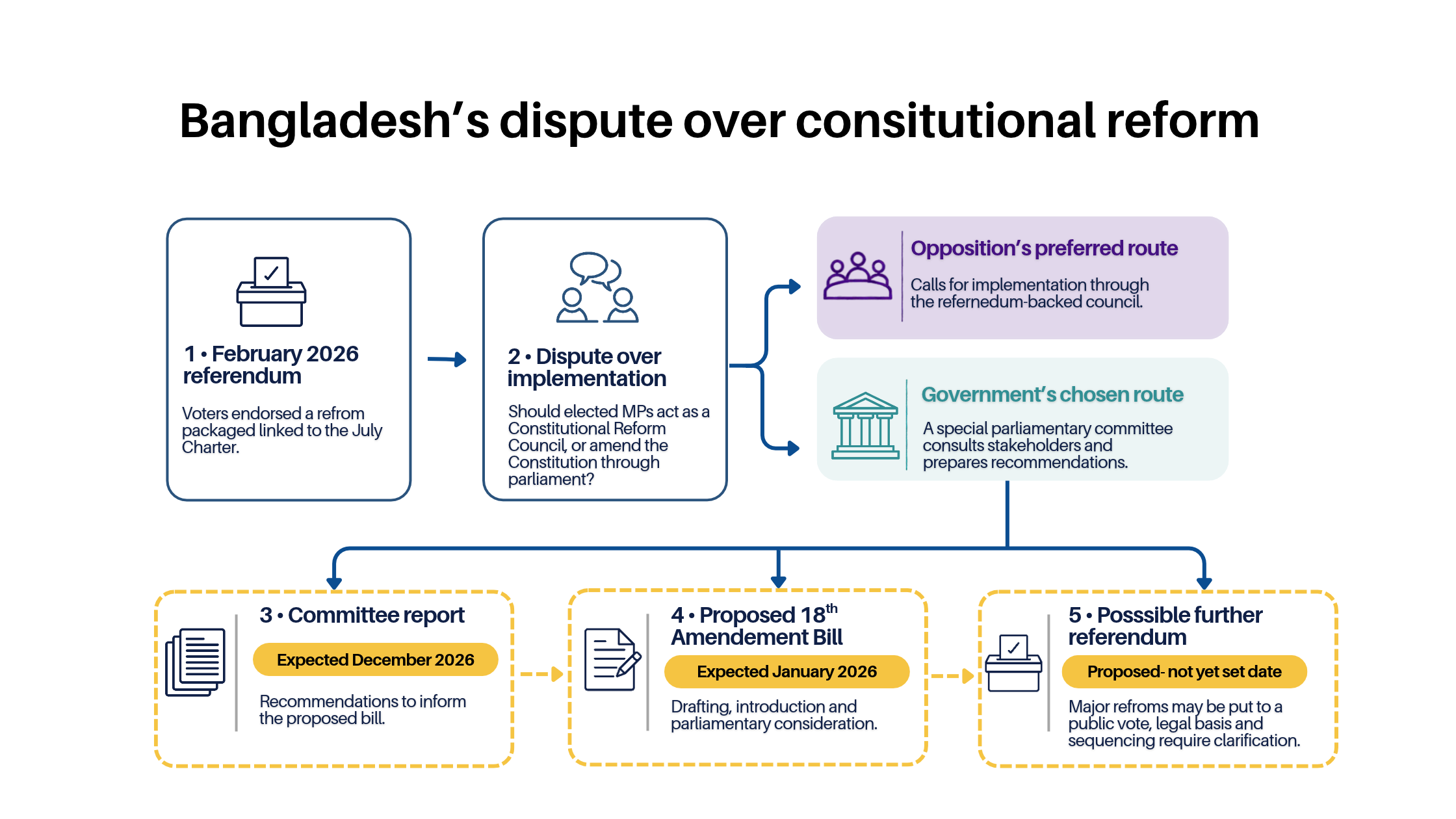
But disagreements soon emerged over how those commitments should be implemented following the February 2026 election and referendum. Under the 2025 Implementation Order setting out how the Charter would be implemented, the newly elected MPs were expected to serve both in Parliament and, after taking a separate oath, in a Constitution Reform Assembly intended to exercise constituent power and pass Charter reforms in 180 days. The ruling Bangladesh Nationalist Party (BNP) declined to take the latter prescribed oaths, citing the lack of an express constitutional basis for such a body or oath.
Although the BNP had backed the July Charter, it disputed the legal basis and legitimacy of the proposed Constitutional Reform Council, maintaining that constitutional changes should instead be enacted by parliament through the normal amendment procedure under Article 142. Siddiq has previously argued that this “literalism” prioritizes constitutional procedure over the substance of reform. In practice, the parliamentary route also gives BNP greater control over which reforms are ultimately adopted.
For Riaz, the distinction between the potential processes is fundamental. “It is not a matter of semantics when we talk about reform and amendments,” he said. The Charter, he argues, was intended to deliver structural change, backed by the “popular verdict” or “constituent power of the people” expressed through the referendum, a mandate he believes is now being ignored. Ordinary amendments risk amounting to little more than “band-aids.”
There is also a legal difference. Siddiq argues that a Constitution Reform Council could have exercised constituent power, particularly with the authority conferred by a referendum. Reforms passed through Parliament’s ordinary amendment powers, by contrast, could be “susceptible to judicial review on the ground that they violate the existing Constitution's basic structure.” This concern carries further weight given the failure to implement earlier measures aimed at reducing executive influence over the judiciary.
Is the real obstacle political?
For both Riaz and Siddiq, however, the underlying problem is less procedural than political.
Riaz argues that the February 2026 referendum on the July Charter’s constitutional reforms the negotiations behind the July Charter and the resulting political agreements provided the foundations for pursuing fundamental reform. What matters now, he says, is whether the ruling party has the political will to follow through. Riaz notes, “Unfortunately, I'm getting increasingly less optimistic than I used to be, because the process itself is constraining itself in significant manners.” He further expresses his disappointment and concern with the BNP’s “tendency of maintaining the status quo in a roundabout way.”
Siddiq also points to the breakdown in broader political participation. Opposition parties have refrained from participating in the parliamentary reform committee and its consultations, arguing that it bypassed the referendum and was structured to give the BNP control over the process. A cross-party agreement, he suggests, would give the resulting reforms greater legitimacy and make them more sustainable. Indeed, this point aligns with broader research on the importance of inclusive constitution-building processes.
Beyond the 18th Amendment, what are the immediate reform priorities?
Many of the Charter’s proposals centred on a common objective of reducing executive influence and strengthening the institutions responsible for holding government to account.
Both Riaz and Siddiq highlight judicial independence, including an independent Supreme Court Secretariat and more transparent, merit-based procedures for appointing Supreme Court judges. Similar questions surround the independence of the Election Commission, Public Service Commission, Anti-Corruption Commission and Comptroller and Auditor General. Other proposed checks include opposition leadership of key parliamentary committees, an upper house, constraints on the Prime Minister’s powers and new arrangements for the caretaker government.
Above all else, Riaz emphasizes that all these measures need to be considered together. With the scope of the proposed 18th Amendment bill still being determined, it remains to be seen how much of the Charter ultimately survives. Implementing some while weakening or abandoning others risks undermining the structural change the Charter was designed to achieve.
What comes next?
A special parliamentary committee is currently reviewing reform proposals and aims to submit its recommendations for constitutional amendments by December 2026. The proposed18th Amendment Bill, based on these recommendations, is expected to be introduced in parliament in January 2027, even without opposition participation.
Government ministers have said the July Charter will be implemented “word for word.” For Siddiq, publication of the Bill, together with its contents, will provide the clearest indication yet of whether that commitment is being honoured.
The key question will be what the agreed reforms look like once translated into law. For example, does the Bill meaningfully constrain executive power, including by reducing the President’s dependence on prime ministerial advice under Article 48? Does it genuinely safeguard the independence of the judiciary and constitutional bodies, rather than amounting to what Riaz calls “eyewash”? And does it preserve the institutional checks agreed through the July Charter process?
Moreover, Bangladesh’s non-party caretaker system, in which an interim administration oversees elections, has a contested history. Introduced constitutionally in 1996 and abolished in 2011, its restoration was upheld by the Supreme Court in July 2026. Riaz describes the design of the restored system as “a litmus test,” particularly whether it will be sufficiently insulated from the political influence that affected previous models.
Ultimately, the 18th Amendment will show whether Bangladesh is moving towards the structural reform envisaged by the July Charter, or the “band-aid” amendments Riaz and Imran warns
Note: This blog is the third in a three-part series on Bangladesh’s democratic transition. The first blog post can be read here, and the second here.


About the author