


Opening remarks by Kevin Casas-Zamora at the UNESCO World Trends Report launch in Stockholm
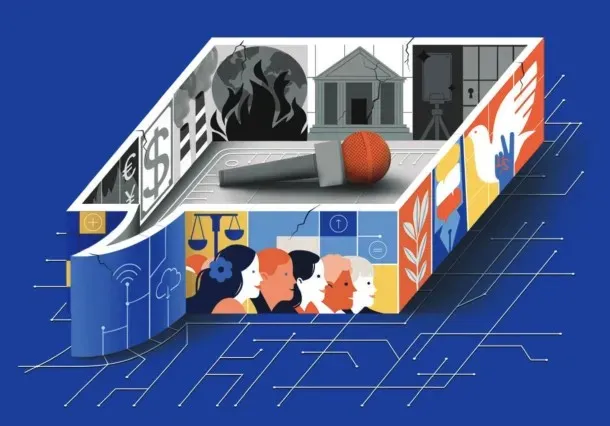
I am delighted that International IDEA is partnering with UNESCO and the Swedish National Commission for UNESCO to host today’s launch.
I’m Kevin Casas-Zamora, the Secretary-General of International IDEA. For any of you who are not so familiar, our Institute is an intergovernmental organization, with 35 Member States from all regions and a sole mandate to support democracy globally. We are proud to have our headquarters here in Sweden, but we also have offices around the world, and we work in more than 60 countries.
Our activities combine research with capacity development projects, convening of dialogues like this one, and policy advocacy. For more than 30 years, we have developed and delivered expertise in elections, constitutions, political participation, gender and inclusion, and money in politics, to name a few topics. We are also one of the world’s leaders in assessing the quality and performance of democracies, through our Global State of Democracy Initiative.
In what remains of my brief remarks, I want to do two things. First, I’ll share how the core messages of the World Trends Report resonate with International IDEA’s own work. And second, I’ll reflect on why these messages are so important and timely, not just for freedom of expression and press freedom, but for the fate of democracy overall.
The World Trends Report shows how media freedom and freedom of expression are under a level of strain not seen in a generation and rarely encountered outside wartime. The unprecedented nature of this decline echoes findings in International IDEA’s most recent Global State of Democracy Report, published at the end of last year. That analysis revealed that over the previous 5 years, Freedom of the Press declined in a quarter of the 173 countries covered, marking the most far-reaching decline since the start of our dataset in 1975. This deterioration was found in all regions, impacting 15 African countries, 15 European countries, 6 countries in the Americas, and 6 in Asia and the Pacific. The decline in Freedom of the Press complemented a broader decline in Freedom of Expression.
At International IDEA, we are also familiar with these trends from our work on the ground, seeking to strengthen democratic resilience. I’ll share just two examples. In Sierra Leone, we partnered with the national association of journalists to deliver intensive media and information literacy training—empowering journalists, bloggers, and youth advocates with skills and tools to sustain the integrity of their media ecosystem in a digital age. And in Moldova, we have helped bolster the Central Electoral Commission’s ability to oversee online campaigning and political advertising, supporting them in the fight against foreign information manipulation and interference.
So, we are not surprised by the themes and findings in the latest World Trends Report. But we are certainly concerned. We are concerned not only because press freedom is one vital aspect of democracy, but also because the deterioration of press freedom is a crucial symptom of a broader trend of democratic decline. Let me elaborate.
Worldwide, we are witnessing the rise of populist movements with autocratic orientations that have wreaked havoc with traditional party systems and, more broadly and more importantly, with democratic institutions writ large. In many cases, including my own home region of Latin America, this trend is largely rooted in citizens’ legitimate exasperation with political corruption—yet the result of this phenomenon is, in most cases, a weakened institutional capacity to fight corruption and channel social demands in peaceful ways.
Among the key institutions that have been weakened by this virulent strain of populism, is press freedom. Autocrats and would-be autocrats go after independent media outlets as a first order of business. As press freedom is reduced, the unique ability of independent media to reveal abuses of power, including corruption, is degraded. The ensuing flourishing of corruption further undermines public confidence in democracy and its institutions, powering a vicious cycle that perpetuates the trend towards authoritarian alternatives. As the banner on the Washington Post famously says, Democracy Dies in Darkness.
This, then, is why the subject of today’s event is so timely and vital—for the wellbeing of our independent media and more generally for the health of our democracy. And this is why International IDEA is so proud to be partnering on this event. Safeguarding press freedom is an indispensable part of renewing democracy, at a time when democracy is coming under mounting pressure and such renewal is greatly needed.
As Nobel Laureate and leading Filipino journalist Maria Ressa has warned, “Without facts, you can’t have truth. Without truth, you can’t have trust. Without all three, we have no shared reality, and democracy as we know it—and all meaningful human endeavors—are dead.” Well, a free and independent media is crucial for building facts, truth, trust, and shared reality. It is key to keeping democracy alive. And I put it to you that there is no more worthy cause than that.
Thank you.


