


Opening Remarks from Kevin Casas-Zamora at the 2026 Global State of Democracy Report Launch
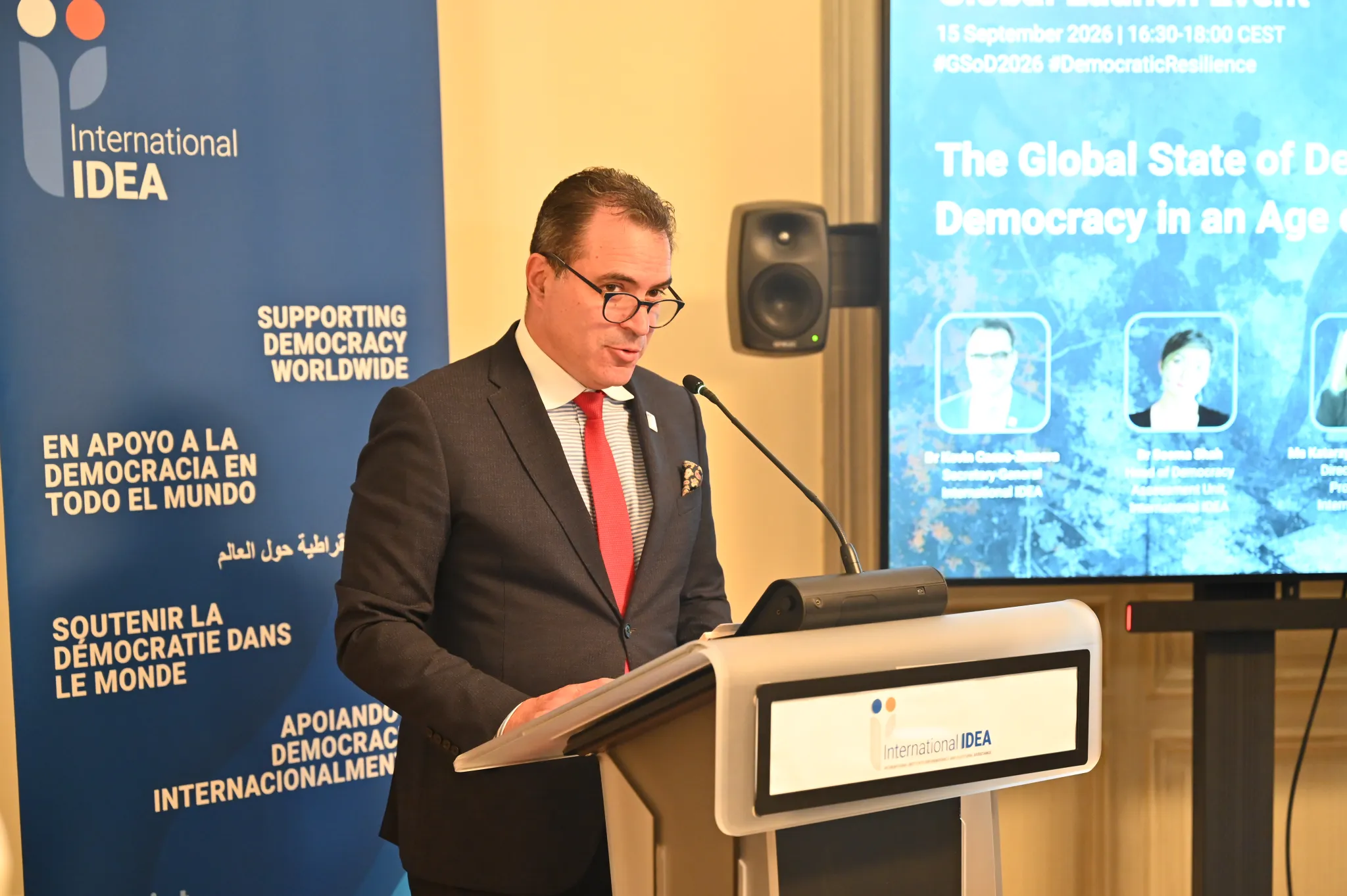
Hello, and welcome to this launch of International IDEA’s 2026 Global State of Democracy Report. I am so happy to see so many of you joining us, here in the room in Stockholm and online from all over the world.
I’m Kevin Casas-Zamora, the Secretary-General of International IDEA. And for any who are not so familiar with our Institute, we are an intergovernmental organization, with 35 Member States from all regions, dedicated to supporting sustainable democracy globally. As part of this mandate, we have an important role as one of the leading voices in assessing the quality and performance of democracies around the world.
Each year, these efforts culminate in the publication of our flagship report, the Global State of Democracy, which is what brings us together today.
In what remains of these brief opening remarks, I want to do two things. First, I’ll give you a sense of how International IDEA assesses democratic performance. And second, I’ll share a glimpse of this year’s main findings, as a preview of the presentation to follow.
International IDEA’s Global State of Democracy Initiative is a unique combination of comparative data, timely analysis, and policy-relevant publications. Our research leverages our global presence and expertise, our comprehensive quantitative databases, and our innovative Democracy Tracker, which assesses democracy qualitatively on a continuous basis. We aim to reflect global, regional, and country-level trends, while also capturing emerging phenomena relevant to democracy. Our approach is granular, assessing democratic performance in 173 countries around four core dimensions, namely Representation, Rights, Rule of Law, and Participation. Since different aspects of democracy evolve at different rates in different places, we evaluate a country’s democracy in each of these four categories, rather than aggregating results into a single score or ranking, which often obscures more than it reveals.
We are only able to provide such broad and deep analysis because many of our Member States support us through the Institute’s core budget. I want to thank them, not only from our organization but on behalf of the policymakers, practitioners, and researchers worldwide who use our findings to understand and support democracy.
To increase the impact of our research, and to bring greater attention and focus to our policy recommendations, we now structure each annual report in two parts. The first part of the report is an assessment of how democracy is performing globally, illustrated through cases from all over the world, as well as tables showing countries’ relative performance in each of the four categories I just mentioned. The second part of the report is a thematic policy paper, illuminating a specific issue, phenomenon or trend, and providing policy recommendations related to it. This year, our report focuses on the relationship between democracy and conflict.
Let me now highlight a few of the main trends this year, some of which will be familiar to those of you who have read our previous reports. For the 11th year in a row, more countries declined in performance than advanced. At the same time, if we look at all indicators of democracy across all countries, more than 80% experienced no change at all. In most places in the world today, democracy’s dominant narrative is actually one of stagnation. In most cases, this stagnation is at a mediocre or even low level of performance, which means that it is not good news.
Among the four dimensions of democracy our report measures, Rule of Law appears especially vulnerable. Not only is it declining, but it is doing so from a low baseline. The reasons for this are both historical and very current. Many newer democracies never fully consolidated their judicial systems, legal enforcement mechanisms, or anti-corruption institutions. Insofar as these safeguards did exist, however, they are now being further weakened, as authoritarian populism challenges judicial independence, and as the normative infrastructure of international law is weakened by disuse and abuse.
It is not only young democracies that are vulnerable to this democratic decay. The United States has become the most prominent example and a leading accelerator of the trend towards a diminished Rule of Law. Indeed, the negative trajectory of democracy in the United States on many fronts stands out in our report.
The quality of a country’s governance must ultimately be measured by its impact on the governed—and in this regard, the greatest promise of democracy is peace. The second part of this year’s report considers the interactions between democracy’s recent challenges, including those I’ve just mentioned, and the well-documented resurgence of conflict both within and between states.
Our analysis reinforces the persistence of international democratic peace—overwhelmingly, democracies are peaceful with each other, making democratization an invaluable vector of peace. But our research adds important nuance, finding that the countries with the highest risk of conflict, both internally and internationally, are those that are neither fully autocratic nor well-established democracies. The current era of democratic decline is producing more countries in the messy middle-to-low territory of democratization, and this in turn is spreading the conditions for conflict.
Two weeks ago, I was in Côte d’Ivoire, meeting with counterparts at the African Development Bank and the African Union Mission for Mali and the Sahel to discuss cooperation in supporting democratic governance, sustainable development, and peacebuilding in one of the most fragile parts of the world. And let me tell you, for those on the frontlines, the connection between their mandates and democracy is self-evident. Just as we have known for decades that democracies are more inclusively prosperous than undemocratic regimes, achieving better results on a range of indicators from basic welfare to gender and social equality, so too have we known for decades that democratic consolidation is part of the pathway to peace.
This report is less a revelation than a reminder that the choice between investing in democracy and investing in security is a false one. With these pages we want to convey a key message in this time and age: governments should treat democracy support abroad as a national security priority because stronger democratic systems can help reduce conditions leading to conflict. Even small investments in democracy support can deliver significant peace and governance gains, at a much, much lower cost than military responses.
Quite simply, a more democratic world is a more peaceful world. And such a world is possible.
With that, I’m now very pleased to hand the floor over to our Head of Democracy Assessment, Dr. Seema Shah, to present the 2026 Global State of Democracy Report.
Thank you again for joining us.


