


Strengthening Indigenous Peoples’ Land and Territorial Rights in Northeast India
Policy Brief, August 2026

Executive Summary
Indigenous peoples of Northeast India have diverse systems of communal ownership, customary governance, and natural resource management. Constitutional protections like the Sixth Schedule, articles 371A and 371G of the Constitution of India, and the Scheduled Tribes and Other Traditional Forest Dwellers (Recognition of Forest Rights) Act 2006 provide important safeguards, but their operation varies considerably across the region (India 1950; India, Ministry of Tribal Affairs 2012).
Land and territorial rights concern the ability of individuals and communities to access, use, govern, control, and benefit from land and natural resources. For many Indigenous peoples in Northeast India, these rights are collective as well as individual and are closely connected to identity, customary law, livelihoods, cultural continuity, and self-governance. Indian constitutional and statutory frameworks generally use the terms “Scheduled Tribes” and “tribal communities.” This paper uses “Indigenous peoples” in the broader international human rights sense, while recognizing that legal rights under Indian law depend on the relevant constitutional and statutory categories.
Customary tenure is often absent from formal land records; land governance responsibilities are shared among state authorities, autonomous councils, and customary institutions; and Indigenous communities may have limited influence over decisions affecting their lands and resources. These gaps can contribute to land insecurity, displacement, and intercommunity tension (Fernandes and Barbora 2009; Dhanaraju 2022).
This policy brief examines how clearer institutional responsibilities, context-specific recognition of collective tenure, accessible documentation, and stronger community participation could improve land governance. It presents policy options for national and state governments, autonomous councils, Indigenous institutions, communities, Asia Indigenous Peoples Pact (AIPP) member organizations, and development actors.
1. Background
Northeast India comprises eight states and a highly diverse range of Indigenous peoples, customary institutions, landholding systems, and constitutional arrangements (Fernandes and Barbora 2009). Land may be held or governed by villages, clans, families, chiefs, customary authorities, autonomous councils, or state institutions (Fernandes and Barbora 2009). These arrangements cannot be understood through a single regional model.

The Sixth Schedule of the Constitution establishes autonomous district and regional councils in specified tribal areas of Assam, Meghalaya, Mizoram, and Tripura (India 1950). These councils may exercise legislative, administrative, and judicial functions in areas that can include land, forests, customary law, and village administration (India 1950; Dhanaraju 2022). Their authority and capacity nevertheless vary. In some areas, land records, forest administration, development approvals, and financial resources remain substantially controlled by state departments, creating overlapping responsibilities and uncertainty over which institution has final authority (Dhanaraju 2022).
Different constitutional arrangements apply elsewhere. Article 371A protects specified aspects of Naga customary law and procedure and the ownership and transfer of land and its resources. Article 371G provides related protections in Mizoram (India 1950). Other areas are governed through state laws, village councils, chieftainship systems, and customary institutions. This diversity means that approaches appropriate in one state or autonomous area may not be transferable to another.
The Scheduled Tribes and Other Traditional Forest Dwellers (Recognition of Forest Rights) Act 2006 (Forest Rights Act) seeks to address historical injustice by recognizing individual and community rights in forest areas. Its operation in Northeast India has been uneven and shaped by preexisting customary ownership, constitutional autonomy, administrative capacity, and different state positions concerning its applicability. Community rights, in particular, have often received less attention than individual claims (India, Ministry of Tribal Affairs 2012; Fernandes and Barbora 2009).
Customary land rights are commonly maintained through oral histories, community knowledge, locally recognized boundaries, and established patterns of use rather than through statutory land records. Their absence from formal records does not mean that the land is unowned or unused. However, it can make communities more vulnerable during land acquisition, forest classification, infrastructure development, conservation initiatives, and compensation procedures.
These institutional and documentary gaps have become more significant as infrastructure, extractive activity, urban expansion, conservation measures, migration, and changing land markets place additional pressure on land. The main governance challenge is to improve coordination and recognition without replacing diverse customary systems with a single model of individual ownership.
In this paper, land rights refer to rights to access, use, occupy, own, control, and benefit from land and resources. Territorial rights have a broader collective dimension: they concern the authority of a people or community to govern a defined area, maintain cultural and social relationships with it, and participate in decisions affecting its future. The distinction is important in Northeast India because recognition of individual plots alone may not protect customary institutions, shared resources, sacred sites, mobility routes, or collective decision-making.
Recognition of customary governance should be designed with the communities concerned rather than imposed through a uniform statutory model. At the same time, formal recognition can raise questions about who is authorized to speak for a community, how decisions are recorded, and how the rights of women, young people, smaller clans, and other groups are represented. Locally agreed safeguards for inclusive participation, transparent decision-making, and accessible review can strengthen rather than displace customary authority.
Young Indigenous people have an important role in the continuity and adaptation of customary land systems. Research on the Karbi Jirsong youth institution illustrates how culturally embedded youth structures can support group learning, mutual assistance, and the transmission of Indigenous knowledge (Kiling and Engti 2026). Young people may contribute to documenting oral histories and boundaries, participatory mapping, legal awareness, and environmental monitoring. Involving young people in land-governance and consultation processes can support intergenerational knowledge transfer while introducing new technical and communication skills. Participation mechanisms should include young women and youth from smaller or less-represented communities.
2. Analysis: Why legal safeguards do not consistently secure land rights
Land and territorial rights are also questions of democratic governance. Decisions concerning land determine which institutions exercise authority, whose knowledge is recognized, and whether affected communities and disadvantaged groups can influence public decisions and hold decision-makers accountable. Northeast India does not lack legal protection for Indigenous land. The central problem is that constitutional, statutory, and customary safeguards do not always operate as a coherent system. Four related governance gaps are particularly important.
2.1. Fragmented Institutional Responsibilities
Responsibility for land governance is divided among state revenue and forest departments, autonomous councils, customary institutions, village authorities, and, in some cases, central agencies. The allocation of functions varies across states and autonomous areas. Where mandates over land records, forests, development approval, and dispute resolution are unclear, communities may face several institutions without knowing which one has final authority. Fragmentation can also allow one institution to approve a project or land-use change without fully accounting for rights recognized by another.
2.2. Customary Tenure is Not Fully Reflected in Formal Systems
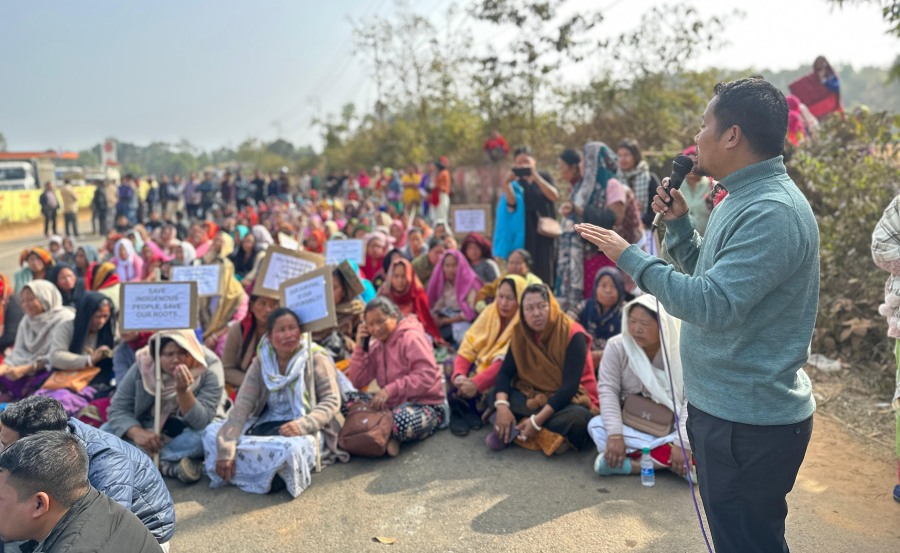
Customary tenure frequently recognizes collective, layered, or overlapping rights that conventional land records are not designed to capture (Fernandes and Barbora 2009). A community may hold territorial authority while families possess cultivation or residential rights, and other groups retain seasonal access to forests, water, or grazing areas. When administrative systems recognize only individual title or officially recorded possession, some of these rights disappear from legal and compensation processes (Fernandes and Barbora 2009; Debbarma 2015). Two reports published in 2025 documented a dispute in Assam’s Sixth Schedule district of Dima Hasao over the allocation of approximately 3,000 bighas of land to a private cement company. Residents of affected Karbi and Dimasa villages alleged inadequate consultation, unclear land demarcation, and pressure to accept compensation, while the Gauhati High Court requested information on the policy and procedures governing the allocation (Deep 2025; Guha and Bharadwaj 2025). Formalization can therefore improve security only if it reflects the tenure system concerned rather than replacing it.
2.3. Development and Conservation Decisions May Identify Rights Too Late
Infrastructure, industrial, extractive, and conservation initiatives can affect land before customary rights have been documented or all rights-holders identified (Fernandes and Barbora 2009). Consultation may take place only after key decisions have been made, limiting communities’ ability to consider alternatives or negotiate conditions. The absence of an individual title may also affect eligibility for compensation (Debbarma 2015). Stronger participation would require early tenure assessment, accessible information, recognition of collective interests, and clear arrangements for compensation, benefit-sharing, and remedy.
2.4. Land Disputes Intersect with Demographic and Political Tensions
Historical refugee settlement, migration, changing markets, urbanization, and administrative boundary changes have affected land access in parts of the region (Ghoshal 2019). Their effects are intensified where records are incomplete and citizenship, ethnicity, and land rights are politically contested (Ghoshal 2019). Policies framed only as land recovery or protection against encroachment may therefore generate new grievances unless they apply transparent standards, distinguish among different categories of occupation, and protect due process for all affected groups.
3. Development Decision-Making and Procedural Protections
Development projects like infrastructure, industry, conservation, and natural resource extraction have increasingly exerted pressure on Indigenous lands in Northeast India (Fernandes and Barbora 2009; Deep 2025; Guha and Bharadwaj 2025). While such projects may contribute to economic development, they can also give rise to disputes over customary land rights that are not adequately recognized, institutional responsibilities that overlap, or affected communities that have limited opportunities to participate in decision-making. Such challenges arise frequently in land acquisition, compensation, environmental clearances, and development projects, particularly where statutory and customary systems exist (Fernandes and Barbora 2009; Debbarma 2015). Transparent procedures, clear institutional responsibilities, and accessible grievance mechanisms are therefore important to ensure that competing land claims are addressed fairly and consistently.
North Joynagar in Tripura demonstrates these larger governance challenges. Development-related land acquisition gave rise to disputes over consultation, compensation, and recognition of customary land rights. The case shows how a lack of clarity in institutional responsibilities, poor recognition of customary tenure, and inadequate procedural safeguards can lead to long-standing conflicts between communities and public authorities (Debbarma 2015). This is not an isolated incident but symptomatic of broader governance issues that may emerge when statutory procedures are not fit for purpose to accommodate customary landholding systems.
These challenges extend beyond any one development project. When communities are unable to access information, consultation processes, effective grievance mechanisms, or opportunities to present customary evidence, decisions that affect Indigenous lands can become contested and erode confidence in public institutions. The principle of Free, Prior and Informed Consent (FPIC) as enshrined in the United Nations Declaration on the Rights of Indigenous Peoples (UNDRIP) offers an important international governance benchmark for participation and decision-making in this regard (United Nations General Assembly 2007). While UNDRIP is not directly binding in domestic law, the principles outlined therein can help to shape the design of consultation, information-sharing, and decision-making processes within India’s constitutional and statutory framework to support the strengthening of procedural fairness and accountability in land governance (United Nations 2007).
3.1. State Versus Autonomous District Councils
Autonomous district councils provide an important institutional basis for self-governance in Sixth Schedule areas (India, Republic of 1950; Dhanaraju 2022), but their ability to protect land and territorial rights differs considerably. Some councils have limited technical and administrative capacity, depend heavily on transfers, or lack effective control over functions such as land records, forests, development approvals, and spatial planning (Dhanaraju 2022; Singha 2021). Their relationship with state departments and customary village institutions may also be unclear. Strengthening their role therefore requires attention not only to formal powers, but also to finance, staffing, information systems, coordination, public accountability, and inclusive community participation.
3.2. Development Decision-Making and Land-Rights Safeguards
Development and the protection of Indigenous land rights do not need to be treated as opposing objectives. The key question is whether decisions identify legitimate tenure and involve affected communities before the main project parameters are fixed. Relevant safeguards include early mapping of customary and collective rights, accessible information in appropriate languages, participation while alternatives remain open, consideration of cumulative environmental and social effects, and clear arrangements for compensation, benefit-sharing, and grievance resolution. The level and form of participation should reflect the applicable legal framework and the scale of the likely impact (
The experience of residents of North Joynagar in Tripura illustrates how customary occupation may be overlooked when development and compensation procedures depend on formal documentation: research concerning the village describes repeated attempts to use community land for FCI (Food Corporation of India) and IOCL (Indian Oil Corporation Limited) and public-sector projects and reports that residents were not consistently recognized as entitled to compensation. Community resistance reportedly prevented a further occupation of the land in 2013. Although the case cannot represent the region, it highlights the importance of identifying customary and collective rights before project approval and of providing accessible procedures for participation, compensation, and remedy (Debbarma 2015).
3.3. Demographic and Political Changes
Beyond individual cases of displacement, broader demographic and political changes have also intensified pressures on Indigenous land rights across the region. Tripura’s demographic composition changed substantially following Partition, later episodes of communal violence, and the settlement of refugees and other migrants (Ghoshal 2019). These changes affected access to land, political representation, and relations between Indigenous peoples and other residents (Ghoshal 2019). Their impact cannot be understood solely as a consequence of migration: it also reflects state settlement policies, changes in land administration, market expansion, and the limited recognition of customary tenure (Ghoshal 2019; Fernandes and Barbora 2009). Contemporary policy should therefore distinguish among historical settlement, lawful residence, disputed occupation, and land acquired through administrative or commercial processes. Any land-recovery or eviction measure should apply clear criteria, protect due process, and avoid attributing collective responsibility to ethnic or migrant groups.
The evidence suggests that the main challenge is not the complete absence of legal safeguards, but the gap between formal protection and day-to-day land governance. Greater security is likely to depend on clearer institutional responsibilities, recognition of diverse forms of customary tenure, early participation in decisions affecting land, and accessible mechanisms for documentation and remedy. Because constitutional and customary arrangements vary across Northeast India, policy responses should be developed state by state and with the communities concerned. These reforms would also strengthen democratic accountability by clarifying who makes land decisions, widening participation, and enabling communities to monitor implementation.
4. Policy options
4.1. Clarify Institutional Responsibilities
National and state authorities, autonomous councils, and customary institutions should review how responsibilities for land records, forests, development approvals, spatial planning, and dispute resolution are allocated in each state or autonomous area. Where functions overlap, publicly available rules of business, coordination protocols, or joint decision-making procedures may reduce uncertainty. Administrative reforms may be possible without constitutional amendment, although the appropriate approach will depend on the legal context (Dhanaraju 2022; Fernandes and Barbora 2009).
4.2. Strengthen the Capacity and Accountability of Autonomous Councils
In Sixth Schedule areas, governments and councils should assess whether existing financial, staffing, and technical arrangements allow councils to exercise their assigned functions effectively. Options include more predictable financing, land-administration expertise, spatial-planning capacity, and improved access to information. Capacity support could be accompanied by transparent budgeting, publication of land decisions, and locally appropriate participation by women, young people, smaller clans, and other groups (Dhanaraju 2022; Singha 2021).
4.3. Recognize Customary and Collective Tenure in Appropriate Forms
State governments, autonomous institutions, and communities should explore legally valid forms of documentation that reflect collective, clan, village, household, and overlapping rights. Possible tools include participatory maps, community registers, customary boundary records, and collective certificates. Such processes should not presume that individual or transferable title is always appropriate. Communities should determine what is documented, who may access the information, and how it may be used (Fernandes and Barbora 2009).
4.4. Review Forest Rights Act Arrangements State by State
Relevant authorities should undertake state-specific reviews of how the Forest Rights Act interacts with constitutional autonomy and preexisting customary ownership. Reviews may consider the recognition of community forest resource rights, the role of the Gram Sabha or equivalent community institutions, unresolved and rejected claims, and the availability of disaggregated data. The purpose would be to identify arrangements appropriate to each context rather than impose a single regional model (India 1950; India, Ministry of Tribal Affairs 2012).
4.5. Improve Participation in Development and Conservation Decisions
Authorities and project proponents could identify customary and collective tenure before approving infrastructure, extraction, industrial, or conservation measures. Participation should begin while alternatives remain open and provide information in accessible languages and formats. Depending on the legal and institutional setting, possible safeguards include community consultation protocols, independent facilitation, social and environmental impact assessment, compensation for collective interests, benefit-sharing, and accessible grievance mechanisms. UNDRIP and FPIC principles may provide useful governance benchmarks (United Nations General Assembly 2007).
4.6. Support Community-Led Documentation and Knowledge
Communities, AIPP member organizations, research institutions, and development partners should support locally led documentation of customary boundaries, oral histories, land-use practices, and environmental change. Communities should retain ownership and control of the resulting data. Such initiatives could provide meaningful roles for Indigenous youth in participatory mapping, intergenerational documentation, and community monitoring, building on their existing roles in Indigenous knowledge systems and community organization (Kiling and Engti 2026). Exchange among communities may also strengthen legal literacy, intergenerational learning, dispute-resolution practice, and the use of mapping or monitoring tools (Fernandes and Barbora 2009).
4.7. Strengthen Public Information and Accountability
Governments and councils should publish accessible information on land procedures, institutional responsibilities, recognized claims, rejected applications, development approvals, and available grievance mechanisms. Training for land, forest, and development officials would improve understanding of customary and collective tenure. Better public information would also allow communities and civil society organizations to monitor implementation and identify where further reform is needed.
Abbreviations
AIPP Asia Indigenous Peoples Pact FPIC Free, Prior and Informed Consent UNDRIP United Nations Declaration on the Rights of Indigenous Peoples
References
Debbarma, Khumtiya. 2015. “Human Rights and Land Acquisition: A Case Study of North Joynagar Village in Tripura.” Journal of North East India Studies 5 (2): 18–31. https://doi.org/10.5281/zenodo.12779684.
Deep, Pratyush. 2025. “The Real Story behind Assam’s 3,000-bigha land row.” Newslaundry, 19 August. https://www.newslaundry.com/2025/08/19/no-it-wasnt-adani-the-real-story-behind-assams-3000-bigha-land-row.
Dhanaraju, Vulli, ed. 2022. Problems and Prospects of the Sixth Schedule: Towards Tribes Autonomy and Self-Governance. The Asiatic Society.
Fernandes, Walter, and Sanjay Barbora, eds. 2009. Land, People and Politics: Contest over Tribal Land in Northeast India. North Eastern Social Research Centre, Panos South Asia and International Work Group for Indigenous Affairs. https://iwgia.org/en/resources/publications/2573-land-people-and-politics-contest-over-tribal-land-in-northeast-india.html.
Ghoshal, Anindita. 2019. “From Hosts to Hostiles: Land, Migrants and the Contest for Habitat in Tripura.” Journal of History 33:159–98.
Guha, Nabarun, and Sanskrita Bharadwaj. 2025. “First Came the Drones, Then the Eviction Threat: Assam Tribals in Constitutionally Protected Area Defy Cement Plant.” Article 14, 3 September. https://article-14.com/post/first-came-the-drones-then-the-eviction-threat-assam-tribals-in-constitutionally-protected-area-defy-cement-plant-68b7bc8fdcc91.
India, Ministry of Tribal Affairs. 2012. Guidelines on the Implementation of the Scheduled Tribes and Other Traditional Forest Dwellers (Recognition of Forest Rights) Act 2006. 12 July. https://tribal.nic.in/downloads/FRA/General%20executive%20direction/GED-25%20FRA%20implementation%20Guidelines%20dated%2012.07.2012.pdf.
India, Republic of.1950. Constitution of India. https://www.indiacode.nic.in/bitstream/123456789/19150/1/constitution_of_india.pdf.
Kiling, Manish, and Binod Engti. 2026. “Jirsong: An Indigenous Youth Model of Group Work among the Karbi People.” Social Work With Groups 1-19. Published online 24 April. https://doi.org/10.1080/01609513.2026.2664397.
Singha, Baba Chandra. 2021. “Alienation of Tribal Land in the Sixth Schedule Area: A Case Study of West Karbi Anglong District of Assam.” Psychology and Education 58(2): 9998–10003. https://psychologyandeducation.net/pae/index.php/pae/article/view/3936/3490.
United Nations General Assembly. 2007. United Nations Declaration on the Rights of Indigenous Peoples. Resolution A/RES/61/295, 13 September. https://docs.un.org/A/RES/61/295.
About the author
John Debbarma is the former General Secretary and current Vice President of Twipra Students’ Federation (TSF) and serving as the Focal Person for Northeast India in the Asia Indigenous Youth Platform (AIYP). He belongs to the Tripuri Indigenous people of Northeast India (Tripura) and is actively engaged in the protection of Indigenous peoples’ human rights and identity, particularly in relation to sustainable development. He works to protect land and territorial rights, preserve Indigenous cultures, promote Indigenous youth empowerment, and advocate for social justice, education, and the rights of the Indigenous peoples.
About the AIPP
The Asia Indigenous Peoples Pact (AIPP) is a regional membership-based organization founded in 1992 by Indigenous Peoples’ movements across Asia. Serving as a platform for 46 member organizations and movements across 14 countries, AIPP brings together Indigenous Peoples to discuss shared challenges, develop common positions, and advance programs that promote and protect their rights and interests. Over three decades, AIPP has become a trusted and influential vehicle for solidarity, cooperation, and collective action among Indigenous Peoples in Asia, implementing initiatives developed and approved in partnership with its members and coordinating five regional networks focused on Indigenous Media, Women, Defenders, Knowledge, and Youth.


© 2026 International Institute for Democracy and Electoral Assistance
International IDEA publications are independent of specific national or political interests. Views expressed in this publication do not necessarily represent the views of International IDEA, its Board or its Council members.
With the exception of any third-party images and photos, the electronic version of this publication is available under a Creative Commons Attribution-NonCommercial-ShareAlike 4.0 (CC BY-NC-SA 4.0) licence. You are free to copy, distribute and transmit the publication as well as to remix and adapt it, provided it is only for non-commercial purposes, that you appropriately attribute the publication, and that you distribute it under an identical licence. For more information visit the Creative Commons website:
http://creativecommons.org/licenses/by-nc-sa/4.0
Design and layout: International IDEA
DOI: <https://doi.org/10.31752/46068>
ISBN: 978-91-8137-209-0 (PDF)
ISBN: 978-91-8137-210-6 (HTML)


