


The Role of Youth in Climate Litigation in the Republic of Korea
Case Study, September 2026

Executive Summary
On 13 March 2020, 19 teenage members of Youth 4 Climate Action filed a constitutional complaint challenging the Republic of Korea’s greenhouse gas reduction framework (Youth 4 Climate Action n.d.-d). The case was later consolidated with three related constitutional complaints. On 29 August 2024, the Constitutional Court of Korea found article 8(1) of the 2021 Framework Act on Carbon Neutrality and Green Growth for Coping with Climate Crisis not in conformity with the Constitution because it failed to provide quantified greenhouse gas reduction targets for the period from 2031 to 2049, thereby shifting an excessive burden onto future generations. The court did not invalidate the 2030 reduction target, leaving considerable discretion over the precise emissions pathway to the legislature.1
From a democracy perspective, the case illustrates how youth-led climate litigation can provide a channel for people with limited electoral influence to bring long-term and intergenerational interests into constitutional review. Youth advocacy also extended beyond the courtroom through public campaigns, coalition-building, and transnational cooperation. Following the judgment, the National Assembly initiated a deliberative process that sought specifically to reflect the interests of younger and future generations.
The case also illustrates the limits of judicial intervention. The National Assembly missed the court’s February 2026 amendment deadline and subsequently adopted a legislative compromise following a public deliberative process on the long-term emissions reduction pathway (National Assembly 2026). The amendment was passed by the National Assembly on 26 August and promulgated on 8 September 2026.2 The case therefore suggests that the democratic significance of climate litigation lies not only in judicial outcomes but also in how litigation interacts with political participation, legislative deliberation, and institutional implementation, including by creating opportunities for younger generations to participate in public debate.
Introduction
On 13 March 2020, 19 teenagers filed a constitutional complaint with the Constitutional Court of Korea, challenging the national greenhouse gas (GHG) reduction target established under the then-applicable 2010 Framework Act on Low Carbon, Green Growth, claiming that the target failed to protect their constitutional rights from the emerging impacts of the climate crisis. This marked the first climate litigation in the Republic of Korea. Following the adoption of the 2021 Framework Act on Carbon Neutrality and Green Growth for Coping with Climate Crisis, the petitioners amended their complaint to challenge the new statutory framework. On 29 August 2024, the court found article 8(1) of the 2021 Framework Act not in conformity with the Constitution because it contained no quantified reduction standard for the period from 2031 to 2049 and therefore failed to prevent an excessive mitigation burden from being shifted to future generations. The provision was allowed to remain temporarily in force, with the National Assembly required to amend it by 28 February 2026.3
This historic victory not only marks a turning point in climate action in the jurisdiction, but it is also a powerful testament to how the voices of young people are changing public perceptions, political narratives, and legal interpretations of the climate crisis. This case study traces the history and development of youth climate litigation in the Republic of Korea and examines how young people have shaped climate discourse.
1. Case History
The 19 youth plaintiffs who filed the first climate litigation before the Constitutional Court of Korea are members of Youth 4 Climate Action, a climate action group organized by teenagers in 2018, the year the youth-led climate movement emerged around the globe. Youth 4 Climate Action began with school strikes, picketing demonstrations, and public campaigns demanding stronger climate action as well as improved climate education in schools (Youth 4 Climate Action n.d.-a).
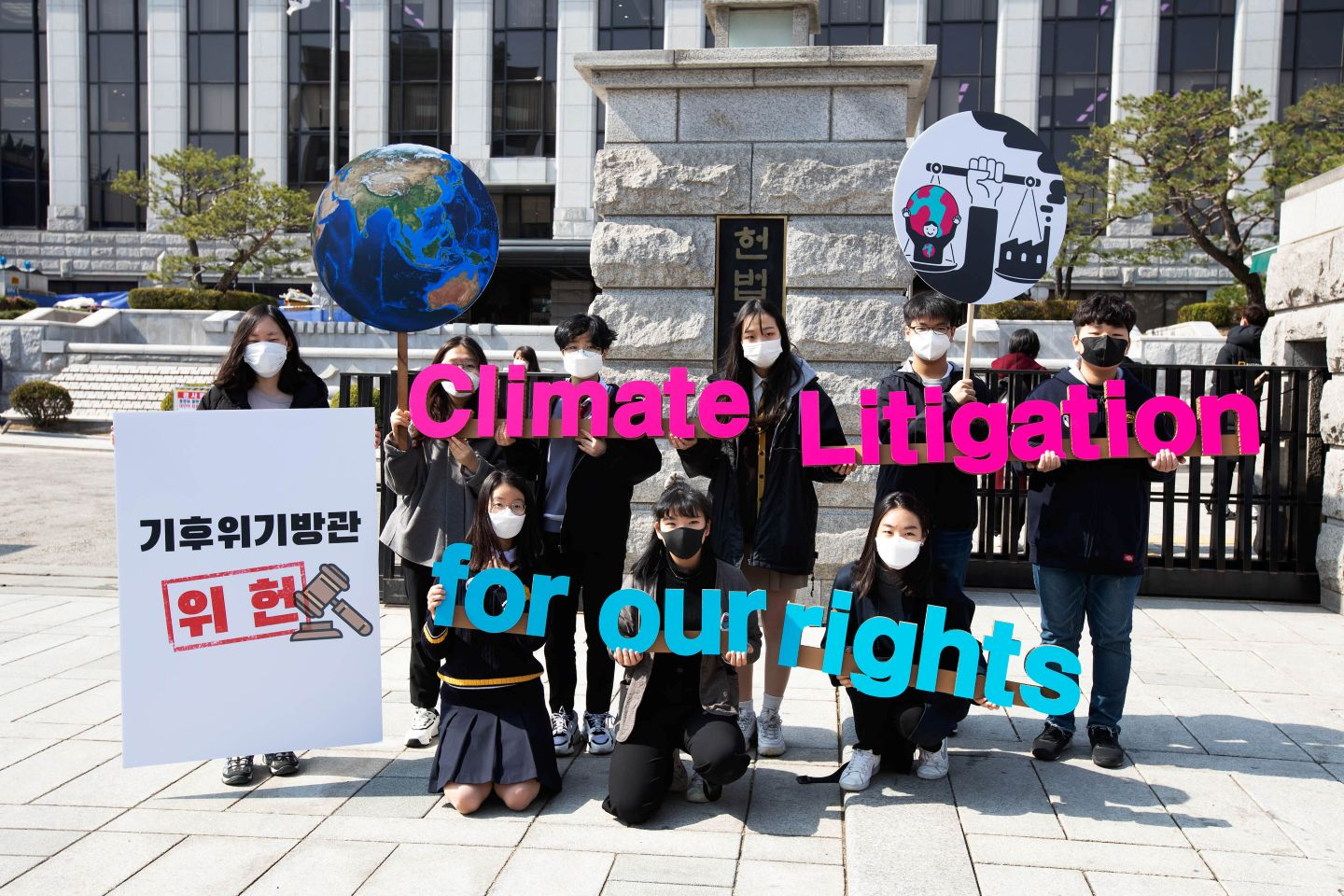

Youth 4 Climate Action attracted significant media attention because it was not common for teenagers to take action on social issues in the Republic of Korea. Youth activists were also invited to speak to policymakers and politicians about their demands. However, they soon realized their demands were not being taken seriously, and they decided to change their strategy and take the matter to court.
On 13 March 2020, the youth petitioners challenged the statutory and regulatory framework governing the national GHG reduction target. They argued that the target established under the Framework Act on Low Carbon, Green Growth and its accompanying enforcement decree failed to provide adequate protection for several fundamental rights, including the rights to a healthy environment, life, and health, as well as intergenerational equality.4
At the time of the filing, the Framework Act on Low Carbon, Green Growth called for a 24.4 percent reduction in GHG emissions from 2017 levels by 2030.5 In October 2020, the government pledged to achieve carbon neutrality by 2050 (Republic of Korea 2020). Subsequently, in September 2021, the National Assembly passed the Framework Act on Carbon Neutrality and Green Growth for Coping with Climate Crisis as the new legal framework for climate change. The government announced a revision of its Nationally Determined Contribution (NDC) in October 2021, calling instead for a 40.0 percent reduction from 2018 levels by 2030. The revised 2030 target was subsequently incorporated into the act’s enforcement decree in March 2022.6 In April 2023, the government finalized the First National Carbon Neutrality and Green Growth Basic Plan, which established annual and sectoral emissions reduction targets through 2030 (2050 Carbon Neutrality and Green Growth Commission 2023).
Following the adoption of the new act, the petitioners amended their complaint to challenge the revised 2030 target and the legal framework supporting it. They maintained that the updated framework still failed to provide the level of protection for their fundamental rights required by the Constitution.7
The case triggered a wave of climate litigation. In October 2021, 123 citizens, including civil society activists, political party members, and citizens representing the most affected people and areas, filed a constitutional claim arguing the unconstitutionality of the law.8 In June 2022, 62 children under the age of 10, including one unborn fetus, filed another constitutional claim against the law and the presidential decree prescribing the 2030 NDC.9 Finally, in July 2023, 51 citizens filed a constitutional claim against the Carbon Neutrality Basic Plan.10
On 21 August 2023, the National Human Rights Commission of Korea submitted an opinion to the Constitutional Court arguing that article 8(1) of the Framework Act and article 3(1) of its enforcement decree failed to provide the minimum protection required for the rights and freedoms of current and future generations (National Human Rights Commission of Korea 2023).
A major development occurred in February 2024, almost four years after the initial filing of the case, when the court decided that it would merge the four cases and convene a public hearing.
The court convened public hearings in April and May 2024, including oral arguments, expert testimony on climate science and international law, and the statements of the petitioners.
The final decision was rendered three months after the second hearing, on 29 August 2024.
2. Key Findings in the Case
The petitioners in the consolidated cases had three overlapping claims. First, they argued that article 8 of the carbon neutrality act violated the state’s obligation to protect the petitioners’ fundamental rights because it prescribed a GHG reduction target for 2030 only and net zero for 2050 but failed to provide any targets for the period from 2031 to 2049. Second, regarding the enforcement decree, the petitioners argued that the GHG reduction target for 2030 of 40 percent from 2018 levels was in violation of the state’s obligation to protect fundamental rights because it was insufficient to limit temperature increase to 1.5 degrees based on: (a) the Intergovernmental Panel on Climate Change’s (IPCC) 1.5-degree global pathway; (b) the United Nations Environment Programme’s Emissions Gap Report; (c) Climate Action Tracker analysis; (d) carbon budget analysis based on per capita distribution; (e) a comparison of NDCs from Organisation for Economic Co-operation and Development countries; and (f) Climate Change Performance Index rankings. Third, the plaintiffs claimed that the carbon neutrality plan violated the state’s obligation to protect fundamental rights because the actual reduction measures fell short of the 40 percent target, as it used gross emissions for the base year but net emissions for the target year.
2.1. Right to a Healthy Environment
In its final decision, the court began its analysis by identifying the relevant right. After acknowledging the key scientific facts regarding climate change, including its cause, projected outcomes, urgency of mitigation, carbon budget, and tipping points, the court ruled that the right to a healthy environment, as guaranteed in article 35 of the Constitution,11 was the most relevant right.12
The court also recognized that the petitioners had argued on the basis of a number of other fundamental rights under the Constitution, including the right to intergenerational equality, but ruled that it would not provide a separate analysis of the other rights because the rationale provided in the analysis of the right to a healthy environment encompassed the analysis of the other rights. However, as discussed in 2.2. Constitutional Requirements, the court’s actual rationale in determining the unconstitutionality of the statute was very much based on the intergenerational impact of climate actions and inactions.
2.2. Constitutional Requirements of a National GHG Reduction Target
The court next addressed the applicable legal standard used to determine whether the state’s GHG reduction target provided the minimum level of protection required in light of the risks posed by the climate crisis.
The court identified three considerations for assessing whether the emissions reduction framework provided constitutionally sufficient protection. It considered whether the Republic of Korea’s targets reflected an appropriate contribution to global mitigation efforts; whether the framework prevented disproportionate climate impacts and mitigation burdens from being transferred to the future; and whether the legal and institutional arrangements were capable of securing effective GHG reductions. The court indicated that these questions should be assessed in light of scientific evidence and relevant international standards.13
The standard provides both a substantive standard for the level of reduction and a formal standard for the legal framework. As to the adequacy of the reduction, the court effectively required that the reduction target reflect the Republic of Korea’s “fair share.” The court’s reliance on the IPCC’s latest findings and on the principle of common but differentiated responsibilities and respective capabilities as the international standard further supports this interpretation.14 Regarding the design of the legal framework, the court insisted that the target should be implemented in a way that would not put an excessive burden on future generations while ensuring an effective reduction in GHG emissions, which should be reflected in the annual and sectoral targets or enforcement mechanisms. It should be noted that intergenerational equality—although the court did not explicitly adopt the term “intergenerational”—is central to the standard.
2.3. Rulings on the Key Claims
The court applied the legal standard to the act and concluded that the law had failed to provide minimum protection of fundamental rights and was therefore unconstitutional because it failed to provide any quantified standard for the targets for the period between 2031 and 2049. In particular, regarding the government’s defense that the act was aligned with the Paris Agreement, where national GHG reduction targets are updated every five years, the court decided that the act did not guarantee a continuous and consistent reduction and pointed out that the government’s decisions could be influenced by short-term interests that favored delaying action.15
The court also held that the provision violated the principle of statutory—or parliamentary—reservation. Because national GHG reduction targets substantially affect fundamental rights, the essential parameters of those targets must be determined by the legislature rather than left entirely to executive regulation.16 On this point, the court again focused on the intergenerational issue by stating that the democratic process is particularly important in light of the climate crisis because future generations are inadequately represented in the process. During the hearing, the court specifically quoted the 12-year-old petitioner, who stated, “Grown-ups can elect members of the National Assembly or the President through voting, but children do not have that opportunity. Participating in this lawsuit was the only action I could take, and had to take, for the future.”17
On the issue of the adequacy of the 2030 target in the enforcement decree, the court denied the petitioners’ claim on the grounds that the court was unable to identify a “single standard” that could be applied to determine the adequate numerical value of the target.18 In other words, the court ruled that the question of determining the precise target was a matter of legislative discretion and that the separation-of-powers doctrine precluded further judicial review of the matter.
On the issue of the carbon neutrality plan, five of the nine justices considered the plan unconstitutional because its calculation of the 40 percent reduction treated land use, land-use change, and forestry (LULUCF) removals differently in the base and target years, thereby reducing the actual level of mitigation required.19 However, because a decision on unconstitutionality requires a supermajority, at least six out of nine justices,20 the claims regarding the plan were denied.
2.4. Ordered Relief
The court declared that article 8 of the carbon neutrality act was unconstitutional and ordered that the provision be amended by 28 February 2026. Pursuant to article 47 of the Constitutional Court Act, the court’s decision is binding on all state organs. Accordingly, the effect of the decision required that the National Assembly rectify the unconstitutionality by setting a quantified target for the period 2031–2049, in accordance with the Republic of Korea’s share of contribution based on scientific facts and international standards and in a way that does not impose an excessive burden on future generations.
3. Future Generations, Democratic Representation, and Climate Governance
Political failure is central to explaining the inadequate response to the climate crisis. Climate change poses particular challenges for democratic decision-making because the costs and benefits of policy choices are distributed across long-term horizons and generations. Scholars have described climate change as a “super wicked problem:” those responsible for addressing it are also involved in creating the problem, time is limited, and political incentives may favor postponing costly action (Lazarus 2009; Levin et al. 2012).
The “super wickedness” of the climate crisis is closely related to the structural weakness of the political process in modern democracy. This process is primarily bound by election cycles, which makes it difficult to properly address problems when there is a significant time gap between action and consequences and the risk materializes in the long term, far beyond what is captured by election cycles. Such short-termism is exacerbated by an excessive discounting of future harms (Lazarus 2009; Levin et al. 2012).
Drawing on the democracy discussion in the report Let the Courts Decide?, the intergenerational challenge can be examined through four conceptions of democracy particularly relevant to this case —representative, participatory, deliberative, and epistemic (Poletto and Hickey 2025). Representative democracy confers legitimacy on elected authorities through majority rule but offers little or no representation for future or younger generations and tends to limit its focus to election cycles. Participatory democracy invites input from citizens, and deliberative democracy goes a step further, seeking “reasoned assent” through social discourse, but the intergenerational challenge still exists as participation and deliberation are made available only for the current generation. Finally, the fact that the level of climate action derived from the current political consensus falls short of what is scientifically required shows that the current political processes fail to fulfill the epistemic justification of democracy.
All of these critical features are closely related to the intergenerational injustice aspect of the climate crisis. Future generations cannot participate directly in present-day political decision-making, and children and younger people may have more limited formal political influence, particularly where they are below voting age. Climate policy therefore raises a distinctive representation problem because its long-term consequences fall heavily on people who have little or no influence over current decisions. This exclusion not only compromises the legitimacy of the political process from the perspective of representative, participatory, and deliberative democracy but also results in myopic decisions that call epistemic legitimacy into question.
These features help explain the prominence of young people in rights-based climate litigation. Youth plaintiffs can make the intergenerational dimension of climate change particularly visible because they are likely to experience the long-term consequences of present mitigation choices while, depending on their age, having limited influence through electoral politics. Youth-led or youth-supported climate claims have consequently emerged in several jurisdictions, including the Republic of Korea, Germany,21 and the US state of Montana.22
In the Korean case, the youth petitioners played a central role not only in the initiation and execution of the litigation but also in the court’s final analysis. Although the court did not adopt the term ”intergenerational equality” as a separate constitutional right, its reasoning explicitly addressed the unequal distribution over time of climate impacts and mitigation burdens. Further, the court, in many instances, has specifically recognized that the youth plaintiffs and their generation have limited access to the policymaking process or political discourse and that the democratic process must take such limitations into account.23
The Constitutional Court’s decision was followed by efforts to give greater institutional recognition to younger and future generations during the legislative response. In early 2026, the National Assembly initiated a deliberative process on the long-term emissions reduction pathway. The process included a randomly selected citizens’ panel whose age composition was adjusted to increase the representation of younger people, as well as a separate panel for participants aged 10–14 (National Assembly 2026). The deliberative process took approximately two months, including weeks of online education and four televised debates. The results of the deliberation were announced in April 2026. Regarding the two key questions on the ambition level and the shape of the reduction pathway, 74.9 percent of panel members responded that the Republic of Korea’s GHG reduction target should be at least aligned with the IPCC’s 1.5-degree global reduction pathway, and that the pathway should reflect early reduction (77.9 percent of the panel) rather than linear (17.5 percent) or delayed (2.5 percent) reduction, which is well aligned with the Constitutional Court’s 2024 decision (National Assembly 2026).
The legislative response remained contested. Although the conclusion of the deliberation showed strong support for early action based on the IPCC 1.5-degree pathway, the National Assembly’s Climate Crisis Special Committee approved a proposed amendment on 13 August 2026 prescribing a “compromised” pathway that sets a linear reduction pathway as the lower end and an early-action pathway as the higher end. The proposed amendment set post-2030 reduction ranges of 53–61 percent by 2035, 69–80 percent by 2040, and 84–90 percent by 2045. Some committee members opposed the proposal on the grounds that the lower end of the pathway did not sufficiently reflect either the Constitutional Court’s reasoning or the results of the citizen deliberation (Oh 2026). The proposed amendment ultimately passed the National Assembly on 26 August 2026, completing the legislative implementation of the Constitutional Court decision.24
4. Youth Advocacy Beyond the Courtroom
The role of youth in the Korean case was not limited to the court proceedings. For the Youth 4 Climate Action activists, the litigation was an important part of their campaign strategy. During the four and a half years that the case was pending before the court, the activists organized various campaigns urging lawmakers and policymakers to take action on climate targets, coal phase-out, climate finance, and education. In addition, they carried out a public awareness campaign on climate change that took full advantage of the media attention on the litigation (Youth 4 Climate Action n.d.-a).
One notable feature of Youth 4 Climate Action’s campaign activities that made them particularly effective was the activists’ ability to translate the litigation’s legal language into accessible campaign language. For example, when the government submitted its first response to the claim in 2020, the youth petitioners took issue with the fact that the government’s defense mainly focused on challenging the standing of the petitioners, claiming that the disputed provisions had no “direct relevance” to the individual petitioners.25 The standing argument reinforced the activists’ emphasis on the limited formal political influence available to petitioners below voting age. The activists began to frame the litigation as “the last line of defense” or “the minimum line of protection,” emphasizing that the claims made in court concerned the minimum protection that they believed they were entitled to under the Constitution (Youth 4 Climate Action n.d.-b).
Youth 4 Climate Action’s campaigns were also part of the litigation strategy. During the public hearing in the spring of 2024, the youth activists set up an online campaign platform inviting citizens to write letters to the Constitutional Court or leave comments and messages describing how the climate crisis was impacting their lives (Youth 4 Climate Action n.d.-b). The activists collected 5,289 messages and submitted them to the court in what the campaign described as a “people’s amicus brief” (Youth 4 Climate Action n.d.-c).
Cross-border collaboration was also an important element of the campaigns. On the day of the filing in March 2020, Youth 4 Climate Action released video messages from Fridays for Future (Portugal), School Strike 4 Climate (Australia), Youth Advocates for Climate Action Philippines, and the Urgenda Foundation (Netherlands) supporting the Korean litigation. In September 2022, Youth 4 Climate Action, together with 28 other organizations conducting climate litigation around the world, sent an open letter to the government urging immediate action (Youth 4 Climate Action n.d.-d).
Cross-border exchange has continued as climate litigation involving young people has developed elsewhere in the region. In January 2024, a group of 13 applicants in Taiwan—including children, farmers, fishers, Indigenous peoples, and civil society representatives—filed Taiwan’s first constitutional climate case challenging the adequacy and legal framework of emissions reduction targets (Environmental Rights Foundation 2024). In August 2024, 16 young plaintiffs aged 15–29 filed Japan’s first youth climate lawsuit against 10 thermal power companies, seeking emissions reductions consistent with a 1.5-degree pathway (Youth Climate Case Japan 2024). Youth plaintiff groups are actively engaging with each other, sharing experiences and strategies, and working together to support one another’s litigation efforts.26
5. Conclusion
The Republic of Korea case demonstrates how youth-led litigation can bring intergenerational interests into constitutional and political decision-making. Young people played an important role not only in initiating the first complaint but also in framing the wider public debate around the distribution of climate burdens between present and future generations. The Constitutional Court’s 2024 decision gave constitutional significance to this concern by finding that the absence of a quantified post-2030 reduction pathway failed to provide sufficient protection for fundamental rights.
At the same time, the judgment illustrates the limits as well as the potential of judicial intervention. The court required the legislature to establish a legally structured post-2030 pathway but declined to prescribe the precise numerical level of the 2030 target. This preserved an important role for elected institutions in determining climate policy. The subsequent parliamentary deliberative process, including specific efforts to reflect the interests of younger and future generations, provides an important example of how litigation can influence democratic processes beyond the courtroom.
Implementation has nevertheless been neither automatic nor uncontested. The National Assembly missed the court’s February 2026 amendment deadline, and the debate continued over how far the eventual reduction pathway should reflect the deliberative process and the interests of future generations. This debate eventually resulted in a political compromise that fails to fully reflect the standards set by the court or the conclusion of the deliberation. The case therefore suggests that the democratic significance of climate litigation lies not only in judicial outcomes but also in how litigation interacts with political participation, legislative deliberation, and institutional implementation, particularly if the litigation provides an opportunity for the younger generation to raise its voice and participate in public discourse.
Abbreviations
GHG Greenhouse gas IPCC Intergovernmental Panel on Climate Change LULUCF Land use, land-use change, and forestry
References
2050 Carbon Neutrality and Green Growth Commission. 2023. “탄소중립・녹색성장 국가전략 및 제1차 국가 기본계획 요약” [Carbon Neutrality and Green Growth National Strategy and First National Basic Plan: Summary]. 12 April.
Environmental Rights Foundation. 2024. “首次氣候憲法訴訟,落實世代正義” [Shǒucì qìhòu xiànfǎ sùsòng, luòshí shìdài zhèngyì: First Climate Constitutional Lawsuit to Achieve Generational Justice]. 30 January. https://erf.org.tw/news20240130/.
Lazarus, Richard J. 2009. “Super Wicked Problems and Climate Change: Restraining the Present to Liberate the Future.” Cornell Law Review 94 (5): 1153–1234. https://scholarship.law.cornell.edu/clr/vol94/iss5/8/.
Levin, Kelly, Benjamin Cashore, Steven Bernstein, and Graeme Auld. 2012. “Overcoming the Tragedy of Super Wicked Problems: Constraining Our Future Selves to Ameliorate Global Climate Change.” Policy Sciences 45 (2): 123–52. https://doi.org/10.1007/s11077-012-9151-0.
MBC (@MBCNEWS11). 2026. “신년특집 기후다큐멘터리 ‘사건번호 2026지구’—‘기후위기 법정에 서다’” [sinnyeonteugjib gihudakyumenteoli ‘sageonbeonho 2026jigu’—‘gihuwigi beobjeong-e seoda’: New Year Climate Documentary Case No. 2026 Earth: “The Climate Crisis Goes to Court”]. YouTube video, 1 January. https://www.youtube.com/watch?v=eDJY5IguJYE.
National Assembly. 2026. “(2026) 기후위기 대응 방안에 대한 공론화 백서” [gihuwigi daeung bangane daehan gongronhwa baekseo: White Paper on Public Deliberation on Climate Crisis Response]. 13 April. https://dl.nanet.go.kr/detail/MONO12026000022040.
National Human Rights Commission of Korea. 2023. “The Government Is Called Upon to Implement Minimum Protection Measures Against Climate Crisis, A Necessity for the Protection of Freedoms and Rights of Current and Future Generations.” 21 September. https://www.humanrights.go.kr/eng/board/read?boardManagementNo=7003&boardNo=7609513&menuLevel=2&menuNo=114&page=22&searchCategory=&searchType=&searchWord.
Oh, Gyu-jin. 2026. “기후위기특위, ‘2040년 탄소감축 목표 69-80%’ 탄소중립법 의결” [gihuwigi teukwi, ‘2040nyun tansogamchuk mokpyo 69–80%, tansojunglibbub euigyeol’: Climate Crisis Special Committee Approves Carbon Neutrality Act with 2040 Reduction Target of 69–80 Percent]. Yonhap News Agency, 13 August. https://www.yna.co.kr/view/AKR20260813084500001.
Poletto, Michele, and Sharon Pia Hickey, eds. 2025. Let the Courts Decide? The Potential and Limitations of Climate Litigation from a Democracy Perspective. International IDEA. https://doi.org/10.31752/idea.2025.70.
Republic of Korea. 2020. “2021년도 예산안 시정연설” [2021nyeondo yesan-an sijeong-yeonseol: Address on the 2021 Budget Proposal]. 대한민국 정책브리핑 [daehanmingug jeongchaegbeuliping: Korea Policy Briefing]. 28 October. https://www.korea.kr/briefing/speechView.do?newsId=132032533.
Youth 4 Climate Action. n.d.-a. “소개” [sogae: About]. Accessed 9 August 2026. https://youth4climateaction.org/about_us.
Youth 4 Climate Action. n.d.-b. “기후대응 이의있음” [gihudaeeung iuiiss-eum: Climate Response: Objection!]. Accessed 9 August 2026. https://objection.y4ca.kr/main.
Youth 4 Climate Action. n.d.-c. “우리 삶을 지킬 최저선의 요구” [uli salm-eul jikil choejeoseon-ui yogu: The Minimum Protection Needed to Safeguard Our Lives]. Accessed 9 August 2026. https://youth4climateaction.org/amicus-brief.
Youth 4 Climate Action. n.d.-d. “청소년기후행동의 기후헌법소원” [cheongsonyeongihuhaengdong-ui gihuheonbeobsowon: Youth 4 Climate Action’s Climate Constitutional Complaint]. Accessed 9 August 2026. https://youth4climateaction.org/climate-litigation.
Youth Climate Case Japan. 2024. Backgrounder: Youth Climate Case Japan for Tomorrow/Future. 6 August. Accessed 8 September 2026. https://youth4cj.jp/en/wp-content/uploads/sites/2/2025/09/backgrounder_yccj_20250404.pdf.
About the Author
Sejong Youn is a co-founder of Plan 1.5, a nonprofit climate organization based in the Republic of Korea, and is counsel for the Korean Youth Climate Litigation. Sejong has been involved in numerous climate litigation cases in the jurisdiction concerning coal power plants and public financing of fossil fuel projects. Before becoming a climate activist in 2019, he practiced law at Kim & Chang, specializing in environmental law and international arbitration. He is a graduate of Seoul National University (LLB) and Law School (JD), and Harvard Law School (LLM).


© 2026 International Institute for Democracy and Electoral Assistance International IDEA publications are independent of specific national or political interests. Views expressed in this publication do not necessarily represent the views of International IDEA, its Board or its Council members.
With the exception of any third-party images and photos, the electronic version of this publication is available under a Creative Commons Attribution NonCommercial-ShareAlike 4.0 (CC BY-NC-SA 4.0) licence. You are free to copy, distribute and transmit the publication as well as to remix and adapt it, provided it is only for non-commercial purposes, that you appropriately attribute the publication, and that you distribute it under an identical licence. For more information visit the Creative Commons website: http://creativecommons.org/licenses/ by-nc-sa/4.0.
Design and layout: International IDEA
DOI: https://doi.org/10.31752/68364
ISBN: 978-91-8137-225-0 (PDF)
ISBN: 978-91-8137-226-7 (HTML)


