


Protecting Elections in Honduras
Case Study, July 2026

Executive summary
This case study examines efforts to safeguard the integrity of the general elections held in Honduras on 30 November 2025, analysing the entire electoral cycle across three dimensions: risk prevention, institutional resilience under pressure and post-crisis recovery capacit. The report incorporates a cross-cutting perspective on gender equality and inclusion and examines the roles of election observation missions, the media and civil society organizations in monitoring the process.
The 2025 electoral cycle unfolded against a backdrop of deep accumulated mistrust—stemming from the 2009 coup d’état and the 2017 post-election crisis—and political polarization at historic highs. Adding to this was the continued enforcement of a state of exception that had been in place since December 2022, which, while not designed to regulate elections, raised legitimate concerns about guarantees for the exercise of fundamental rights. Against this backdrop, four main risks shaped the process:
- Risk 1. Political capture and paralysis of electoral bodies. The party-quota composition of the National Electoral Council (Consejo Nacional Electoral, CNE) and the Electoral Justice Tribunal (Tribunal de Justicia Electoral, TJE) reproduced the negative traits of a power-sharing system that hampered strategic decision-making. Internal disagreements, attempts by the National Congress to use budget approval as a bargaining tool and judicial actions brought against members of both bodies undermined perceptions of their autonomy and impartiality. The risk materialized in procurement delays and budget approval setbacks that hindered compliance with the electoral calendar. Institutional continuity was sustained through a tacit alliance between two members of the CNE and the refusal of the Liberal Party of Honduras (Partido Liberal de Honduras, PLH) to endorse a rupture.
- Risk 2. Disinformation and external interference. Preemptive fraud narratives created an environment of structural mistrust. In response to the baseless accusations of fraud, the CNE conducted nationwide simulations and pre-validated the system for the Transmission of Preliminary Election Results (Transmisión de Resultados Electorales Preliminares, TREP); civil society and independent media deployed digital platform monitoring; and international missions—including the Organization of American States (OAS), the European Union and the Carter Center—provided external validation that deterred destabilizing manoeuvres. Despite these efforts, institutional capacity to sanction disinformation proved limited in the face of the speed at which it spread digitally.
- Risk 3. Political violence and organized crime pressure. The influence of organized crime in specific territories, particularly the Atlantic Coast, manifested in pressure on local voting and intimidation of candidates and voters. The CNE and security forces responded with differentiated deployment plans and specific protocols for vulnerable populations (women, indigenous communities, LGBTQ+ people). The state of exception created an ambivalent framework: while it facilitated the presence of security forces in high-risk areas, human rights organizations warned of its restrictive effects on freedom of assembly and expression during the campaign.
- Risk 4. Technical failures and narrow electoral margins. Technical difficulties with biometric identification—particularly among elderly voters—led to overcrowding and delays, fuelling suspicions of manipulation. The extremely narrow presidential result—40.26 per cent for Nasry Asfura from the National Party of Honduras (Partido Nacional de Honduras, PNH); 39.5 per cent for Salvador Nasralla from the PLH; 19.19 per cent for Rixi Moncada from the Liberty and Refoundation Party (Partido Libertad y Refundación, LIBRE)—heightened post-election tension, with mobilizations and cross‑accusations of fraud. However, election observation missions did not identify systemic irregularities that would invalidate the process, and the gradual recognition of the results by the various actors allowed for a progressive stabilization of the situation.
The Honduran electoral system emerged from the 2025 cycle with an institutional architecture that demonstrated greater operational resilience than anticipated, yet remains exposed to its structural vulnerabilities: budgetary dependence on Congress, party-based composition of electoral bodies, extreme political polarization and an unequal information ecosystem. A fragmented National Congress (49 seats for the PNH, 41 for the PLH, 35 for LIBRE) and the tripartite distribution of mayoral offices (151 for the PNH, 76 for the PLH, 69 for LIBRE) portend complex governance, with a high likelihood of legislative gridlock that could affect pending electoral reforms. Public mistrust in institutions, while it did not escalate into an open crisis, remains unresolved.
To prevent recurrence, the report identifies four priority areas for reform: (a) the financial and technical autonomy of electoral bodies; (b) the regulation of disinformation and the protection of the democratic information ecosystem; (c) the depoliticization of electoral justice and the clarification of jurisdictional boundaries; and (d) the strengthening of civic education and public trust in electoral processes. These recommendations are presented at the end of each analytical section of the report (see sections 2, 3 and 4).
In conclusion, the Honduran case demonstrates that the effective protection of elections depends as much on institutional technical capacity as on the commitment of political forces and the active participation of an informed citizenry. The resilience shown in 2025 is an asset that can be built upon and consolidated, but only if it is translated into concrete reforms before the next electoral cycle.
Introduction
On 30 November 2025, Honduran citizens went to the polls to elect the president and three vice-presidents, the 128 members of the National Congress, the 298 members of municipal councils and, indirectly, the 20 Honduran members of the Central American Parliament (Parlamento Centroamericano, PARLACEN). Although 11 political parties were registered, the National Electoral Council (Consejo Nacional Electoral, CNE) allowed only five parties to participate, rejecting candidacies from parties previously represented in the National Congress. In this scenario, the contest and the electoral institutions were dominated by the Liberty and Refoundation Party (Partido Libertad y Refundación, LIBRE), the National Party of Honduras (Partido Nacional de Honduras, PNH) and the Liberal Party of Honduras (Partido Liberal de Honduras, PLH), leaving limited political space for the Christian Democratic Party of Honduras (Partido Demócrata Cristiano de Honduras, PDCH) and the Party for Innovation and Social Democratic Unity (Partido Innovación y Unidad Social Demócrata, PINU‑SD).
Against this backdrop of high party concentration, this case study analyses the entire 2025 electoral cycle in Honduras using the methodology set out in the Protecting Elections reports published by the International Institute for Democracy and Electoral Assistance (International IDEA). These reports are structured around three dimensions: risk prevention (section 2), institutional resilience (section 3) and post-election recovery (section 4), in line with the approach set out in The Protecting Elections Guide: The Guide to Knowing and Using the Integrated Framework for Protecting Elections, published by International IDEA. The main objective is to examine the key risks to the integrity of the process; how they materialised; what electoral management bodies (EMBs), civil society, the media and observers did to prevent, counteract or recover from them; and what lessons and pending reforms remain for the next cycle.
Honduras presents a particularly demanding combination of risk factors: institutional mistrust entrenched since the 2009 coup and the 2017 post-election crisis; ideological polarization at historic highs; a state of exception in force since December 2022 that was extended throughout the entire electoral period; an institutional architecture reformed after 2017 but not yet fully consolidated; and an extremely narrow presidential result that heightened post-election tension. Despite these constraints, the system avoided an open rupture of the constitutional order, making this case a relevant reference point for both persistent vulnerabilities and democratic resilience.
The study combines documentary analysis with semi-structured interviews conducted between February and March 2026 with journalists; representatives of civil society and human rights organizations; electoral observers; democracy experts; and representatives of the electoral authority. Data on democratic quality and political polarization are presented, allowing the 2025 process to be analysed in a temporal and comparative perspective. Throughout the text, a cross-cutting gender and inclusion perspective is incorporated, with particular attention to the specific risks and barriers faced by women, indigenous communities and other vulnerable groups.
Section 1 provides the political and institutional context essential for understanding the 2025 cycle: the recent democratic trajectory, the crises that eroded electoral legitimacy, party system polarization and the new institutional design arising from the 2017–2024 reforms. Sections 2, 3 and 4 constitute the analytical core of the report and each concludes with a block of recommendations differentiated by stage of the electoral cycle. Section 5 presents conclusions and priority themes for future action.
1. Background
1.1. Evolution of the regime and quality of democracy
In the 1980s, after decades of authoritarianism and strong military tutelage, Honduras embarked on a democratic transition based on periodic elections and universal suffrage. The adoption of the 1982 Constitution and the holding of competitive elections marked the beginning of a period characterized by the institutionalization of electoral mechanisms as the primary pathway to political power. For much of this period, the political system was structured around a dominant two-party system led by the PLH and the PNH, which alternated in government and held most elected offices.
This system, considered one of the most stable in the region (Alcántara Sáez 2008), was built on an elite political culture capable of negotiating reforms and managing internal conflicts without breaking the constitutional order. However, this stability rested on a deeply clientelist character that allowed traditional parties to co-opt social demands and restrict opportunities for new political forces. Thus, while the 1997 reforms permitted a modest entry of minority parties—such as PINU‑SD, PDCH and the Democratic Unification Party (Partido Unificación Democrática, UD)—into the legislative arena, effective control of the state remained under the ideological convergence of the two dominant parties, whose electoral platforms were often indistinguishable and focused more on personalist leadership than on differentiated national programmes.
Despite the regularity of elections, Honduras’ consolidation as a formal electoral democracy has coexisted with persistent weaknesses in the rule of law and institutional trust (Rodríguez Balmaceda and Otero Felipe 2024; Salomón 1996; Taylor-Robinson 2009). Critical episodes such as the 2009 coup against then-President Manuel Zelaya and the 2017 post-election crisis—marked by allegations of irregularities in the presidential reelection and widespread protests1—significantly eroded public trust in elections. The 2025 electoral process unfolded against this backdrop of accumulated mistrust, compounded by a particularly high degree of political polarization.
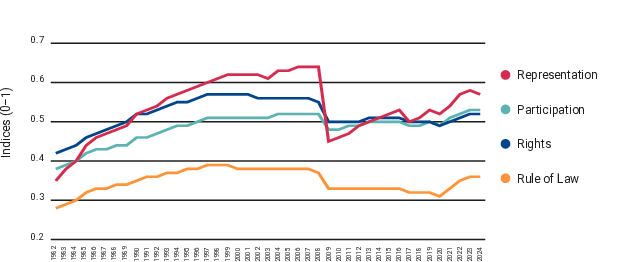
This ambivalence is reflected in the indicators of the leading democratic monitoring organizations. According to the classifications of Varieties of Democracy (V-Dem), Honduras entered a grey zone of electoral autocracy following the 2009 and 2017 events, characterized by uncertainty and the erosion of freedoms. However, after the 2021 change of government, the country returned to the category of electoral democracy (V-Dem n.d.). Meanwhile, International IDEA’s Global State of Democracy (GSoD) indices place Honduras in a persistently mid-range position over the last four decades, identifying three key stages: the first is a period of progressive institutional construction between 1982 and 2008, during which all indicators—Representation, Rights, Rule of Law and Participation—recorded gradual but sustained advances. The second stage is marked by the 2009 coup d’état. This event produced the sharpest decline in the Representation indicator over the entire period studied, with effects that persisted for nearly a decade. The third stage corresponds to a deep deterioration in Rights and Rule of Law following the 2017 crisis, followed by a modest improvement from 2021 onward (see Figure 1).

1.2. Prior political crises and the erosion of institutional legitimacy
Within this democratic trajectory, two crises stand out as turning points for the Honduran political system: the 2009 coup against President Manuel Zelaya and the contentious 2017 general election (Romero Ballivián 2019). Both episodes significantly eroded trust in the rules of democratic competition and in the neutrality of the institutions responsible for administering and adjudicating electoral processes.
The 2009 coup not only constituted an abrupt rupture of the legal order backed by key sectors of the elite and the Armed Forces, but it also created the perception that high-level political conflicts could be resolved outside democratic channels (Rodríguez Balmaceda 2015). Elections subsequently organized under a de facto government helped restore a degree of institutional normalcy but fell short of fully repairing the political and social fractures caused by the rupture, which gave rise to new opposition forces such as LIBRE.
The 2017 crisis deepened this divide through a controversial judicial ruling that allowed for presidential reelection, a development which, combined with serious irregularities in the vote count, sparked widespread public outrage. The Organization of American States (OAS) Election Observation Mission described the process as one characterized by a lack of transparency and integrity, pointing out critical deficiencies that undermined confidence in the results (OAS EOM 2018). Although the OAS went so far as to propose a repeat of the elections, the crisis was deemed ‘resolved’ through a de facto process: the official declaration by the Supreme Electoral Tribunal (Tribunal Supremo Electoral, TSE), the gradual diplomatic recognition led by the United States and the territorial control exercised by security forces in the face of protests (OAS EOM 2018).
This imposed resolution left a wound of legitimacy that compelled the political class to seek an institutional way out through structural reforms. In charting the path toward 2021, the main recommendations of international organizations were taken as a foundation, centred on three axes:
- The depoliticization and segmentation of electoral bodies’ attributes and responsibilities, which led to the replacement of the controversial TSE with the CNE and the Electoral Justice Tribunal (Tribunal de Justicia Electoral, TJE).
- The purification and modernization of the electoral census to reduce the risk of identity fraud.
- The implementation of a more robust and auditable system for the Transmission of Preliminary Election Results (Transmisión de Resultados Electorales Preliminares, TREP).
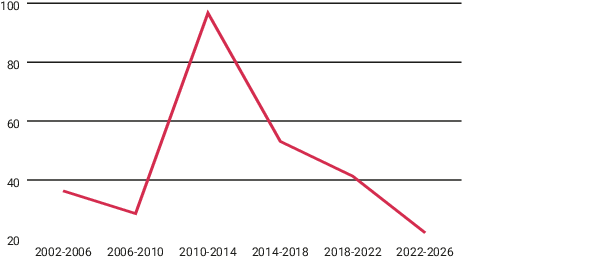
These events not only reinforced the perception that electoral processes were susceptible to manipulation by those in power but also necessitated the design of new procedural frameworks that, after years of accumulated mistrust, would enable peaceful alternation of power in the subsequent cycle. However, this process of institutional erosion has permeated both parliamentary elites and the general public. A longitudinal analysis of trust in the electoral body, based on data from the Parliamentary Elites in Latin America Project at the University of Salamanca (PELA-USAL), reveals a trajectory of pronounced volatility over the past two decades (see Figure 2). Following a period of relative stability, trust increased exceptionally during the 2010–2014 legislative term (96.7 per cent), but it proved to be an institutional mirage that failed to take hold. Starting in 2014, positive perceptions began a sustained decline, reaching their historic low during the 2021–2025 legislative session, when only 22.1 per cent of legislators expressed confidence in the electoral body.
Figures are in percentages.
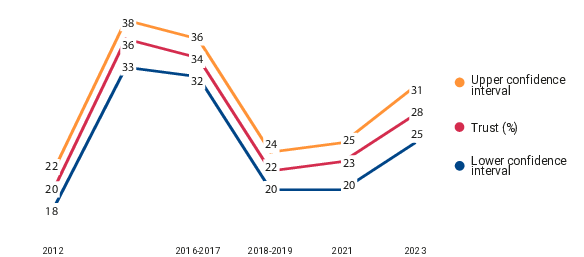
This decline in institutional trust among parliamentary elites was accompanied by a decrease in citizens’ trust in elections, as captured by the Latin American Public Opinion Project (LAPOP) at Vanderbilt University, with figures showing a dramatic collapse following 2017, remaining at critical levels with only a slight recovery by 2023 (see Figure 3). The collapse of trust after the 2017 elections, when it fell to 22 per cent, indicates that the post-election crisis was not an isolated episode but rather a turning point that consolidated a narrative of vulnerability and potential electoral manipulation.
Figures are in percentages.
The combination of declining trust among parliamentary elites in the electoral body (Figure 2) and declining citizens’ trust in elections (Figure 3) created a particularly fertile environment in which, by 2025, fraud allegations could rapidly take hold as a plausible explanation for any logistical problem or delay in the transmission of results.
This context of institutional weakness and accumulated mistrust is a central element for understanding the recent evolution of the Honduran political system. By the time the 2025 electoral cycle began, the legitimacy of institutions and electoral processes was already eroded, creating a particularly favourable environment for the intensification of political polarization and disputes over electoral integrity.
1.3. Ideological polarization and party system fragmentation
Finally, the evolution of the Honduran political system has been marked by a sustained increase in ideological polarization, a phenomenon that has transformed the dynamics of political competition since 2013 (Otero Felipe, Rodríguez Balmaceda and Rodríguez Zepeda 2023). This transformation stems from the breakdown of the traditional two-party system following the 2009 political crisis, which catalysed a profound reconfiguration of the party system. The emergence of new forces such as LIBRE and the Anti-Corruption Party (Partido Anticorrupción, PAC) in the 2013 election cycle ended the historical hegemony of the PLH and the PNH, shifting the country toward a three-party system with satellite parties. In this new landscape, while the PNH has managed to retain strategic regional strongholds and the PLH has seen its territorial power wane, LIBRE has established itself as the linchpin of the Honduran left. Its rise, which culminated in Xiomara Castro’s election as president in 2021, has not only introduced an unprecedented level of electoral competitiveness but also shifted the old politics of patronage and personalist leadership toward competition structured around clearly differentiated, opposing ideological blocs. According to PELA-USAL weighted polarization indicators, the distances between political forces have increased progressively, reaching their highest levels in the most recent legislative sessions. This trend reflects not only greater fragmentation of the National Congress but also a context in which the ability to negotiate and reach legislative agreements has become increasingly limited.
The data presented in Figure 4 show that the ideological polarization of the Honduran party system has varied over time, though with a general upward trend in recent periods. The three polarization indicators calculated confirm this pattern. In the first legislative session analysed (1993–1997), the average polarization based on the parties’ ideological positioning was relatively low (0.4). Although the indicator peaked during the 2001–2005 period and subsequently declined, it has increased steadily since the 2013 elections, culminating in its highest level in the current legislative session. Since the calculation is weighted by the number of seats, the ideological distances between the parties with the largest representation have a decisive influence on the aggregate level of polarization, while the divergences among minority parties have more limited effects.
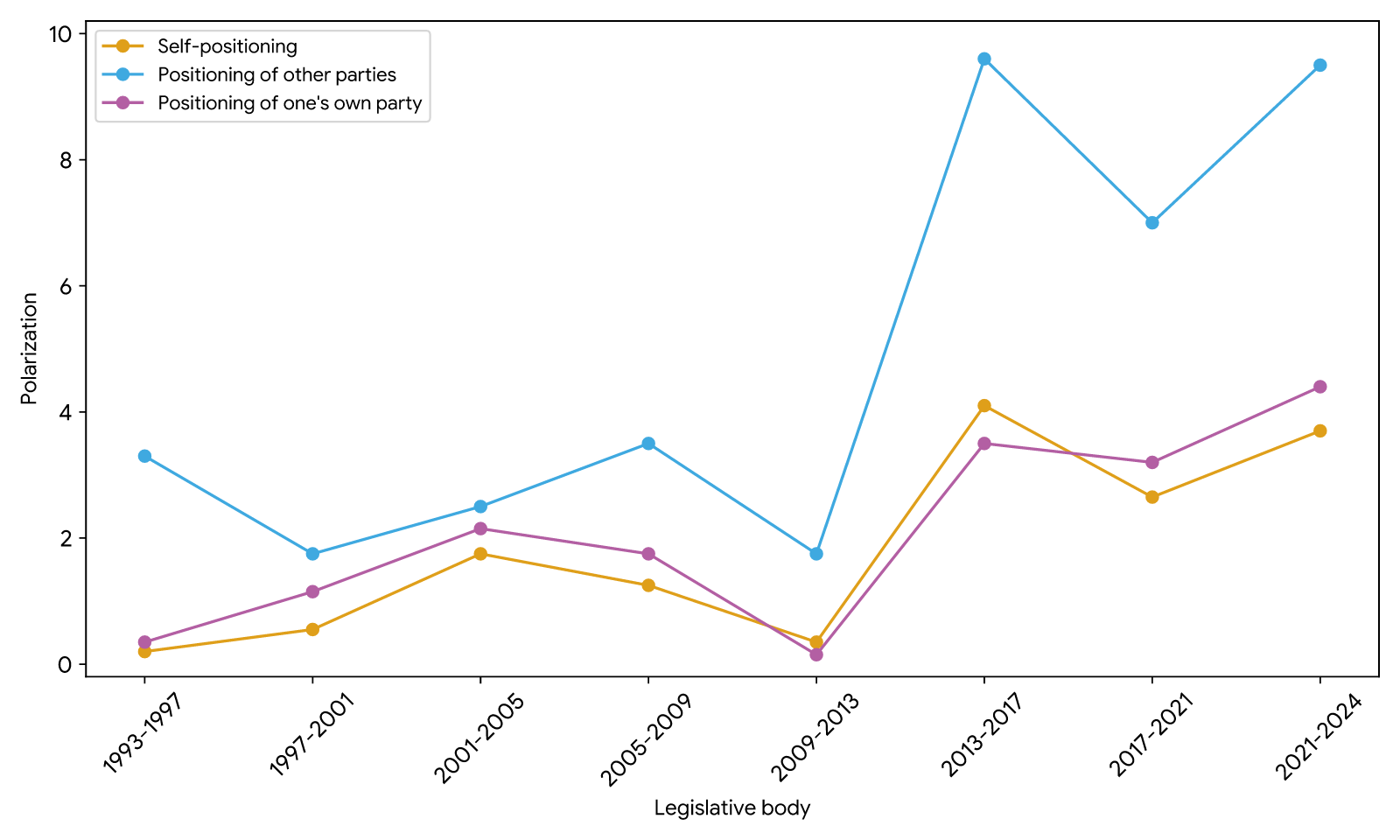
This widening of ideological distances has coincided with greater congressional fragmentation since 2013, making it harder to form stable majorities and complicating parliamentary negotiation dynamics. In this sense, polarization not only describes an ideological configuration of the party system but also directly affects governance.
A similar pattern is observed in the indicator based on legislators’ own ideological self-positioning. While values are slightly lower—suggesting that legislators tend to perceive themselves as closer to one another than their parties are—the overall trend is equally clear: ideological distances among parliamentarians have widened in the most recent periods analysed, reflecting a growing differentiation within the political space.
The indicator based on legislators’ perceptions of other parties’ ideological positioning reveals even higher levels of polarization. The data show that parliamentary elites tend to place their opponents at more extreme ideological positions than those they attribute to their own party or themselves. This dynamic reinforces a narrative of confrontation that pervades both electoral competition and interparty relations in the legislative arena. As a result, polarization has continued to increase throughout the period analysed, once again surpassing 9 points in the current legislature.
This ideological divide is not merely a statistical indicator but a factor that shapes governance and the relationship between political elites and citizens. As polarization intensifies in the spheres of power, structural problems such as persistent poverty, corruption, mass migration and dependence on remittances continue to weaken the link between the political class and social demands (Meléndez 2019; Salomón 2022; Sosa 2021). As the 2025 electoral cycle approached, the combination of eroded institutional legitimacy, a historical legacy of unresolved crises and growing polarization among elites created a highly tense scenario. In this context, the integrity of the elections ceased to be perceived solely as a technical issue and became the centre of a deep political dispute, in which accumulated mistrust crystallized into one of the main challenges to the country’s democratic stability.
1.4. Electoral reform and the new institutional design
In response to the accumulated challenges following the 2017 electoral crisis, Honduras undertook a series of reforms over the past decade aimed at modernizing its electoral architecture and strengthening the institutional guarantees of the democratic process.
A key element of this process was the replacement of the former TSE with two distinct bodies: the CNE, responsible for organizing and administering electoral processes, and the TJE, responsible for resolving electoral disputes and litigation. This division sought to align Honduras’ institutional design with comparative models in which the separation between electoral administration and justice serves as an additional safeguard for the integrity of the process (see Tables A.1 and A.2 in Annex A).
The new institutional framework was complemented by the adoption of various legal instruments, including the 2017 Law on the Financing, Transparency and Oversight of Political Parties and Candidates (and its subsequent amendments); the 2021 Honduran Electoral Law; and the 2024 Organic and Procedural Electoral Law. These provisions establish, at least formally, mechanisms to regulate voter registration, candidate filings, electoral campaigning, political financing and dispute resolution procedures. Among these reforms, the creation of the Financing, Transparency and Oversight Unit (Unidad de Financiamiento, Transparencia y Fiscalización, UFTF) sought to strengthen controls over the use of campaign resources and prevent illicit financing.
In parallel, the National Registry of Persons (Registro Nacional de las Personas) continued to play a key role in citizen identification and the preparation of the electoral census, a fundamental element for the credibility of the vote.
In theory, this institutional and regulatory framework should provide an adequate foundation for holding periodic, competitive and transparent elections, in line with Honduras’s international commitments on political rights. However, the implementation of these reforms was conditioned by political and structural factors that significantly limited their scope.
The composition of the CNE and the TJE, through party quotas, reflected the balance of power among the main political forces—LIBRE, PNH and PLH—and largely reproduced the institutional power-sharing logic that the reforms sought to overcome. Moreover, the CNE’s internal structure replicated this tripartite scheme across several key departments, resulting in diffuse responsibilities, coordination difficulties and delays in strategic decision-making.
These institutional limitations were compounded by significant material constraints. The electoral authorities’ dependence on the National Congress for funding—sometimes used as a tool for political bargaining—undermined their operational autonomy. The limited availability of resources to modernize electoral technology, adequately train polling station staff and strengthen oversight mechanisms left gaps that, in contexts of high political mistrust, tend to be perceived as potential opportunities for manipulation.
Finally, the growing judicialization of electoral decisions—with interventions by the Attorney General’s Office and ordinary courts in matters that should fall primarily under electoral jurisdiction—contributed to blurring the boundaries between branches of government and weakening the position of specialized bodies.
Taken together, Honduras entered the 2025 electoral process with a formally established electoral democracy, but one whose recent trajectory was marked by deep political crises and a reformed electoral architecture that had not yet fully consolidated or generated sufficient public trust. It was against this institutional and political backdrop that the 2025 electoral cycle unfolded, in which partisan polarization, pressure on institutions and the involvement of various actors tested the system’s capacity to preserve electoral integrity.
Despite regulatory advances, the integrity of the 2025 electoral process faced critical challenges that tested the resilience of the new institutional architecture. Extreme political polarization not only fractured public debate but also drove preemptive fraud narratives and disinformation campaigns designed to delegitimize the CNE. A high-impact destabilizing factor was foreign interference, embodied in Donald Trump’s announcements in the days leading up to the elections. His public statements questioning the transparency of the Honduran system, combined with the controversial promise of a pardon for former President Juan Orlando Hernández, were perceived as direct external pressure intended to influence voter behaviour and undermine the sovereignty of national institutions. Added to this hostile environment was the threat of organized crime, whose involvement in political violence and pressure on local voting boards in specific territories required an emergency response coordinated with security forces.
The management of these risks exposed the system’s operational limitations in the face of legitimacy crises. To mitigate mistrust, the CNE implemented a strategy of technical transparency by conducting national simulations and validating the TREP system in advance to ensure an uninterrupted flow of data from the moment polls closed. However, while the technical response was robust, the institutional capacity to sanction disinformation and curb political violence was limited, revealing a critical dependence on the willingness of partisan actors. The survival of the process ultimately depended on the technical staff’s capacity to maintain the system’s operability under intense budgetary and judicial pressure and to process results despite the environment of systemic confrontation.
2. Prevention
The process of conflict prevention in 2025 cannot be understood without considering the context of the March primary elections. In the Honduran political system, given the absence of a runoff election, the primaries function in practice as a binding electoral poll that determines not only the candidates of the three major parties (LIBRE, PNH and PLH) but also the actual balance of power with which each actor enters the general election (Rodríguez Balmaceda 2024). This event is the first barometer of the cycle’s integrity and the capacity of political organizations to mobilize voters. However, the March 2025 process was marked by heavy intervention by the Armed Forces in the custody and transport of ballot boxes, which, combined with significant technical failures in the processing of vote tallies,2 fuelled allegations of ‘ballot box stuffing’ and mutual accusations of fraud that undermined the climate of trust from the start of the electoral calendar.
In response to these incidents, the CNE implemented corrective measures as part of its electoral schedule and special operational plans. The objective was to strengthen the links that failed in March: data transmission security and the accreditation of polling station delegates. However, despite the early identification of these ‘bottlenecks’, biometric identification once again became a critical factor, causing delays on 30 November. The system experienced recurring technical difficulties, particularly with fingerprint scanning for elderly voters, leading to crowds and prolonged wait times that partisan narratives used to justify suspicions of manipulation.
On the regulatory front, provisions on political financing and campaign conduct were strengthened to mitigate disinformation. The CNE updated its guidelines for equitable press access and maintained monitoring of digital platforms to detect false narratives about electoral fraud.
To safeguard the process, the CNE developed a strategy of widespread international validation, accrediting a record number of approximately 3,500 domestic observers and more than 300 international observers (including missions from the OAS, the EU and the Carter Center). However, this openness stood in stark contrast to the difficulties faced by the local press. While some sectors were able to report without systematic restrictions (interview 1, journalist, February 2026), other journalists noted that extreme polarization created a hostile environment that hindered balanced reporting. As one of the interviewees for this study noted, although there was a flow of official data, access to technical verification spaces was limited for certain sectors of the press, and digital disinformation complicated neutral coverage of the process (interview 6, journalist, March 2026).
This situation was compounded by the structural dynamics of the media market. In this regard, technical reports such as that of the EU Election Observation Mission have documented that, while Honduras legally guarantees freedom of expression, in practice, there persists a marked polarization and an unequal distribution of government advertising, factors that undermine the neutrality of the information ecosystem and limit the reach of institutional communication directed at voters (EU EOM 2026).
Furthermore, the media environment during the 2025 electoral process was characterised by adverse conditions for journalistic practice. According to the EU Election Observation Mission, the media operated in a context of intimidation, coordinated smear campaigns and legal persecution, accompanied by hostile rhetoric from senior government officials and key political figures (EU EOM 2026). This climate of pressure further undermined media pluralism and restricted fair public debate.
Some civil society organizations, by contrast, highlighted that, despite the tensions and episodes of internal difficulties among CNE members, these did not prevent the independent monitoring and oversight work of citizen observers (interview 2, representative of civil society organization, February 2026).
Finally, security measures were implemented through tailored deployment plans in areas with high rates of organized crime or territorial conflict, such as the Atlantic Coast. At the same time, forums for dialogue were promoted to encourage respect for the election results, and internal protocols were issued to prevent violence against vulnerable groups, such as women, Indigenous peoples, LGBTQ+ people and people with disabilities. The issuance of internal protocols, awareness-raising initiatives, training for election staff and coordination with specialized entities constituted efforts to anticipate risks of discrimination and political violence, as well as to ensure reasonable conditions for accessibility and participation. While these measures did not eliminate existing gaps, they did help establish violence prevention and inclusion as central dimensions of electoral integrity.
2.1. Recommendations for the prevention stage
An analysis of the pre-election phase reveals four priority recommendations for strengthening the system’s preventive capacity in future election cycles:
- Establish a permanent electoral risk management mechanism. Between election cycles, the CNE should establish a risk-monitoring unit that systematically identifies threats to the integrity of the process—including political violence, disinformation and pressure from illegitimate actors—and proposes corrective measures before the formal start of the campaign. Incidents during the March 2025 primaries demonstrated the value of identifying technical failures and political tensions early, allowing them to be addressed before the general election if this institutional capacity exists.
- Adopt a regulatory framework for electoral disinformation. Honduras lacks specific regulations addressing disinformation in digital environments during the electoral period. It is recommended that, in consultation with civil society and technology platforms, a protocol be developed to detect and rapidly respond to narratives alleging fraud, including fact-checking mechanisms coordinated with the media, without compromising freedom of expression.
- Expand and stabilize CNE funding well in advance. The late approval of the 2025 electoral budget caused delays in technology and logistics procurement, compromising process planning. A guaranteed minimum budget allocation should be established by law and approved at least 18 months before the election to protect the operational autonomy of electoral bodies from political pressures arising from dependence on the National Congress for budget approval.
- Strengthen inclusion and security protocols in high-risk areas. The differentiated plans for the Atlantic Coast and other high-conflict areas were a step forward, but their implementation was partial. It is recommended to develop updated territorial risk maps, increase inter-institutional coordination with security forces and human rights organizations, and ensure that inclusion protocols for women, Indigenous peoples and LGBTQ+ people are systematically monitored and evaluated in each electoral process.
3. Institutional resilience
The institutional framework resulting from the 2017 reform sought to reflect the reality of a three-party system by including LIBRE in the decision-making process, so that the main actors would feel represented in its management (interview 8, electoral authority, March 2026). However, that same model of composition based on party quotas was the source of the main tensions during the 2025 cycle. Disagreements among council members, the National Congress’s attempts to make approval of the electoral budget conditional and the resulting delays in tenders and contracting affected operational planning and created uncertainty across various phases of the cycle, mirroring Guatemala’s vulnerability, which took the form of the judicialization of politics. An electoral expert interviewed for this study confirmed that internal conflict within the electoral authorities and the budgetary delay were the main sources of tension during the cycle (interview 5, electoral expert, March 2026).
Despite this, the institution demonstrated a greater degree of operational resilience on election day than the pre-election scenario had suggested. A key factor was the capacity of the CNE’s technical and operational staff to respond under pressure and mitigate the effects of the paralysis at the top: polling stations were deployed, election materials were delivered on time and biometric identification and the TREP system were implemented under reasonably functional conditions.3 While this performance points to important operational strengths, it should be interpreted with caution, given pre-election assessments highlighting uneven preparation and inconsistencies in training processes. The same expert mentioned in the previous paragraph noted that, despite delays in transmitting preliminary results—a recurring problem in previous elections—the initial percentage of published vote tallies was higher than in 2021, representing a relative improvement in transparency (interview 5, electoral expert, March 2026). This operational resilience was reinforced by the firm leadership of the CNE presidency, which, during moments of greatest partisan pressure, defended institutional integrity and prioritized the publication of credible results.
The moment of greatest tension occurred on election night, when the TREP halted at 91 per cent of tally sheets with a very narrow presidential margin. The Honduran Government then launched a fraud narrative that combined prior judicial blockades with public rejection of partial results. According to experts, the ruling party also attempted to bring Salvador Nasralla into that narrative to invalidate the process as a whole (interview 7, electoral expert, March 2026). Institutional continuity was sustained through two channels: a tacit alliance between two of the three CNE members that kept the publication of results operational, and the PLH’s decision not to endorse a rupture, prioritizing system stability over short-term gain.
Resilience was also evident at the decentralized levels of electoral administration. The Departmental and Municipal Electoral Councils, despite their shortcomings in infrastructure, equipment and communications, assumed additional responsibilities for logistics and materials distribution, demonstrating a capacity for coordination and practical problem-solving that contrasted sharply with the institutional conflicts observed at the central level. In many municipalities—from logistically isolated areas such as Puerto Lempira to densely populated centres like El Progreso—cooperation prevailed among representatives of different parties and electoral officials, which reduced local tensions, ensured the conduct of the count and prevented the central dysfunctions from translating into a general collapse of the process (interview 7, electoral expert, March 2026).
3.1. Recommendations for strengthening institutional resilience
The operational resilience demonstrated in 2025 was remarkable, but it relied too heavily on individual commitment and informal partnerships. To institutionalize that resilience, three recommendations are proposed:
- Professionalize the intermediate technical structure through an electoral civil service. The current system of discretionary appointments to strategic positions transfers political polarization into the operational execution of the CNE and the TJE. It is recommended that those key areas be established in law and staffed by career officials selected through competitive, merit-based public examinations. This protection of the intermediate structure ensures that the technical operation of the electoral cycle is resilient to leadership-level crises, safeguarding the integrity of the results regardless of agreements or deadlocks among CNE members.
- Clarify the jurisdictional boundaries between electoral and ordinary courts. The growing judicialization of electoral decisions through interventions by the Attorney General’s Office and ordinary courts blurred the boundaries between branches of government and weakened the position of specialized bodies. It is recommended that an explicit clause establishing the TJE’s exclusive jurisdiction over electoral matters during the electoral cycle be incorporated into law, together with a mechanism to protect the process from external interference.
- Strengthen electoral technology and technical contingency protocols. The recurring difficulties with biometric identification and TREP delays demonstrate that electoral technology needs greater investment and a formal contingency communication protocol that explains, in real time and in accessible language, the causes of technical delays to political actors and citizens, preventing fraud narratives from taking hold before they consolidate. The 2025 experience also exposed the vulnerability of relying on an externally contracted TREP system: response times and decision margins on election night were conditioned by the vendor relationship rather than by the CNE’s direct control over the infrastructure. It is recommended that the CNE develop its own technological capacity for the transmission and publication of preliminary results, so that Honduras reaches the 2029 cycle with an institutional TREP, under permanent public control and subject to citizen oversight throughout its development, not only in its final output.
4. Post-crisis recovery
Following the publication of results and the initial resolution of challenges, the Honduran political system entered a recovery phase aimed at restoring institutional trust and managing the government transition. The gradual recognition of results by the main political actors helped defuse rupture scenarios, and the absence of a prolonged post-election crisis—comparable to that of 2017—was itself a significant indicator of institutional stabilization.
An exceptional feature of this process was the continued enforcement of a state of exception, which had been extended multiple times throughout the electoral period. From the perspective of human rights organizations, this element posed specific challenges to the full guarantee of rights and freedoms: a representative of one such organization noted that states of exception can restrict freedom of assembly, movement and expression, and that the repeated extension of this measure raised well-founded concerns about its impact on the democratic environment in which the elections took place (interview 4, representative of a human rights organization, February 2026). This element must be read alongside the recovery process: post-election democratic normalization occurred against an institutional backdrop that human rights organizations already considered compromised.
Civil society, the media and election observation missions played an active role in the post-election recovery process. National and international organizations deployed observers throughout the country, monitored the vote count and helped verify the accuracy of the results in the face of allegations of fraud. A member of an election observation mission interviewed for the purposes of this study noted that, despite stricter regulations than in previous elections, observers were able to document the difficulties that arose on election day and that, in general terms, no significant inconsistencies were identified that would compromise the integrity of the vote (interview 3, member of an election observation mission, February 2026). This external monitoring served as a deterrent against destabilizing manoeuvres, similar to the role played by domestic and international observation in Guatemala following the 2023 elections.
Recovery also entailed addressing the aftermath of conflict for specific actors. As in Guatemala, risks of retaliation and discrediting of electoral officials, observers and civic leaders who defended the integrity of the process persisted in Honduras; public support from national and international organizations and the monitoring of harassment cases through human rights protection mechanisms proved essential for containing these risks. At the institutional level, complaint and appeal procedures before the electoral courts offered a formal mechanism for channelling grievances and reduced incentives for violent mobilization, despite the evident resource limitations and political pressures operating on these bodies.
Finally, sustaining this recovery requires understanding the electoral cycle as a continuum. As long as institutional financial vulnerability, political polarization and citizens’ mistrust persist, the normalization of democratic life will remain partial and reversible. Opening a reform window in the first year of the mandate—before the logic of the next electoral cycle influences actors’ incentives—is the necessary condition for the resilience demonstrated in 2025 to become lasting institutional robustness.
4.1. Recommendations for recovery and the post-election reform agenda
Recovery does not conclude with the inauguration; it demands a reform agenda that addresses the structural vulnerabilities that made the risks of 2025 possible. Four priority issues are identified to prevent recurrence in the next electoral cycle:
- Reform the Electoral Law to guarantee the financial and operational autonomy of the CNE. The EU and OAS Election Observation Missions, as well as the United Nations Office of the High Commissioner for Human Rights (OHCHR), concurred that budgetary dependence on the National Congress is a critical structural vulnerability. The reform should establish an automatic budget allocation to the CNE—calculated as a fixed percentage of the national budget—with scheduled disbursements that do not require annual legislative approval. Additionally, the EU Election Observation Mission recommended modifying the CNE’s procurement regime to expedite tenders for critical electoral supplies (technology, logistics, communications) without being subject to ordinary state contracting law deadlines when the electoral calendar so requires. The optimal window for these reforms is the first year of the mandate, before the logic of the next electoral cycle conditions political actors’ incentives.
- Protect those who defended the integrity of the process and prevent retaliation. As in Guatemala after the 2023 elections, the post-election period in Honduras presents risks of discrediting and retaliation against electoral officials, observers and civic leaders who acted in defence of the results. It is recommended to activate protection mechanisms through the human rights system, public support from national and international organizations and specific monitoring of cases of threats or harassment against actors who served as integrity guarantors.
- Rebuild citizens’ trust in electoral institutions. Data from LAPOP and PELA-USAL show that trust in the electoral body and in the elections has been eroding for over a decade and that progress remains fragile. It is recommended to design a post-election public communication strategy that transparently accounts for the performance of the 2025 electoral process and to develop long-term civic education programs—in partnership with the education system, civil society and the media—that rebuild the bond between citizens and democratic institutions.
- Review the regulatory framework of the state of exception and its interactions with the electoral cycle. Holding elections under an extended state of exception raised legal and political questions about the minimum conditions necessary to guarantee the full exercise of fundamental rights during an electoral campaign. It is recommended that the National Congress, with the participation of civil society and the support of international bodies, establish clear limits on the compatibility of states of exception with the holding of electoral processes, in line with international human rights standards.
5. Conclusions
The Honduran electoral process on 30 November 2025 tested the capacity of the country’s democratic system. On the one hand, structural weaknesses—party interference in electoral institutions, financial vulnerability, polarization and logistical shortcomings—demonstrated that the institutional framework remains fragile and susceptible to high-intensity crises. On the other hand, the combination of preventive measures, the professionalism of election staff, the commitment of civil society and the media, and international support made it possible to preserve the basic integrity of the results and prevent an open breakdown of the constitutional order.
Interviews conducted with key actors in the electoral process confirm that, despite the political tensions and institutional weaknesses identified, various independent monitoring mechanisms—including journalists, civil society organizations, electoral observers and human rights organizations—helped reinforce public oversight of the electoral process. At the same time, these testimonies converge in noting that the main sources of conflict did not necessarily originate in massive irregularities during the vote, but rather in political polarization, disputes among electoral authorities and the narrowness of the results, factors that amplified the perception of uncertainty surrounding the electoral process.
Three lessons stand out particularly clearly. First, prevention must be conceived as a long-term state policy that includes advance planning for the electoral cycle, clear regulatory frameworks to address disinformation and violence, and mechanisms for inter-institutional coordination on security and risk management. Second, the resilience of institutions depends both on their formal design—independence, resources, professionalization—and on the conduct of the actors within and around them: when electoral authorities, observers, civil society and the international community come together to defend the will of the people, the chances of success for antidemocratic actors are significantly reduced.
Third, post-crisis recovery is not limited to the administrative closure of the electoral process but requires a reform agenda that addresses the deep causes of institutional fragility and responds to the consequences for people and institutions. Without effective changes to electoral system governance, the advances achieved in 2025 could prove reversible in the face of future critical junctures marked by conflict. Honduras’s challenge is therefore to consolidate the 2025 experience as a turning point toward a more robust, inclusive democracy capable of withstanding and overcoming new waves of political conflict.
Annex A. Institutional framework and the evolution of electoral authorities in Honduras
| General election | Electoral authority |
|---|---|
| 1985 | Supreme Electoral Tribunal (TSE) |
| 1989 | Supreme Electoral Tribunal (TSE) |
| 1993 | Supreme Electoral Tribunal (TSE) |
| 1997 | Supreme Electoral Tribunal (TSE) |
| 2001 | Supreme Electoral Tribunal (TSE) |
| 2005 | Supreme Electoral Tribunal (TSE) |
| 2009 | Supreme Electoral Tribunal (TSE) |
| 2013 | Supreme Electoral Tribunal (TSE) |
| 2017 | Supreme Electoral Tribunal (TSE) |
| 2021 | National Electoral Council (CNE) |
| 2025 | National Electoral Council (CNE) |
| Feature | Supreme Electoral Tribunal (TSE) | National Electoral Council (CNE) |
|---|---|---|
| Period of operation | 1982–2019 | 2019–present |
| Institutional origin | 1982 Constitution | Constitutional reform following the 2017 electoral crisis |
| Type of body | Single electoral authority with both administrative and adjudicative functions | Administrative authority responsible for organizing elections |
| Main function | Organization of the electoral process and resolution of electoral disputes | Organization and administration of elections |
| Resolution of electoral disputes | Handled by the TSE itself | Handled by the Electoral Justice Tribunal (Tribunal de Justicia Electoral, TJE) |
| Composition | Three full magistrates and three alternates appointed by the National Congress | Three full councillors and two alternates appointed by the National Congress |
| Institutional model | Concentration of electoral functions | Separation of administrative and adjudicative functions |
| General elections administered by the body | 1985–2017 | 2021–present |
Annex B. Methodology
This case study is based on a combination of documentary analysis and qualitative interviews with key actors in the Honduran electoral process. The documentary review included an examination of the current electoral legal framework, with particular emphasis on the Honduran Electoral Law, the Organic and Procedural Electoral Law and other regulatory provisions relevant to the organization and oversight of elections. Electoral observation reports, academic publications, reports from international organizations and documents produced by national institutions linked to electoral management were also analysed.
To complement the documentary review and capture institutional practices not always reflected in public records, semi-structured interviews were conducted between February and March 2026. The selection of interviewees was based on their experience and responsibilities in the electoral sphere, whether in technical, observation or communications roles. These dialogues provided detailed information on strategic decision-making, the challenges faced and the lessons learned during the electoral cycle.
Through these testimonies, the study captured perceptions, experiences and evaluations from diverse sectors and actors regarding risk-prevention mechanisms, institutional resilience amid political tensions and post-election management strategies. A gender and inclusion perspective was incorporated throughout the analysis of the voices consulted and the policies examined. Finally, the information gathered was triangulated with documentary sources and publicly available reports to strengthen the analytical consistency and robustness of the study’s findings.
| No. | Interviewee profile | Sector | Date |
|---|---|---|---|
| 1 | Journalist | Media | February 2026 |
| 2 | Representative of civil society organization | Civil society | February 2026 |
| 3 | Member of an election observation mission | Electoral observation | February 2026 |
| 4 | Representative of a human rights organization | Human rights | February 2026 |
| 5 | Expert in democracy and electoral processes | Academia / Electoral expert | March 2026 |
| 6 | Journalist | Media | March 2026 |
| 7 | Expert in democracy and electoral processes | Academia / Electoral expert | March 2026 |
| 8 | Representative of the administrative electoral authority | Electoral authority | March 2026 |
Acronyms and abbreviations
CNE National Electoral Council (Consejo Nacional Electoral) EMB Electoral management body GSoD Global State of Democracy LAPOP Latin American Public Opinion Project LGBTQ+ Lesbian, gay, bisexual, transgender and queer LIBRE Liberty and Refoundation Party (Partido Libertad y Refundación) OAS Organization of American States OHCHR Office of the High Commissioner for Human Rights, United Nations PAC Anti-Corruption Party (Partido Anticorrupción) PARLACEN Central American Parliament (Parlamento Centroamericano) PDCH Christian Democratic Party of Honduras (Partido Demócrata Cristiano de Honduras) PELA-USAL Parliamentary Elites in Latin America Project at the University of Salamanca PINU‑SD Party for Innovation and Social Democratic Unity (Partido Innovación y Unidad Social Demócrata) PLH Liberal Party of Honduras (Partido Liberal de Honduras) PNH National Party of Honduras (Partido Nacional de Honduras) TJE Electoral Justice Tribunal (Tribunal de Justicia Electoral) TREP Transmission of Preliminary Election Results (Transmisión de Resultados Electorales Preliminares) TSE Supreme Electoral Tribunal (Tribunal Supremo Electoral) UD Democratic Unification Party (Partido Unificación Democrática) UFTF Financing, Transparency and Oversight Unit (Unidad de Financiamiento, Transparencia y Fiscalización) V-Dem Varieties of Democracy
References
Alcántara Sáez, M., ‘Honduras’, in M. Alcántara Sáez, Sistemas políticos de América Latina [Political systems in Latin America] (Madrid: Tecnos, 2008), vol. II, second edition
European Union Election Observation Mission (EU EOM), ‘Honduras. Informe final. Elecciones generales 2017’ [Honduras. Final Report. 2017 General Elections], 2018, <https://www.eeas.europa.eu/sites/default/files/373041878-moe-ue-honduras-2017-informe-final.pdf>, accessed 26 March 2026
European Union Election Observation Mission (EU EOM), ‘Honduras 2025. Final Report’, 2026, <https://www.eeas.europa.eu/moe-honduras-2025/la-misión-de-observación-electoral-de-la-unión-europea-–-honduras-2025-presentó-su-informe-final-con_es>, accessed 26 March 2026
Honduras, Republic of, Ley de Financiamiento, Transparencia y Fiscalización a Partidos Políticos y Candidatos. Decreto No. 137-2016 [Law on the Financing, Transparency and Oversight of Political Parties and Candidates. Decree No. 137-2016], La Gaceta. Diario Oficial de la República de Honduras, No. 34242, 18 January 2017
Honduras, Republic of, Ley Electoral de Honduras. Decreto No. 35-2021 [Honduran Electoral Law. Decree No. 35-2021], La Gaceta. Diario Oficial de la República de Honduras, No. 35610, 26 May 2021
Honduras, Republic of, Ley Orgánica y Procesal Electoral. Decreto No. 85-2024 [Organic and Procedural Electoral Law. Decree No. 85-2024], La Gaceta. Diario Oficial de la República de Honduras, No. 36701, 28 November 2024
Human Rights Watch, ‘Honduras: guarantee credibility of elections, protect free expression’, 11 December 2017, <https://www.hrw.org/news/2017/12/11/honduras-guarantee-credibility-elections-protect-free-expression>, accessed 10 March 2026
International IDEA, The Global State of Democracy 2025: Democracy on the Move (Stockholm: International IDEA, 2025), <https://doi.org/10.31752/idea.2025.53>
Latin American Public Opinion Project (LAPOP), AmericasBarometer, Vanderbilt University, [n.d.], <https://www.vanderbilt.edu/lapop/about-americasbarometer.php>, accessed 26 March 2026
Meléndez, C., ‘Evolución del clientelismo en Honduras 2009-2017’ [The evolution of clientelism in Honduras, 2009–2017], in J. Castellanos and S. Romero Ballivián (eds.), Encrucijadas de la democracia en Honduras y América Central [Crossroads of democracy in Honduras and Central America] (Tegucigalpa: Instituto Universitario en Democracia Paz y Seguridad, 2019)
Office of the High Commissioner for Human Rights (OHCHR), ‘Situation of human rights in Honduras: Report of the United Nations High Commissioner for Human Rights’, A/HRC/61/19, United Nations, 2026, <https://www.ohchr.org/es/documents/country-reports/ahrc6119-situacion-de-los-derechos-humanos-en-honduras-informe-del-alto>, accessed 26 March 2026
Organization of American States Election Observation Mission (OAS EOM), ‘Elecciones generales Honduras. 26 de noviembre de 2017. Informe final’ [General elections in Honduras. 26 November 2017. Final report], 2018, <https://scm.oas.org/pdfs/2017/cp38551smoeh.pdf>, accessed 26 March 2026
Otero Felipe, P., Rodríguez Balmaceda, C. G. and Rodríguez Zepeda, J. A., ‘Evolución de la competencia partidista hondureña. De la baja polarización ideológica a la radicalización’ [The evolution of party politics in Honduras: from low ideological polarization to radicalization], Revista Mexicana de Análisis Político y Administración Pública, 12/24 (2023), <https://doi.org/10.15174/remap.v12i24.410>
Parliamentary Elites in Latin America Project at the University of Salamanca (PELA-USAL), <https://oir.org.es/pela>, accessed 10 March 2026
Rodríguez Balmaceda, C. G., ‘Honduras: hacia una reconfiguración del sistema partidario tras las elecciones generales de 2013’ [Honduras: towards a reshaping of the party system following the 2013 general election], Colombia Internacional, 85 (2015), <https://doi.org/10.7440/colombiaint85.2015.07>
Rodríguez Balmaceda, C. G., ‘Analizando las reglas del juego. Características y efectos de las elecciones primarias presidenciales en Honduras’ [Analysing the rules of the game: characteristics and effects of the presidential primaries in Honduras], Colombia Internacional, 118 (2024), <https://doi.org/10.7440/colombiaint118.2024.07>
Rodríguez Balmaceda, C. G. and González Tule, L., ‘Honduras 2019: persistente inestabilidad económica y social y debilidad institucional’ [Honduras 2019: persistent economic and social instability and institutional weakness], Revista de Ciencia Política, 40/2 (2020), <https://doi.org/10.4067/S0718-090X2020005000112>
Rodríguez Balmaceda, C. G. and Otero Felipe, P., ‘Elecciones generales en Honduras 2021. Entre la esperanza y la incertidumbre’ [Honduras General Election 2021: between hope and uncertainty], in M. Alcántara Sáez, M. García Montero and A. Bohigues (eds.), Elecciones en América Latina: de pandemia y de derrotas (2020-2023) [Elections in Latin America: on pandemic and defeats (2020–2023)] (Madrid: Centro de Estudios Políticos y Constitucionales, 2024)
Romero Ballivián, S., ‘Democracia bajo tensión, elecciones cuestionadas y quiebre del bipartidismo: Honduras (1980-2019)’ [Democracy under strain, contested elections and the breakdown of the two-party system: Honduras (1980–2019)], in J. Castellanos and S. Romero Ballivián (dirs.), Encrucijadas de la democracia en Honduras y América Central [Crossroads of democracy in Honduras and Central America] (Tegucigalpa: Instituto Universitario en Democracia Paz y Seguridad, 2019)
Salomón, L., ‘Honduras, los retos de la democracia’ [Honduras: the challenges facing democracy], Nueva Sociedad, 141 (1996), <https://static.nuso.org/media/articles/downloads/2463_1.pdf>, accessed 10 March 2026
Salomón, L., ‘Los desafíos de Xiomara Castro en Honduras’ [The challenges facing Xiomara Castro in Honduras], Nueva Sociedad, 299 (2022), pp. 14–26
Sosa, E., ‘La corrupción, un fantasma en las precandidaturas presidenciales del partido de gobierno’ [Corruption: a spectre haunting the ruling party’s presidential primaries], Centro de Estudio para la Democracia, 18 January 2021, <https://v1.cespad.org.hn/2021/01/18/analisis-la-corrupcion-un-fantasma-en-las-precandidaturas-presidenciales-del-partido-de-gobierno>, accessed 8 March 2026
Taylor-Robinson, M. M., ‘Honduras: una mezcla de cambio y continuidad’ [Honduras: a mix of change and continuity], Revista de Ciencia Política (Santiago), 29/2 (2009), <https://doi.org/10.4067/S0718-090X2009000200011>
Varieties of Democracy (V-Dem), The V-Dem Dataset, [n.d.], <https://www.v-dem.net/data/the-v-dem-dataset>, accessed 26 March 2026
About the author
Cecilia Graciela Rodríguez Balmaceda is a Professor at the University of Burgos and holds a PhD in Political Science from the University of Salamanca (Spain). She has conducted research at the Catholic University of Leuven (Belgium), the University of the Republic (Uruguay), and the University of Warsaw (Poland). Previously, she worked as a postdoctoral researcher at the University of Salamanca and is currently an editor of the journal América Latina Hoy.
Her research interests include comparative politics, democracy, gender and political elites, with a special focus on Latin America. Throughout her career, she has contributed to numerous projects on democratization processes and the functioning of social and political institutions in the region.
Acknowledgements
This publication has been made possible thanks to the generous support of the Government of the Grand Duchy of Luxembourg within the framework of the project ‘Improving the Resilience of Democracy in Central America’.
International IDEA thanks the author, as well as Blanca Blanco, Central America Project Manager, and Nicolás Liendo, Latin America and the Caribbean Programme Officer, for their review and valuable contributions.


© 2026 International Institute for Democracy and Electoral Assistance
International IDEA publications are independent of specific national or political interests. Views expressed in this publication do not necessarily represent the views of International IDEA, its Board or its Council members.
With the exception of any third-party images and photos, the electronic version of this publication is available under a Creative Commons Attribution NonCommercial-ShareAlike 4.0 (CC BY-NC-SA 4.0) licence. You are free to copy, distribute and transmit
the publication as well as to remix and adapt it, provided it is only for non-commercial purposes, that you appropriately attribute the publication, and that you distribute it under an identical licence. For more information visit the Creative Commons website:
http://creativecommons.org/licenses/by-nc-sa/4.0.
This case study is part of the Protecting Elections project. The project is supported by the Government of Luxembourg.
Design and layout: International IDEA
DOI: https://doi.org/10.31752/19291
ISBN: 978-91-8137-198-7 (PDF)
ISBN: 978-91-8137-199-4 (HTML)


