


From Inclusion to Influence: Indigenous Youth in Nepal
Policy Brief, August 2026

Executive Summary
Nepal’s Constitution and electoral framework recognize inclusion and proportional representation, but Indigenous youth remain underrepresented in political leadership and have limited influence over candidate selection, party decisions, and public policy.
Barriers include centralized party nomination, patronage networks, socioeconomic inequality, geographic exclusion, linguistic exclusion, uneven access to political information, and intersecting discrimination affecting young Indigenous women and other marginalized youth. Customary governance and youth participation in past political movements demonstrate that Indigenous youth possess relevant leadership experience, but formal institutions often engage them primarily as campaign mobilizers rather than decision-makers.
This policy brief examines the gap between formal representation and meaningful participation and presents options for political parties, electoral authorities, federal and local governments, Indigenous institutions, and youth networks to improve transparency, leadership pathways, inclusive consultation, and accountability.
1. Background
Nepal’s transition from monarchy and armed conflict to a federal democratic republic was shaped by a succession of political and social movements, including demands from Madhesi, Adivasi Janajati, Dalit, women’s, and regional movements for inclusion, identity recognition, and devolved government. The 2015 Constitution and subsequent electoral arrangements responded in part through federalism, proportional representation, and constitutional inclusion guarantees. According to Nepal’s 2021 National Population and Housing Census, Indigenous nationalities/Adivasi Janajati comprise 35 percent of the population and represent diverse linguistic, cultural, and traditional governance systems (Nepal, National Statistics Office 2023). Indigenous organizations, however, estimate that Indigenous peoples comprise more than half of the population, reflecting broader approaches to identification and classification (IWGIA n.d.).
Despite their demographic significance, these communities have historically faced systemic marginalization rooted in Hindu caste hierarchies, linguistic domination, and centralized state structures (World Bank and DFID 2006: 12). Indigenous nationalities also remain underrepresented relative to their demographic share. According to the Election Commission’s report on the 2026 House of Representatives election, members classified within the Adivasi Janajati cluster account for 21.09 percent of the new House, compared with more than one-third of the population recorded in the 2021 census (Nepal, Election Commission 2026; Nepal, National Statistics Office 2023). Publicly available election data do not provide a combined breakdown by age, gender, and Indigenous identity, making it difficult to determine how many current representatives are Indigenous youth.
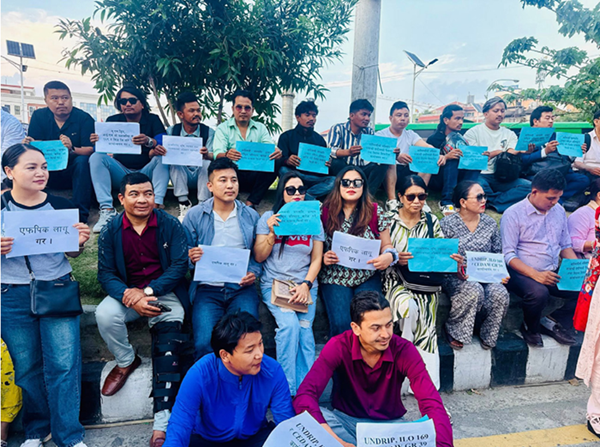

The 2015 Constitution was expected to empower marginalized Indigenous communities through devolved governance, proportional representation, and recognition of local identities. However, the extent to which these formal commitments translate into meaningful participation for Indigenous youth remains uneven.
Nepal’s Constitution provides several foundations for inclusion. Article 18 permits special measures for the protection and advancement of socially or culturally disadvantaged groups. Article 42 establishes the right of socially marginalized groups, including Indigenous nationalities, to participate in state bodies on the basis of inclusion. Article 51 directs the state to enhance participation and protect the identity, knowledge, skills, and culture of Indigenous nationalities. Article 84 establishes the mixed electoral system for the House of Representatives, including proportional representation, while article 176 provides a related framework for provincial assemblies. Article 261 establishes the Indigenous Nationalities Commission (Nepal 2015).
The Local Government Operation Act 2017 and the applicable National Youth Policy provide further entry points for youth participation (Nepal 2017; Nepal, National Youth Council 2025). While these constitutional and legislative provisions establish an important basis for inclusion, the central question is whether they translate into specific opportunities for Indigenous youth to enter party leadership, obtain nominations, and influence public decisions.
While these constitutional and legislative provisions establish an important basis for inclusion, Indigenous youth continue to face barriers to meaningful political participation. These include centralized and opaque party and candidate selection processes; weak institutional mechanisms for youth influence; unequal access to education, economic resources, political information, and networks; and intersecting forms of exclusion linked to language, gender, geography, and socioeconomic position.
Research on the political careers of Dalits demonstrates how caste hierarchy, elite control of party structures, and unequal access to political networks can constrain the advancement of historically marginalized groups (Nepali 2024). These findings should not be treated as direct evidence about Indigenous youth, whose exclusion also has distinct ethnic, linguistic, territorial, and cultural dimensions. They are nevertheless relevant as comparative evidence that formally inclusive political institutions may continue to reproduce entrenched social hierarchies.
Nepal’s federal democratic system cannot achieve its promise of inclusion without the meaningful participation of Indigenous youth. Their engagement is crucial for ensuring that local and national policies reflect the diversity of the country’s population and that federalism functions as a mechanism for empowerment rather than another layer of exclusion.
2. Analysis
Indigenous youth in Nepal face a complex set of overlapping barriers to political participation. These include institutional and structural obstacles within party systems and electoral mechanisms, the erosion of traditional Indigenous governance practices, socioeconomic and educational constraints, cultural and linguistic marginalization, and gendered inequalities that place a disproportionate burden on young Indigenous women. Implementation gaps in existing legal frameworks further compound these challenges.
2.1. Institutional, Socioeconomic, and Structural Barriers
Young people have played an important role in Nepal’s political movements and democratic transition through organizing, campaigning, and protest. Indigenous youth also participated in Adivasi Janajati movements and other struggles for inclusion and political change. However, participation in mobilization has not consistently translated into access to candidate selection, party leadership, or elected decision-making. Political parties often provide young members with campaign and organizational roles while senior leadership and nomination authority remain concentrated among established figures (Shakya 2022).
One major barrier to participation is Nepal’s current political party system. Candidate selection is largely controlled by political parties, particularly through central nomination procedures and closed proportional representation lists. The central policy concern is not that communities must directly select party candidates, but that nomination criteria and decision-making are often insufficiently transparent or participatory. Indigenous youth may therefore have limited influence over who is placed on candidate lists, where candidates are ranked, and which constituencies they contest. Possible reforms include published nomination criteria, consultation with Indigenous and youth structures, transparent internal selection procedures, and reporting on the age, gender, and Indigenous identity of applicants, nominees, and elected representatives (Shakya 2022; Yadav 2022).
Nepal’s democratic framework protects individual rights such as freedom of expression, association, privacy, and political choice. These rights need not conflict with Indigenous practices of collective deliberation and community responsibility. The policy challenge is to create institutional arrangements that allow customary forms of consultation, consensus-building, and intergenerational dialogue to inform public decisions while continuing to protect individual choice, gender equality, and the rights of dissenting or less powerful community members.
Nepal elects 165 members of the House of Representatives through first-past-the-post contests and allocates 110 seats through a closed-list proportional representation system. For proportional lists, electoral legislation prescribes an inclusive distribution among six population clusters, including Khas Arya, Adivasi Janajati, Madhesi, Dalit, Tharu, and Muslim communities. The constitutional framework also requires political parties to ensure that women constitute at least one-third of their total representation in the Federal Parliament. These provisions establish a significant basis for descriptive inclusion, but parties retain substantial influence over which individuals are listed, their placement, and their eventual selection (Nepal 2015; Nepal, Election Commission 2026).
In the 2026 House of Representatives, members classified within the Adivasi Janajati cluster accounted for 21.09 percent of the full House, compared with more than one-third of the population recorded in the 2021 census. This suggests that cluster rules within the proportional component do not necessarily produce population-proportionate representation across Parliament as a whole (Nepal, Election Commission 2026; Nepal, National Statistics Office 2023).
Broad proportional representation clusters do not necessarily ensure representation of smaller ethnic groups. An analysis of the previous electoral cycle found that nearly half of Nepal’s ethnic groups remained unrepresented in Parliament despite more than a decade of proportional representation (Pradhan 2022). This illustrates the difference between representation of broad population clusters and representation of smaller Indigenous nationalities.
Underrepresentation and tokenism are related but distinct problems. Some Indigenous nationalities remain absent from elected institutions altogether, while individuals from other communities may be included without obtaining meaningful influence over party decisions or policy. Research on youth participation in Nepal indicates that young people may be mobilized for campaigns and political activities without gaining comparable access to leadership or policymaking. Indigenous youth organizations have also reported exclusion from national youth forums (Yadav 2022; IWGIA 2025). In this policy brief, tokenism therefore refers to participation that is visible but does not provide meaningful access to information, decision-making authority, or institutional response.
2.2. Participation Outside Political Parties
Political participation also takes place outside political parties and elected office. Indigenous youth may engage through community organizations, public consultations, social movements, civic monitoring, digital advocacy, and direct engagement with local representatives. A study of six local units found that young people participated in elections, policymaking, and governance monitoring but often lacked appropriate platforms, financial resources, and institutional mechanisms through which their proposals could influence decisions (Yadav 2022). These channels are important for Indigenous youth who may not have immediate access to party nominations, but their effectiveness depends on whether public institutions respond to their inputs. Yet these systems are rarely acknowledged within Nepal’s formal political structures, meaning that Indigenous youth must navigate two parallel political worlds: one rooted in their communities, the other in state institutions that largely ignore their heritage.
Meaningful participation therefore requires not only invitations to meetings but also timely access to information, opportunities to participate before decisions are finalized, and a clear institutional response. Public bodies and political parties should be able to explain how youth proposals were considered and why particular recommendations were or were not adopted.
2.3. Traditional Governance
Political participation is not limited to elections and political parties. Indigenous youth may also learn, exercise, and transmit political responsibilities through customary institutions, community assemblies, and collective resource governance systems. Historically, Indigenous institutions have practiced consensus-based decision-making oriented toward collective welfare, including in the Mithewa, Mundum, Parma, and Shagya systems. The following examples illustrate practices such as intergenerational learning, consensus-building, and mutual accountability. They are not presented as uniform across Indigenous communities or as substitutes for constitutional institutions.
The Mithewa system emphasizes conflict resolution, community coordination, and collective decision-making, while Shagya, practiced in the Tsum region, uses community meetings and collective agreement in matters including resource management (Sherpa 2021, 2024). Where young people are able to observe and participate in such processes, customary governance may provide opportunities for intergenerational learning about leadership, deliberation, and accountability.
The policy relevance of these systems depends on whether young people participate in actual deliberation rather than only observation, whether young women and marginalized youth are included, and whether customary decisions remain compatible with constitutional equality and individual rights. Recognition should therefore be community-led and accompanied by locally appropriate safeguards for inclusive participation, transparency, and review.
2.4. Socioeconomic and Educational Constraints
Institutional barriers do not operate in isolation for Indigenous youth; they are compounded by socioeconomic and educational constraints that further limit access to political spaces. These constraints include unequal access to education, secure livelihoods, information, mobility, and political networks. These inequalities affect who can attend meetings, join political parties, campaign for office, or develop the experience required for leadership.
Indigenous students may face disadvantages where Nepali or English is the primary language of instruction and educational materials do not reflect their mother tongues such as Magar, Rai, or Tamang, or cultural contexts. (Poudel and Costley 2023).
2.5. Cultural and Linguistic Marginalization
Language affects political participation because it determines who can understand electoral information, follow public debate, communicate with officials, and contribute effectively to meetings and consultations. Nepal’s 2021 census recorded 124 mother tongues. The proportion of the population reporting Nepali as its mother tongue increased from 44.6 percent in 2011 to approximately 51 percent in 2021, while around 46 percent reported speaking Nepali as a second language (Nepal, National Statistics Office 2023).
The 2021 census also collected information on ancestral language as a distinct category, providing additional evidence of the relationship between linguistic identity and current language use (Nepal, National Statistics Office 2023). Concerns about language endangerment extend beyond the census data. In 2022, Nepal’s Language Commission reported preservation initiatives for 37 languages with fewer than 1,000 native speakers, including 23 described as being on the verge of extinction (OnlineKhabar 2022).
Language endangerment and language shift also have implications for Indigenous youth participation, particularly where they reduce young people’s ability to engage with customary institutions, access intergenerational political knowledge, or communicate community priorities. Where voter education, party materials, public hearings, and local government procedures are available mainly in Nepali, young people with limited access to Nepali-language education may participate on unequal terms. Multilingual civic information, interpretation in consultations, and mother-tongue civic education should therefore be considered political participation measures as well as cultural policies.
2.6. Gender and Intersectionality
These institutional, linguistic, and socioeconomic barriers do not affect all Indigenous youth in the same way. Young Indigenous women may face additional obstacles linked to gender, age, ethnicity, geography, and socioeconomic position. These can include unequal access to party networks and campaign resources, limited mentoring and leadership opportunities, mobility and care responsibilities, and exclusion from candidate selection processes. Broader gender inequalities in education, income, and public participation can further narrow pathways into political leadership.
Available evidence on the intersection of age, gender, and Indigenous identity remains limited. The absence of consistently disaggregated data makes it difficult to determine the representation of young Indigenous women across candidate lists, elected office, party leadership, and public institutions (UN Women 2022). Age, gender, Indigenous identity, and socioeconomic position can therefore interact to create compounded barriers, particularly for young Indigenous women. Better disaggregated data are needed to identify where these inequalities arise and which measures are effective in addressing them.
Beyond formal politics, broader socioeconomic marginalization can restrict Indigenous women’s access to resources and opportunities that support participation in public life. Research on Indigenous women in Nepal has documented concerns regarding land and natural resource rights, including limited recognition of collective rights and participation in decisions concerning forests and other resources (IWGIA 2021, 2022). For young Indigenous women, these inequalities may intersect with educational, linguistic, and socioeconomic barriers, narrowing opportunities to build political networks and leadership experience. Language-related disadvantage in education can further compound these barriers (Poudel and Costley 2023).
As a result, Indigenous women and youth suffer intersecting barriers of gender discrimination, ethnic marginalization, and socioeconomic exclusion, making it significantly harder for them to participate meaningfully in Nepal’s federal democratic system. In order to strengthen Indigenous youth participation, gendered inequalities must be addressed, not as an afterthought but as a core structural reform within political parties, local governments, and national policies.
2.7. Implementational Gaps
Nepal’s legal framework requires political parties to maintain democratic internal structures and provide for inclusive representation in their executive committees. It does not, however, appear to establish a specific requirement for Indigenous youth representation in party leadership. Similarly, the National Youth Council has a broad mandate to involve youth in policy and national development, but there is no clear public requirement for dedicated Indigenous youth representation within its principal structures (Nepal, Election Commission 2026; Nepal, National Youth Council 2025).
These gaps matter because general commitments to inclusion may not address the combined barriers associated with age and Indigenous identity. The International Work Group for Indigenous Affairs (IWGIA) reported that Indigenous-youth organizations were absent from two major youth forums held in Nepal in 2024, illustrating that general youth participation mechanisms do not automatically ensure Indigenous youth inclusion (IWGIA 2025).
At the local level, federalism has created important opportunities for community participation, but Indigenous youth may still lack regular mechanisms to influence planning and decision-making. Research on youth participation in local governance points to gaps in participation platforms, financial resources, and institutional follow-up, while broader Indigenous rights reporting indicates that general youth mechanisms do not automatically ensure Indigenous youth inclusion (Yadav 2022; IWGIA 2025). More structured consultation, youth advisory roles, and Indigenous-language facilitation could help strengthen substantive participation.
Interviews with Indigenous representatives provide additional perspectives. Diwas Kirat of the Nepal Federation of Indigenous Nationalities observed that Indigenous youth remain marginal within the political landscape despite broader constitutional and policy commitments to inclusion. Hilari Bhandu Bhujel, formerly of the Youth Federation of Indigenous Nationalities Nepal, similarly emphasized that federalism and inclusion provisions have not yet translated into consistent Indigenous youth participation in policymaking (Bhujel 2025; Kirat 2025).
Nepal has established important constitutional and electoral foundations for inclusion, but formal representation does not necessarily give Indigenous youth influence over political decisions. Centralized nominations, limited access to party leadership, unequal educational and political resources, and linguistic and gender barriers continue to constrain participation. Indigenous youth have nevertheless demonstrated political agency through social movements, community institutions, and advocacy. The policy challenge is to create transparent and inclusive pathways through which this participation can progress into candidacy, leadership, and sustained influence across federal, provincial, and local institutions.
3. Policy Options
The following recommendations suggest ways to move from formal recognition to meaningful participation in light of the barriers identified throughout this policy brief.
3.1. Strengthen Indigenous Youth Representation
Federal, provincial, and local institutions should consider measures to increase the representation of Indigenous youth in elected bodies, political parties, and public decision-making structures. Options may include youth-sensitive placement within proportional lists, voluntary or statutory targets for party leadership, transparent nomination criteria, and designated places in consultative or advisory bodies. These measures should aim to strengthen meaningful influence rather than symbolic inclusion.
3.2. Improve Transparency Within Political Parties
Political parties should publish clear information on candidate selection procedures, proportional-list placement, and leadership appointments. Political parties and the Election Commission should also consider publishing standardized data on candidates and leadership bodies disaggregated by age, gender, Indigenous identity, and level of office, subject to appropriate data protection safeguards. This would make it easier to assess whether inclusion commitments translate into actual access to nominations and leadership.
3.3. Create Meaningful Participation and Accountability Mechanisms
Federal ministries, provincial governments, and local authorities should establish regular mechanisms for Indigenous youth participation in planning, consultation, and monitoring. These may include youth advisory groups, public consultations, constituency dialogues, and participation in local planning processes, with clear rules on representation, access to information, and institutional follow-up. Institutions should publish how youth input was considered and explain where proposals were not adopted.
3.4. Expand Political Education and Leadership Pathways
The National Youth Council, political parties, universities, and Indigenous organizations should integrate targeted political literacy and leadership programs for Indigenous youth into existing structures. These should combine mentoring with practical pathways such as internships, policy fellowships, placements in provincial and local government, and transparent party candidate development programs. Particular attention should be given to young Indigenous women and youth facing geographic or socioeconomic barriers.
3.5. Promote Linguistic Inclusion in Political Participation
Electoral authorities, local governments, and political parties should provide civic information, voter education, consultation materials, and relevant public information in Indigenous languages, particularly in Indigenous majority areas. Interpretation should also be considered for public hearings, ward meetings, local government consultations, and complaints procedures. This would address linguistic barriers to participation rather than treating language policy only as a cultural issue.
3.6. Recognize Suitable Indigenous Governance Practices
Local governments should work with customary institutions and communities to identify practices such as consensus-building, intergenerational dialogue, and collective accountability that may strengthen local participation. Any recognition should be community-led and should respect constitutional equality, individual rights, and locally appropriate safeguards for the participation of young women and other marginalized youth.
3.7. Improve Data, Monitoring and Collaboration
The Election Commission, National Statistics Office, National Youth Council, research institutions, and Indigenous youth organizations should strengthen the collection and publication of data on candidacy, elected office, party leadership, and participation in public consultations. Data should, where feasible, be disaggregated by age, gender, Indigenous identity, disability, geography, and electoral route. Government institutions, the Asia Indigenous Peoples Pact (AIPP), the Asia Indigenous Youth Platform (AIYP), and Nepalese Indigenous youth organizations should also cooperate on multilingual civic education, leadership pathways, monitoring of inclusion commitments, and youth-led research.
References
Bhujel, Hilari Bhandu. 2025. Interview by the author, 14 November.
IWGIA (International Work Group for Indigenous Affairs). n.d. “Nepal.” Accessed 11 August 2026. https://www.iwgia.org/en/countries/nepal.
IWGIA (International Work Group for Indigenous Affairs). 2021. “Nepal.” In The Indigenous World 2021, edited by Dwayne Mamo. https://www.iwgia.org/en/nepal/4236-iw-2021-nepal.html.
IWGIA (International Work Group for Indigenous Affairs). 2022. “Nepal.” In The Indigenous World 2022, edited by Dwayne Mamo. https://www.iwgia.org/en/resources/publications/5503-the-indigenous-world-2022.html.
IWGIA (International Work Group for Indigenous Affairs). 2025. “Nepal.” In The Indigenous World 2025, edited by Dwayne Mamo. https://www.iwgia.org/en/nepal/5672-iw-2025-nepal.html.
Kirat, Diwas. 2025. Interview by the author, 14 November.
Nepal. 2015. Constitution of Nepal. Nepal Law Commission. https://lawcommission.gov.np/content/13437/nepal-s-constitution/.
Nepal. 2017. Local Government Operation Act 2074. Ministry of Federal Affairs and General Administration. https://mofaga.gov.np/news-notice/1697.
Nepal, Election Commission. 2026. “Election Commission Submits Report on House of Representatives Election Results to President Ramchandra Paudel.” 19 March. https://ebulletin.election.gov.np/2026/03/3043/.
Nepal, National Statistics Office. 2023. National Population and Housing Census 2021: National Report. https://censusresults.nsonepal.gov.np/.
Nepal, National Youth Council. 2025. National Youth Policy 2082. https://www.nyc.gov.np/content/16/national-youth-policy2082/.
Nepali, Ghamber B. 2024. “Politics of Marginalization: How Caste Affects Political Career of Dalits in Nepal.” Dhaulagiri Journal of Sociology and Anthropology 18 (1). https://doi.org/10.3126/dsaj.v18i01.67552.
OnlineKhabar English. 2022. “37 Languages in Nepal on the Verge of Extinction Being Preserved.” 21 February. https://english.onlinekhabar.com/languages-in-nepal-nearly-extinct.html.
Poudel, Prem Prasad, and Tracey Costley. 2023. Understanding the Impact of Languages and Language Policies on Children’s Learning Outcomes in Nepal. Center for Education and Human Resource Development and UNICEF Nepal. https://www.unicef.org/nepal/media/21421/file/20240416Understanding%20the%20Impact%20of%20Languages%20and%20Language%20Policies%20on%20Children%27s%20Learning%20Outcomes%20in%20Nepal%20English%20version%20Final_PDF%20Print.pdf.pdf.
Pradhan, Tika R. 2022. “Nearly Half of Ethnic Groups Unrepresented in Parliament in 15 Years of PR Exercise.” Kathmandu Post, 15 October. https://kathmandupost.com/politics/2022/10/15/nearly-half-of-ethnic-groups-unrepresented-in-parliament-in-15-years-of-pr-exercise.
Shakya, Krisha. 2022. “Prospects of Youth Participation in Political Landscape in Nepal.” Nepal Economic Forum, 5 December. https://nepaleconomicforum.org/prospects-of-youth-participation-in-political-landscape-in-nepal/.
Sherpa, Pasang Dolma. 2021. Indigenous Peoples’ Customary Governance for Sustainable Management of Natural Resources and Protection of Biodiversity. Center for Indigenous Peoples’ Research and Development. https://cipred.org.np/uploads/pdf/195216067report-on-indigenous-customary-governance-system--Shagya_compressed.pdf.
Sherpa, Pasang. 2024. “Customary Governance and Social Dynamics in Natural Resource Management Among Mountain Indigenous Communities in Upper Manang.” Tribhuvan University Journal 39 (2): 113–30. https://doi.org/10.3126/tuj.v39i2.72898.
UN Women. 2022. Final Annual Report: Making Every Woman and Girl Count. Moving the Needle on Gender Data. United Nations Entity for Gender Equality and the Empowerment of Women. https://data.unwomen.org/sites/default/files/documents/Publications/AR2021/Annual%20Report_2022_Final.pdf.
World Bank and Department for International Development (DFID). 2006. Unequal Citizens: Gender, Caste and Ethnic Exclusion in Nepal. https://documents.worldbank.org/en/publication/documents-reports/documentdetail/745031468324021366.
Yadav, Yukta. 2022. Youth’s Participation in the Governance Process in Nepal. Centre for Social Change. https://socialchange.org.np/publications/ypgp/.
About the Author
Supriya Rai is Chairperson of the Asian Indigenous Youth Platform (AIYP) and Vice Chairperson of the Youth Federation of Indigenous Nationalities of Nepal (YFIN Nepal). She is also pursuing a master’s degree in Indigenous Education and Development at Kathmandu University, Nepal.
About the AIPP
The Asia Indigenous Peoples Pact (AIPP) is a regional membership-based organization founded in 1992 by Indigenous Peoples’ movements across Asia. Serving as a platform for 46 member organizations and movements across 14 countries, AIPP brings together Indigenous Peoples to discuss shared challenges, develop common positions, and advance programs that promote and protect their rights and interests. Over three decades, AIPP has become a trusted and influential vehicle for solidarity, cooperation, and collective action among Indigenous Peoples in Asia, implementing initiatives developed and approved in partnership with its members and coordinating five regional networks focused on Indigenous Media, Women, Defenders, Knowledge, and Youth.


© 2026 International Institute for Democracy and Electoral Assistance
International IDEA publications are independent of specific national or political interests. Views expressed in this publication do not necessarily represent the views of International IDEA, its Board or its Council members.
With the exception of any third-party images and photos, the electronic version of this publication is available under a Creative Commons Attribution-NonCommercial-ShareAlike 4.0 (CC BY-NC-SA 4.0) licence. You are free to copy, distribute and transmit the publication as well as to remix and adapt it, provided it is only for non-commercial purposes, that you appropriately attribute the publication, and that you distribute it under an identical licence. For more information visit the Creative Commons website: http://creativecommons.org/licenses/by-nc-sa/4.0.
Design and layout: International IDEA
DOI: https://doi.org/10.31752/64383
ISBN: 978-91-8137-214-4 (PDF)
ISBN: 978-91-8137-215-1 (HTML)


