


Envisioning Democratic Futures: The Nordic–Baltic Region in 2050
Discussion Paper 5, 2026

The discussion paper was written by Gentiana Gola, Emily Bloom and Daniel Riveong and was reviewed by Katarzyna Gardapkhadze, Seema Shah, Alexander Hudson and Marilyn Neven. Additional feedback was provided by Toomas Hanso, Iida Hyyryläinen, Johanna Ketola, Michael Runey and Elin Westerling. The paper was developed on the basis of the insightful and creative contributions of the participants at the Nordic–Baltic Region Democratic Futures Foresight Workshop and the Nordic–Baltic Youth Design Hub held in Stockholm in March 2026. These sessions were organized by the International Institute for Democracy and Electoral Assistance (International IDEA) and facilitated by Daniel Riveong (Plural Futures) and Johanna Ketola (Demo Finland) (see Annex A for a list of participants). While the participants’ invaluable work and insights informed the paper, the views expressed herein should not be understood as representing the participants’ opinions. The paper also features original artwork by Liisa Kruusmägi.
In recent years, democratic systems across the wide-ranging Nordic–Baltic region have been exposed to domestic political stressors, including rising economic inequality and intensifying questions of political belonging (Statisikmyndigheten 2023; Eurostat 2026). At the same time, the region is at a pivotal moment of geopolitical pressure as Russia’s aggression against Ukraine and the evolving strategic significance of the Arctic underscore new and compounding security risks (Nordic Council of Ministers 2025; Pechko 2025; Thorhallsson and Vidal 2025).
The pressing question to consider now is whether Nordic–Baltic democracies can seize this moment to adapt, recognize emerging stressors and respond in ways that strengthen democratic institutions, reinforce democratic norms and revive a culture of engagement that builds resilience against future shocks. Failure to do so could lead to a pattern of erosion affecting the core of the region’s democratic hallmarks—declining institutional trust, weakening accountability, and undermined social and political equality. Critically, this moment could either fragment regional coordination and undermine shared understanding or catalyse a stronger Nordic–Baltic identity and deeper integration.
Using strategic foresight methods, this report explores four archetypal scenarios for the future of democracy in the region through 2050 (baseline, decline, new equilibrium and transformation) (University of Houston n.d.). The scenarios were developed within the framework of several boundary conditions: (a) no large interstate war; (b) no state collapse; and (c) a continued—though in some futures increasingly fragmented—European Union. These assumptions reflect the project’s intention to explore democratic change within functioning, if stressed, political systems rather than full institutional breakdown.
By 2050 the Nordic–Baltic region remains democratic, efficient and technologically advanced, but public life feels increasingly hollow. Elections run smoothly through digital systems, yet fewer than half of citizens feel motivated to vote, and political contestation narrows to technical debates. Welfare systems gradually shrink, migration becomes more conditional, and administrative algorithms play a bigger role than politics in shaping everyday life. Security spending, demographic ageing and population decline, and climate pressures gradually reorient governance towards efficiency and risk management rather than participation or equality. Democracy still functions, but with low trust, limited ambition and a sense of detachment from citizens’ real concerns.
Inequality widens sharply by 2050, and the Nordic–Baltic region loses much of its social cohesion. Foreign-owned digital economic infrastructure comes to underpin welfare delivery, energy systems, agriculture and public administration. Governments are increasingly unable to audit or regulate the systems on which they depend, weakening sovereignty, accountability and public authority. A shrinking working-age population, combined with high defence spending driven by persistent geopolitical instability, erodes welfare systems. As national institutions find themselves unable to counter these pressures, public trust collapses, and people increasingly turn to local issues and authorities. Society fractures along urban–rural, ideological and gender lines, with polarized online movements shaping political attitudes. Regional cooperation falters as incompatible domestic information environments undermine trust, coordination and shared threat perceptions. Content generated by artificial intelligence replaces independent journalism as foreign-owned media platforms rely on automated news feeds, algorithmic summaries and influencer-driven narratives. The region remains democratic in form, but is weakened, polarized and heavily dependent on external actors.
By 2050 national governments, facing budget constraints driven by defence costs, climate adaptation and demographic pressures, openly acknowledge hard limits and codify trade-offs. A regional defence pact replaces membership of the North Atlantic Treaty Organization (NATO) for several countries, pairing security guarantees with explicit fiscal constraints. Democracy is most vibrant at the local level, and municipalities take on major responsibilities, including for social services. Local communities with strong tax bases in the Nordic countries thrive, while others, particularly in the Baltic countries, struggle—deepening regional inequality. Trust in national governments falls to historically low levels, and local assemblies, cooperatives and community networks become the main arenas of democratic life. The welfare state still exists but is thinner and more uneven due to budget constraints and divergent local capacity, with universality partially sacrificed through healthcare copayments and selective provision. The region stabilizes in a new balance—resilient and locally driven, but fragmented in capacity and outcomes.
After geopolitical shocks, climate disasters and demographic crises overwhelm national systems, by 2050 the Nordic–Baltic states cooperate closely through a powerful regional Nordic–Baltic Union Assembly with binding authority over cross-border issues. Youth movements, Sámi activism and civic mobilization drive institutional reform, including lowering the voting age and establishing intergenerational fiscal guarantees. The Assembly has a mandate to establish policies on defence, climate adaptation, minority rights and youth investment. A shared regional identity emerges, and democratic participation is revitalized through transnational parties and digital platforms. The region becomes more integrated, innovative and collectively governed.
Box. E.1. How to use this paper
This paper is designed to support policymakers, public officials, and national and regional cooperation actors working on democratic governance in the Nordic–Baltic region. Among other things, the scenarios and policy pathways can be used to:
- stress‑test ongoing or planned reforms against multiple plausible futures;
- identify robust policy options that are viable under different conditions;
- inform long‑term strategies in ministries, parliaments and public agencies;
- shift from reactive crisis response to proactive democratic preparedness, strengthening the region’s ability to anticipate and shape future developments;
- support regional cooperation agendas, including work by regional or international organizations such as the International Institute for Democracy and Electoral Assistance (International IDEA); and
- facilitate dialogue among stakeholders about emerging risks and opportunities.
The scenarios are not forecasts. They are tools to help decision makers reflect on uncertainty, challenge assumptions and strengthen democratic resilience across a range of possible futures.
Each scenario is accompanied by policy recommendations that provide concrete ideas for reform. They are directed at specific groups of decision makers and may be implemented over various timeframes. It should be noted that the recommendations are specific to the scenario from which they emerge, but they share a number of common structural features that can serve as a guide for decision makers. These include the following points (described in greater detail and linked to the scenarios in Chapters 2 to 5), in no particular order:
- promoting strong, consistent and innovative regional collaboration that is marked by inclusive participation, transparency and forward-looking action;
- protecting democratic infrastructure against resource competition arising from defence, welfare and climate demands;
- building genuine civic belonging for newcomers beyond formal rights;
- ensuring democratic oversight of algorithmic governance before reliance becomes irreversible;
- strengthening local democratic infrastructure as a deliberate strategy rather than a by-product of national withdrawal; and
- defending a shared information commons as core democratic infrastructure.
Taken together, these priorities require a shift from treating democracy as an assumed outcome of good governance to understanding it as a shared capacity that must be continuously resourced and renewed across society.
Nordic–Baltic democracies—understood to include Denmark, Estonia, Finland, Iceland, Latvia, Lithuania, Norway and Sweden—consistently rank among the strongest in the world in the Global State of Democracy Indices (see Figure I.1) (International IDEA n.d.). At the same time, a number of strains on democratic systems across the region have become increasingly visible. While levels of economic inequality have been low historically, income and wealth inequality have risen in recent years and have become increasingly salient in political debate, including in discussions regarding the taxation of wealth (Blackburn 2025; Rasmussen 2026). Contested questions about who belongs to the political community have gained prominence (Kotonen et al. 2023). These domestic challenges intersect with cross-border pressures, including mounting geopolitical tensions, hybrid threats to critical infrastructure and the securitization of public policy; the accelerating impacts of climate change; and an intensifying demographic squeeze linked to ageing populations and migration (Ek, Slätmo and Sonesson 2026). As recent work on the ‘democracy stack’ highlights, democratic resilience depends on a layered ecosystem of institutions, information integrity and civic digital infrastructure that must function together under pressure (Rodriguez 2026).
These pressures do not affect all countries uniformly, and democratic life across the region continues to reflect differing historical trajectories. In the Baltic countries—Estonia, Latvia and Lithuania—democratic aspirations endured despite repeated disruptions to sovereignty and prolonged periods of occupation and repression (Lithuanian Armed Forces n.d.; Bennich-Björkman 2007). Russia’s aggression against Ukraine has reinforced how these historical experiences continue to matter today, sharpening security concerns and underscoring the region’s exposure to geopolitical pressure. Iceland’s position within the region is distinct: its small population, remote location and unique demographic profile mean that some regional pressures manifest differently there and are therefore less prominent in certain scenarios in this report.
While specific consequences differ, all the countries in the region are exposed to the effects of climate change. As part of Northern Europe and the Arctic, the Nordic–Baltic region is warming at more than twice the rate of the global average. While the Nordic–Baltic countries have comparatively strong adaptation capacities, climate change impacts from sea-level rise and ecosystem degradation in the Baltic Sea, more frequent and intense extreme weather events, and changing precipitation patterns are already posing local and transnational governance challenges (C3S/ECMWF and WMO 2025; Notre Dame Global Adaptation Initiative 2026).
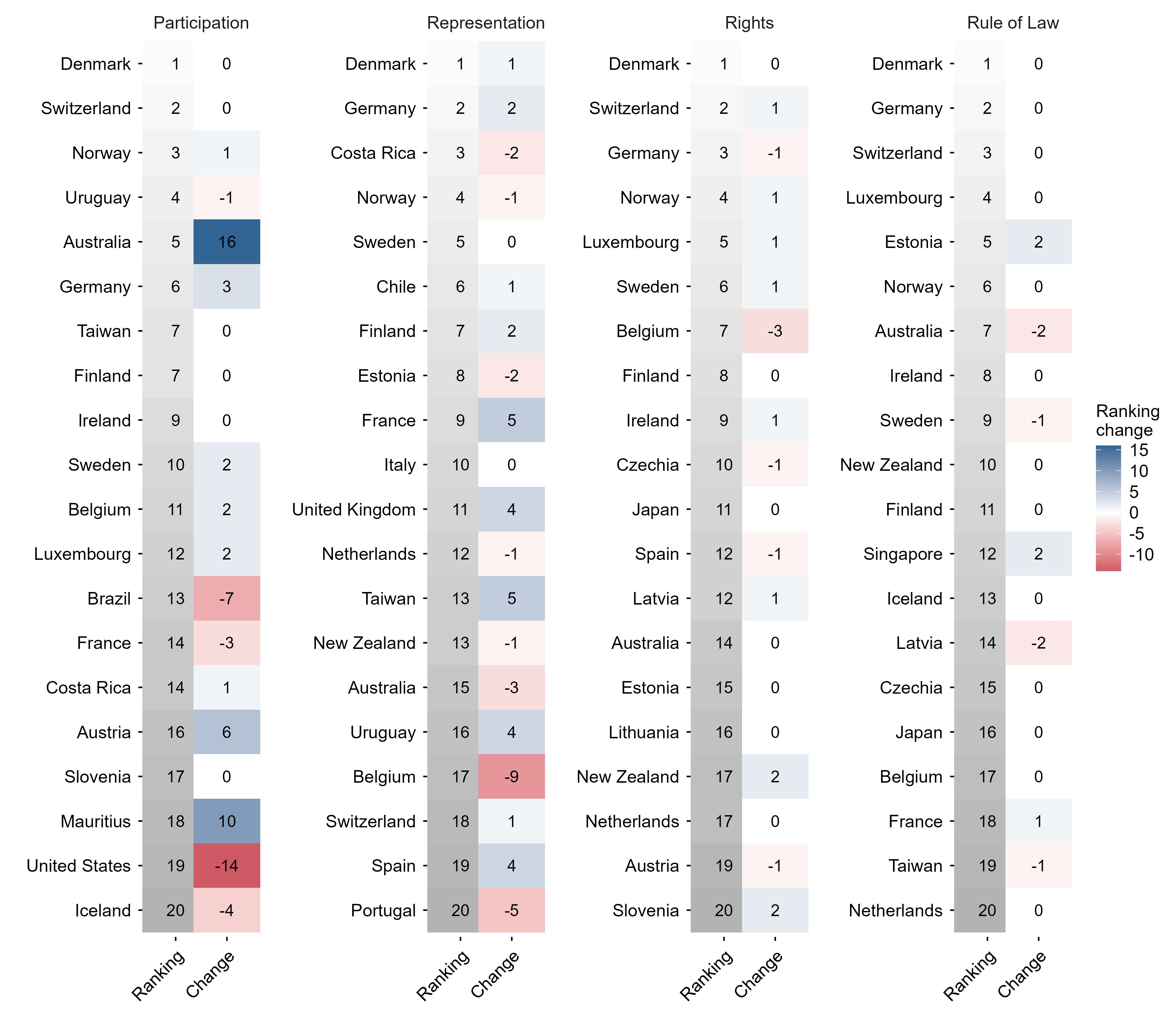

A complete citation to the source of the figure should be provided.
One key dividing line within the region is demographic change. Across the region, fertility rates are historically low, but outcomes diverge sharply. The Nordic countries—Denmark, Finland, Iceland, Norway and Sweden—continue to grow, driven by urbanization and sustained immigration (Nordregio n.d.; World Bank Group 2024; Heleniak and Bruno 2026). By contrast, the Baltic countries are still dealing with the long-term effects of emigration, which has reduced working-age populations and strained labour markets (Statistics Estonia 2026). While this pattern is beginning to shift, most clearly in Lithuania, where net migration has been positive since 2019 and young people are returning, the country has not yet reversed population loss (Official Statistics of Latvia n.d.; Birka 2019; Chmielewski 2023; Official Statistics of Lithuania 2023; Delfi 2026). Reflecting this cautiously optimistic trend, a majority (56 per cent) of Lithuanian respondents in International IDEA’s Perceptions of Democracy Survey reported a sense of intergenerational progress (International IDEA 2024).
These demographic trends feed directly into questions of political inclusion. In the Nordic countries, immigration has made societies more diverse, bringing debates over social cohesion and security to the fore. Demographic ageing is exerting significant impacts across the Nordic–Baltic region, and projections indicate that sustaining current levels of economic performance and welfare provision will increasingly depend on net positive immigration (Nordregio 2026). In parallel, concerns about violence in socio-economically marginalized areas and rising hostility towards migrants have become central political issues, shaping national discourse and testing long-standing commitments to openness and inclusion (Tunström and Wang 2019; Civil Rights Defenders 2024; Krzyżanowski and Ekström 2025;
At the same time, gendered patterns of political engagement have begun to shift, even though the Nordic region is widely regarded as one of the most gender‑equal in the world. Young men have increasingly gravitated towards the far right of the political spectrum, while young women have moved further left (Nennstiel and Hudde 2025), introducing a new vulnerability concerning democratic inclusion. Previous research suggests that such gaps and backlash may emerge precisely because of advances in gender equality or where gender issues become more salient (Inglehart and Norris 2000;
This multidimensional variation between the countries grouped together in the Nordic–Baltic region provides important context for considering possible future scenarios. The region covers a vast geographical area: the eastern border of the Dieveniškės salient of Lithuania is 3,000 km from the western coast of the Westfjords of Iceland. This distance influences how different countries in the region perceive future challenges, including the impacts of climate change, the threat of invasion by Russia and the difficulty of enforcing migration policy. Larger and wealthier countries may have more time to decide on future policies, as they have greater capacity to absorb shocks. As a result, the urgency of these future pressures may be felt differently across the region.
To explore how these dynamics may shape the region’s democratic future, International IDEA convened a workshop in Stockholm in March 2026, bringing together researchers, democracy practitioners and activists from across the Nordic–Baltic countries. Participants used strategic foresight methods (the approach and methodology are described in Chapter 1) to develop scenarios outlining how democracy in the region might evolve through 2050.
In the baseline scenario, ‘The Secure Drift’, democracy runs like clockwork, but few bother to check the time: formal processes function as intended, yet the sense of a shared democratic project has waned. In the decline scenario, ‘Countries within Countries’, the state persists largely on paper, while algorithms govern in practice and citizens inhabit increasingly fragmented enclaves. Representing a new equilibrium, ‘The Reluctant Bargain’ depicts a democracy that endures by openly acknowledging its limits and negotiating stark fiscal trade-offs. In contrast, the transformation scenario, ‘The Northern Assembly’, emerges from systemic crisis, as a younger generation dismantles inherited structures and builds a renewed democratic project across borders.
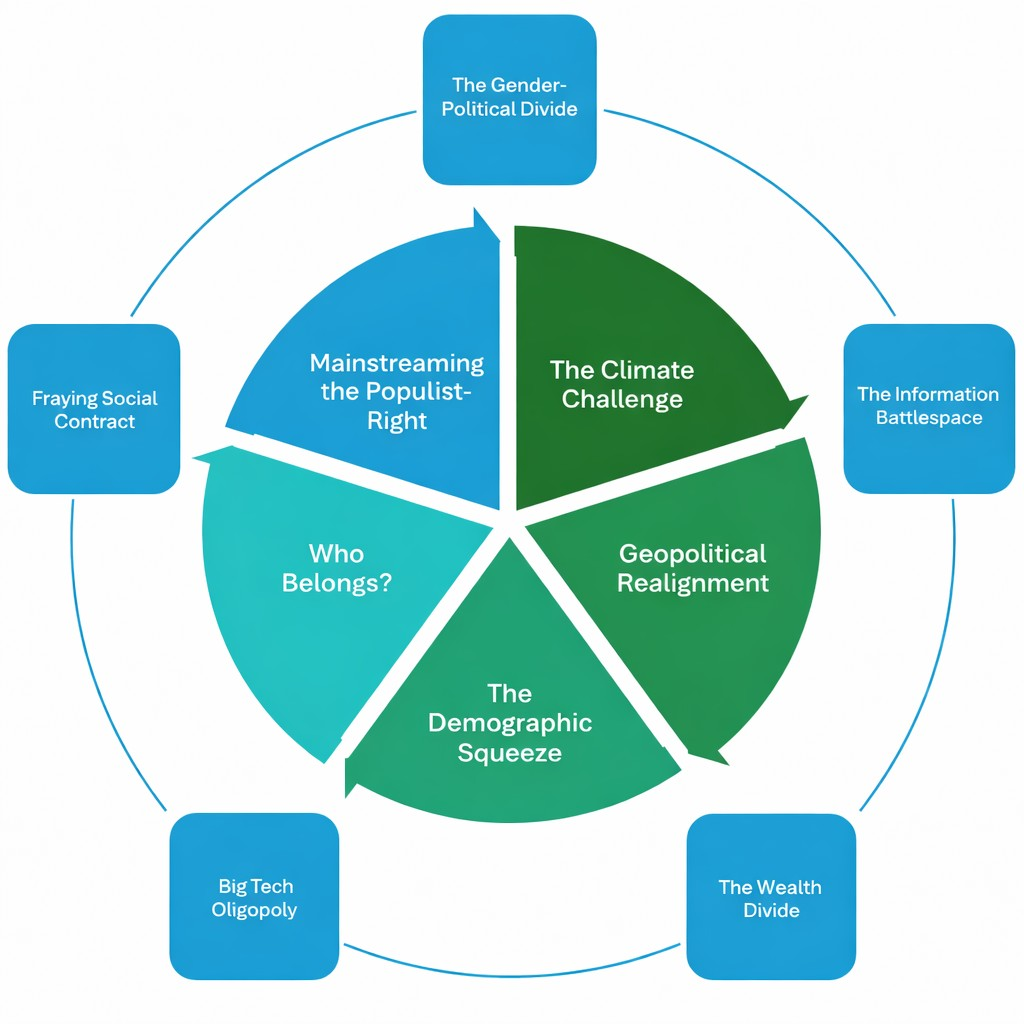
The scenarios are built around a defined set of parameters and drivers of change—including climate stress, geopolitical realignment, demographic pressures, debates over political belonging and the normalization of populist right-wing agendas (see Figure I.2). These parameters do not appear uniformly across all scenarios, nor do the scenarios cover every dimension of democracy in equal depth. This lack of uniformity reflects both the scenario design and the workshop process: different participant groups prioritized different drivers, and in some futures certain dynamics proved less salient than others. Experts identified the drivers through an initial mapping of megatrends, followed by a structured process in which participants selected a subset for deeper exploration.
The scenarios share a set of core assumptions that define the common background conditions across all possible futures explored in this report. Throughout the scenario horizon, the Nordic–Baltic region does not experience large-scale interstate war, territorial fragmentation or state collapse; national borders, sovereignty and basic democratic institutions remain intact. The European Union continues to exist, and core frameworks of integration endure, even if contested or unevenly applied. Market-based economies persist, as does relatively high state and administrative capacity, ensuring that the scenarios examine democratic variation rather than systemic failure. Advanced digitalization remains a structural condition shaping governance, political communication and civic life. Finally, climate change continues to exert growing pressure but does not trigger an abrupt catastrophe that overwhelms society within the timeframe.
The scenarios should be read not as exhaustive evaluations or predictions. Rather, they offer structured explorations of how different constellations of democratic actors, institutions and power dynamics could plausibly interact over time. Used in this way, the scenarios serve as analytical tools to support reflection, dialogue and strategic planning under conditions of uncertainty.
Read together, the scenarios point to a set of policy pathways that prove robust across futures—offering guidance regardless of what the future holds. (The ordering of the pathways is not indicative of priority.)
Protect democratic infrastructure from the defence–welfare–climate fiscal squeeze. Democratic institutions do not defend themselves in budget negotiations against competing pressures. Without deliberate structural protection, democratic infrastructure erodes by default rather than through explicit political decisions. As explored in the scenarios, measures can take the form of a constitutional or treaty-level commitment to minimum democratic investment; a ‘fiscal pact’ confronting defence–welfare trade-offs before long-term dependencies become entrenched; or a municipal revenue compact designed to mitigate Nordic–Baltic fiscal asymmetries. In the Northern Assembly scenario (the most positive transformation), this commitment manifests as a binding intergenerational fiscal compact with floors for youth investment. The scenarios also highlight the value of identifying linkages across policy domains—for example, participatory climate action or social protection investments that reinforce trust and democratic engagement—as interventions targeting overlapping challenges can multiply impact.
Build genuine civic belonging for newcomers. There is a need for structured pathways from residency to full civic participation that extend beyond legal rights to actual belonging, anchored in local community engagement rather than national assimilation requirements. Every scenario describes a failure to integrate newcomers into democratic life. The mechanisms differ from scenario to scenario—selective migration with shallow integration, hostile fragmentation, a two-tier ‘half-belonging’ arrangement where newcomers are assigned denizen1-like status with civic inclusion at the local level but exclusion from national political rights, or a new regional citizenship framework—but they all point to the same underlying policy gap.
Establish democratic oversight of algorithmic governance. Regional algorithmic accountability standards—audit requirements, transparency mandates and democratic governance of artificial intelligence (AI) systems that can serve to mediate public services and civic participation—should be developed before dependency on foreign-owned infrastructure becomes irreversible. Given the breadth of the challenge, governments should prioritize open‑source foundational models with democratic guardrails, strict data‑protection regimes and diversified supply chains. AI-mediated governance appears in every scenario as a force that simultaneously increases efficiency while eroding democratic accountability. The Secure Drift scenario describes algorithmic consultation replacing deliberation. The Countries within Countries scenario depicts foreign-owned digital infrastructures running welfare systems that governments cannot audit, while the Northern Assembly scenario embeds digital technologies, including AI, in a new assembly, raising concerns that these systems could become targets for hybrid threats.
Invest in local democratic infrastructure. Municipal-level democratic infrastructure—participatory budgeting, local assemblies, civic education and, critically, the revenue-raising capacity to fund these—should be supported as a deliberate strategy rather than as a by-product of national withdrawal. The Nordic–Baltic asymmetry is key: Nordic municipalities can partially fund this infrastructure themselves; Baltic municipalities cannot. Any robust local democracy strategy must address this gap. Across all four scenarios, democratic engagement migrates from the national to the local level. In the Secure Drift, this shift takes the form of a quiet hollowing-out reflected in a metropolitan-versus-peripheral divergence. In the Countries within Countries scenario, the local level becomes the last remaining site of trust. It is also the Reluctant Bargain’s central feature: local assemblies are where democracy remains most alive. The Reluctant Bargain directly addresses the question of what local democracy needs to function—fiscal capacity, anti-capture safeguards and mechanisms connecting local deliberation to national policymaking.
Defend the shared information commons. A Nordic–Baltic information resilience strategy that scales proven models—Lithuania’s volunteer ‘Elves’ network,2 Sweden’s Psychological Defence Agency and Finland’s media literacy curriculum—should become permanent regional infrastructure. Possible measures include the adoption of algorithmic transparency regulations, investment in independent journalism across all Nordic–Baltic languages and protection of public broadcasters as democratic infrastructure. It is important to emphasize that the Information Battlespace driver was rated among the most impactful drivers of change during the workshop (43 per cent high impact). Two scenarios, Countries within Countries and the Northern Assembly, mention sovereign digital infrastructure and information resilience as key issues, respectively.
The insights described in this report were derived from a foresight workshop convened by International IDEA with more than 20 experts from across the Nordic–Baltic region, guided by experienced foresight facilitators from Plural Futures and Demo Finland. The process combined a participatory foresight approach with structured secondary research, emphasizing not the scenarios themselves as a final product but the critical insights and actionable responses that emerged from them.
The 1.5-day workshop was structured around a ‘double‑diamond’ innovation process, an approach that begins with broad exploration and idea generation, and then moves towards selecting and refining the most relevant insights and policy pathways for action today.
The University of Houston’s Foresight scenario archetypes provided the methodological backbone (University of Houston n.d.), augmented by secondary research supported by Anthropic’s Claude AI. Participants used Claude’s synthesis of collected research material for further verification and analysis in crafting each of the four scenarios.
In the divergent phase, participants revisited and tested definitions of democracy, identified democratic practices from across the region that could contribute to stronger democratic futures, and surfaced trends and emerging issues likely to shape governance in the decades ahead. These trends and emerging issues were then collectively discussed and prioritized along two dimensions: (a) the factors most likely to have the greatest impact on democracy and governance; and (b) those most likely to evolve in unexpected ways.
Drawing on the University of Houston’s Framework Foresight scenario archetypes, participants then imagined how these prioritized factors could produce radically different outcomes for the region, ranging from a sustained decline in democratic systems to a fundamental transformation characterized by new values and institutions. These scenarios served not as endpoints but as analytical tools: participants used them to surface implications and identify specific actions that can be taken today to seize opportunities and mitigate the challenges revealed through the process.
Additionally, vignettes were woven into each scenario to ground the analysis in lived human experience, translating trends and emerging issues to the human scale of everyday life. Drawing on the same framework that anchored the broader scenario work, these short narratives illustrate how individuals might encounter each scenario’s defining dynamics in 2050, with an emphasis on belonging and democratic trust. The vignettes complement the scenarios by further surfacing second-order implications and reinforcing the human stakes of democracy and governance (see Boxes 2.1, 3.1, 4.1 and 5.1).
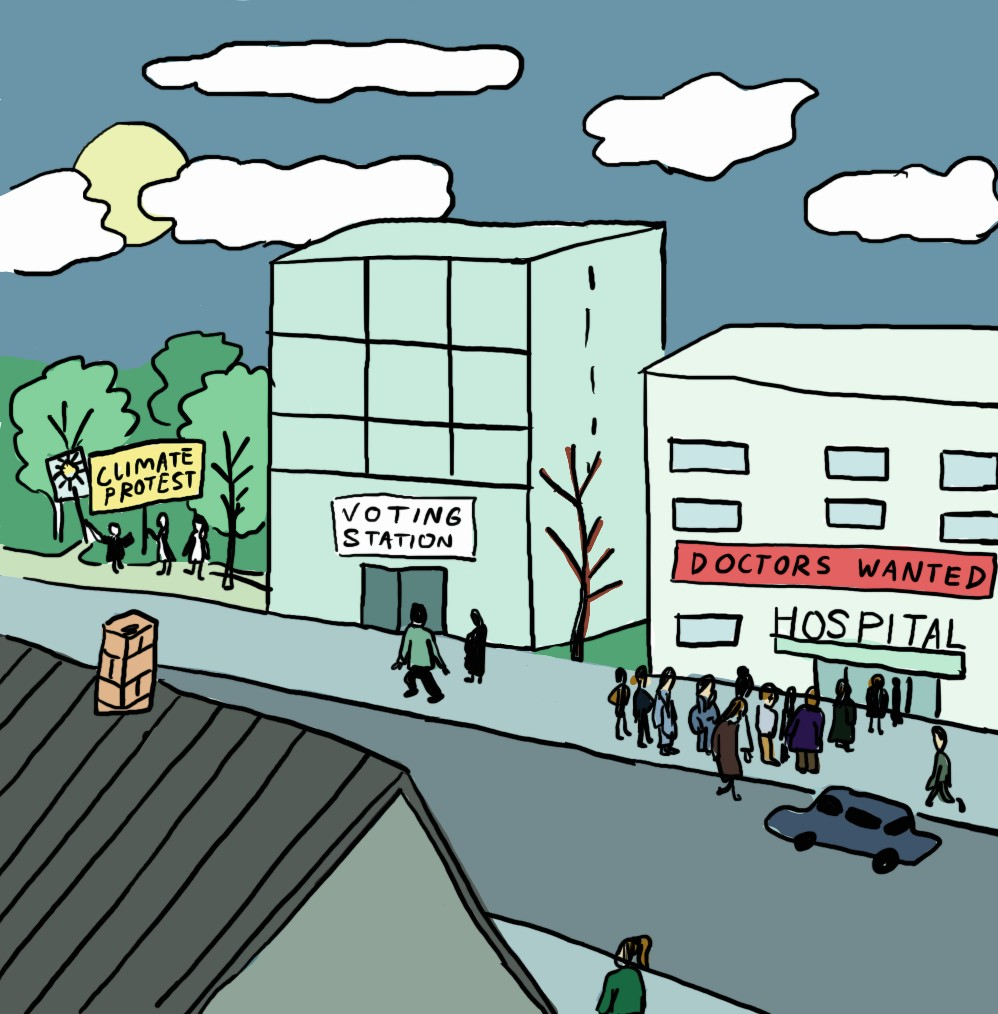
Image credit: Liisa Kruusmägi, 2026.
Election day in Tallinn, October 2050. Turnout hovers below 50 per cent, down from the 62 per cent that once seemed like a floor. Voters are authenticated via electronic identification documents in seconds—Estonia’s frictionless digital democracy now processes ballots faster than any system on earth—and yet the campaign itself barely registered. The four competitive parties differ on tax rates and childcare subsidies; none contests the fundamentals. The mood in the capital’s polling stations feels emblematic of democratic life across the Nordic–Baltic region—orderly, efficient, undramatic and increasingly hollow.
Beyond elections, societal participation and democratic life are increasingly shaped by administrative processes. In Copenhagen, AI-mediated citizen feedback platforms generate monthly policy briefs that ministers dutifully acknowledge but rarely act upon. AI has increased efficiency, but democratic trust has not kept pace.
In Vilnius, conscription notices arrive alongside targeted wellness nudges from the public health algorithm. National digital ID systems now include a ‘resilience’ module, linking identity verification not only to service access and mobility but also to priority and eligibility for public health benefits during emergencies. While most comply, some communities resist digitalization in favour of more community-based welfare support. Journalists complain about new accreditation requirements introduced on national security grounds.
Across the region, social programmes shrink unnoticed, reclassified as ‘non-core’. Migration continues but under narrower, more conditional terms. New arrivals are processed efficiently, assigned language tracks and skills pathways within weeks. People become accustomed to navigating a system that is reliable in process, if not responsive in practice. In Malmö, a software engineer from Tbilisi tells a friend that she still avoids certain neighbourhoods after dark—not because of crime, but because she has been stopped there before. A Syrian-born nurse checks her ID status before signing a longer lease, unsure which data update might change her eligibility.
The Nordic–Baltic region remains the world’s democratic benchmark, yet a Eurobarometer special report notes that only 18 per cent of citizens under 40 across the region describe elections as ‘meaningful to my life’. Outside polling stations, however, democracy takes a different form: episodic rent protests in Helsinki and climate blockades in Gothenburg draw thousands of young people who would never campaign for a political party, mobilized instead by rising living costs and anger over repeated postponements of emissions targets. Democracy functions. While it no longer inspires through its institutions, it has also not died in the streets.
The trajectory was set by several reinforcing pressures that emerged simultaneously in the mid-2020s and never relented. These pressures did not unfold as discrete shocks, but interacted with a series of later policy decisions and institutional pivots that gradually reshaped democratic governance across the region.
First, geopolitical realignment locked the region into a permanent security footing. In the decade after Finland and Sweden joined the North Atlantic Treaty Organization (NATO), defence budgets across the Nordic–Baltic region rapidly rose to between 4.0 per cent and 6.5 per cent of gross domestic product (GDP)—a new floor that crowded out social investment year after year. Intelligence sharing deepened, hybrid-threat coordination became routine, and defence priorities became embedded across domestic policy agendas. In 2029 the Nordic Defence Compact—an agreement formalizing joint Nordic–Baltic procurement, intelligence sharing and civil-defence coordination—passed through all eight parliaments with minimal debate. Peace organizations objected, but their funding had already been cut. The Compact was popular, and its security logic gradually extended into education curricula, media regulation and digital-identity standards.
Second, the demographic squeeze proved unforgiving. Lithuania’s population fell below 2.4 million by 2045; Finland’s working-age cohort shrank by nearly a fifth. Across the region, every country needed immigrants, and every country struggled politically to accept them.
Third, climate adaptation absorbed resources without resolving root causes. After the catastrophic Baltic Sea algal bloom of the early 2030s devastated fisheries from Gotland to the Gulf of Finland, governments shifted spending towards short-term recovery measures, while emissions targets slipped to ‘mid-century aspirational’.
Fourth, and perhaps most consequentially for democratic life, the mainstreaming of populist-right politics reshaped fiscal and social policy from within. This was not a disruption; it was a process of normalization. By the early 2030s, positions on migration, taxation and belonging that had been associated with the far right in 2020 had become centrist consensus across most Nordic–Baltic parliaments.
Successive governments cut taxes on capital gains and high earners, quietly narrowing the revenue base over the course of the early 2030s. The resulting fiscal deficits justified further austerity measures between 2033 and 2035, alongside mounting costs associated with ageing populations and defence commitments, tightening welfare eligibility. Social services were progressively eroded, deepening resentment towards immigrants perceived as competing for shrinking resources and reinforcing the very politics that produced the cuts. The feedback loop became self-sustaining while remaining entirely compatible with democratic procedure.
Across the region, welfare systems were restructured, with asymmetric social effects. Finland restructured its universal healthcare into a tiered system, while Denmark’s flexicurity3 model shifted towards workfare.4 Sweden’s regional housing subsidies were eliminated, accelerating a spatial sorting already underway. Young professionals concentrated in a handful of expensive cities while peripheral municipalities struggled to retain residents and sustain public services as population decline reduced local tax bases. Collectively, these changes fell hardest on communities already experiencing precarity—such as immigrant-background suburbs in Stockholm or depopulating towns in eastern Latvia—yet rather than triggering revolt, they produced resignation. Survey data from 2036 showed trust in government flattening at mediocre levels, neither collapsing nor recovering.
The final pivot came when Estonia’s Algorithmic Governance Act of 2038 codified AI-driven decision making across welfare, policing and immigration processing. Other Nordic–Baltic countries adopted variants within five years. Efficiency improved. Democratic oversight did not keep pace.
Box 2.1. Meet Aiga
Consider Aiga, a 32-year-old Latvian-born nurse of Filipino descent working in Riga’s largest hospital. She votes, pays taxes and speaks fluent Latvian, yet she has never been invited to participate in a citizens’ assembly, and the neighbourhood council in her district has not met in three years. Her professional licence was renewed automatically by an AI credentialing system that she cannot appeal to in person. She is tired in ways that do not show up in economic indicators: the constant stream of security alerts, algorithmic health nudges and climate forecasts for a Baltic coast she grew up on creates a background anxiety she shares with most of her generation.
She trusts the health system more than the Saeima, Latvia’s unicameral parliament, which feels remote and performative. Her experience is not one of oppression but of irrelevance: the state is competent and distant.
Not far from Aiga’s hospital, a small cooperative of families has opted out of the ManaVeseliba5 health platform entirely, managing appointments by phone and paper—part of a quiet but growing archipelago of ‘analogue communities’ across the Nordic–Baltic region that resist full digital integration because of surveillance concerns or simple exhaustion. They are not dissidents. They are merely invisible to a governance system that no longer has an offline mode, and their children’s access to public services suffers as a result.
Legislative and policy frameworks
Impact assessments for AI-mediated public decisions. National parliaments should require all public-sector AI systems affecting rights, benefits or legal status to undergo independent algorithmic impact assessments before deployment, recognizing that ex ante assessments alone cannot reliably predict real‑world effects. Governments should establish a statutory right to human review of automated decisions, explicitly covering analogue and non-digital users. Existing ombudsman institutions should be resourced to host independent technical audit capacity. Audit authority should be anchored in public institutions, such as ombudsman offices or a dedicated AI oversight body, rather than relying on private consultancies or civil society organizations that may lack full access or independence.
Economic and fiscal instruments
Housing-as-democratic-infrastructure compacts. National and municipal governments should negotiate compacts linking housing policy to democratic-participation outcomes. Measures should include limits on speculative property ownership (particularly by non-resident investors), affordable housing requirements in new developments, and coordination with transport and digital-connectivity planning. Housing access should be treated explicitly as a precondition for participation: those most affected by housing shortages and rising costs are often the first to be forced to relocate. When people cannot afford to live where key economic and political decisions are made, housing can become a mechanism of democratic exclusion.
Anti-austerity protections for civic infrastructure funding. National legislatures should enshrine minimum per capita funding levels for civic infrastructure—libraries, community centres, public meeting spaces and local democratic institutions—requiring supermajority approval to reduce them. Modelled on protections already applied to education or healthcare, this approach would safeguard spaces for democratic engagement, particularly in depopulating municipalities.
Social and civic capacity-building programmes
A youth programme addressing the gendered political divide. Education and culture ministries, coordinated at the Nordic–Baltic regional level, should fund a regional programme to address the gendered political divide. The programme, which would operate through schools, community organizations and digital platforms, should combine civic education reform, structured democratic practice (including youth citizens’ assemblies with binding advisory mandates on municipal decisions), and integrated mental health support addressing climate anxiety and digital overload as barriers to civic participation. Outreach to young men should use platforms and formats where they are already engaged.
Oversight and accountability mechanisms
Permanent parliamentary security–democracy review commissions. National parliaments should establish standing cross-party commissions to assess how security and defence policies affect democratic rights, civic space and deliberative processes. The commissions should publish annual reports, include civil society and academic advisors, and review areas beyond defence, including education, media regulation, digital-identity systems and other areas where security logic has expanded into governance.
Economic and fiscal instruments
A regional minimum effective tax framework. Finance ministries should negotiate a coordinated Nordic–Baltic minimum effective tax framework covering capital gains and the assets of high-net-worth individuals. Modelled on the Organisation for Economic Co-operation and Development’s global minimum corporate tax, revenues above current baselines should be ring-fenced for housing, civic infrastructure and inclusion. The framework would establish a floor below which Nordic–Baltic countries commit not to compete on the taxation of wealth and capital.
Oversight and accountability mechanisms
A Nordic–Baltic Belonging Index linked to funding. Nordic–Baltic governments, working with national statistical offices and human rights institutions, should publish an annual Belonging Index measuring substantive democratic inclusion. Indicators should include civic participation rates, access to public services, representation in elected bodies and public administration, language accessibility and experiences of discrimination. Regional and national integration funding should be partially tied to performance against these indicators. At the national level, scoring criteria for procurement processes should be tied to Belonging Index performance. At the regional level, high-scoring or improving governments should gain priority access to pilot projects, innovation grants, peer-learning partnerships and policy-transfer mechanisms.
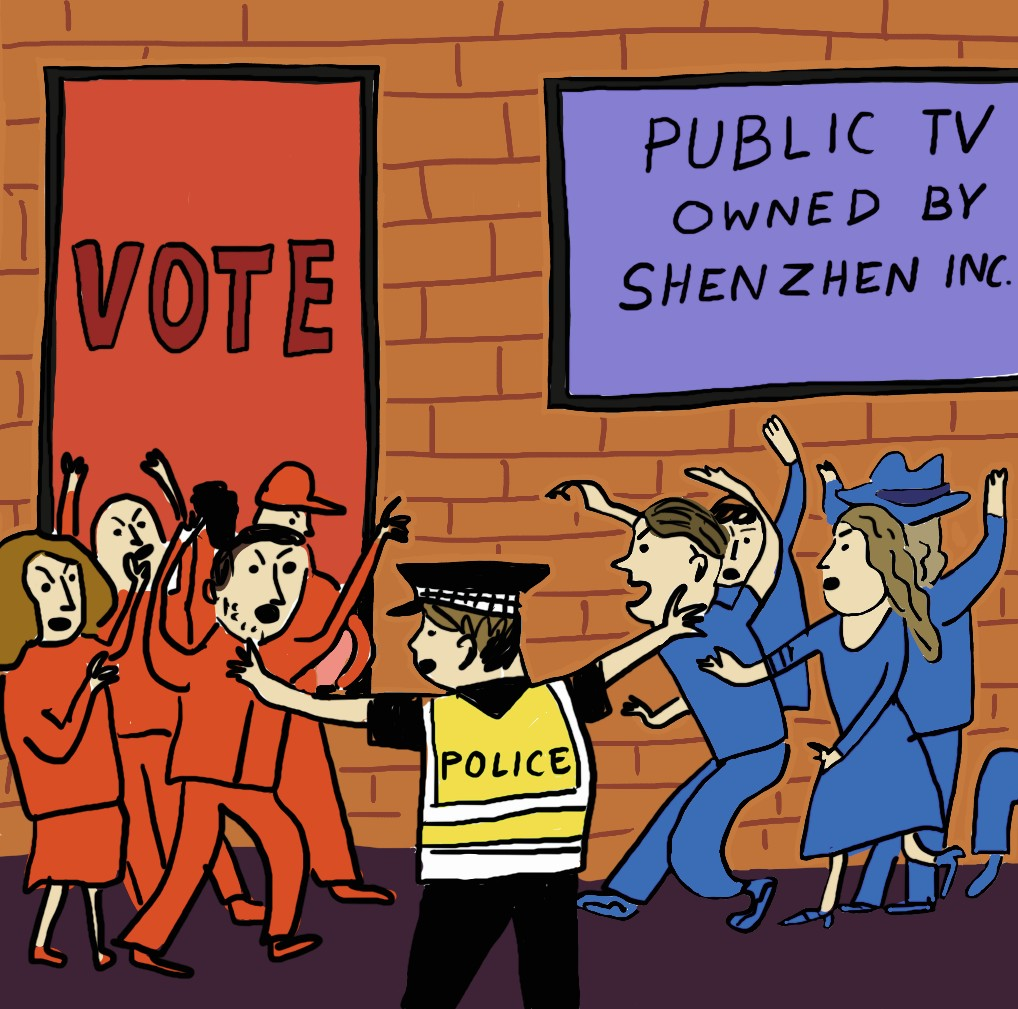
Image credit: Liisa Kruusmägi, 2026
It is 2050 and, in a region that once set global standards for equality, inequality now stands front and centre. In Malmö, police drones patrol ‘safety zones’ that became permanent in the 2030s, turning what were once temporary measures to improve safety in disadvantaged, high-crime neighbourhoods into lasting symbols of deep social and spatial inequality. Climate adaptation measures have inadvertently increased inequality, exemplified by Copenhagen’s coastal defence wall, which allowed some residents to remain in protected neighbourhoods, while others were relocated to prefabricated housing blocks in Jutland.
Across the region, critical digital and economic infrastructures are run by foreign firms, reducing sovereignty. Tallinn’s digital government still functions, but its services operate on AI infrastructure owned by a Shenzhen-based conglomerate that also manages Estonia’s agricultural logistics and energy grid. Governments, constrained by financial and human resources, increasingly rely on digitalizing government services while continuing to reduce public expenditure. Independent and investigative journalism is hard to find in this environment. In Vilnius, the evening news is a curated feed from a station whose parent company answers to shareholders in Singapore.
Demographic pressures are visible everywhere: understaffed hospitals and long queues reflect a shrinking working-age population, while rising pension costs and decades of increased defence spending have squeezed welfare budgets. With the United States long withdrawn from regional security arrangements and the EU increasingly fragmented, governments now navigate an uneasy dependence on Chinese supply chains and energy-grid software they cannot fully control.
Society is increasingly divided between cities and rural areas, political ideologies and genders. Internal migration along socio-political lines has become more common, with people less willing to live alongside neighbours with differing political views. The former manosphere is no longer a fringe corner of the Internet (Barnes and Karim 2025) but has evolved into a widespread ideology. Former influencers who promoted toxic masculinity, distrust of women and hostility towards gender equality have become politicians with growing support who subtly normalize these views in policy debates.
Economic life is global and increasingly difficult to govern, while political life has retreated to the municipal level, and the distance between the two has become the defining fracture. In Copenhagen, residents follow every meeting of the municipal coastal-wall committee but cannot name a single national minister. Elections still take place in the region, but turnout has fallen below 40 per cent, as a polarized society, foreign-run public systems and the shift towards local politics have left many feeling that there is no reason to engage in national political life.
The unravelling began with pressures that policymakers never confronted as an interconnected system. Many pressures were managed as isolated, short-term emergencies, and little attention was paid to their causes or long-term impacts, leading to a gradual but profound widening of inequality. When Malmö’s ‘temporary’ safety zones were treated as a quick policing fix rather than a symptom of deeper patterns of exclusion and limited economic opportunity, the underlying problems worsened. Frustration fuelled further violence, and the security zones became permanent. At the same time, demographic decline and strained welfare systems hit poorer communities hardest, accelerating inequality.
Fragmentation grew as different parts of society experienced pressures in different ways, with online echo chambers, uneven governance and demographic pressures pulling people into separate realities with different priorities and access to information. The gendered political divide—young men drifting rightward, young women leftward—hardened into mutual contempt and polarization, making coalition governance impossible. Even in a region long associated with high levels of gender equality, the spread of transnational online manosphere communities that equated gender equality with loss for men widened the gender gap, including in voting behaviour. In the early 2030s, Estonia’s reforms prioritizing Estonian as the language of instruction—combined with the 2025 voting-rights rollback (International IDEA 2025a)—left a generation of Estonians who grew up in Russian-speaking households linguistically assimilated yet politically alienated. Parts of Estonia’s eastern regions elected municipal officials who refused to cooperate with national authorities, withdrawing into the only level of governance that still felt real.
By the early 2030s, the USA’s withdrawal from European security left the Nordic–Baltic region caught between Chinese leverage and a fragmented EU. Defence budgets consumed 4.0–6.5 per cent of GDP across the Baltic countries, cannibalizing welfare as the demographic squeeze intensified. Between 1990 and 2025, Lithuania’s working-age population shrank by 24 per cent (Macijauskas 2025), Finland’s fertility rate continued falling year on year (YLE 2025), and Latvia’s total population declined to 1.54 million by 2050 (LSM 2026). Foreign-owned platforms filled this vacuum, not merely as contractors but as core infrastructure.
As the AI models underpinning energy, welfare and agricultural systems belonged to firms headquartered outside the region, governments became dependent on systems they could not audit. By 2033 algorithm-driven media platforms, combined with the collapse of publicly funded media, had destroyed traditional investigative journalism and long-standing notions of the checks and balances associated with the fourth estate. In its place, information increasingly flowed through foreign-owned media platforms that pushed sensationalist content generated by online influencers and AI agents. In many cases, these dynamics were driven by organizations and foreign governments seeking to influence political outcomes in specific countries. Productive political discourse—a critical element of democratic systems—essentially collapsed except in certain pockets at the local level.
As national institutions ceded authority to foreign-controlled actors, and as distance from national policymaking widened due to societal fragmentation, local governments became the only actors still capable of responding, at least partially, to immediate pressures. When people lost trust in national institutions’ capacity to address climate risks, they turned instead to local institutions, which could at least answer whether their neighbourhoods would be protected from flooding.
Box 3.1. Meet Marius
Marius is 44, a logistics worker in Kaunas who has never voted. His shifts come through an app owned by a company headquartered in Seoul. His mother’s pension is managed by an AI system whose decisions she cannot appeal; when it reduced her payments by 18 per cent, no human representative was available to explain why. His daughter is one of three Lithuanian-speaking students in a class of Belarusian, Ukrainian and Uzbek children—newcomers the region needed but never fully welcomed.
Marius considered moving to Vilnius, but the capital’s progressive communities operate according to assumptions he does not share, and the informal signals were clear: he would not belong. His 16-year-old son consumes masculinity-focused influencers and anti-immigration commentary that Marius finds alien but cannot counter, as no trusted alternative exists in Lithuanian. This is what decline looks like—not overt oppression but irrelevance, a slow sorting of people into communities that no longer communicate with one another. Trust survives within each enclave; what has vanished is the trust between them.
Regional cooperation and institutions:
A Nordic–Baltic regional sovereign digital infrastructure consortium. By 2029 Nordic–Baltic governments should establish a jointly owned regional consortium responsible for developing, auditing and operating sovereign digital and AI infrastructure for welfare, energy and agriculture. The consortium should pool regional resources to reduce long-term dependency on foreign platforms, operate under democratic governance arrangements, and require mandatory algorithmic transparency and citizen appeal mechanisms for all systems it deploys. A fully operational framework, including funding commitments and governance rules, should be agreed by 2028.
Social and civic capacity-building programmes:
A Gender Bridge initiative targeting young men’s democratic engagement. By 2028 Nordic–Baltic governments should launch a coordinated Gender Bridge initiative designed to strengthen young men’s engagement in democratic life through channels they already use—gaming communities, sports clubs, vocational training programmes and military or civil service. The initiative should fund independent content creators to produce inclusive democratic-engagement material in local languages, paired with digital and media literacy modules. The programme should engage young men as active participants in democratic life, not risks to it, and should publish annual participation and impact reports.
Legislative and policy frameworks:
A democratic infrastructure floor. By 2028 each country should legislate minimum per capita public funding levels for independent journalism and public broadcasting, indexed to GDP and protected from annual budget cycles (similar to how defence spending is currently protected through minimum expenditure thresholds of 2 per cent of GDP). This should include mandatory funding for minority-language media (Arabic, Russian, Ukrainian, etc.) to prevent information vacuums that are vulnerable to exploitation by hostile actors, alongside robust anti-SLAPP6 protections. Countries should also establish a Nordic–Baltic press freedom support mechanism to coordinate responses to cross-border threats, misinformation and deepfake incidents.
Mandatory algorithmic accountability for all public-service AI. By 2028 all Nordic–Baltic governments should adopt legislation requiring that any AI system used in public-service delivery, including welfare, pensions and energy allocation, must be fully auditable by a national authority, provide human-readable explanations for decisions and, critically, guarantee a human appeal pathway. No new public-service contract should be awarded to providers that do not provide recourse to human review, and existing long-term contracts should be renegotiated or reviewed for compliance by 2030.
Social and civic capacity-building programmes:
A Belonging by Doing civic integration programme. By 2028 Nordic–Baltic governments should launch a shared Belonging by Doing civic integration model, adapted nationally, that funds community-level projects where newcomers and long-term residents work together on practical tasks such as environmental restoration, neighbourhood services and local infrastructure. Participation should be formally linked to accelerated residency pathways and, where relevant, the restoration of local voting rights. Each country should commit to annual reporting on participation rates, gender balance and community-level outcomes, while integrating digital and media literacy modules to strengthen resilience against harmful online content.
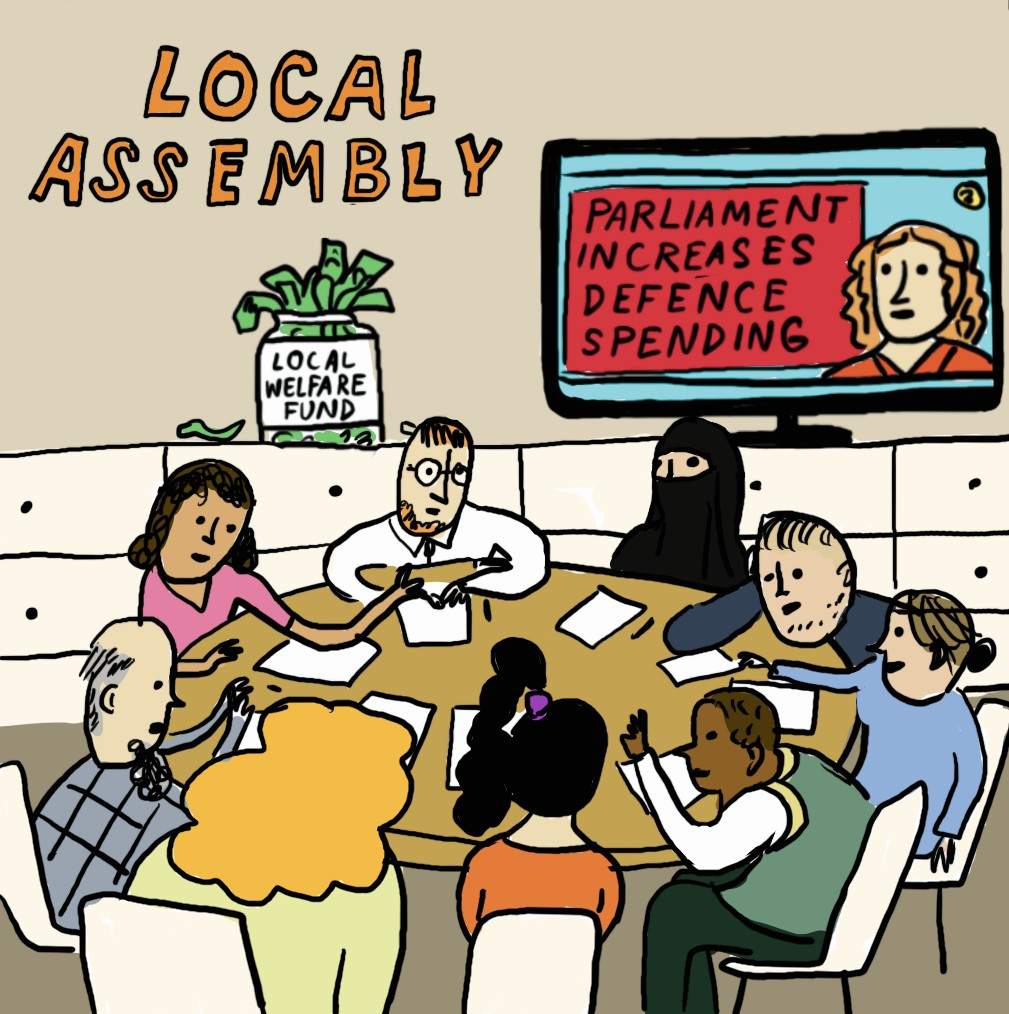
Image credit: Liisa Kruusmägi, 2026
The municipal hall in Tampere is full on a Tuesday evening, with standing room along the back wall and coats piled on chairs. Forty-six residents debate how to allocate EUR 2.3 million (approximately USD 2.7 million) in locally raised participatory funds between elder-care top-ups, flood-proofing the Tammerkoski riverbank and subsidizing the district heating cooperative that has kept energy bills below the national average. The discussion, conducted in Finnish, English and occasionally Estonian, grows more pointed when a retired nurse points out that Tampere’s municipal health copayment is now triple that of Espoo, highlighting uneven municipal capacity. While equality has not collapsed, access to care is more uneven than it used to be, varying according to where people live and the strength of their local communities.
Several rows back, a food‑service worker who migrated under the 2036 labour scheme listens. Her right to remain in the country depends on continuous employment. When the chair invites comments, she speaks briefly: local assemblies feel welcoming, she says, but participation does not translate into security when residence permits, benefits and family reunification remain tightly controlled at the national level. Others nod.
Three seats away, a young organizer from the Ilmasto-Oikeus climate-justice coalition checks her phone. This coalition, in coordination with Sámi land-rights activists and a Baltic anti-austerity network, blocked the Sodankylä rare-earth mine expansion the previous spring. When the moderator invokes ‘local participation’ as evidence that democracy is adapting, she muses that Sámi communities have long participated in local assemblies, but are rarely heeded once defence or energy infrastructure is declared a national priority. Still, these local forums are where democracy feels most alive across the Nordic–Baltic region in 2050. This vitality is anchored in interpersonal trust, which has become more concentrated within local communities as pressures intensified and trust in national institutions evaporated.
Foreign threats and geopolitical vulnerabilities are part of those pressures. A woman in the room says that, according to a private media outlet, the district heating cooperative is still waiting for spare parts caught in customs after the previous month’s China–EU tariff dispute. Someone at the back of the hall says that the news must be double-checked against municipal livestreams, which publicly broadcast council briefings, arguing that the delay would otherwise have been brought to the attention of city officials. With private media platforms now largely recycling AI-generated agency summaries, no one is certain whether the report has been independently verified.
The ambitions of the old welfare state have been visibly pared back, and what remains is distributed unevenly while also being strained by demographic changes. Hospital waiting times in Sweden exceed six months for non-urgent procedures. Latvia’s pension age has risen to 69.
While national parliaments still meet, elections still take place on schedule, and the rule of law remains intact, trust in national governments has settled at levels that would have been unthinkable a generation earlier—below 30 per cent in the Baltic countries and below 40 per cent in the Nordic countries.
The path to this new equilibrium began with the compounding budget crises of the early 2030s. Defence spending, driven by the permanent rupture with Russia and the collapse of US security guarantees, rose dramatically to 5–6 per cent of GDP. Finland’s ‘Plan B’ Defence Compact, formalized in 2033 with the other seven Nordic–Baltic countries, replaced reliance on a fraying NATO with a tighter regional pact that was credible but expensive. Simultaneously, climate-adaptation costs surged: billions of euros were spent reinforcing Baltic Sea coastal infrastructure by 2040, responding to melting permafrost in northern Finland and Norway, and relocating three Icelandic coastal settlements after the Grindavík volcanic zone expanded, compounding hazards.
This rise in defence spending came at the expense of universal welfare and equality. Denmark’s Social Compact Act of 2034 made the trade-off explicit: parliament capped total public spending at 52 per cent of GDP, forcing the government to decide each year how to divide the limited expenditure between defence, climate adaptation and social services. The act expanded the scope of services municipalities could fund through their own revenue as the national budget became increasingly constrained. Other Nordic countries adopted similar systems by 2038.
The Baltic countries followed the same principle but could not replicate the fiscal mechanism. The demographic squeeze—Lithuania’s population falling below 2.4 million and Latvia’s below 1.5 million—made the arithmetic inescapable. Their municipalities lacked the tax base necessary to raise revenue as populations continued to shrink. They remained dependent on declining central transfers, widening the governance gap between the Nordic and Baltic parts of the region. However, the Baltic Migration Accord of 2036 between Estonia, Latvia and Lithuania created a shared labour-immigration system designed both to move beyond reliance on return migration by Baltic citizens and to attract workers from outside the region. The scheme was highly selective regarding skills and neutral regarding where applicants came from. The shift was driven by necessity: defence factories lacked sufficient workers, and elder-care homes were understaffed. Entry into the Baltic countries became more difficult and increasingly tied to employment. For those who did arrive, however, local civic inclusion gradually became much stronger than what the previous generation of native-born Russian-speaking residents had experienced.
In 2035, the Sámi Parliaments of Finland, Norway and Sweden united after new NATO logistics routes cut across herding areas and wind farms were built on Sámi lands. They jointly demanded shared authority with national governments over Arctic land use and security infrastructure, a response shaped by both geopolitical pressure and long-standing territorial inequality. Sámi representatives received a formal consultative role in decisions relating to the siting of defence and energy infrastructure. This arrangement prevented a constitutional crisis and aligned with the broader shift towards inclusive local and community-level governance. However, herding routes still had to divert around military sites and wind-turbine fields, a reminder that even within this new equilibrium, external pressures, uneven capacity and centre–periphery divides continue to shape daily life.
The institutional trust that was already declining sharply by the mid-2020s—including Finland’s 14-point drop between 2021 and 2024—accelerated as governments explained, year after year, what would be cut and why (OECD 2024). The old social contract was not revoked. It was renegotiated line by line, and citizens understood exactly what was being traded away.
Box 4.1. Meet Aisha and Niilas
Consider two lives. Aisha, 38, a Sierra Leonean–born biomedical technician, arrived in Riga through the Baltic Migration Accord in 2037. She votes in municipal elections, sits on her district’s participatory-budget committee and coaches a robotics team at a bilingual school. She cannot vote in Saeima elections and believes she likely never will: full citizenship requires 12 years of residency and a Latvian language exam that fewer than 40 per cent of applicants pass on the first attempt. She describes her life as ‘half-belonging’. Riga’s municipality, constrained by limited resources and ongoing population decline, offers her fewer services than Nordic municipalities such as Tampere provide to their residents. The copayment gap between Nordic and Baltic municipalities has become one of the region’s sharpest inequalities.
Then there is Niilas, a 52-year-old Sámi reindeer herder in Enontekiö, whose autumn migration routes now cross a NATO rapid-deployment corridor and two wind farms. He received compensation, sits on the local Arctic Governance Protocol advisory board and describes the arrangement as ‘better than being ignored, worse than being heard’. His nephew, an organizer with the Ilmasto-Oikeus coalition, connects Sámi land claims with Baltic anti-austerity movements and Nordic tenants’ unions in a loose alliance that has become the region’s most active civic network.
Legislative and policy frameworks
A tiered civic inclusion pathway decoupling local participation rights from national citizenship timelines. National governments should legislate a three-stage civic inclusion pathway by 2028 that separates local participation rights from national citizenship processes. This pathway should include:
- automatic local voting rights and participatory-budget eligibility after two years of legal residency and employment; these rights should be automatic and unconditional, supporting local participation as a mechanism for integration, not a reward for it;
- eligibility for local elected office and regional consultative bodies after five years of legal residency and employment; and
- national voting rights and full citizenship eligibility after a maximum of eight years, with a realistic language requirement (B1).
Economic and fiscal instruments
A Nordic–Baltic Democratic Resilience Fund. Nordic–Baltic governments should establish an annual Nordic–Baltic Democratic Resilience Fund of EUR 10–50 million by 2028 to provide multiyear core funding for cross-community alliances linking climate, Indigenous, newcomer and anti-austerity movements. Eligible alliances should operate in at least two Nordic–Baltic countries, include both established and newcomer communities, and work at both local and national levels. The fund would help stabilize bottom-up, cross-issue civic cooperation, which currently relies on volunteer labour and short-term grants.
Economic and fiscal instruments
Annual fiscal trade-off reports at the national level. Nordic–Baltic national governments should publish an annual fiscal trade-off report by 2028, detailing the explicit budget choices made between defence, climate adaptation and social spending. Each report should present municipality-level data showing what was funded, where funding was reduced and what alternative allocations were considered. Reports should be debated simultaneously in national parliaments and local assemblies, ensuring visibility across levels of governance. Moreover, each report should be paired with a structured national deliberation day, using existing participatory infrastructure, where citizens can formally respond and propose reallocation priorities. While these inputs would not grant citizens a veto, they would make trade-offs more transparent, contestable and grounded in public deliberation rather than opaque technocratic decision making.
A Nordic–Baltic Municipal Revenue Compact to close the fiscal governance gap. A binding Nordic–Baltic Municipal Revenue Compact should be established by 2029 to grant all municipalities in the region expanded taxation authority, including local income-tax surcharges, land-value capture mechanisms and green levies, paired with mandatory minimum service standards. For Baltic municipalities lacking a sufficient tax base, a Nordic–Baltic Municipal Solidarity Fund should be established, financed through a small levy on Nordic municipal surpluses and EU cohesion funds. Transfers should be conditional on democratic-governance benchmarks, such as participatory budgeting and minority inclusion in local assemblies. The Compact would help ensure that strong local democracy that can compensate for the retreat at the national level remains viable across the entire region. Without a shared fiscal framework, the governance gap between Nordic and Baltic municipalities is likely to continue to widen.
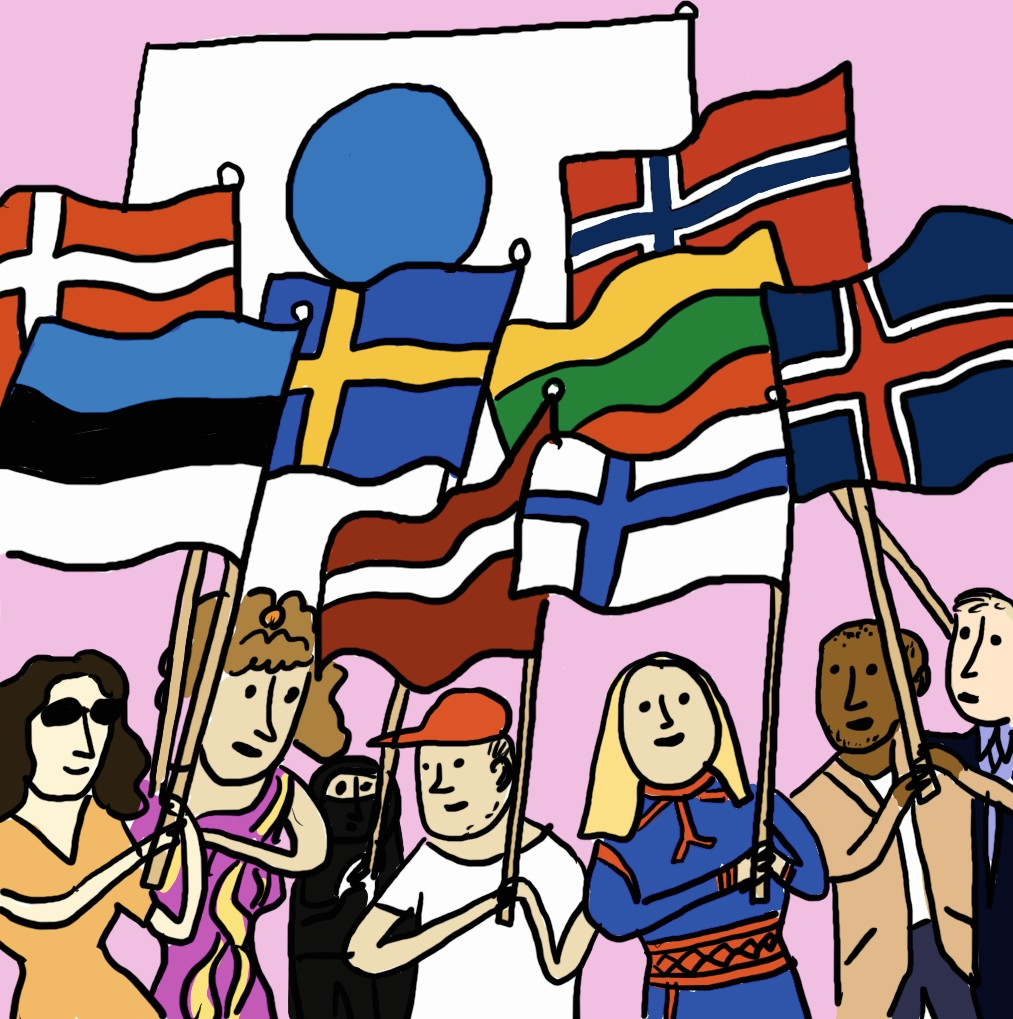
Image credit: Liisa Kruusmägi, 2026.
On a Tuesday morning in Riga, a delegate from Tromsø opens a session of the Nordic–Baltic Union Assembly by reading aloud a binding resolution on coastal resettlement rights—submitted not through a national parliament but through the Assembly’s own digital-initiative platform, built on the architecture of Latvia’s old platform ManaBalss.lv7 and relaunched under a regional treaty in 2041. By the time the session begins, the resolution has already crossed the participation threshold in six countries.
The Assembly, housed in a converted Soviet-era building on Brīvības gatve, meets six times a year. It holds qualified-majority authority over cross-border climate adaptation, shared defence procurement, minority rights standards and intergenerational fiscal floors—a minimum of 6 per cent of GDP that every member state must direct towards services for people under 35, from housing to education. In practice, the Assembly is encountered through phone notifications highlighting revised flood-insurance terms, standardized rent caps for students or legally binding cross-border relocation options.
Flags of eight nations hang from the ceiling, but the Assembly’s own banner—a blue circle on white, adopted after a public design competition won by a Finnish–Somali teenager from Vantaa—is the symbol projected during plenary sessions. It appears not only above the chamber but also on transit passes and civic-platform dashboards, as well as in the footer of school lunch invoices that indicate how much of the meal is funded through the youth fiscal floor.
A quarter of Assembly delegates are under 35. Several represent Framtíð, the transnational youth party founded in Reykjavík in 2038 by a 22-year-old Icelandic–Polish climate organizer, which now holds seats in four national parliaments and in the Assembly itself. Outside, the Latvian winter is mild. Snow has not accumulated on the ground in Riga before January since 2038.
The path to the Assembly began with compound failure rather than grand design. Three forces destabilized the old order simultaneously.
First, the geopolitical context shifted under pressure from three directions: the USA dramatically reduced its contribution to NATO defence in the early 2030s amid its Pacific pivot; Sino–Russian cooperation intensified in the Arctic and Baltic regions, including joint naval patrols and a Chinese bid for Greenland’s rare-earth deposits that alarmed Copenhagen; and Beijing’s near-monopoly on solar panels, batteries and electric vehicles meant the region could not decouple from China even as it armed against Russia. The Nordic–Baltic countries were forced into binding defence cooperation through the 2033 Helsinki Compact, which pooled air defence and intelligence across all eight countries.
Second, the climate challenge ceased to be abstract. Between 2029 and 2035, the Baltic Sea’s first recorded anoxic event covered 40 per cent of its basin, while simultaneous crop failures struck Denmark and Lithuania. No single government in the region could respond alone.
Third, the demographic squeeze collided with an intergenerational economic crisis. Latvia’s population fell below 1.5 million. Lithuania recorded a fertility rate of 0.94. Pension obligations in the Baltic countries consumed over 40 per cent of public budgets, while youth unemployment benefits and housing subsidies were cut to fund defence spending. A generation that inherited debt, housing costs triple those faced by their parents and a warming planet alongside shrinking public services had no reason to trust institutions that had invested so little in them.
The decisive rupture came in 2034, when the populist-right coalition governing Finland attempted to suspend the Sámi Parliament’s authority, citing ‘national emergency coordination’. What followed was unexpected—a cross-border solidarity movement, organized through encrypted civic platforms and anchored by Lithuanian civil society veterans of the 2025 defence of Lithuanian National Radio and Television,8 garnered 800,000 petition signatures across all 8 countries in 11 days.
The ‘Northern Spring’ forced a reversal, but it also revealed the existence of a regional civic identity that was capable of mobilizing faster than national institutions could respond. The movement’s overwhelmingly young composition catalysed a second turning point: between 2035 and 2037, Denmark, Finland and Norway lowered their voting age to 15—not as a symbolic concession to youth but as recognition that those who would live longest with the consequences of climate, debt and security decisions deserved a proportional voice. Estonia and Lithuania followed by 2040.
With the signing of the 2037 Reykjavík Declaration, eight prime ministers, pressured by citizens’ assemblies held simultaneously in all Nordic–Baltic capitals, agreed to establish the Assembly with binding authority over defined cross-border domains. Iceland’s prime minister brokered the critical compromise: member states could opt out of any binding decision but only through an explicit parliamentary vote within 90 days—effectively reversing the principle of subsidiarity by making compliance the default and defiance politically costly.
Box 5.1. Meet Aino
For Aino, a 26-year-old councillor for Framtíð, the transnational youth party, based in Oulu, democracy is something her generation built rather than inherited. She was 16 when Finland lowered the voting age, 19 when she helped found Framtíð’s Finnish chapter and 24 when she won a seat on Oulu’s municipal council on a platform of intergenerational budget auditing. Her experience is not universal. In rural Jutland, where the Green Tripartite Agreement hollowed out farming communities, resentment towards the Nordic–Baltic Union Assembly runs deep—‘another parliament nobody asked for’, as a dairy cooperative leader told the Danish Broadcasting Corporation.
The Assembly’s multilingual deliberation platform, powered by Estonian AI infrastructure, functions fluently in the region’s official languages but excludes many newer residents. Arabic-speaking climate migrants settled in depopulated Finnish Lapland report that participatory exercises remain inaccessible. Democracy in the region is broader and younger than it was in 2025. However, it is not yet entrenched enough to reach everyone who lives in the region. The transformation continues.
Economic and fiscal instruments
Transnational youth political infrastructure. The Nordic Council of Ministers should create a transnational youth political participation fund, administered through its youth programme, to support cross-border political organizing. The fund should finance multilingual digital platforms for policy deliberation, network building and campaign infrastructure, enabling bottom-up transnational mobilization.
Legislative and policy frameworks
A regional climate-adaptation and supply-chain sovereignty strategy. Nordic–Baltic governments should jointly commission a regional climate-adaptation and supply-chain vulnerability assessment by 2028, followed by a strategy containing binding commitments and oversight through existing regional intergovernmental bodies. The strategy should address two interconnected challenges—accelerating climate risks and dependency on Chinese green technology—including through joint investment in regional battery and solar-panel manufacturing, a shared strategic reserve of critical components and a coordinated regional approach to climate migration.
Regional cooperation and institutions
Regional citizens’ assemblies with binding mandates. Before 2030 Nordic–Baltic governments, in partnership with universities and non-governmental organizations, should convene two to three pilot regional citizens’ assemblies focused on concrete cross-border policy issues such as Baltic Sea restoration, shared defence-service obligations, or standards for migrant inclusion and political participation. Assemblies should be sortition-based, draw participants from all eight countries using demographic quotas and operate multilingually with AI-assisted translation. At least one pilot should operate under a binding mandate, whereby its recommendations would automatically take effect unless overturned by a supermajority of Nordic–Baltic national parliaments.
A Nordic–Baltic parliamentary convention with graduated authority. By 2030 foreign ministers should negotiate a treaty establishing a Nordic–Baltic Assembly with binding authority over defined cross-border domains. Its authority should begin with climate adaptation and defence procurement and expand gradually into areas such as minority rights and intergenerational fiscal standards. The treaty should apply reverse subsidiarity, making compliance the default unless parliaments explicitly opt out within 90 days. Implementation should be phased over 10–15 years and funded through assessed contributions proportional to GDP, combined with earmarked revenues from regional carbon pricing and shared natural-resource management (including allocations derived from interest generated by the Norwegian sovereign wealth fund).
A Nordic–Baltic inclusive belonging framework. Recognizing divergent national approaches to political membership, national human rights institutions should negotiate a regional framework establishing minimum standards for political participation. These could include local voting rights for long-term residents after two years of legal residency and employment, multilingual access to participatory platforms and anti-discrimination protections, while still allowing national variation in implementation. The framework should include a monitoring mechanism and regular peer review among Nordic–Baltic countries.
The diverse and wide-ranging Nordic–Baltic region is moving forward with a strong democratic legacy, yet the pressures shaping its future are already visible. These democracies combine robust rule of law, vibrant local democracy and some of the world’s most trusted institutions, but they also face challenges stemming from rising inequality, demographic decline, climate stress and geopolitical uncertainty that vary across the countries of the region.
Several strands run through the scenarios, linking otherwise divergent democratic futures. These themes emerged organically during the workshop and point to shared areas of vulnerability and points of leverage for intervention.
Across all four scenarios, local democracy and grassroots initiatives emerge as critical anchors of democratic resilience. As national-level governance becomes more distant, fragmented or constrained, democratic life increasingly centres on local practices (everyday forms of participation, mutual support and organizing), highlighting the diversity of civic engagement across the region. Even where confidence in national institutions weakens, trust persists within close‑knit communities and local networks, sustained through these shared practices. At the same time, local institutions take on renewed importance as visible and accessible sites of authority. In more transformative futures, locally rooted initiatives begin with community practices but are increasingly supported by institutional frameworks, allowing them to scale across borders and contribute to broader regional mobilization. Together, these trajectories underscore the importance of investing in local democratic infrastructure—not only as service providers but also as core sites of representation, deliberation and political learning.
A second recurring theme concerns the ways in which gender equality comes under strain through widening gendered political divides. Several scenarios examine how mental health pressures, social isolation and the mobilization of anger—particularly among young men in online subcultures—can emerge as potential risks to social cohesion. These dynamics mirror broader shifts already visible in the Nordic region, where young men have moved rightward and young women leftward despite high levels of gender equality, and where labour‑market pressures and zero‑sum gender narratives circulating in transnational online communities may deepen this divide. These developments signal that formal democratic processes alone may be insufficient to sustain participation and legitimacy, as well as interest in politics more broadly. Addressing the social and emotional foundations of political engagement, including through inclusive civic spaces, mental‑health support and interventions targeting polarized online environments, emerges as an increasingly important democratic task.
The scenarios also highlight the relationship between regional identity and interstate cooperation. In one future, regional cooperation fragments as incompatible domestic information environments undermine shared understanding, while in another, political organization increasingly coalesces around a strengthened regional identity. Youth‑led movements and shared regional symbols support deeper integration, including a binding supranational assembly with qualified‑majority authority over selected cross‑border domains and the formation of transnational political parties. The region’s current heterogeneity could therefore evolve in different directions, requiring difficult choices about what may be gained or lost through deeper integration.
Finally, technology consistently shapes democratic outcomes, but its effects depend less on innovation itself than on governance and control. Across scenarios, digital systems increasingly mediate welfare delivery, public services and information flows. Where these systems develop without transparency or democratic oversight, efficiency comes at the cost of accountability, and governments risk losing both control and public trust. By contrast, futures that place democratic values at the centre of technological governance illustrate how digital infrastructure can expand participation rather than constrain it, enabling deliberation across linguistic, geographic and social divides.
Taken together, these themes point to a shift in where democratic resilience is built—downward towards local communities and institutions, outward towards regional and transnational cooperation, and inward towards the social foundations of participation and trust. Rather than identifying a single preferred future, the scenarios highlight priority areas where sustained attention and investment are likely to matter across a wide range of democratic trajectories. Collectively, they underscore a central message: the region’s democratic strengths remain substantial, but the pressures it faces are equally real. Preparing for multiple possible futures will be essential to sustaining democratic resilience in the decades to come.
Abend, L., ‘Meet the Lithuanian ‘Elves’ fighting Russian disinformation’, Time, last updated 12 December 2023, <https://time.com/6155060/lithuania-russia-fighting-disinformation-ukraine/>, accessed 25 May 2026
Barnes, M. J. and Karim, S. M., ‘The manosphere and politics’, Comparative Political Studies, 59/1 (2025), pp. 3–43, <https://doi.org/10.1177/00104140241312095>
Bennich-Björkman, L., ‘The cultural roots of Estonia’s successful transition: How historical legacies shaped the 1990s’, East European Politics and Societies, 21/2 (2007), pp. 316–47, <https://doi.org/10.1177/0888325407299785>
Berbert, K. B., Birgier, D. P., Bogason, Á., Brynteson, M., Gudmundsdottir, H., Heleniak, T., Lundgren, A., Pils, D., Sánchez Gassen, N., Slätmo, E., Sonesson, M., Tapia, C., Thomson Ek, H. and Tornberg, P., State of the Nordic Region 2026 (Stockholm: Nordregio, 2026), <https://doi.org/10.6027/R2026:2.1403-2503>
Berlina, A., Guðmundsdóttir, H. and Kačkus Tybjerg, J., Policy Frameworks for Migrant Integration in the Nordic Countries 2025: An Overview (Copenhagen: Nordic Council of Ministers, 2025), <https://www.norden.org/en/publication/policy-frameworks-migrant-integration-nordic-countries-2025-overview>, accessed 26 May 2026
Birka, I., ‘Can return migration revitalize the Baltics? Estonia, Latvia, and Lithuania engage their diasporas, with mixed results’, Migration Policy Institute, 8 May 2019, <https://www.migrationpolicy.org/article/can-return-migration-revitalize-baltics-estonia-latvia-and-lithuania-engage-their-diasporas>, accessed 22 May 2026
Blackburn, G., ‘Norway votes in closely fought election with wealth tax in focus’, EuroNews, 8 September 2025, <https://www.euronews.com/2025/09/08/norway-votes-in-closely-fought-election-with-wealth-tax-in-focus>, accessed 22 May 2026
Chmielewski, B., ‘How to postpone a demographic crisis: Estonia and the lifeline of immigration’, Centre for Eastern Studies, 17 August 2023, <https://www.osw.waw.pl/en/publikacje/osw-commentary/2023-08-17/how-to-postpone-a-demographic-crisis-estonia-and-lifeline>, accessed 22 May 2026
Civil Rights Defenders, ‘Lack of protection against hate crimes, discrimination, and for Indigenous rights – our shadow report to the UN’, 8 November 2024, <https://crd.org/2024/11/08/lack-of-protection-against-hate-crimes-discrimination-and-for-indigenous-rights-our-shadow-report-to-the-un/>, accessed 22 May 2026
Copernicus Climate Change Service (C3S)/European Centre for Medium-Range Weather Forecasts (ECMWF) and World Meteorological Organization (WMO), ‘European State of the Climate Report 2025’, 29 April 2026, <https://doi.org/10.24381/zy93-sb27>
Delfi, ‘Į Lietuvą sugrįžo daugiau tautiečių, nei išvyko’ [More Lithuanians have returned to the country than have left it], 29 January 2026, <https://www.delfi.lt/naujienos/lietuvoje/i-lietuva-sugrizo-daugiau-tautieciu-nei-isvyko-120205050>, accessed 28 May 2026
Ek, H. T., Slätmo, E. and Sonesson, M., ‘Economic perspectives on critical infrastructure in the Nordic region’, in M. Bobrinskaya and T. Niedomysl (eds), State of the Nordic Region 2026 (Stockholm: Nordregio, 2026), <https://doi.org/10.6027/R2026:2.1403-2503>
European Commission, Flexicurity, [n.d.], <https://employment-social-affairs.ec.europa.eu/policies-and-activities/eu-employment-policies/flexicurity_en>, accessed 25 May 2026
European Federation of Journalists, ‘Lithuania: Parliament pushes ahead with controversial LRT reforms despite Venice Commission concerns’, 11 March 2026, <https://europeanjournalists.org/blog/2026/03/11/lithuania-parliament-pushes-ahead-with-controversial-lrt-reforms-despite-venice-commission-concerns/>, accessed 25 May 2026
Eurostat, ‘Gini coefficient of equivalised disposable income’, 6 May 2026, <https://doi.org/10.2908/TESSI190>
Gottzén, L., Fangen, K. and Qvotrup Jensen, S., ‘Masculinity, masculinist politics, and political extremism’, Journal of Gender Studies (2026), pp. 1–7, <https://doi.org/10.1080/09589236.2026.2654169>
Heleniak, T. and Bruno, K. B., ‘Population change in the Nordic region’, in M. Bobrinskaya and T. Niedomysl (eds), State of the Nordic Region 2026 (Stockholm: Nordregio, 2026), <https://doi.org/10.6027/R2026:2.1403-2503>
Inglehart, R. and Norris, P., ‘The developmental theory of the gender gap: Women’s and men’s voting behavior in global perspective’, International Political Science Review / Revue internationale de science politique, 21/4 (2000), pp. 441–63, <http://www.jstor.org/stable/1601598>, accessed 25 May 2026
International IDEA, Global State of Democracy Indices, Democracy Tracker, [n.d.], <https://www.idea.int/democracytracker/gsod-indices>, accessed 22 May 2026
—, Perceptions of Democracy: A Survey about How People Assess Democracy around the World (Stockholm: International IDEA, 2024), <https://doi.org/10.31752/idea.2024.24>
— ‘Parliament passes amendments restricting right to vote in local elections’, Democracy Tracker, Estonia, March 2025a, <https://www.idea.int/democracytracker/report/estonia/march-2025>, accessed 22 May 2026
—, ‘Parliament considers legislation impacting public broadcaster’, Democracy Tracker, Lithuania, November 2025b, <https://www.idea.int/democracytracker/report/lithuania/november-2025>, accessed 22 May 2026
Kildal, N., Workfare Tendencies in Scandinavian Welfare Policies (Geneva: International Labour Organization, 2001)
Kotonen, T., Andersson Malmros, R., Sivenbring, J., Karcher, N., Bundgård Christensen, C., Lööw, H., Malkki, L., Mattsson, C., Ravik Jupskås, A., Ritola, V., Sallamaa, D. and Silvennoinen, O., “When Neo-Nazis March on Norwegian Streets, You Hear a Lot of Swedish”: Pan-Nordic and Transnational Dimensions of Right-Wing Extremism (Copenhagen: Nordic Council of Ministers, 2023),<https://doi.org/10.6027/temanord2023-503>
Krzyżanowski, M. and Ekström, H., ‘“No longer the haven of tolerance”? The press and discursive shifts on immigration in Sweden 2010–2022’, Social Semiotics, 35/3 (2025), pp. 472–94, <https://doi.org/10.1080/10350330.2024.2352656>
Lithuanian Armed Forces, ‘The fight for Lithuanian statehood. From ancient times to NATO’, [n.d.], <https://kariuomene.lt/en/who-we-are/history/23563>, accessed 22 May 2026
LRT, ‘Vienijasi kovai su dezinformacija: pristatyta iniciatyva „Demaskuok.lt“’ [Uniting to fight disinformation: ‘Demaskuok.lt’ initiative introduced], 13 September 2018, <https://www.lrt.lt/naujienos/lietuvoje/2/226671/vienijasi-kovai-su-dezinformacija-pristatyta-iniciatyva-demaskuok-lt?srsltid=AfmBOooMaM21JE-tLkatI1CnvwEGIrHMCSiBAyENWk8t3BVybWD4zN4J>, accessed 25 May 2026
LSM, ‘Latvia predicted to have EU’s largest population decline this century’, 17 April 2026, <https://eng.lsm.lv/article/society/society/17.04.2026-latvia-predicted-to-have-eus-largest-population-decline-this-century.a642602/>, accessed 25 May 2026
Łucka, D., ‘Between alien and citizen: Denizenship in the “old” and “new” Europe’, Polish Sociological Review, 207/3 (2019), pp. 337–54, <https://polish-sociological-review.eu/Between-Alien-and-Citizen-Denizenship-in-the-Old-and-New-Europe,117907,0,2.html>, accessed 8 June 2026
Macijauskas, M., ‘Crystal ball projections 2050’, National Audit Office of Lithuania, 27 March 2025, <https://www.valstybeskontrole.lt/EN/Post/18212/crystal-ball-projections-2050>, accessed 25 May 2026
ManaBalss, ‘Mana balss – mana brīvība’ [My voice is my freedom], [n.d.], <https://manabalss.lv/>, access 25 May 2026
Nennstiel, R. and Hudde, A., ‘Is there a growing gender divide among young adults in regard to ideological left–right self-placement? Evidence from 32 European countries’, European Sociological Review, 41/6 (2025), pp. 862–83, <https://doi.org/10.1093/esr/jcaf021>
Nordic Council of Ministers, ‘Unemployment benefit in Sweden’, [n.d.], <https://www.norden.org/en/info-norden/unemployment-benefit-sweden>, accessed 25 May 2026
—, A Resilient Arctic: Nordic Arctic Programme 2025–2027 (Copenhagen: Nordic Council of Ministers, 2025), <https://doi.org/10.6027/politiknord2025-703>
Nordregio, ‘The population of the Nordic region’, [n.d.], <https://www.norden.org/en/information/population-nordic-region>, accessed 22 May 2026
—, ‘Nordic population ageing at record pace’, 25 March 2026, <https://nordregio.org/news/nordic-population-ageing-at-record-pace/>, accessed 22 May 2026
Notre Dame Global Adaptation Initiative, ‘Country Index’, 2026, <https://gain.nd.edu/our-work/country-index/>, accessed 25 May 2026
Off, G., ‘Gender equality salience, backlash and radical right voting in the gender-equal context of Sweden’, West European Politics, 46/3 (2023), pp. 451–76, <https://doi.org/10.1080/01402382.2022.2084986>
Official Statistics of Latvia, ‘Long-term international migration’, [n.d.], <https://stat.gov.lv/en/statistics-themes/population/migration/8807-long-term-international-migration?themeCode=IB>, accessed 22 May 2026
Official Statistics of Lithuania, ‘The population of Lithuania (edition 2023)’, 2023, <https://osp.stat.gov.lt/en/lietuvos-gyventojai-2023/gyventoju-migracija/tarptautine-migracija>, accessed 22 May 2026
Organisation for Economic Co-operation and Development (OECD), OECD Survey on Drivers of Trust in Public Institutions – 2024 Results: Building Trust in a Complex Policy Environment (Paris: OECD Publishing, 2024), <https://doi.org/10.1787/9a20554b-en>
Pechko, K., ‘Rising tensions and shifting strategies: The evolving dynamics of US grand strategy in the Arctic’, The Arctic Institute, 7 January 2025, <https://www.thearcticinstitute.org/rising-tensions-shifting-strategies-evolving-dynamics-us-grand-strategy-arctic/>, accessed 22 May 2026
Petersoo, P., ‘Roundtable on “Ethnic Minorities in the Baltic Sea Region”’, Centre for Geopolitics at University of Cambridge, October 2025, <https://www.cfg.cam.ac.uk/wp-content/uploads/2026/02/Ethnic-minorities-final.pdf>, accessed 25 May 2026
Rasmussen, L., ‘Wealth tax pledge stirs equality debate ahead of Danish election’, Reuters, 18 March 2026, <https://www.reuters.com/world/europe/wealth-tax-pledge-stirs-equality-debate-ahead-danish-election-2026-03-18/>, accessed 22 May 2026
Rodriguez, S., The Case for a Democracy Stack: Rethinking Digital Public Infrastructure for Democratic Societies (Stockholm: International IDEA, 2026), <https://doi.org/10.31752/50906>
Statisikmyndigheten, ‘Inkomstskillnaderna ökar i Sverige’ [Income inequality is increasing in Sweden], 2 February 2023, <https://www.scb.se/pressmeddelande/inkomstskillnaderna-okar-i-sverige/>, accessed 25 May 2026
Statistics Estonia, ‘Population’, 2026, <https://stat.ee/en/find-statistics/statistics-theme/population>, accessed 22 May 2026
Svenska Dagbladet, ‘Så fungerar danska modellen Flexicurity’ [This is how the Danish flexicurity model works], 25 September 2011, <https://www.svd.se/a/daa30925-6d46-3464-a575-5d376e00edd3/sa-fungerar-danska-modellen-flexicurity>, accessed 25 May 2026
Thorhallsson, B. and Vidal, T. S., ‘The Nordic region in the Arctic’, in N. Græger, R. Hemstad, P. Nedergaard and P. Stadius (eds), Handbook of Nordic Cooperation (Cheltenham and Northampton: Edward Elgar, 2025), <https://doi.org/10.4337/9781035319725.00037>
Tunström, M. and Wang, S., The Segregated City: A Nordic Overview (Copenhagen: Nordic Council of Ministers, 2019), <http://dx.doi.org/10.6027/Nord2019-007>
University of Houston, ‘Houston archetype technique: Introducing the HAT’, [n.d.], <https://www.houstonforesight.org/houston-archetype-technique-introducing-the-hat/>, accessed 25 May 2026
World Bank Group, ‘Fertility rate, total (births per woman) – Central Europe and the Baltics’, UN Population Division, 2024, <https://data.worldbank.org/indicator/SP.DYN.TFRT.IN?locations=B8>, accessed 25 May 2026
YLE, ‘Finland’s birth rate declines for third consecutive year’, 21 January 2025, <https://yle.fi/a/74-20138902>, accessed 25 May 2026
Ágúst Bogason, Senior Research Advisor, Nordregio
Alexander Hudson, Senior Advisor, Democracy Assessment, International IDEA
Aline Mayr, Policy Officer Youth, Council of the Baltic Sea States
Amy Delis, Sustainable & Prosperous Region and Safe & Secure Region Intern, Council of the Baltic Sea States
Anna Marta Marjankowska, Community and Labour Organizer, East of Moon
Aura Saxen, Democracy Assessment Intern, International IDEA
Binto Bali, Associate Programme Officer, Democracy Assessment, International IDEA
Bjanka Ilievska, Democracy Assessment Intern, International IDEA
Daniel Riveong, Foresight Facilitator and Co-Principal, Plural Futures
Elin Westerling, Associate Programme Officer, Climate Change and Democracy, International IDEA
Emily Bloom, Associate Programme Officer, Democracy Assessment, International IDEA
Gentiana Gola, Advisor, Democracy Assessment, International IDEA
Iida Hyyryläinen, Governance and Member State Relations Officer, Office of the Secretary-General, International IDEA
Ingrida Kalinauskienė, CEO, Transparency International Lithuania
Johanna Ketola, Director of Programmes, Demo Finland
Katarzyna Gardapkhadze, Director of Global Programmes, International IDEA
Katerina Vyzvaldova, Policy Analyst, EU Agency for Fundamental Rights
Krzysztof Izdebski, Advocacy and Development Director, Stefan Batory Foundation
Linea Sveistrup, Consultant, We Do Democracy
Marilyn Neven, Head of EU Liaison, International IDEA
Marta Vunš, Fact-Checking and Investigative Reporter, Delfi Estonia
Michael Runey, Advisor, Democracy Assessment, International IDEA
Mindaugas Damijonaitis, Advisor for Political Affairs, Societal Resilience and Belarus, Nordic Council of Ministers’ Office in Lithuania
My Bergklint, Program Lead, Digital Prevention, Nordic Safe Cities
Nora Ulrikke Andersen, Project Developer, SoCentral
Petra Goran, Policy Analyst, European Commission
Riikka Kaukonen Lindholm, Project Coordinator, Deaconess Foundation
Siri Bjørgengen, Electoral Processes Intern, International IDEA
Toomas Hanso, Junior Research Fellow, International Centre for Defence and Security
Vadims Murašovs, Project Advisor, Nordic Council of Ministers’ Office in Latvia
Victoria Poyraz Escobar, Co-founder and COO, Changers Hub
Wouter Biesterbos, Principal Advisor, Office of the Secretary-General, International IDEA
- ‘Denizenship’ refers to an in-between social or legal position in which the state grants certain economic and social rights to long-term residents while denying full political rights on equal terms to citizens (Łucka 2019).
- A volunteer‑led digital network that works to counter Russian disinformation by identifying and debunking propaganda and coordinated online manipulation (LRT 2018; Abend 2023).
- This term, popularized by former Danish Prime Minister Poul Nyrup Rasmussen in the 1990s, refers to policy approaches aiming to simultaneously improve flexibility and security in the labour market by seeking to balance employers’ need for workforce flexibility with workers’ need for job security. Measures can include flexible contract arrangements, active labour market policies and continuing education programmes (European Commission n.d.; Svenska Dagbladet 2011).
- Workfare encompasses government schemes under which welfare recipients who are able to work are subject to employment or training requirements in order to receive benefits (Nordic Council of Ministers n.d.; Kildal 2001).
- ManaVeseliba (The Latvian Digital Health Centre) is a national e-health platform that enables residents to manage their electronic prescriptions.
- SLAPP stands for strategic lawsuit against public participation.
- ManaBalss.lv (My Voice) is a public participation platform, launched in 2011, enabling citizens to propose legislation and express support for legislative proposals (ManaBalss n.d.).
- In 2025 local and international non-governmental organizations, journalist associations and media-freedom watchdogs mobilized in response to amendments seen as weakening the editorial independence and financial sustainability of Lithuanian National Radio and Television, Lithuania’s public broadcaster (European Federation of Journalists 2026; International IDEA 2025b).
| AI | Artificial intelligence |
|---|---|
| GDP | Gross domestic product |
| NATO | North Atlantic Treaty Organization |


© 2026 International Institute for Democracy and Electoral Assistance
International IDEA publications are independent of specific national or political interests. Views expressed in this publication do not necessarily represent the views of International IDEA, its Board or its Council members.
With the exception of any third-party images and photos, the electronic version of this publication is available under a Creative Commons Attribution-NonCommercial-ShareAlike 4.0 (CC BY-NC-SA 4.0) licence. You are free to copy, distribute and transmit the publication as well as to remix and adapt it, provided it is only for non-commercial purposes, that you appropriately attribute the publication, and that you distribute it under an identical licence. For more information visit the Creative Commons website:
<http://creativecommons.org/licenses/by-nc-sa/4.0>.
International IDEA
Strömsborg
SE–103 34 Stockholm
SWEDEN
Tel: +46 8 698 37 00
Email: info@idea.int
Website: <https://www.idea.int>
Cover illustration: The cover and the drawingss within the scenarios: Liisa Kruusmägi, 2026
Design and layout: International IDEA
Copyeditor: Curtis Budden
DOI: <https://doi.org/10.31752/85776>
ISBN: 978-91-8137-169-7 (PDF)
ISBN: 978-91-8137-170-3 (HTML)


