


Democracy and the 2030 Agenda
How Is Democracy Addressed in the Voluntary National Reviews?

Since the adoption of the United Nations’ 2030 Agenda for Sustainable Development (2030 Agenda) in 2015, voluntary national reviews (VNRs) have become the primary global mechanism through which UN Member States report on progress, challenges and priorities in implementing the Sustainable Development Goals (SDGs).
Despite the number of Member States reporting on the SDGs, the past decade has been marked by a concerning trend of democratic backsliding worldwide, including the weakening of checks and balances, restrictions on civic space, declining electoral integrity and the concentration of power in the executive branch. In this context, it is essential to examine how democracy is reflected in VNRs, as their treatment of democratic principles provides important insights into Member States’ commitments to accountability, participation and the rule of law, and helps identify gaps that may hinder inclusive and sustainable development. Against this backdrop, this report examines how democracy-related keywords, as reflected in the International Institute for Democracy and Electoral Assistance’s (International IDEA) data and aligned with the targets of SDG 16 (peaceful, just and inclusive societies), were portrayed across the 402 VNRs submitted by 191 Member States and Observers between 2016 and 2025.
The findings show that democratic principles are widely referenced in VNRs, though with significant variation in depth, emphasis and consistency. The term ‘democracy’ has been used both implicitly and explicitly over the years, with many countries emphasizing core democratic values such as transparency, participation and accountability as central to national strategies for achieving the 2030 Agenda. More implicit references to democracy also appear in the VNRs and are indexed under the keywords used in this study. Civil society emerges as the most prominently featured element, mentioned in nearly all VNRs and consistently framed as a key partner in policy design, implementation, monitoring and accountability across the SDGs. Human rights and anti-corruption measures are also strongly embedded in national reporting, often presented as cross-cutting foundations for sustainable development, social inclusion and institutional trust.
Other democratic principles receive uneven attention. Access to justice, elections and the rule of law are regularly discussed, particularly in relation to institutional reform, peacebuilding and governance capacity. Elections are increasingly recognized not merely as events, but as safeguards of legitimacy, inclusion and accountability—especially in transitional and post-conflict contexts. Democracy itself is frequently referenced, but often in broad or generic terms (not necessarily as a regime type), with meanings shaped by national political systems and trajectories.
By contrast, political participation, political parties, political representation, press freedom and fundamental freedoms are among the least explicitly addressed themes. When they do appear, they are often embedded within broader governance narratives rather than treated as distinct, measurable components of either democracy or SDG 16. Press freedom and political representation are particularly under-reported, despite their central importance to accountability, pluralism and inclusive decision making; these factors have also declined the most in the past five years, according to International IDEA’s Global State of Democracy Indices (International IDEA n.d.). This finding suggests a tendency within the VNR process to prioritize institutional and procedural aspects of governance over more politically sensitive dimensions related to power, voice and representation.
The analysis also reveals notable differences across countries and over time. Countries that submit multiple VNRs tend to address a wider range of democratic principles more consistently than those that submit fewer VNRs. Qualitative findings further show that references to democracy and related concepts vary significantly in substance, reflecting diverse political contexts—from consolidated democracies to hybrid and authoritarian regimes.
Overall, the report concludes that democracy is deeply intertwined with the 2030 Agenda, even when not explicitly framed as such, although interlinkages between democratic governance and the SDGs can be uneven. To better assess how democracy is discussed in the VNRs and determine where progress is needed, Member States should prioritize reporting on more democratic dimensions of the 2030 Agenda—whether through official or non-official indicators—and address more substantive issues such as participation, representation, freedoms and media independence. Enhancing the democratic content of VNRs could be essential to advancing SDG 16 and ensuring that sustainable development efforts genuinely support peaceful, just and inclusive societies for all. However, the context and meaning of democratic reporting matter. As countries strive to meet the 2030 Agenda, the global community must remain attentive to both the promises and the narratives surrounding democracy in development reporting.
The United Nations and its 193 Member States marked a significant milestone on 25 September 2015 by adopting the 2030 Agenda for Sustainable Development (2030 Agenda), which includes 17 Sustainable Development Goals (SDGs) composed of 169 targets. Building on the Millennium Development Goals,1 the 2030 Agenda sets out a global path forward by introducing an action plan focused on critical global issues, including people, the planet, prosperity, peace and partnership. With goals ranging from gender equality and reduced inequalities to good health and well-being, clean water and sanitation, and climate action to end poverty, the 2030 Agenda presents an ambitious and transformative vision for a better world for all, ensuring that no one is left behind.
Implementation of the 2030 Agenda began on 1 January 2016, with the expectation that Member States would collaborate on the follow-up and review of these goals at the national, regional and global levels. In a resolution adopted in 2015, Member States identified nine principles for the SDG follow-up and review process—resulting in the production of reports referred to as voluntary national reviews (VNRs)—which would be used in accordance with a set of global indicators. These principles stipulated that VNRs should (a) be voluntary and country-led, while considering different national realities, capacities and levels of development; (b) track progress in implementing the SDGs and related targets; (c) maintain a long-term orientation while identifying achievements, challenges and gaps in implementation; (d) be open, inclusive, participatory and transparent; (e) be people-centred and gender-sensitive; (f) uphold human rights; (g) build on existing platforms and processes; (h) be rigorous and evidence-based; (i) require enhanced capacity-building support for developing countries; and (j) benefit from the active support of the UN system and other multilateral institutions (United Nations General Assembly 2015).
The primary platform overseeing the follow-up and review process for these national reviews at the global level is the High-Level Political Forum (HLPF) (see Box I.1), held every July in New York under the auspices of the Economic and Social Council.
Box I.1. SDG 16 in the High Level Political Forum
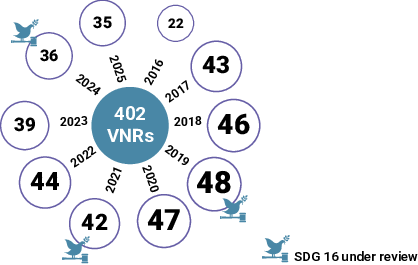
The UN High-Level Political Forum presents a unique opportunity for Member States to learn from one another and focus on specific goals that are assessed each year. SDG 16 has been thematically reviewed three times since the inception of the 2030 Agenda—in 2019, 2021 and 2024. In 2019, 48 VNRs were presented, in contrast to 42 in 2021 and 36 in 2024.
VNRs provide a platform for countries to exchange experiences, including achievements, gaps in implementation, challenges and lessons learned, in order to advance the implementation of the 2030 Agenda. They also aim to reinforce government policies and institutions while fostering multi-stakeholder engagement and partnerships to support progress on the SDGs (United Nations High-Level Political Forum on Sustainable Development n.d.b). From the start of the VNR process in 2016 until 2025, 402 VNRs from 191 Member States and Observers were officially presented or submitted to the HLPF, with only 4 Member States failing to produce a national review—Haiti, the Islamic Republic of Iran, Myanmar and the United States. In the first year, 22 countries presented reviews, and this number increased in subsequent years, reaching a peak of 48 countries in 2019. In 2025 the total number of countries submitting VNRs decreased to 35 (Figure I.1).

Over the past decade, although reporting on progress and challenges regarding the SDGs has become common, the world has witnessed a marked trend of democratic backsliding, characterized by the erosion of checks and balances, constraints on civic space, declining electoral integrity and the concentration of power in the executive branch. Across regions, governments have increasingly undermined judicial independence, restricted media freedoms and limited the participation of civil society, weakening the foundational principles of accountability and representation (International IDEA 2024). In this context, it is critical to assess whether democracy is being meaningfully addressed in the national reviews of implementation of the Sustainable Development Goals. As VNRs serve as key instruments for tracking progress on inclusive and accountable governance, their treatment—or omission—of democratic principles provides important insights into countries’ commitments to transparency, participation and the rule of law. Analysing how democracy is reflected in VNRs is therefore essential not only for evaluating progress on sustainable development but also for identifying gaps where democratic governance must be strengthened to ensure that development outcomes are equitable, inclusive and resilient.
Through qualitative and quantitative analysis, this report examines how key principles of democracy (Box I.2), based on the International Institute for Democracy and Electoral Assistance’s (International IDEA) Global State of Democracy (GSoD) Indices framework (Annex A) and aligned with SDG 16 targets on peaceful, just and inclusive societies, were portrayed in 402 VNRs presented between 2016 and 2025. More specifically, these principles are reflected in references to 12 keywords selected in accordance with the official targets and indicators of the 2030 Agenda under SDG 16, and on four unofficial indicators—Participation, Representation, Rights and Rule of Law—produced and measured by International IDEA’s GSoD Indices (Table I.1). The keywords are access to justice, civil society, corruption, democracy, elections, fundamental freedoms, human rights, political participation, political parties, political representation, press freedom and rule of law.
| Target | Target description | GSoD-related democracy attribute | GSoD-related democracy keywords |
|---|---|---|---|
| 16.3 | Promote the rule of law at the national and international levels and ensure equal access to justice for all | Rule of Law | Rule of law Access to justice |
| 16.5 | Substantially reduce corruption and bribery in all their forms | Rule of Law | Corruption |
| 16.6 | Develop effective, accountable and transparent institutions at all levels | Democracy | Democracy Elections |
| 16.7 | Ensure responsive, inclusive, participatory and representative decision-making at all levels | Participation Representation | Political representation Political parties Civil society Political participation |
| 16.10 | Ensure public access to information and protect fundamental freedoms, in accordance with national legislation and international agreements | Rights | Fundamental freedoms Press freedom Human rights |
The selected keywords embody basic principles of democracy based on International IDEA’s GSoD Indices. Although they were selected for their association with SDG 16—as covered by International IDEA—the findings of this report are not limited to peaceful, just and inclusive societies. Several of the keywords appear throughout the VNRs, not only in relation to SDG 16 but also in connection with other goals of the 2030 Agenda that were reported by countries over the years. This finding likely reflects the interlinkages between SDG 16 and the other SDGs, as well as SDG 16’s enabling role across the 2030 Agenda and its association with democracy and democratic principles (Cram 2024).
Box I.2. Official findings related to SDG 16
This report aims to complement the United Nations’ official findings on Sustainable Development Goal (SDG) 16 from a democracy perspective. It is not meant to replace the official findings in the ‘Global Progress Report on Sustainable Development Goal 16’ (UNDP, OHCHR and UNODC 2025) and in the report 2025 Voluntary National Reviews through the Lens of Peaceful, Just and Strong Institutions (Sood, Mcmillon and Ukre 2025), among others.
The UN reports that SDG 16 has evolved from being politically sensitive and marginal to becoming central to national reporting and development planning over the past 10 years. Some key highlights from these reports include the following:
- Most countries now recognize that peace, justice and strong institutions are foundational for achieving all other SDGs.
- In 2025, 81 per cent of reporting countries included a standalone SDG 16 chapter, showing strong institutional mainstreaming.
- Access to justice, violence reduction, child protection, institutional effectiveness and inclusive decision making are widely reported and prioritized.
- Reporting on organized crime, corruption and global governance is less consistent, suggesting uneven political prioritization of some targets.
The findings of this report are based on quantitative and qualitative analyses of 443 documents produced by UN Member States and Observers. These documents are publicly available online and were retrieved from the UN website for this research. They comprise Voluntary National Review reports, annexes with supplementary data and statistics, and main messages, such as executive summaries, all of which are part of the 402 VNRs produced to date. Voluntary local reviews were not included in the research documents or the analysis. At the time of data collection and analysis,3 the full VNR reports of the majority were available in the UN database, with the exceptions of China (2016), Barbados (2020) and the Bahamas (2021);4 only the main messages and executive summaries available on the UN’s website were used in these cases.
The author retrieved reports in five of the UN’s official languages—Arabic, English, French, Russian and Spanish. For the countries that submitted their reports in both their official language and English, the author used the English version. As a result, no reports in Chinese, the sixth official UN language, were retrieved, as English versions were available.
References to 12 keywords were assessed to determine whether democratic principles related to SDG 16 were incorporated in the VNRs from 2016 to 2025. These keywords were selected based on International IDEA’s GSoD framework (Annex A) and their association with SDG 16. The research was conducted using Adobe’s advanced search function, applying whole-word searches only to ensure consistency across the reports analysed. The keywords were translated from English into Arabic, French, Russian and Spanish using an online translator and later verified by native speakers of those languages to ensure accuracy.
As noted above, the keywords included in the quantitative analysis are access to justice, civil society, corruption, democracy, elections, fundamental freedoms, human rights, political participation, political parties, political representation, press freedom and rule of law.5 Only these exact terms were used for the quantitative analysis, and no other variants were considered unless listed in Annex B, which provides the complete list of keywords and their respective translations (see 1.1: Caveats). These keywords were selected for their interlinkages with democracy and SDG 16, including its targets and indicators, based on International IDEA’s GSoD Indices framework. It is important to note that the selected keywords are not the only ones that International IDEA associates with positive democratic outcomes. Other terms, including ‘gender equality’, ‘parliaments’, ‘freedom of expression’ and ‘political equality’, to name a few, were not included in the findings of this report. These keywords were initially selected for this research because they reflect the overall health of democracies and the achievement of the 2030 Agenda. However, they were ultimately excluded due to research constraints, but their relevance to democracy and the 2030 Agenda remains crucial. Additional research is needed to assess how additional keywords, as listed above, could complement the findings of this report and enhance understanding of their role in the VNRs.
Furthermore, the keywords ‘human rights’, ‘fundamental freedoms’ and ‘press freedom’ were analysed separately, despite being interconnected. The same approach was applied to ‘access to justice’ and ‘rule of law’. This was an intentional choice to demonstrate how countries report on and interpret these themes separately, given their connection to the targets of the 2030 Agenda, particularly SDG 16.
The study generated quantitative data on the number of VNRs that mentioned each keyword at least once, the total number of mentions across the reports for each keyword, the percentage of countries referencing each keyword each year and country rankings based on how often they referenced democratic principles over the years. The quantitative analysis of keywords and their final counts are best read as an indicator of reporting patterns and terminology use, rather than as a direct proxy for emphasis, progress or depth of reform.
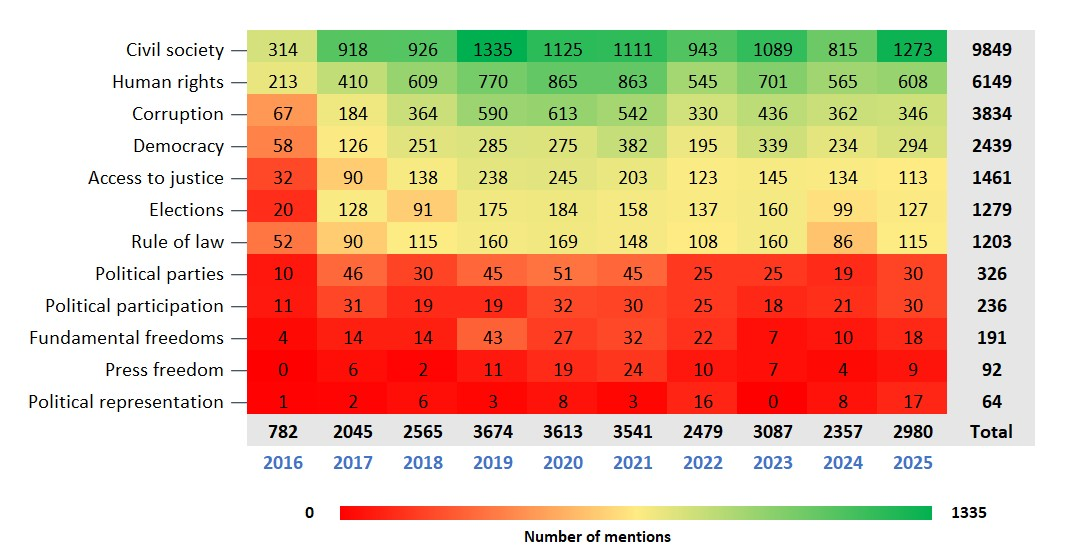
The qualitative analysis identified key recurring themes associated with each keyword, and a final manual review of the reports was completed to determine how these themes were framed in various countries and political contexts. This final review focused on the location of the keywords within the VNRs and the surrounding text. The qualitative analysis presents country examples throughout the report that illustrate how Member States address the democratic principles captured by the keywords. The qualitative section (see Chapter 3) starts with an analysis of the keyword ‘democracy’, followed by other keywords ranked by the number of mentions (see Figure 2.3).
Any translations required for the qualitative analysis were carried out using online and artificial intelligence tools, such as Google Translate, Gemini and ChatGPT.
1.1. Caveats
Although many countries do not mention ‘political representation’ in their VNRs, several reports highlighted the representation of marginalized groups, including women and youth, in political and decision-making processes. It is worth noting that the quantitative data accounts only for the exact phrases identified in the keywords and their translations listed in Annex B. For ‘political representation’, even though the exact phrase is absent from many reports, countries often addressed the matter of political representation using terms such as ‘representation in decision-making’, ‘representation in parliaments’ and ‘representation in political life’, among others. In 2023, for instance, no countries included the exact phrase ‘political representation’ in their reports; however, a qualitative review of the term ‘representation’ within the reports indicates that many countries referred to representation in the political sphere. Examples include Bosnia and Herzegovina, Brunei, Cambodia, Canada, the European Union, the Maldives, Saudi Arabia and Tanzania, to name a few; however, they were not included in the quantitative analysis for that specific keyword. This limitation also applies to other keywords used in this study. It should therefore be taken into account when interpreting both the quantitative findings and the qualitative analysis, since neither fully captures the breadth of how Member States reflect these concepts in their reports.
Moreover, for terms that are frequently presented as abbreviations, such as civil society (CS), access to justice (A2J), rule of law (RoL) or human rights (HR), only the full keywords were used in the analysis, which may impact the total number of mentions of these principles if countries used abbreviations in their reports.
Another important caveat is that references to keywords related to democracy in the VNRs do not necessarily indicate that the Member States have a strong democratic standing in global rankings. The practical reality of each country might differ from what is reflected in their VNRs. This report does not analyse countries’ actual democratic performance.
Finally, global and regional developments, such as the Covid-19 pandemic, the 2024 elections super-cycle year and regional conflicts, were not taken into consideration in the qualitative analysis of this report. These events may have played a role in how countries addressed certain keywords over the years.
Additional research would be necessary to fill in these gaps.
1.2. Referencing
All VNRs were retrieved from the UN High-Level Political Forum on Sustainable Development (n.d.a) website. However, to make it easier for the reader to find the documents used, references throughout the report cite the country name and the year of reporting. The links to the VNR reports direct readers to the UN website, where all VNRs are hosted.
Since 2016, 402 voluntary national reviews have been presented to the HLPF, covering aspects of the 2030 Agenda and its 17 SDGs. Although not all countries explicitly highlight the significance of democracy within their national contexts, many reports have emphasized essential democratic principles as part of their priorities for achieving the 2030 Agenda. Some reports highlight these principles under the umbrella of SDG 16 (peaceful, just and inclusive societies), but several democracy-related keywords appear throughout the VNRs, whether countries include a specific chapter on SDG 16 or review this goal in their reports. Several countries reference these keywords in relation to SDG 16, other SDGs or their national contexts outside the SDG framework—for example, in introductory or background sections of their VNRs. This suggests that these democratic principles may be intrinsically linked to SDGs across the 2030 Agenda and to the broader understanding of governance, rather than being confined solely to SDG 16.
The keywords ‘civil society’, ‘human rights’, ‘corruption’, ‘democracy’, ‘access to justice’, ‘rule of law’ and ‘elections’ appeared in the largest number of VNRs (Figure 2.1). In contrast, ‘political parties’, ‘fundamental freedoms’, ‘political participation’, ‘press freedom’ and ‘political representation’ were referenced much less frequently. ‘Press freedom’ and ‘political representation’, in particular, were rarely referenced in the reports, being mentioned in only 78 VNRs, with 156 total mentions combined (Figures 2.1 and 2.3).
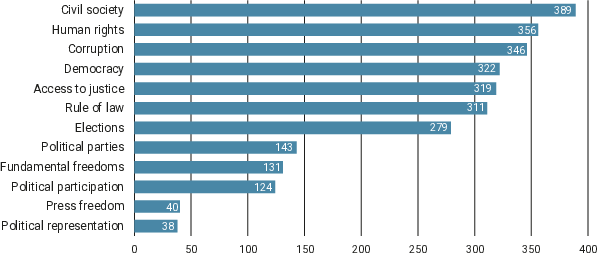
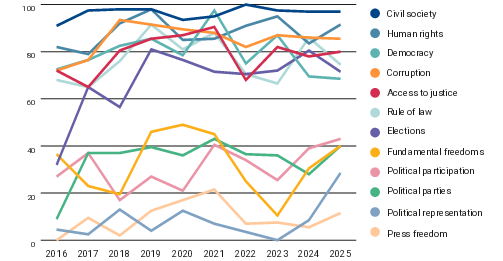
‘Civil society’ was the most frequently referenced keyword in the VNRs, with 389 reports mentioning it at least once. It was also the only keyword that received 100 per cent coverage in the VNRs for one year (2022) (Figure 2.2). ‘Civil society’ also recorded the highest total number of mentions (9,849), followed by ‘human rights’ (6,149 mentions) and ‘corruption’ (3,834 mentions). These findings indicate a significant gap in how often these keywords have been mentioned relative to one another, especially when compared with the three keywords mentioned least often—‘fundamental freedoms’ (191 mentions), ‘press freedom’ (92 mentions) and ‘political representation’ (64 mentions) (Figure 2.3). The keyword ‘elections’ experienced one of the most significant increases in visibility during the history of the VNRs, rising from 32 per cent of countries referencing it in 2016 to 71.5 per cent in 2025, dropping from 81 per cent in 2019 (Figure 2.2).
‘Democracy’ was the fourth most frequently referenced keyword in the VNRs (Figure 2.1) and the fourth most mentioned overall, with a total of 2,439 mentions (Figure 2.3). In 2021 ‘democracy’ was referenced by 97.5 per cent of countries. ‘Press freedom’ and ‘political representation’ were the only keywords that were not referenced by any country in at least one year of the VNR cycle (Figures 2.2 and 2.3).
In terms of total mentions by year, 2019 saw the highest number of references to the selected keywords across all years (3,674 mentions)—2019 was also the first year in which SDG 16 was under review—followed closely by 2020 (3,613 mentions) and 2021 (3,541 mentions) (Figure 2.3). The first year of the VNR process recorded only 782 mentions of democracy-related keywords, likely reflecting the fact that only 22 VNRs were presented that year. The average number of mentions per VNR in 2016 was 35.5 (the lowest average recorded), compared with 85.1 in 2025 (the highest average recorded) (Table 2.1).
| 2016 | 2017 | 2018 | 2019 | 2020 | 2021 | 2022 | 2023 | 2024 | 2025 | |
|---|---|---|---|---|---|---|---|---|---|---|
| Number of VNRs presented | 22 | 43 | 46 | 48 | 47 | 42 | 44 | 39 | 36 | 35 |
| Average number of mentions per VNR | 35.5 | 47.6 | 55.8 | 76.5 | 76.9 | 84.3 | 56.3 | 79.2 | 65.5 | 85.1 |
The countries with the highest percentages of keywords mentioned at least once per VNR include São Tomé and Príncipe (91.7 per cent); Cabo Verde and Papua New Guinea (87.5 per cent each); Cuba, North Macedonia, Serbia and Seychelles (83.3 per cent each); Angola, Liberia and Sweden (79.2 per cent each); and Chile (77.8 per cent). The countries with the lowest percentages include Grenada (8.3 per cent); Belarus and the Syrian Arab Republic (16.7 per cent); Tajikistan (20.8 per cent); Kiribati, Monaco and Yemen (25 per cent each); Botswana (29.2 per cent); and Brunei Darussalam, China, Djibouti, Libya, Nauru, Saint Kitts and Nevis, the Republic Korea and the United Arab Emirates (33.3 per cent each).
This chapter examines how the 12 democracy-related keywords are reflected across the VNRs submitted between 2016 and 2025. Combining quantitative trends with qualitative examples, it explores how Member States refer to core democratic principles, addressing not only how frequently these themes appear but also how they are framed across different political systems and national contexts. This approach reveals both the breadth of democratic language in VNRs and the unevenness with which different democratic principles are addressed.
3.1. Democracy
Overview
Reports referencing the keyword: 322
Countries referencing the keyword: 171
Year with the highest percentage of countries referencing the keyword: 2021
Year with the lowest percentage of countries referencing the keyword: 2017
Total mentions 2016–2025: 2,439
‘Democracy’ was the fourth most frequently referenced keyword in the VNRs, with a total of 322 reports covering the topic (Figure 2.1). While several VNRs included implicit references to democracy in their VNRs—as highlighted through the keywords used in this research—explicit references to the word ‘democracy’ also appeared across a wide range of political systems, including established democracies, newer democracies, and hybrid or authoritarian regimes.
Democracy was often framed either as a vital governance principle or as a rhetorical tool used by non-democracies to reinforce their authoritarian rule.
Established democracies, such as Finland and Germany, explicitly referenced the concept of democracy in their reports. Finland (2025) noted that its model of democracy rests on equality, rule of law, participation and institutional trust—factors crucial for achieving the SDGs. Germany (2016) emphasized how participatory processes and a strong civil society underpin its democracy, contributing to inclusive and transparent governance. Both countries identified the need to adapt democratic governance to the challenges of digitalization and rising political polarization.
In newer democracies, such as Chile, efforts were made to consolidate democracy through ongoing electoral reform and the expansion of civic spaces (Chile 2017). Despite these advances, however, Chile (2017) acknowledged difficulties in fully engaging marginalized populations in democratic processes. Similarly, Georgia (2024) referred to initiatives to enhance democracy, promote effective governance, increase transparency and improve accountability, including efforts to strengthen its justice system.
For countries that have undergone transitions from authoritarian contexts in the past—despite their current democratic rankings—such as The Gambia and Tunisia, their democratic transitions were presented as significant achievements. The Gambia (2020) noted its peaceful transfer of power following its democratic elections of 2016 and its efforts to restore public trust as successful milestones. Tunisia (2019) also celebrated its democratic progress following its 2011 revolution, emphasizing the adoption of a democratic constitution and its commitment to institutional reforms.
By contrast, some authoritarian and hybrid regimes framed democracy in a more symbolic or ideological way. Cambodia (2019) invoked democracy in the context of political stability and national development, linking democratic legitimacy with government-led accomplishments. Venezuela (2016) referred to a model of ‘participatory and protagonist democracy’ tied to its Bolivarian Revolution, reflecting a state-centric version of democracy that diverges from liberal norms.
These examples demonstrate how the concept of democracy varies across the VNRs. While democratic countries tend to emphasize pluralism, civic participation and accountability, authoritarian and hybrid regimes often use the term to validate the regime’s legitimacy and national sovereignty. This divergence underscores the importance of assessing not only the presence of democratic language in VNRs but also the context and meaning of its use. As countries strive to achieve SDG 16 on peaceful, just and inclusive societies, the global community must remain attentive to both the promises and the narratives surrounding democracy in development reporting.
3.2. Civil society
Overview
Reports referencing the keyword: 389
Countries referencing the keyword: 187
Year with the highest percentage of countries referencing the keyword: 2022
Year with the lowest percentage of countries referencing the keyword: 2016
Total mentions 2016–2025: 9,849
‘Civil society’ was a prominent keyword in the VNRs, with 96 per cent of all reports from 2016 to 2025 mentioning it (Figure 2.2). Among all the keywords analysed for this paper, ‘civil society’ had by far the highest number of mentions (9,849) (Figure 2.3). Many countries identified civil society actors as key partners in the implementation of national and international policies. Ireland (2018), one of the co-facilitators of the process that led to the adoption of the 2030 Agenda, recognized in its first VNR that successful implementation of the 2030 Agenda depends not only on government efforts but also on partnerships with other stakeholders, including civil society organizations (CSOs), since these partnerships are essential for achieving the goals set out in 2015. This acknowledgment was echoed by several other countries, such as Brazil (2017), Finland (2016) and Oman (2024).
Countries also reported that CSOs have played a crucial role in supporting efforts related to SDG 16. In 2016, for instance, Georgia (2016) noted a significant contribution from civil society in monitoring the implementation of anti-corruption strategies and judicial reforms, as these organizations were actively engaged in public consultations, legislative oversight and transparency initiatives. Similarly, Nepal (2020) indicated that CSOs were involved in legal awareness and conflict-resolution efforts at the community level. Other countries also emphasized the contributions of civil society to achieving not only SDG 16 but also other goals of the 2030 Agenda, such as SDG 3 (good health and well-being), SDG 4 (quality education), SDG 5 (gender equality), SDG 10 (reduced inequalities) and SDG 13 (climate action). For instance, Costa Rica (2024) defended civil society’s role in promoting human rights and gender equality through policy dialogue, while Senegal (2018) highlighted CSOs’ support for public education, social inclusion, equality and justice. Such recognition of the role of civil society in implementing the 2030 Agenda is crucial, given the growing backlash against civil society actors in recent years and the shrinking of civic space around the world (SDG 16 Data Initiative 2025).
Other highlighted issues included civil society’s unique role in policy formulation and implementation, monitoring and data collection, regional coordination, capacity building and social accountability—all essential elements of democratic governance and SDG 16.
Civil society serves as a vital enabler of sustainable development, bridging the divide between communities and governments and ensuring that the vision of the 2030 Agenda is both inclusive and achievable. Therefore, its systematic inclusion in SDG follow-up and review processes not only aligns with the core principles of SDG 17 on partnerships—a critical element for achieving the 2030 Agenda—but also yields key insights and initiatives, including through non-official data and service delivery, that are essential for addressing challenges and reporting gaps. Member States must ensure that civil society’s participation is transparent, open and free from coercion; otherwise, references to civil society in VNRs risk being merely descriptive rather than reflecting genuine, meaningful engagement that contributes to accountability, inclusive decision making and improved development outcomes. As governments approach the final years leading up to 2030, these partnerships will be more crucial than ever.
3.3. Human rights
Overview
Reports referencing the keyword: 356
Countries referencing the keyword: 181
Year with the highest percentage of countries referencing the keyword: 2019
Year with the lowest percentage of countries referencing the keyword: 2017
Total mentions 2016–2025: 6,149
Human rights are consistently portrayed as both a foundational principle and a practical framework for implementing the 2030 Agenda. Rather than being treated as a standalone policy area, human rights are integrated across education, climate action, peace and security, governance, development cooperation and social inclusion, reflecting a growing consensus that sustainable development and human dignity are mutually reinforcing. On average, 88 per cent of the VNRs presented between 2016 and 2025 referenced ‘human rights’, with 2017 recording the lowest average (79 per cent); and 2019, the highest (98 per cent) (Figure 2.2). In total, 181 countries and observers mentioned ‘human rights’ at least once in 356 reports (Figure 2.1).
Human rights were often framed as an essential foundation for sustainable development and global cooperation. Belgium (2017) explicitly positioned human rights at the core of education for sustainable development, global citizenship and climate policy, emphasizing coherence between climate action and human rights obligations under the Paris Agreement. Denmark (2017) similarly presented human rights and the SDGs as mutually supportive, with human rights guiding SDG implementation and the SDGs advancing the realization of rights. Portugal (2017) reinforced this narrative by framing its VNR as evidence of a broader commitment to human rights, sustainable development and multilateralism. More recently, Spain (2024) presented a human rights–based approach as the country’s guiding framework for a just transition (energy and climate), linking inequality, conflict and climate change to the need for people- and planet-centred development.
Another theme is the centrality of human rights to peace, security and political stability. Cyprus (2017) placed human rights at the heart of its efforts to resolve a protracted conflict, emphasizing international legal obligations, the protection of refugees and missing persons, and the role of international human rights mechanisms in addressing violations. Timor-Leste (2019) similarly linked democratic consolidation, peacebuilding and the rule of law to the establishment of independent human rights, anti-corruption and electoral institutions, portraying human rights protection as a prerequisite for lasting peace. Ghana (2019) also highlighted this institutional dimension, underscoring constitutional safeguards and the role of a nationally accredited human rights institution in anchoring sustainable development within a rights-based legal order.
The establishment and strengthening of national human rights institutions emerged as a clear indicator of commitment and accountability. Ghana (2019), Mauritius (2019), Timor-Leste (2019), Angola (2021), Cabo Verde (2021), Qatar (2021) and others highlighted the importance of independent human rights bodies tasked with monitoring compliance, advising governments and aligning domestic law with international standards. In these contexts, human rights were portrayed not only as values but also as enforceable standards supported by permanent oversight mechanisms and reporting obligations.
Education and awareness raising were repeatedly presented as key pathways for advancing human rights. Belgium’s (2017) investment in global citizenship education, Israel’s (2019) integration of human rights, democracy and pluralism into school curricula, and Sweden’s (2017) national human rights strategy all emphasize the role of education in cultivating respect for rights, tolerance and democratic culture. Human rights education is framed as both preventative—countering discrimination and exclusion—and enabling and equipping citizens with the knowledge to claim and defend their rights.
Gender equality and non-discrimination were among the most dominant thematic lenses through which human rights were assessed. Iceland (2019) positioned gender equality and women’s empowerment as core drivers of sustainable development and central pillars of its foreign policy. Angola (2021) highlighted concrete measures to advance the rights of women and girls, including protections for prisoners and journalists, while Indonesia (2021) linked human rights protection to efforts to address gender-based violence and discrimination. Japan (2025) adopted a reflective tone, acknowledging progress in women’s empowerment alongside persistent gaps in gender equality rankings, and detailing evolving measures to address sexual violence and discrimination.
Finally, many VNRs emphasized engagement with international human rights mechanisms as a measure of seriousness and credibility. Several countries, including Denmark (2017), Sweden (2017), Iceland (2019), Spain (2024) and Finland (2025), highlighted their active roles within the UN Human Rights Council and treaty body system, presenting multilateral engagement as both a responsibility and a tool for advancing rights globally.
The VNRs portray human rights as the ethical backbone of the 2030 Agenda and as an operational framework for addressing inequality, conflict, environmental crises and governance challenges. While the emphasis varies across reports—from education and institutions to gender equality, climate justice and business practices—the overarching narrative is consistent: sustainable development cannot be achieved without the protection, promotion and realization of human rights for all.
3.4. Corruption
Overview
Reports referencing the keyword: 346
Countries referencing the keyword: 176
Year with the highest percentage of countries referencing the keyword: 2018
Year with the lowest percentage of countries referencing the keyword: 2016
Total mentions 2016–2025: 3,834
Across the reports submitted between 2016 and 2025, countries increasingly emphasized that anti-corruption measures and transparency are essential elements of SDG 16 and vital for achieving the 2030 Agenda. On average, 85 per cent of the VNRs referenced the keyword ‘corruption’, with 2016 having the lowest percentage of countries mentioning it (72 per cent); and 2018, the highest (93.5 per cent) (Figure 2.2). While references to anti-corruption varied, many countries addressed the underlying issues of transparency, integrity and accountability. Many reports indicated that anti-corruption initiatives are increasingly integrated into broader governance reforms.
According to International IDEA’s GSoD Indices,6 the lowest levels of corruption are in Denmark, Switzerland, Germany, New Zealand and Finland (Table 3.1). These countries highlighted various aspects of national anti-corruption efforts in their reports, such as the role of institutional trust and civic engagement in supporting low corruption outcomes (Denmark 2017), the strengthening of international cooperation to combat illicit financial flows (Switzerland 2022), the promotion of transparency through open policymaking practices (Germany 2021), effective institutional checks and public access to information (New Zealand 2019), and the connection between the rule of law, public integrity and protection against corruption (Finland 2016).
The countries with the highest levels of corruption—Venezuela, Chad, Cambodia, Nicaragua and Papua New Guinea (Table 3.1)—also emphasized the issue of corruption in their VNRs—often as a challenge to address. In 2019 Cambodia (2019) noted that one of its key obstacles to combating corruption was the lack of funds to enforce existing laws, yet the country continued to take action against corruption by strengthening accountability and building institutional capacity. Papua New Guinea (2020) reported the importance of enhancing service delivery mechanisms to address inefficiencies and misuse of public funds, as corruption was one of the challenges faced by the country. Chad (2024) noted that the fight against corruption was crucial to ensuring sustainable economic development, as high levels of corruption undermine public trust, divert foreign investment, hinder improvements in public infrastructure and foster a culture of bribery. Nicaragua and Venezuela did not mention anti-corruption measures in their reports, despite being in the bottom five countries in corruption levels (International IDEA n.d.) (Table 3.1).
| Highest level of corruption | Lowest level of corruption | |||
|---|---|---|---|---|
| Country | 2024 GSoD score | Country | 2024 GSoD score | |
| Venezuela | 0.00 | Denmark | 1.00 | |
| Chad | 0.07 | Switzerland | 0.91 | |
| Cambodia | 0.17 | Germany | 0.91 | |
| Nicaragua | 0.17 | New Zealand | 0.91 | |
| Papua New Guinea | 0.17 | Finland | 0.90 | |
| Yemen | 0.17 | Norway | 0.90 | |
| Cameroon | 0.19 | Sweden | 0.89 | |
| Somalia | 0.19 | Luxembourg | 0.88 | |
| Turkmenistan | 0.20 | Canada | 0.87 | |
| Lebanon | 0.20 | The Netherlands | 0.87 | |
While countries reported on corruption based on their national contexts, the emphasis on transparency, accountability and integrity as fundamental governance priorities highlights a potential universal need for more just and resilient institutions. Countries with low corruption typically emphasized proactive, trust-based and institutional approaches, while those with high corruption often focused more on the structural challenges and capacity limitations preventing them from lowering their levels of corruption. This contrast illustrates both the progress achieved and the ongoing gaps in global anti-corruption efforts, indicating the need for sustained support, particularly in countries where systemic corruption threatens sustainable development.
3.5. Access to justice
Overview
Reports referencing the keyword: 319
Countries referencing the keyword: 172
Year with the highest percentage of countries referencing the keyword: 2021
Year with the lowest percentage of countries referencing the keyword: 2017
Total mentions 2016–2025: 1,461
Ensuring equal access to justice for all is one of the key targets of SDG 16 (16.3). On average, 78 per cent of the VNRs presented between 2016 and 2025 mentioned ‘access to justice’ (Figure 2.2). A total of 172 countries and observers referenced this keyword at least once, across 319 reports, with 1,461 mentions (Figures 2.1 and 2.3). While many countries referenced ‘access to justice’ within the formal wording of SDG 16 (‘promote peaceful and inclusive societies for sustainable development, provide access to justice for all, and build effective, accountable, and inclusive institutions at all levels’), there were several references to ‘access to justice’ more broadly as a fundamental pillar of sustainable development.
The approaches countries took to address issues of access to justice varied across the VNRs, but many emphasized the critical role that accessible, fair and accountable legal systems play in promoting inclusive societies. In 2017, for instance, Kenya (2017) and the Maldives (2017) reported on draft bills and the implementation of legal aid systems aimed at increasing access to justice for the most vulnerable groups, especially those who cannot afford legal representation. However, having legal aid systems in place alone is insufficient. Belize (2017) noted in its report that, while a legal aid system existed, it was not free, which, combined with lengthy trial periods, often negatively impacted victims of gender-based violence. This kind of reporting also highlights the important interlinkages between SDG 16 and other goals of the 2030 Agenda, such as gender equality (SDG 5)—a cross-cutting theme identified, often implicitly, by several countries throughout the VNRs.
Other issues addressed in the VNRs include the need for institutional and legal reforms, such as independent justice systems; legal solutions that focus on vulnerable groups, including children, people with disabilities, women and Indigenous peoples; and the critical role of data—official and non-official—in monitoring accountability and justice delivery. These references reflect a broader recognition that access to justice is not only a legal right but also a catalyst for inclusive governance and sustainable development.
3.6. Elections
Overview
Reports referencing the keyword: 279
Countries referencing the keyword: 167
Year with the highest percentage of countries referencing the keyword: 2019
Year with the lowest percentage of countries referencing the keyword: 2016
Total mentions 2016–2025: 1,279
On average, 67.5 per cent of the VNRs presented between 2016 and 2025 referenced ‘elections’, with 2016 recording the lowest average (32 per cent); and 2019, the highest (81 per cent) (Figure 2.2). Across the VNRs, references to ‘elections’ appear in many contexts, including electoral reform and strengthening electoral institutions, women’s political participation and representation, and broader governance and democratic processes linked to free and fair elections. For instance, The Gambia (2022) referred to its presidential 2016 election as the turning point that restored democratic governance after authoritarian rule. Its report highlighted that strengthened civil society monitoring of electoral processes contributed to a more stable and accountable political environment. Elections were addressed not merely as events but as democratic safeguards supported by independent actors.
Croatia (2023) noted that women’s representation in local government improved after the 2021 elections. Following the elections, the share of women in city and municipal councils rose from 25 per cent to 28 per cent; and in county councils, from 27 per cent to 30 per cent. The proportion of female mayors also increased slightly.
In Sierra Leone (2024), following the 2023 general election, the National Electoral Commission reported that it had assisted in mediating post-election disputes, promoting peace between major parties and supporting the implementation of a tripartite electoral reform agreement. The enactment of the 2022 Political Parties Act strengthened the regulation of political parties, leading to an increase in accountability and transparency in political parties in 2023. Despite these democratic advances, the country remained concerned about growing polarization and intolerance in society. Sierra Leone (2024) also reported that elections had increasingly become a source of tension and mistrust, and that confidence in key state institutions was declining, including in electoral bodies, the judiciary and the security sector.
Bangladesh (2025) emphasized that its new interim government, formed after a youth-led uprising demanding equity, justice and reform, had the opportunity to reshape national development through institutional reform, justice and accountability processes, and the organization of free and fair elections. The government’s vision focused on rebuilding trust and promoting an inclusive, shared approach to governance.
These examples show that elections are a key component of how countries measure and report progress towards achieving the 2030 Agenda. With more than two-thirds of all VNRs addressing electoral issues, Member States are increasingly recognizing that credible, inclusive and well-managed elections are essential to democratic governance. The examples from The Gambia, Croatia, Sierra Leone and Bangladesh highlight the variety of electoral dynamics across different contexts: elections can restore democratic order after authoritarian rule, lead to real improvements in women’s political representation, reveal institutional weaknesses and societal divisions, or serve as a transformative path for national renewal following public mobilization. When free and fair, elections are not just isolated political events but crucial parts of democratic resilience, institutional legitimacy, accountability and public trust. As countries work to implement SDG 16 and the 2030 Agenda, strengthening electoral processes will remain crucial for creating peaceful, just and inclusive societies.
3.7. Rule of law
Overview
Reports referencing the keyword: 311
Countries referencing the keyword: 175
Year with the highest percentage of countries referencing the keyword: 2019
Year with the lowest percentage of countries referencing the keyword: 2017
Total mentions 2016–2025: 1,203
The rule of law is a cornerstone of SDG 16—explicitly acknowledged under target 16.3 to ‘promote the rule of law at the national and international levels and ensure equal access to justice for all’—and of democracy more broadly. On average, 76 per cent of the VNRs presented between 2016 and 2025 referenced the keyword ‘rule of law’ (Figure 2.2). In total, 175 countries and observers mentioned ‘rule of law’ at least once since 2016, in 311 reports (Figure 2.1).
In the VNRs, the rule of law is consistently presented as a foundational condition for achieving SDG 16 and the 2030 Agenda. However, countries’ definitions, priorities and implementation of the rule of law vary significantly across national contexts, reflecting differences in political systems, institutional capacity, conflict exposure and reform trajectories.
Several countries portrayed the rule of law primarily through the lens of public institutions, the constitution and governance strategy. Some framed the rule of law as intrinsically connected to their national identity, as a set of rules and norms that underpin their national beliefs. For the Kingdom of the Netherlands (2017), for instance, the separation of powers, the rule of law and due process are embedded in the Constitution and the Charter of the Kingdom of the Netherlands and apply to all four of its constituent countries.7 Portugal (2017) considers itself to be a democratic state, based on the rule of law, popular sovereignty, pluralism of expression and political democratic organization. Morocco (2020) implemented a National Action Plan for Democracy and Human Rights 2018–2021 to create sustainable mechanisms to enshrine the foundations of the rule of law and human rights and to promote the political reform and democratization process.
The rule of law is also seen as a means of ensuring good governance, accountability and trust, often associated with judicial independence, anti-corruption efforts, electoral integrity and establishing international cooperation. Ukraine (2020) affirmed in its report that reform of the judicial system to ensure the practical implementation of the rule of law and to secure the functioning of the judiciary had become a precondition for a higher level of public confidence in the judicial authorities and related legal institutions. Nepal (2017) framed the rule of law as part of good governance and essential to restoring legitimacy following a political transition, while Japan (2025) viewed the rule of law as foundational for constructing a sustainable future and achieving the SDGs at home and abroad.
In some conflict-affected and fragile contexts, such as Iraq (2019), Libya—among the 10 countries with the lowest score in terms of rule of law, according to International IDEA’s GSoD Indices (Table 3.2)—and Ethiopia, the rule of law was framed as either fragile, contested or closely tied to peacebuilding, institutional rebuilding and recovery. The VNRs submitted by these countries acknowledged weakened justice systems, the politicization of judicial institutions, low public trust, and challenges stemming from insecurity and displacement. For instance, Libya (2024) recognized the rule of law as integral to rebuilding a functioning state after prolonged instability and terrorism, while Ethiopia (2025) saw the rule of law as central to a democratic transition, justice, accountability and trust yet highly vulnerable to ongoing security challenges and conflict. In these contexts, the rule of law is presented as a long-term objective rather than an achieved condition.
| Highest score in rule of law | Lowest score in rule of law | |||
|---|---|---|---|---|
| Country | 2024 GSoD score | Country | 2024 GSoD score | |
| Denmark | 0.99 | Venezuela | 0.03 | |
| Germany | 0.91 | Afghanistan | 0.08 | |
| Switzerland | 0.89 | Yemen | 0.09 | |
| Luxembourg | 0.89 | Libya | 0.09 | |
| Australia | 0.86 | Eritrea | 0.10 | |
| Estonia | 0.86 | Nicaragua | 0.11 | |
| Norway | 0.86 | Chad | 0.13 | |
| Ireland | 0.85 | North Korea | 0.13 | |
| New Zealand | 0.85 | Syria | 0.13 | |
| Finland | 0.85 | South Sudan | 0.14 | |
These VNRs underscore that, while the rule of law is universally recognized as indispensable to achieving SDG 16 and the 2030 Agenda and to sustaining democratic governance, its realization remains uneven and deeply context-specific. The wide variation in how countries define, prioritize and implement the rule of law reflects different institutional capacities, political trajectories and levels of stability. Yet across contexts—whether consolidated democracies, reforming states or conflict-affected societies—the rule of law consistently emerges as a critical enabler of trust, accountability, peace and sustainable development. As the 2030 Agenda advances, strengthening the rule of law will remain both a shared aspiration and a central challenge, requiring sustained political commitment, inclusive institutions and long-term investment in justice systems that serve all.
3.8. Political parties
Overview
Reports referencing the keyword: 143
Countries referencing the keyword: 101
Year with the highest percentage of countries referencing the keyword: 2021
Year with the lowest percentage of countries referencing the keyword: 2016
Total mentions 2016–2025: 326
On average, 34 per cent of the VNRs presented between 2016 and 2025 addressed political parties in their reports, with 2016 being the year with the lowest percentage (9 per cent); and 2021, the highest (43 per cent) (Figure 2.2). In total, 101 countries and observers have referenced the keyword ‘political parties’ at least once since 2016, in 143 reports (Figure 2.1).
Across several VNRs, political parties were addressed through a set of recurring and interlinked themes that reflect their central role in democratic governance, inclusion and political stability. Rather than being discussed solely in relation to electoral processes, these VNRs increasingly portrayed political parties as institutions whose internal structures, behaviour and societal relationships directly shape progress on the 2030 Agenda. Other VNRs presented a negative view of political parties, highlighting their potential role in conflict, destabilization and corruption.
One prominent theme was the role of political parties as vehicles for policy integration and agenda setting around the SDGs. Suriname (2025), for instance, engaged political parties ahead of its 2025 national elections to encourage the incorporation of the SDGs into party manifestos and broader policy platforms, signalling recognition that sustainable development commitments must be translated into partisan programmes to have lasting political impact. The Czech Republic (2021), on the other hand, shared that, while individual parliamentarians expressed interest in sustainability, political parties as collective actors had not made the SDGs a focus of political competition, revealing a gap between international commitments and domestic party politics.
A second recurring theme concerns women’s political participation and gender equality within political parties. Indonesia (2025) linked gains in women’s parliamentary representation to affirmative provisions in its legislation requiring a 30 per cent quota for women among political parties’ founders and administrators, while also acknowledging that limited commitment from parties themselves poses structural challenges. Japan (2025) similarly framed political parties as key gatekeepers, encouraged by law to adopt voluntary targets for gender balance in candidate selection and to reform internal processes. The issue of gender equality and the under-representation of women in political parties was also addressed by other countries, such as Bosnia and Herzegovina (2023) and Zambia (2023).
Institutional strength (or lack thereof), the internal functioning of political parties and the challenges facing them were also addressed across the VNRs. Guinea-Bissau (2022) presented a stark assessment, describing parties as fragile, internally divided, and prone to conflicts over power and control that undermine governance and increase the risk of political instability. Bhutan (2021) similarly pointed to structural limitations—noting that political parties outside parliament played a marginal role between elections—limited access to information and constrained participation in stakeholder consultations, which weakened inclusive political dialogue and underutilized existing multiparty platforms. Zambia (2023) offered a more positive contrast, describing political parties as largely adhering to democratic norms and engaging in constructive dialogue, supported by civil society initiatives that foster interparty cooperation.
Finally, several VNRs addressed polarization, as well as declining trust in political parties and concerns about integrity and corruption. The Dominican Republic (2021) linked the decline in public confidence in political parties to perceptions of corruption and broader institutional deterioration, framing anti-corruption efforts as a necessary measure to be intensified. The Czech Republic (2021) echoed this concern from a societal perspective, noting low levels of trust in political parties among young people (only 25 per cent trust parties), while Sierra Leone (2024) highlighted that the establishment of a dedicated commission to mediate between political parties after the 2023 general election and reforms to party regulation were key democratic gains, but the country continued to face deepening polarization and intolerance that strain the political environment.
Although only just over a third of countries mentioned ‘political parties’ in their reports, there was growing recognition that political parties are central to the SDGs, particularly those related to inclusive institutions, gender equality and peaceful societies. At the same time, the reports underscore persistent challenges, including weak internal party democracy, limited commitment to inclusion, polarization and declining public trust. The way political parties are framed in the VNRs suggests that progress on the 2030 Agenda depends not only on state policies but also on transforming political parties into more inclusive, accountable and programmatically engaged democratic institutions.
3.9. Political participation
Overview
Reports referencing the keyword: 124
Countries referencing the keyword: 92
Year with the highest percentage of countries referencing the keyword: 2025
Year with the lowest percentage of countries referencing the keyword: 2018
Total mentions 2016–2025: 236
Across the VNRs, political participation is portrayed as a central pillar of sustainable development and democratic governance, yet it remains profoundly shaped by inequality and persistent challenges. Rather than treating participation as a purely electoral act, the VNRs increasingly frame it as a broader process involving access to decision making, representation, civic voice, inclusion and influence across public life. On average, 31 per cent of the VNRs published between 2016 and 2025 referenced the keyword ‘political participation’, with 2018 having the lowest percentage (17 per cent); and 2025, the highest (43 per cent) (Figure 2.2). In total, 92 countries and observers have referenced this keyword at least once since 2016, in 124 reports (Figure 2.1).
A recurring narrative emphasizes that political participation is unevenly distributed and closely linked to structural inequalities. Brazil (2017) highlighted how gender inequality intersects with race, class and geography, leaving poor, Black and Indigenous women with fewer opportunities to participate politically. Uruguay (2017, 2022) echoed this concern by distinguishing between the right to vote and the actual ability to hold political office; while women’s political rights have long been guaranteed, the reports acknowledged that effective participation in positions of power remained limited, revealing persistent barriers within political systems themselves.
Legal and institutional frameworks, such as quotas and parity laws, also play a decisive role in shaping political participation. Cabo Verde (2021) described a dramatic shift in women’s political participation following the adoption of a parity law in 2019, with substantial gains in representation in parliament and in local governments. Costa Rica (2024) similarly framed inclusive political participation in an institutional context, linking gender-parity laws to the strengthening of women’s participation in electoral processes at the municipal and national levels. The Dominican Republic (2025) underscored the need for additional institutional reform, such as regional gender quotas, to ensure equitable political participation.
Gender equality was one of the most prominent lenses through which political participation was assessed—in both democracies and authoritarian regimes. Several VNRs acknowledged that progress in economic or social domains does not automatically translate into political empowerment. Qatar (2021), for example, recognized advances in women’s economic participation while noting that women’s political participation remained weak. By contrast, Mauritania (2024) pointed to measurable progress in women’s political participation and access to decision-making roles following government reforms, while Finland (2025) presented political participation as both a domestic strength and an international commitment, linking high levels of women’s participation at home to external support for women’s political empowerment abroad.
Political participation was also portrayed as extending beyond elections to include civic education, dialogue and everyday engagement with democratic institutions. Sweden (2021) reported high levels of political participation both during elections and between them, yet warned that segments of the population remained disengaged and that an increasingly harsh public debate risked silencing important voices. Austria (2024) added an inclusion-focused perspective, identifying the lack of participation opportunities for young people with disabilities and framing participation as an issue of accessibility and institutional openness. Costa Rica (2024) emphasized large-scale investments in civic education and democratic training as essential to meaningful participation.
In transitional contexts, political participation was closely linked to democratization and trust in institutions. For instance, Tunisia (2021) highlighted regular, peaceful elections and improved political participation as key achievements since the 2011 revolution, while also acknowledging that economic and social pressures have limited the population’s sense of progress.
Overall, the VNRs present political participation as a dynamic and contested process rather than a settled democratic outcome. Participation is shaped by political contexts, legal frameworks, social inequalities, institutional capacity and public trust, and its expansion requires deliberate policy choices rather than assumptions of automatic inclusion. Across regions and years, the reviews increasingly suggest that achieving the 2030 Agenda—particularly SDG 5 and SDG 16—depends on transforming political participation into a genuinely inclusive practice that enables all segments of society to influence decisions that affect their lives.
3.10. Fundamental freedoms
Overview
Reports referencing the keyword: 131
Countries referencing the keyword: 99
Year with the highest percentage of countries referencing the keyword: 2020
Year with the lowest number references: 2023
Total mentions 2016–2025: 191
In total, 99 countries and observers have referenced the keyword ‘fundamental freedoms’ at least once since 2016, in 131 reports (Figure 2.1). On average, 32.25 per cent of the VNRs presented between 2016 and 2025 mentioned ‘fundamental freedoms’ in their reports, with 2023 having the lowest average (10.5 per cent); and 2020, the highest (49 per cent) (Figure 2.2).
Despite almost a third of the VNRs mentioning ‘fundamental freedoms’, the term was often included within the wording of target SDG 16.10—‘ensure public access to information and protect fundamental freedoms, in accordance with national legislation and international agreements’—or addressed indirectly rather than as a clearly defined and measurable concept. Few VNRs explicitly assessed specific fundamental freedoms, such as freedom of expression, association, peaceful assembly or access to information, as standalone rights, nor did they identify these civil and political liberties as part of fundamental freedoms. Instead, these freedoms were commonly embedded within broader discussions on governance, participation, gender equality and institutional capacity.
In some contexts, fundamental freedoms were framed as governance obligations anchored in legislation and public administration. Greece (2022) emphasized the state’s responsibility to ensure public access to information and protect fundamental freedoms through legal frameworks and administrative practice, reflecting a procedural and institutional understanding of SDG 16.10. Armenia (2024) similarly linked fundamental freedoms to democratic reform, the rule of law, judicial strengthening and anti-corruption efforts, presenting freedoms as essential to building peace, trust and good governance.
Fundamental freedoms were also highlighted as a human rights principle underpinning inclusive development and equality. Samoa (2020) explicitly affirmed that ‘the promotion, respect of, protection and fulfilment of all human rights and fundamental freedoms’ is indispensable to socio-economic well-being and inclusive development. In this framing, freedoms were understood not only as political entitlements but also as preconditions for equitable development outcomes and social cohesion. The Dominican Republic (2025) also stressed that, in order to achieve an equal, safe and inclusive society, women and girls must be able to exercise their ‘human rights and fundamental freedoms on an equal basis’, while also acknowledging uneven implementation across territories and sectors—an important recognition of the gap between legal guarantees and lived realities. Burkina Faso (2023) adopted a comparable approach for persons with disabilities, explicitly linking fundamental freedoms to international human rights commitments and national legislation.
The findings indicate that references to ‘fundamental freedoms’ are often confined to SDG target 16.10 or embedded in broader discussions of governance and development, rather than presented as distinct rights with clear indicators and accountability. When fundamental freedoms are explicitly linked to democratic governance, human rights and inclusion, they are framed as essential enablers of trust, equality and sustainable development. Strengthening the visibility and measurability of fundamental freedoms in future reporting, as well as greater transparency regarding how these rights are assessed in practice, will help ensure that commitments translate into meaningful improvements in people’s lives.
3.11. Press freedom
Overview
Reports referencing the keyword: 40
Countries referencing the keyword: 35
Year with the highest percentage of countries referencing the keyword: 2021
Year with the lowest percentage of countries referencing the keyword: 2016
Total mentions 2016–2025: 92
Across the VNRs, ‘press freedom’ was one of the least frequently referenced keywords, despite the central relevance of press freedom to accountability, participation and democratic governance. Moreover, based on International IDEA’s GSoD Indices, press freedom deteriorated in 43 countries in 2024—the most widespread decline in this factor since the data set began in 1975—pointing to a serious risk to public accountability and informed political participation (International IDEA 2025). Where press freedom was discussed in the VNRs, it was often incorporated under broader concepts such as access to information, digital governance or fundamental freedoms, rather than addressed directly in terms of media independence or journalist safety. Since 2016 only 35 Member States and Observers across 40 VNRs have explicitly referenced the keyword ‘press freedom’ in their reports (Figure 2.1), with few of them referring to journalists or media freedom.
In several contexts, press freedom was framed as part of a wider effort to strengthen accountability and rebuild trust in public institutions. Bangladesh (2025) explicitly acknowledged that, following a youth-led mass uprising and the formation of an interim government, reform priorities included ‘judicial independence, electoral integrity, press freedom, anti-corruption efforts, women’s rights, access to finance for entrepreneurship, [and] technical skills development’. In this case, press freedom is clearly positioned as a pillar of democratic renewal and institutional integrity, closely linked to broader governance reforms and the restoration of public confidence.
A similar linkage between press freedom and democratic governance appears in Namibia’s VNR, which referenced press freedom in its discussion of good governance (Namibia 2024). While the report did not dwell extensively on media conditions, the inclusion of press freedom was tied to Namibia’s commitment to democratic values. Seychelles (2025) reported that it maintains a generally supportive legal framework for press freedom and commits itself to fostering open dialogue, while also emphasizing that physical threats to journalists in the country remain rare. The safety of journalists also features in the Kingdom of the Netherlands’ VNR, which emphasized the important role that CSOs play in fragile states in enhancing security and the rule of law, women’s participation in politics and peace processes, press freedom and occupational safety for journalists (Netherlands 2017).
Across the VNRs, while access to information is widely recognized as a development priority, the role of a free, independent and pluralistic press remains largely implicit, if not under-addressed. Press freedom is rarely treated as a standalone component of SDG 16 and is seldom assessed in terms of media independence, journalist safety or the enabling environment for investigative reporting. As a result, the VNR process tends to capture whether information is available, but not whether it can be freely produced, scrutinized or disseminated without fear. Bridging this gap will be essential if future VNRs are to reflect the important role that press freedom plays in sustaining peaceful, just and inclusive societies.
3.12. Political representation
Overview
Reports referencing the keyword: 38
Countries referencing the keyword: 37
Year with the highest percentage of countries referencing the keyword: 2025
Year with the lowest percentage of countries referencing the keyword: 2023
Total mentions 2016–2025: 64
‘Political representation’ is the least referenced keyword in the VNRs, with only 8.5 per cent of the reports presented between 2016 and 2025 mentioning it. The lowest percentage (0.0 per cent) was recorded in 2023; the highest (28.5 per cent), in 2025 (Figure 2.2). Only 37 Member States and Observers have referenced ‘political representation’ at least once since 2016, in 38 reports.
Political representation was often framed as a core dimension of inclusion and democratic legitimacy, closely linked to identity, gender equality, generational equity and institutional reform. A prominent theme was the recognition of historically marginalized groups through differentiated forms of representation. Chile (2019) emphasized the importance of diversity, including the constitutional recognition of Indigenous peoples, the strengthening of Indigenous institutions and their political representation—all elements reflected in political reforms and national development plans. India (2020) similarly situated political representation for Scheduled Tribes within a broader constitutional framework of affirmative action, framing representation as a corrective mechanism for historical exclusion rather than symbolic inclusion.
Gender equality also dominated discussions of political representation. Honduras (2020) described uneven progress, with declining women’s representation at the national level alongside gains in local government. The Gambia (2022) reported mixed perceptions from community consultations, with some noting improvements in women’s participation and representation, while others highlighted that persistent barriers, including male-dominated decision making, gender-based violence and cultural norms, continue to constrain women’s political representation. Argentina (2022) highlighted ambitious legal reforms to strengthen women’s political representation, including gender-parity laws and multiparty coordination mechanisms, while acknowledging that parity in practice remained far from perfect.
Several VNRs also highlighted the gap between formal mechanisms and actual outcomes. Kazakhstan (2025) showed a decline in women’s representation despite legislated quotas, and the figures provided by the Federated States of Micronesia (2025) painted a grim picture: women’s political representation remained at 0 per cent despite the establishment of new action plans and monitoring tools. Papua New Guinea (2025) similarly underscored persistently low representation, framing it as one of the most difficult challenges under gender equality measures.
Political representation was also increasingly discussed beyond gender. For instance, the Czech Republic (2025) captured youth perceptions of under-representation and described electoral reforms aimed at improving inclusivity. Nigeria (2025) portrayed representation as dynamic, highlighting record numbers of women candidates and winners driven by advocacy and digital mobilization.
Overall, while some Member States frame ‘political representation’ as a cornerstone of democratic legitimacy—particularly in relation to gender equality, Indigenous rights and youth participation—its marginal presence in reporting suggests that it remains a secondary or implicit priority in the VNRs despite its central role in sustainable development. Legal recognition and quotas emerge as necessary foundations, yet social prejudices, institutional resistance and uneven implementation continue to determine whose voices are represented and whose remain marginalized. The disconnect between formal mechanisms and tangible outcomes highlights enduring structural, cultural and institutional barriers, reinforcing that political representation remains more aspirational than fully realized—raising concerns about the depth of democratic inclusion and accountability in practice.
This report demonstrates that democratic principles are widely, but unevenly, reflected across the VNRs submitted since 2016, underscoring both the centrality of SDG 16 to the 2030 Agenda for Sustainable Development and the persistent gaps and variations in how democracy is articulated, prioritized and operationalized in national reporting. The analysis confirms that while democracy is not always explicitly named, its core components—such as civil society engagement, human rights, access to justice, anti-corruption efforts, elections and the rule of law—are deeply embedded throughout the VNR process and frequently extend beyond the boundaries of SDG 16 into other goals.
The findings reveal a clear imbalance in emphasis. Civil society, human rights, corruption and access to justice receive regular and significant attention across most countries and years, reflecting broad recognition of their importance for inclusive and accountable governance. Civil society, in particular, dominates the reporting landscape, appearing in nearly all reports and achieving full coverage in 2022, with all countries referencing ‘civil society’ in their reports. By contrast, core elements such as political participation, political parties, political representation, press freedom and fundamental freedoms remain marginal, mentioned very infrequently and, in some years, completely absent or embedded within broader governance narratives. While overall attention to democratic principles has increased—evidenced by a substantial rise in total mentions and average references per report, with notable peaks in 2019–2021—this growth has been uneven. Certain themes, such as elections and democracy, have gained visibility over time, but the persistent under-representation of more politically sensitive dimensions highlights ongoing gaps in the comprehensiveness and balance of VNR reporting. This disparity suggests that, while many countries acknowledge the institutional and legal foundations of democracy, fewer engage openly with its more politically sensitive dimensions—particularly those related to power distribution, pluralism and accountability.
At the same time, the qualitative analysis highlights important nuances. Countries at different stages of democratic development, with varying political systems, political trajectories and levels of stability, use the language of democracy in markedly different ways. In some contexts, democratic principles are framed as lived practices supported by strong institutions and civic trust; in others, they are presented as aspirational goals, reform agendas or symbolic references aligned with national narratives of sovereignty and stability. These differences reinforce the need to interpret VNRs not only by the presence of keywords but by their framing and wider context, including the political context.
Overall, the analysis in this report confirms that democracy is a constant component of the VNRs, even when it is not explicitly mentioned. As the international community enters the final stretch towards 2030, strengthening the visibility, measurability and substantive treatment of democratic principles in the VNR process will be essential. In light of these findings, the report proposes the following key recommendations for Member States to strengthen the democratic dimensions of VNR reporting and implementation:
- Integrate democratic governance more systematically across VNRs. Member States should reflect democratic principles not only under SDG 16 but across the implementation of the 2030 Agenda, recognizing that participation, accountability, representation, human rights and the rule of law are cross-cutting enablers of sustainable development.
- Strengthen the quality of reporting on democracy-related issues. Future VNRs should move beyond broad statements and provide clear, evidence-based reporting on how democratic principles are implemented in practice, including data on access to justice, anti-corruption, civic participation, media freedom, electoral integrity and inclusive decision making—particularly in under-reported areas such as political representation, participation, press freedom and fundamental freedoms.
- Ensure that VNR processes are genuinely open, inclusive, participatory and transparent. In line with the principles of the 2030 Agenda, Member States should institutionalize meaningful engagement with civil society, parliaments, local authorities, national human rights institutions and marginalized groups throughout the preparation and presentation of VNRs, as well as during the follow-up process.
- Protect and expand civic space as a foundation for credible SDG implementation. Member States should create and maintain enabling environments in which civil society can participate freely, safely and independently in sustainable development processes.
- Use non-official data as a means of transparency and accountability. Member States should complement official statistics with non-official data, including data generated by civil society, academia, independent institutions and other stakeholders: examples include data from International IDEA’s GSoD Indices and the SDG 16 Data Initiative. The systematic inclusion of such data can enhance transparency, provide more detailed and inclusive insights, and help identify gaps that may not be captured through official reporting alone. Leveraging diverse data sources can also strengthen accountability mechanisms and support more evidence-based, participatory and responsive implementation of the 2030 Agenda.
- Strengthen reporting on political inclusion and representation. Member States are encouraged to provide more systematic analysis of who participates in decision making and who remains excluded, including women, youth, Indigenous peoples, persons with disabilities and minority groups, with attention to both formal representation and actual influence.
- Report explicitly on press freedom and fundamental freedoms. Future VNRs should consider the inclusion of clear information on legal and practical conditions for freedom of expression, association and assembly; media independence; access to information; and the safety of journalists.
- Link governance factors to development outcomes. Member States can demonstrate how anti-corruption efforts, electoral integrity and the rule of law impact service delivery, public trust, equality and resilience, while also identifying institutional weaknesses.
- Use VNRs as tools for ensuring accountability and identifying gaps. Member States should use future reviews not only to highlight progress but also to identify governance gaps and outline concrete measures to address shortcomings related to inclusion, institutional trust, democratic participation and the rule of law.
International IDEA’s Global State of Democracy (GSoD) Indices assess democratic performance across four core dimensions—Participation, Representation, Rights and Rule of Law—based on 29 indices aggregated from 154 source indicators. The GSoD Indices cover 174 countries from 1975 through 2024 and score each dimension from 0 to 1, with three tiers of democratic performance, depending on the score—low (0.0–0.4), mid-range (0.4–0.7) or high (0.7–1.0).
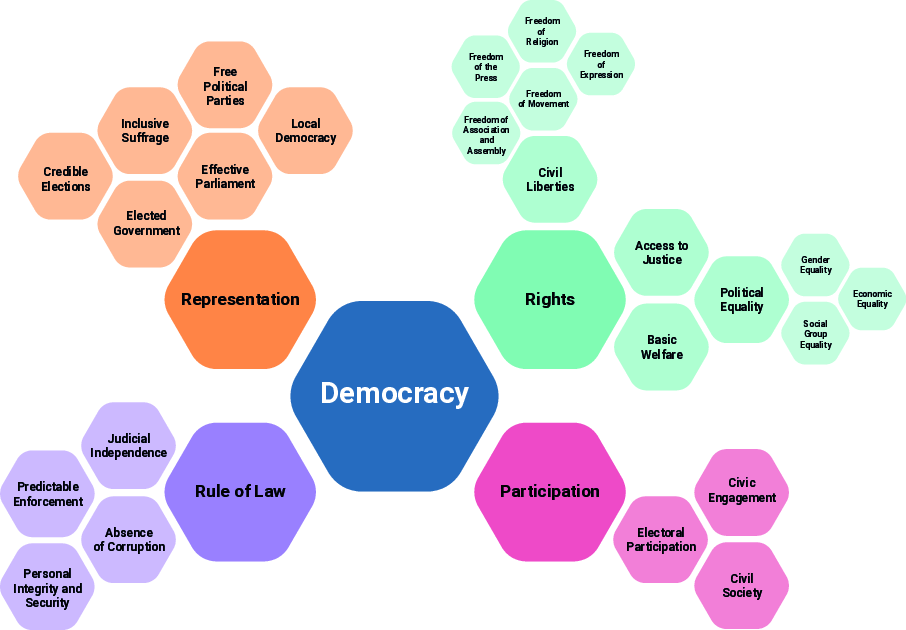
| English | Arabic | French | Russian | Spanish |
|---|---|---|---|---|
| Access to justice | الوصول الى العدالة | Accès à la justice | Доступ к правосудию | Acceso a la justicia |
| Civil society | المجتمع المدني | Société civile | Гражданское общество | Sociedad civil |
| Corruption | فساد | Corruption | Коррупция | Corrupción |
| Democracy/Democratic | ديمقراطية / ديمقراطي | Démocratie/Démocratique | Демократия/демократический | Democracia/Democrático/Democrática |
| Election/Elections | انتخاب/انتخابات | Élection/élections | Выборы | Elección/elecciones |
| Fundamental freedoms | الحريات الأساسية | Libertés fondamentales | Основные свободы | Libertades fundamentales |
| Human rights | حقوق الانسان | Droits humains | Права человека | Derechos humanos |
| Political parties | احزاب سياسية | Partis politiques | Политические партии | Partidos políticos |
| Political participation | المشاركة السياسية | Participation politique | Политическое участие | Participación política |
| Political representation | التمثيل السياسي | Représentation politique | Политическое представительство | Representación política |
| Press freedom/Freedom of the press | حرية الصحافة | Liberté de la presse | Свобода прессы | Libertad de prensa |
| Rule of law | سيادة القانون | L’État de droit | Верховенство закона | Estado de derecho |
Angola, Republic of, ‘Voluntary National Review on the Implementation of the 2030 Agenda for Sustainable Development’, 2021, <https://hlpf.un.org/countries/angola/voluntary-national-review-2021>, accessed 17 December 2025
Argentina, ‘Tercer Informe Voluntario Nacional: Argentina 2022’ [Third Voluntary National Review], 2022, <https://hlpf.un.org/countries/argentina/voluntary-national-review-2022>, accessed 20 December 2025
Armenia, Republic of, ‘Armenia’s 3rd Voluntary National Review 2024’, 2024, <https://hlpf.un.org/countries/armenia/voluntary-national-reviews-2024>, accessed 20 December 2025
Austria, Republic of, ‘Austria and the 2030 Agenda: 2nd Austrian Voluntary National Review on the Implementation of the 2030 Agenda for Sustainable Development and the SDGs’, 2024, <https://hlpf.un.org/countries/austria/voluntary-national-reviews-2024>, accessed 15 December 2025
Bangladesh, People’s Republic of, ‘Bangladesh Voluntary National Review (VNR) 2025’, 2025, <https://hlpf.un.org/countries/bangladesh/voluntary-national-review-2025>, accessed 18 December 2025
Belgium, Kingdom of, ‘Pathways to Sustainable Development: First Belgian Voluntary National Review on the Implementation of the 2030 Agenda’, 2017, <https://hlpf.un.org/countries/belgium/voluntary-national-review-2017>, accessed 13 December 2025
Belize, ‘Belize’s Voluntary National Review for the Sustainable Development Goals 2017: Eradicating Poverty and Promoting Prosperity in a Changing World’, 2017, <https://hlpf.un.org/countries/belize/voluntary-national-review-2017>, accessed 10 December 2025
Bhutan, Kingdom of, ‘Transformations for Sustainable Development in the 21st Century: Bhutan’s Second Voluntary National Review Report on the Implementation of the 2030 Agenda for Sustainable Development’, 2021, <https://hlpf.un.org/countries/bhutan/voluntary-national-review-2021>, accessed 15 December 2025
Bosnia and Herzegovina, ‘Voluntary Review: Implementation of Agenda 2030 and the Sustainable Development Goals in Bosnia and Herzegovina’, 2023, <https://hlpf.un.org/countries/bosnia-and-herzegovina/voluntary-national-reviews-2023>, accessed 14 December 2025
Brazil, Federative Republic of, ‘Voluntary National Review on the Sustainable Development Goals’, 2017, <https://hlpf.un.org/countries/brazil/voluntary-national-review-2017>, accessed 10 December 2025
Burkina Faso, ‘Rapport National Volontaire 2016-2022’ [Voluntary National Review 2016–2022], 2023, <https://hlpf.un.org/countries/burkina-faso/voluntary-national-review-2023>, accessed 20 December 2025
Cabo Verde, Republic of, ‘Voluntary National Review on the Implementation of the 2030 Agenda for Sustainable Development’, 2021, <https://hlpf.un.org/countries/cabo-verde/voluntary-national-review-2021>, accessed 15 December 2025
Cambodia, Kingdom of, ‘Cambodia’s Voluntary National Review 2019 on the Implementation of the 2030 Agenda for Sustainable Development’, 2019, <https://hlpf.un.org/countries/cambodia/voluntary-national-review-2019>, accessed 10 December 2025
Chad, Republic of, ‘Examen National Volontaire des ODD : «Le Tchad que Nous Voulons a l’Horizon 2030»’ [Voluntary National Review of the SDGs: ‘The Chad We Want by 2030’], 2024, <https://hlpf.un.org/countries/chad/voluntary-national-reviews-2024>, accessed 10 December 2025
Chile, Republic of, ‘Informe Nacional Voluntario: Consejo Nacional para la Implementación de la Agenda 2030 y el Desarrollo Sostenible’ [Voluntary National Review: National Council for the Implementation of the 2030 Agenda and Sustainable Development], 2017, <https://hlpf.un.org/countries/chile/voluntary-national-review-2017>, accessed 20 December 2025
—, ‘Informe Nacional Voluntario: Chile 2019’ [Voluntary National Review: Chile 2019], 2019, <https://hlpf.un.org/countries/chile/voluntary-national-review-2019>, accessed 14 December 2025
Costa Rica, Republic of, ‘III Informe Nacional Voluntario: Costa Rica 2024’ [3rd Voluntary National Review: Costa Rica 2024], 2024, <https://hlpf.un.org/countries/costa-rica/voluntary-national-reviews-2024>, accessed 10 December 2025
Cram, S., SDG 16 as an Enabler of the 2030 Agenda, Policy Paper No. 32 (Stockholm: International IDEA, 2024), <https://doi.org/10.31752/idea.2024.47>
Croatia, Republic of, ‘Voluntary National Review of the Implementation of the United Nations 2030 Agenda for Sustainable Development’, 2023, <https://hlpf.un.org/countries/croatia/voluntary-national-reviews-2023>, accessed 11 December 2025
Cyprus, Republic of, ‘Review on the Implementation of the 2030 Agenda in Cyprus’, 2017,<https://hlpf.un.org/countries/cyprus/voluntary-national-review-2017>, accessed 13 December 2025
Czech Republic, ‘Second Voluntary National Review of the 2030 Agenda in the Czech Republic’, 2021, <https://hlpf.un.org/countries/czech-republic/voluntary-national-review-2021>, accessed 14 December 2025
—, ‘Voluntary National Review of the 2030 Agenda: Czech Republic 2025’, 2025, <https://hlpf.un.org/countries/czech-republic/voluntary-national-review-2025>, accessed 16 December 2025
Denmark, Kingdom of, ‘Report for the Voluntary National Review: Denmark’s Implementation of the 2030 Agenda for Sustainable Development’, 2017, <https://hlpf.un.org/countries/denmark/voluntary-national-review-2017>, accessed 10 December 2025
Dominican Republic, ‘Informe Nacional Voluntario: Crecimiento con Equidad y Respeto al Medioambiente’ [Voluntary National Review: Growth with Equity and Respect for the Environment], 2021, <https://hlpf.un.org/countries/dominican-republic/voluntary-national-review-2021>, accessed 20 December 2025
—, ‘Informe Nacional Voluntario: Avances hacia el Bienestar, la Equidad y las Alianzas para el Desarrollo Sostenible’ [Voluntary National Review: Progress towards Well-being, Equity and Partnerships for Sustainable Development], 2025, <https://hlpf.un.org/countries/dominican-republic/voluntary-national-reviews-2025>, accessed 20 December 2025
Ethiopia, Federal Democratic Republic of, ‘Ethiopia: The Third Voluntary National Review 2025’, 2025, <https://hlpf.un.org/countries/ethiopia/voluntary-national-reviews-2025>, accessed 21 December 2025
Finland, Republic of, ‘National Report on the Implementation of the 2030 Agenda for Sustainable Development: Finland’, 2016, <https://hlpf.un.org/countries/finland/voluntary-national-review-2016>, accessed 10 December 2025
—, ‘Progress towards Shared Wellbeing of People and Planet: Voluntary National Review 2025 Finland – Report on the Implementation of the 2030 Agenda for Sustainable Development’, 2025, <https://hlpf.un.org/countries/finland/voluntary-national-review-2025>, accessed 11 December 2025
Gambia, Republic of The, ‘The Gambia: Voluntary National Review – A Report on the Progress of Implementation of SDGs’, 2020, <https://hlpf.un.org/countries/gambia/voluntary-national-review-2020>, accessed 15 December 2025
—, ‘The Gambia: Voluntary National Review Report on the Implementation of the 2030 Agenda for Sustainable Development’, 2022, <https://hlpf.un.org/countries/gambia/voluntary-national-review-2022>, accessed 11 December 2025
Georgia, ‘First Voluntary National Review on Implementation of the Sustainable Development Goals’, 2016, <https://hlpf.un.org/countries/georgia/voluntary-national-review-2016>, accessed 10 December 2025
—, ‘Voluntary National Review: Georgia’, 2024, <https://hlpf.un.org/countries/georgia/voluntary-national-reviews-2024>, accessed 11 December 2025
Germany, Federal Republic of, ‘Report of the German Federal Government to the High-Level Political Forum on Sustainable Development 2016’, 2016, <https://hlpf.un.org/countries/germany/voluntary-national-review-2016>, accessed 11 December 2025
—, ‘Report on the Implementation of the 2030 Agenda for Sustainable Development: German Voluntary National Review to the HLPF 2021’, 2021, <https://hlpf.un.org/countries/germany/voluntary-national-review-2021>, accessed 10 December 2025
Ghana, Republic of, ‘Ghana: Voluntary National Review Report on the Implementation of the 2030 Agenda for Sustainable Development’, 2019, <https://hlpf.un.org/countries/ghana/voluntary-national-review-2019>, accessed 13 December 2025
Greece, ‘Voluntary National Review 2022 on the Implementation of the 2030 Agenda for Sustainable Development’, 2022, <https://hlpf.un.org/countries/greece/voluntary-national-review-2022>, accessed 20 December 2025
Guinea-Bissau, Republic of, ‘Examen Nationale Volontaire : République de Guinée-Bissau 2022’ [Voluntary National Review: Republic of Guinea-Bissau 2022], 2022, <https://hlpf.un.org/countries/guinea-bissau/voluntary-national-review-2022>, accessed 15 December 2025
Honduras, Republic of, ‘II Informe Nacional Voluntario de la Agenda 2030: De la Recuperación al Desarrollo Sostenible’ [2nd Voluntary National Review of the 2030 Agenda: From Recovery to Sustainable Development], 2020, <https://hlpf.un.org/countries/honduras/voluntary-national-review-2020>, accessed 15 December 2025
Iceland, ‘Iceland's Implementation of the 2030 Agenda for Sustainable Development: Voluntary National Review’, 2019, <https://hlpf.un.org/countries/iceland/voluntary-national-review-2019>, accessed 18 December 2025
India, Republic of, ‘Decade of Action Taking SDGs from Global to Local: India Voluntary National Review 2020’, 2020, <https://hlpf.un.org/countries/india/voluntary-national-review-2020>, accessed 14 December 2025
Indonesia, Republic of, ‘Indonesia’s Voluntary National Review 2021: Sustainable and Resilient Recovery from the COVID-19 Pandemic for the Achievement of the 2030 Agenda’, 2021, <https://hlpf.un.org/countries/indonesia/voluntary-national-review-2021>, accessed 17 December 2025
—, ‘Voluntary National Review. Fostering Inclusive Growth: Advancing Sustainable and Resilient Indonesia’, 2025, <https://hlpf.un.org/countries/indonesia/voluntary-national-reviews-2025>, accessed 20 December 2025
Inter-Agency and Expert Group on SDG Indicators (IAEG-SDGs), ‘Lessons from a Decade of Sustainable Development Goal Monitoring’, March 2026, <https://unstats.un.org/UNSDWebsite/statcom/session_57/documents/BG-3k-Lessons_from_a_Decade_of_Sustainable_Development_Goal_Monitoring-E.pdf>, accessed 18 March 2026
International IDEA, Global State of Democracy Indices, 1975–2024, v.9 [data set], [n.d.], <https://www.idea.int/democracytracker/gsod-indices>, accessed 10 December 2025
—, The Global State of Democracy 2024: Strengthening the Legitimacy of Elections in a Time of Radical Uncertainty (Stockholm: International IDEA, 2024), <https://doi.org/10.31752/idea.2024.55>
—, The Global State of Democracy 2025: Democracy on the Move (Stockholm: International IDEA, 2025), <https://doi.org/10.31752/idea.2025.53>
Iraq, Republic of, ‘First National Voluntary Review on Sustainable Development Goals: The Triumph of National Will’, 2019, <https://hlpf.un.org/countries/iraq/voluntary-national-review-2019>, accessed 21 December 2025
Ireland, ‘Ireland: Voluntary National Review 2018 – Report on the Implementation of the 2030 Agenda to the UN High-Level Political Forum on Sustainable Development’, 2018, <https://hlpf.un.org/countries/ireland/voluntary-national-review-2018>, accessed 10 December 2025
Israel, State of, ‘Implementation of the Sustainable Development Goals: National Review – Israel 2019’, 2019, <https://hlpf.un.org/countries/israel/voluntary-national-review-2019>, accessed 17 December 2025
Japan, ‘Voluntary National Review 2025: Report on the Implementation of 2030 Agenda – Japan’, 2025, <https://hlpf.un.org/countries/japan/voluntary-national-reviews-2025>, accessed 21 December 2025
Kazakhstan, Republic of, ‘Third Voluntary National Review of the Implementation of the 2030 Agenda for Sustainable Development’, 2025, <https://hlpf.un.org/countries/kazakhstan/voluntary-national-reviews-2025>, accessed 16 December 2025
Kenya, Republic of, ‘Implementation of the 2030 Agenda for Sustainable Development in Kenya’, 2017, <https://hlpf.un.org/countries/kenya/voluntary-national-review-2017>, accessed 10 December 2025
Libya, State of, ‘الاستعراض الوطني الطوعي الثاني ليبيا 2024 المتابعة تحقيق أهداف التنمية المستدامة 2030’ [Libya’s Second Voluntary National Review 2024: Follow-up to Achieving the 2030 Sustainable Development Goals], 2024, <https://hlpf.un.org/countries/libya/voluntary-national-reviews-2024>, accessed 21 December 2025
Maldives, Republic of, ‘Voluntary National Review for the High Level Political Forum on Sustainable Development 2017’, 2017, <https://hlpf.un.org/countries/maldives/voluntary-national-review-2017>, accessed 10 December 2025
Mauritania, Islamic Republic of, ‘Revue Nationale Volontaire des Objectifs de Développement Durable 2024’ [Voluntary National Review of the Sustainable Development Goals 2024], 2024, <https://hlpf.un.org/countries/mauritania/voluntary-national-reviews-2024>, accessed 15 December 2025
Mauritius, Republic of, ‘Voluntary National Review Report of Mauritius 2019’, 2019, <https://hlpf.un.org/countries/mauritius/voluntary-national-review-2019>, accessed 18 December 2025
Micronesia, Federated States of, ‘Federated States of Micronesia: Second Voluntary National Review 2025’, 2025, <https://hlpf.un.org/countries/micronesia/voluntary-national-reviews-2025>, accessed 16 December 2025
Morocco, Kingdom of, ‘Examen National Volontaire de la Mise en Œuvre des Objectifs de Développement Durable’ [Voluntary National Review of the Implementation of the Sustainable Development Goals], 2020, <https://hlpf.un.org/countries/morocco/voluntary-national-review-2020>, accessed 21 December 2025
Namibia, Republic of, ‘Namibia’s 3rd Voluntary National Review Report: Progress on the Implementation of the Sustainable Development Goals towards Agenda 2030’, 2024, <https://hlpf.un.org/countries/namibia/voluntary-national-reviews-2024>, accessed 19 December 2025
Nepal, Federal Democratic Republic of, ‘National Review of Sustainable Development Goals’, 2017, <https://hlpf.un.org/countries/nepal/voluntary-national-review-2017>, accessed 21 December 2025
—, ‘National Review of Sustainable Development Goals’, 2020, <https://hlpf.un.org/countries/nepal/voluntary-national-review-2020>, accessed 10 December 2025
Netherlands, Kingdom of the, ‘Report on the Implementation of the Sustainable Development Goals’, 2017, <https://hlpf.un.org/countries/netherlands/voluntary-national-review-2017>, accessed 18 December 2025
New Zealand, ‘Towards a Better Future, Together: New Zealand’s Progress towards the SDGs – 2019’, 2019, <https://hlpf.un.org/countries/new-zealand/voluntary-national-review-2019>, accessed 10 December 2025
Nigeria, Federal Republic of, ‘Nigeria’s Third Voluntary National Review: A Whole-of-Society Perspective on the Sustainable Development Goals’, 2025, <https://hlpf.un.org/countries/nigeria/voluntary-national-reviews-2025>, accessed 16 December 2025
Oman, Sultanate of Oman, ‘التقرير الوطني الطوعي حالة التنمية المستدامة المنتدى السياسي رفيع المستوى يوليو ٢٠٢٤’ [Voluntary National Report on the State of Sustainable Development, High-Level Political Forum July 2024], 2024, <https://hlpf.un.org/countries/oman/voluntary-national-reviews-2024>, accessed 10 December 2025
Papua New Guinea, Independent State of, ‘Papua New Guinea’s Voluntary National Review 2020: Progress of Implementing the Sustainable Development Goals’, 2020, <https://hlpf.un.org/countries/papua-new-guinea/voluntary-national-review-2020>, accessed 10 December 2025
—, ‘Papua New Guinea’s Second Voluntary National Review 2025 on the Progress of Implementing the Sustainable Development Goals’, 2025, <https://hlpf.un.org/countries/papua-new-guinea/voluntary-national-review-2025>, accessed 16 December 2025
Portugal, ‘National Report on the Implementation of the 2030 Agenda for Sustainable Development’, 2017, <https://hlpf.un.org/countries/portugal/voluntary-national-review-2017>, accessed 21 December 2025
Qatar, State of, ‘Qatar Voluntary National Review 2021: Report on the Implementation of the 2030 Agenda for Sustainable Development’, 2021, <https://hlpf.un.org/countries/qatar/voluntary-national-review-2021>, accessed 15 December 2025
Samoa, Independent State of, ‘Samoa’s Second Voluntary National Review on the Implementation of the Sustainable Development Goals’, 2020, <https://hlpf.un.org/countries/samoa/voluntary-national-review-2020>, accessed 20 December 2025
SDG 16 Data Initiative, Promoting Progress on SDG 16 and SDG 5 as Pathways to Inclusive Social Development (2025), <https://www.idea.int/un-and-democracy/library/sdg-16-data-initiative-report-2025>, accessed 18 March 2026
Senegal, Republic of, ‘Objectifs de Développement Durable : Revue Nationale Volontaire – Rapport Final’ [Sustainable Development Goals: Voluntary National Review – Final Report], 2018, <https://hlpf.un.org/countries/senegal/voluntary-national-review-2018>, accessed 10 December 2025
Seychelles, Republic of, ‘Voluntary National Review 2025: Republic of Seychelles’, 2025, <https://hlpf.un.org/countries/seychelles/voluntary-national-review-2025>, accessed 18 December 2025
Sierra Leone, Republic of, ‘Sierra Leone 2024 Voluntary National Review Report: Implementation of the Sustainable Development Goals in Sierra Leone’, 2024, <https://hlpf.un.org/countries/sierra-leone/voluntary-national-reviews-2024>, accessed 11 December 2025
Sood, P., Mcmillon, J. and Ukre, T., 2025 Voluntary National Reviews through the Lens of Peaceful, Just and Strong Institutions (New York: United Nations Development Programme, 2025), <https://www.undp.org/publications/2025-voluntary-national-reviews-through-lens-peaceful-just-and-strong-institutions>, accessed 10 December 2025
Spain, Kingdom of, ‘Examen Nacional Voluntario 2024 sobre la Implementación de la Agenda 2030: Un País Comprometido con los Derechos Humanos y el Bienestar Colectivo’ [2024 Voluntary National Review on the Implementation of the 2030 Agenda: A Country Committed to Human Rights and the Common Good], 2024, <https://hlpf.un.org/countries/spain/voluntary-national-reviews-2024>, accessed 21 December 2025
Suriname, Republic of, ‘Suriname Second Voluntary National Review’, 2025, <https://hlpf.un.org/countries/suriname/voluntary-national-reviews-2025>, accessed 14 December 2025
Sweden, Kingdom of, ‘Sweden and the 2030 Agenda: Report to the UN High Level Political Forum 2017 on Sustainable Development’, 2017, <https://hlpf.un.org/countries/sweden/voluntary-national-review-2017>, accessed 18 December 2025
—, ‘Voluntary National Review 2021: Sweden – Report on the Implementation of the 2030 Agenda for Sustainable Development’, 2021, <https://hlpf.un.org/countries/sweden/voluntary-national-review-2021>, accessed 15 December 2025
Swiss Confederation, ‘Implementing the 2030 Agenda for Sustainable Development: Voluntary National Review of Switzerland 2022’, 2022, <https://hlpf.un.org/countries/switzerland/voluntary-national-review-2022>, accessed 10 December 2025
Timor-Leste, ‘Report on the Implementation of the Sustainable Development Goals: From Ashes to Reconciliation, Reconstruction and Sustainable Development – Voluntary National Review of Timor-Leste 2019’, 2019, <https://hlpf.un.org/countries/timor-leste/voluntary-national-review-2019>, accessed 13 December 2025
Tunisia, Republic of, ‘Rapport National Volontaire sur la Mise en Œuvre des Objectifs de Développement Durable’ [Voluntary National Review on the Implementation of the Sustainable Development Goals], 2019, <https://hlpf.un.org/countries/tunisia/voluntary-national-review-2019>, accessed 10 December 2025
—, ‘Rapport National Volontaire sur la Mise en Œuvre des Objectifs de Développement Durable en Tunisie’ [Voluntary National Review on the Implementation of the Sustainable Development Goals in Tunisia], 2021, <https://hlpf.un.org/countries/tunisia/voluntary-national-review-2021>, accessed 10 December 2025
Ukraine, ‘Sustainable Development Goals Ukraine: Voluntary National Review’, 2020, <https://hlpf.un.org/countries/ukraine/voluntary-national-review-2020>, accessed 21 December 2025
United Nations Development Programme (UNDP) and World Bank Group, ‘Transitioning from the MDGs to the SDGs’, 9 November 2016, <https://www.undp.org/publications/transitioning-mdgs-sdgs>, accessed 18 March 2026
United Nations Development Programme (UNDP), United Nations High Commissioner for Human Rights (OHCHR) and United Nations Office on Drugs and Crime (UNODC), ‘Global Progress Report on Sustainable Development Goal 16: Indicators on Peaceful, Just and Inclusive Societies’, 23 September 2025, <https://www.undp.org/policy-centre/governance/publications/global-progress-report-sustainable-development-goal-16-indicators-peaceful-just-and-inclusive-societies>, accessed 10 December 2025
United Nations General Assembly, Resolution Adopted by the General Assembly on 25 September 2015 [Transforming Our World: The 2030 Agenda for Sustainable Development], A/RES/70/1, 21 October 2015, <https://docs.un.org/en/A/RES/70/1>, accessed 10 December 2025
United Nations High-Level Political Forum on Sustainable Development, High-Level Political Forum, [n.d.a], <https://hlpf.un.org/>, accessed 13 January 2026
—, Voluntary National Reviews, [n.d.b], <https://hlpf.un.org/vnrs>, accessed 13 January 2026
Uruguay, Oriental Republic of, ‘Informe Nacional Voluntario – Uruguay 2017’ [Voluntary National Review – Uruguay 2017], 2017, <https://hlpf.un.org/countries/uruguay/voluntary-national-review-2017>, accessed 15 December 2025
—, ‘Objetivos de Desarrollo Sostenible: Informe Nacional Voluntario – Uruguay 2022’ [Sustainable Development Goals: Voluntary National Review – Uruguay 2022], 2022, <https://hlpf.un.org/countries/uruguay/voluntary-national-review-2022>, accessed 15 December 2025
Venezuela, Bolivarian Republic of, ‘Presentación Nacional Voluntaria (PVN) ante el Foro Político de Alto Nivel sobre Desarrollo Sustentable (FPAN) de Naciones Unidas’ [National Voluntary Review to the United Nations High-Level Political Forum on Sustainable Development], 2016, <https://hlpf.un.org/countries/venezuela/voluntary-national-review-2016>, accessed 10 December 2025
Zambia, Republic of, ‘Zambia’s Voluntary National Review 2023: Accelerating the Recovery from the Coronavirus Disease (COVID-19) and the Full Implementation of the 2030 Agenda for Sustainable Development at All Levels’, 2023, <https://hlpf.un.org/countries/zambia/voluntary-national-review-2023>, accessed 14 December 2025
Amanda Sourek is the United Nations Liaison for International IDEA in New York, where she engages with UN Member States and in multilateral processes. Her portfolio includes outreach and relationship building with permanent missions, engagement in UN negotiations and resolutions, drafting and delivery of official statements, and the development of strategic partnerships with UN entities and like-minded organizations.
She coordinates the SDG 16 Data Initiative, a global consortium of 18 organizations working to track progress on Sustainable Development Goal 16 through non-official data, and represents International IDEA on the Steering Committee of the SDG16+ Coalition.
Amanda also leads the UN and Democracy Hub, a user-friendly digital knowledge platform that serves as a one-stop resource for data, analysis and policy-relevant materials on democracy-related issues.
- The Millennium Development Goals (MDGs), adopted in 2000, consisted of eight time-bound goals aimed mainly at reducing extreme poverty, improving health and education, and tackling basic development issues in low-income countries by 2015. In contrast, the Sustainable Development Goals (SDGs), adopted in 2015 as part of the 2030 Agenda for Sustainable Development, include 17 broader and more interconnected goals that apply globally to all countries, addressing not only poverty but also inequality, climate change, environmental sustainability, peace and governance. Unlike the MDGs, which were mostly developed by a small group of international actors, the SDGs came from an extensive, participatory global consultation process and highlight the connections between economic, social and environmental aspects of development, along with the principle of ‘leaving no one behind’ (United Nations General Assembly 2015; UNDP and World Bank Group 2016; IAEG-SDGs 2026).
- According to the official records from 2025, only 47 countries submitted VNRs in 2019, but Uruguay provided a written report for the year, despite not presenting its findings at the HLPF. Therefore, Uruguay's 2019 VNR report was utilized in this analysis as an additional resource since it was available on the UN website when resources were retrieved for this report in 2024 and 2025.
- The VNRs presented between 2016 and 2024 were collected from February to July 2024. The VNRs presented in 2025 were collected in July 2025.
- At the time of data collection for this report, the 2021 VNR of the Bahamas was not available on the UN website. However, the report is now accessible to the public, but its findings were not included in this report’s quantitative or qualitative analysis.
- In this report, inverted commas are used when referring to keywords (e.g. ‘democracy’), to distinguish the terms from their broader associated concepts.
- The data used in this report from International IDEA’s Global State of Democracy Indices is from 2024.
- The Kingdom of the Netherlands and its four autonomous countries include Aruba, Curaçao, the Netherlands and Sint Maarten.
Abbreviations
| CSO | Civil society organization |
|---|---|
| GSoD | Global State of Democracy |
| HLPF | High-Level Political Forum |
| MDG | Millennium Development Goal |
| SDG | Sustainable Development Goal |
| VNR | Voluntary national review |
This report is dedicated to all those who have served in the International Institute for Democracy and Electoral Assistance’s (International IDEA) New York office, advancing the organization’s commitment to democracy within the United Nations system and worldwide. Their tireless efforts to foster meaningful change within a complex multilateral environment merit recognition and appreciation. At a time when democratic values face growing challenges and backsliding in many parts of the world, their dedication, professionalism and steadfast belief in democratic principles have been especially vital. It is through the commitment and perseverance of these individuals that this work has ensured that democracy remains a living and enduring presence within the UN year after year.
This report was conceptualized and written by Amanda Sourek. The author would like to sincerely thank the peer reviewers of this paper, who deserve recognition for their invaluable input. These include Elisenda Balleste Buxo (International IDEA), Stacey Cram (New York University Center on International Cooperation), Alessandro Ercolani (UN Development Programme), Kathryn Grace Hulseman (World Justice Project), Tracy Jooste (Results for Development), Simeon Lauterbach (Organisation for Economic Co-operation and Development), Toby Mendel (Centre for Law and Democracy), Emma Phillips (Organisation for Economic Co-operation and Development), Annika Silva-Leander (International IDEA), Massimo Tommasoli (International IDEA), Peter van Sluijs (Civil Society Platform for Peacebuilding and Statebuilding), Callum Watson (Small Arms Survey), Alexandra Wilde (UN Development Programme) and Margaret Williams (Pathfinders for Peaceful, Just and Inclusive Societies and New York University Center on International Cooperation).
The author would also like to thank Curtis Budden for copyediting the report, Stephanie Huitson for proofreading it, and Lisa Hagman for her editorial guidance and support in designing the report.


© 2026 International Institute for Democracy and Electoral Assistance
International IDEA publications are independent of specific national or political interests. Views expressed in this publication do not necessarily represent the views of International IDEA, its Board or its Council members.
With the exception of any third-party images and photos, the electronic version of this publication is available under a Creative Commons Attribution-NonCommercial-ShareAlike 4.0 (CC BY-NC-SA 4.0) licence. You are free to copy, distribute and transmit the publication as well as to remix and adapt it, provided it is only for non-commercial purposes, that you appropriately attribute the publication, and that you distribute it under an identical licence. For more information visit the Creative Commons website: <http://creativecommons.org/licenses/by-nc-sa/4.0>.
Design and layout: International IDEA
Cover illustration: Generated with ChatGPT
DOI: <https://doi.org/10.31752/18692>
ISBN: 978-91-8137-156-7 (HTML)
ISBN: 978-91-8137-155-0 (PDF)


