


Climate Litigation and Democracy in Bangladesh
Case Study, September 2026

Executive Summary
This case study examines the prospective role of climate litigation in Bangladesh from a democratic governance perspective, using the Barind context as a forward-looking one. It considers how litigation could contribute to access to justice, accountability, participation, and constitutional implementation where slow-onset climate- and water-related pressures intersect with existing inequalities and governance challenges.
The Barind context is particularly relevant because recurrent drought, groundwater stress, and livelihood pressures interact with agricultural dependence, resource management decisions, and unequal access to institutional support. These pressures cannot be attributed to climate change alone; they arise from the interaction of climatic, hydrological, and water-management factors, including dependence on groundwater for irrigation and continued abstraction. The democratic significance of potential litigation therefore lies not only in obtaining judicial remedies, but also in whether legal processes can make affected communities more visible in public decision-making and strengthen institutional accountability.
Bangladesh is yet to expressly frame a court case as climate litigation arising from the Barind context. Its established environmental public-interest litigation jurisprudence nevertheless provides potential legal pathways. Article 32 of the Constitution has provided a basis for environmental and water-related claims while the High Court Division’s 2025 judgment in Suo-Motu Rule No. 09/2020 recognized access to adequate, safe, and clean water as inherent in the constitutional right to life. Article 18A directs the state to protect and improve the environment and safeguard natural resources for present and future citizens, although it is a Fundamental Principle of State Policy rather than a directly enforceable fundamental right. The Bangladesh Water Act, 2013, provides an additional statutory framework for water resource management.
From a democratic perspective, future climate litigation could widen access to justice and strengthen public accountability where administrative mechanisms prove inadequate. At the same time, litigation may raise questions concerning the separation of powers, the relationship between judicial review and policymaking, and the extent to which legal and technical processes incorporate community knowledge and experience. These considerations are prospective rather than established consequences of climate litigation in Bangladesh. The democratic contribution of future litigation will therefore depend on meaningful participation, effective implementation, and its relationship with broader processes of public governance.
Introduction
This case study examines prospective climate litigation in Bangladesh and its implications for democratic governance, with particular attention to the Barind Tract in northwestern Bangladesh. The analysis focuses on slow-onset pressures associated with drought, groundwater stress, and livelihood insecurity and considers how these pressures may intersect with constitutional guarantees relating to life, equality, and environmental protection.
The study is forward-looking. It does not analyze an existing Barind climate litigation case. Instead, it uses the Barind context to identify legal pathways that could become relevant as climate- and water-related pressures intensify and to consider the democratic opportunities and institutional limitations associated with bringing such claims before courts.
Drawing on Let the Courts Decide? The Potential and Limitations of Climate Litigation from a Democracy Perspective (Poletto and Hickey 2025), the study considers four interconnected dimensions: access to justice and inclusion; participation and representation; accountability and transparency; and constitutional implementation and rights protection. It emphasizes that climate litigation can complement political and administrative action by strengthening accountability, visibility, and public debate, while also raising questions concerning judicial authority, democratic decision-making, and implementation.
Methodologically, the study adopts a qualitative approach combining desk-based legal and policy analysis with field research and stakeholder consultations. The desk-based analysis examines constitutional provisions, legislation, policies, and environmental jurisprudence relevant to climate- and water-related claims. The empirical component draws on field research undertaken in climate-vulnerable communities experiencing water scarcity in selected areas of Rajshahi District, including Uchadanga village in Badhair Union and Kolma Union under Tanore Upazila. Approximately 30 structured and semi-structured interviews were conducted with affected community members, supplemented by consultations with legal experts, government officials, and civil society actors. Focus group discussions undertaken in October 2025 also informed the analysis of community experiences of water scarcity, agricultural pressures, and livelihood impacts.
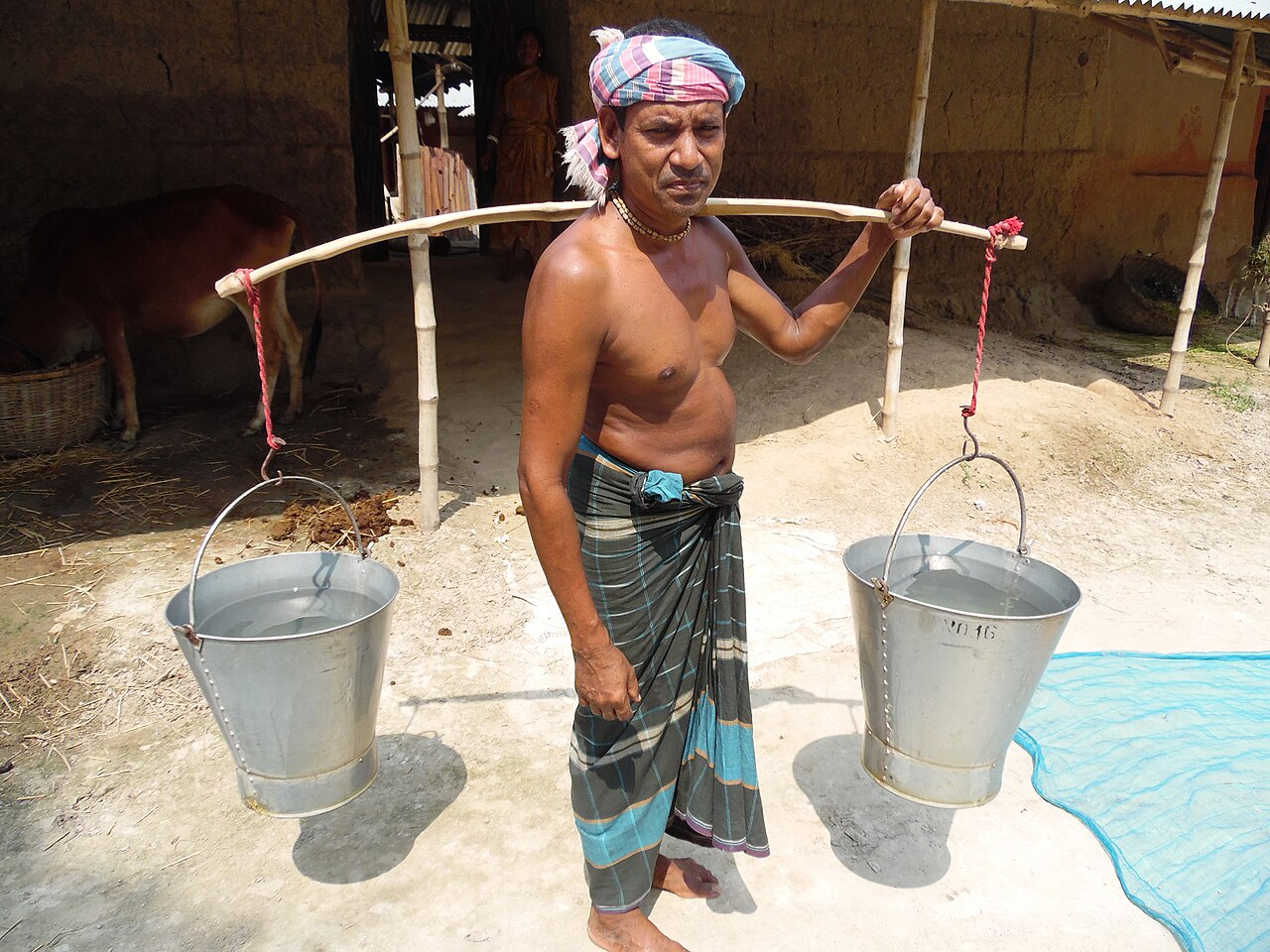
The field-based material indicates concerns relating to declining groundwater availability, increasing difficulty in accessing water for irrigation and household use, rising agricultural costs, and the effects of prolonged dry periods on farming and livelihoods. Participants also described consequences for household income and food security, particularly among households with fewer resources to cope with prolonged water stress. These observations are used in this study as contextual and empirical material rather than as generalized findings applicable to all communities in the Barind.

1. Climate Vulnerability and Governance in the Barind Tract
Bangladesh remains highly vulnerable to climate change, including slow-onset impacts such as drought, groundwater stress, and ecosystem degradation. Its national adaptation framework is anchored in the National Adaptation Plan of Bangladesh (2023–2050), approved in 2022, and complemented by Bangladesh's Third Nationally Determined Contribution (NDC 3.0), submitted to the United Nations Framework Convention on Climate Change (UNFCCC) in September 2025. The National Adaptation Plan of Bangladesh (2023–2050) identifies national adaptation priorities across sectors, while NDC 3.0 sets Bangladesh’s mitigation- and adaptation-related climate commitments through 2035 (Government of Bangladesh 2022, 2025).
The existence of national policies does not necessarily ensure effective implementation at the local level. Bangladesh’s environmental governance framework continues to face institutional and administrative constraints, including weaknesses in coordination, environmental data management, monitoring, enforcement, and institutional capacity. The World Bank’s Building Back a Greener Bangladesh: Country Environmental Analysis 2023 identifies shortcomings in inter-agency coordination, organizational capacity and environmental information systems and examines accountability, transparency, and public participation within the environmental governance framework (World Bank 2024).
Adaptation planning also requires effective links between policy priorities, investment, and implementation. The Asian Development Bank (ADB) has emphasized the importance of integrating climate risks into development planning and budgeting in Bangladesh, to mobilize climate finance, and to strengthen institutional capacity to implement and monitor adaptation measures (Perveen et al. 2023). These institutional and financial dimensions are relevant to the Barind because responses to groundwater stress and drought require sustained action rather than isolated interventions.
In the Barind Tract, drought and groundwater depletion arise from interacting climatic, hydrological, and water-management pressures. Recurrent dry conditions, groundwater-dependent irrigation, and continued abstraction place sustained pressure on water availability and agricultural livelihoods. These pressures cannot be attributed to climate variability alone; they also reflect increasing water demand and existing approaches to groundwater management (Sarker et al. 2026). The Bangladesh Water Act, 2013, provides a framework for the integrated development, management, use, protection, and conservation of water resources, while the Groundwater Management for Agricultural Purposes Act, 2018, addresses groundwater use for agricultural purposes.1
From a governance perspective, the central concern is therefore how climate risks interact with existing resource use patterns and institutional decision-making. This includes whether water-related decisions adequately address drought, groundwater depletion, and agricultural demand, and whether affected communities have meaningful opportunities to obtain information, participate in relevant processes, and seek accountability.
Community participation is consequently an important dimension of water governance in the Barind. Communities are directly affected by decisions concerning groundwater extraction, irrigation, agricultural production, and water allocation. Meaningful participation can also bring locally grounded knowledge into processes that may otherwise rely primarily on administrative or technical assessments.
These pressures do not affect all groups in the same way. Vulnerability is shaped not only by exposure to drought and water scarcity but also by differences in access to land, water, livelihoods, information, institutional support, and decision-making. Indigenous communities, women, and rural youth may therefore experience climate- and water-related pressures differently because of their particular social, economic, and livelihood circumstances.
Climate vulnerability in the Barind should consequently be understood as both an environmental and governance concern. The effectiveness of the legal and institutional framework, the manner in which water and adaptation decisions are made, and the ability of affected groups to participate in and seek accountability through these processes are central to understanding the region’s capacity to respond to climate-related pressures.
2. Democratic Implications for Affected Groups
Indigenous Peoples and Customary Governance
Indigenous communities in the Barind region, including Santal, Munda, and Oraon communities,2 experience climate- and water-related pressures alongside challenges relating to livelihoods, land and resource access, social inclusion, and participation in local governance. These pressures interact with existing patterns of agricultural dependence, resource scarcity, land insecurity, and socioeconomic marginalization, although their effects differ across communities. Barind-specific research on Santal communities highlights their dependence on agriculture and vulnerability to drought and water scarcity (Akan et al. 2015; Haider 2022), while research on Munda communities draws attention to questions of Indigenous identity, representation, and institutional processes (Sharmeen 2013). Research on Oraon communities in the Barind examines their culture, economy, identity, and socioeconomic position, providing a distinct basis for considering Oraon experiences (Islam 2014, 2023).
The Barind context also illustrates how drought and water stress may compound existing livelihood and land-related vulnerabilities. Where households have limited access to land or natural resources, declining water availability may reduce their capacity to absorb agricultural and livelihood shocks. Climate stress should therefore be understood as an additional pressure that may deepen existing vulnerabilities rather than as a direct explanation for land loss or dispossession.
Customary practices and Indigenous knowledge may also inform future climate-related claims, evidence, and remedies. This does not imply that customary law or Indigenous knowledge presently constitutes an independent legal foundation for environmental or climate claims in the Barind. Rather, such practices and knowledge may be relevant to documenting community-level impacts, establishing factual circumstances, understanding changes in land and water use, and developing remedies that respond to local conditions. Their relevance is therefore primarily evidentiary and participatory within the existing constitutional and statutory framework.
Access to justice is also shaped by the ability of communities to engage with institutions. Where communities face constraints in accessing information, resources, or formal decision-making processes, their ability to identify harms, pursue remedies, and influence institutional responses may be affected. Meaningful participation therefore involves more than formal representation; it also concerns whether affected communities can communicate their experiences and have them taken into account.
Indigenous Women and Gender
In the Barind Tract, drought and water scarcity may affect Indigenous women through their existing livelihood and household responsibilities. Broader climate literature associates environmental stress and water insecurity with increased pressures on women’s time, labor, and livelihood activities (IPCC 2023; UNDP 2019). Barind-specific research provides a more localized basis for considering these dynamics, particularly in relation to Santal women involved in agrarian livelihoods. Haider’s study of Santal women in Naogaon examines drought-affected agrarian livelihoods and identifies socioeconomic and institutional vulnerabilities associated with water scarcity and limited livelihood opportunities (Haider 2022).
The implications for other Indigenous women in the Barind should, however, be considered in light of the particular circumstances of their communities. Issues such as access to land and inheritance, official documentation, mobility, participation in local decision-making, and changes in household responsibilities may affect women’s ability to respond to environmental pressures and engage with institutions. These matters should be treated as questions for community-specific inquiry rather than assumed to apply uniformly across Indigenous communities.
The legal and institutional dimensions of these experiences are also important. Indigenous women have limited visibility in formal environmental litigation, and their experiences may not always be reflected in the definition of environmental harm or in institutional responses. Meaningful access to justice therefore concerns not only the availability of legal mechanisms but also the practical ability of women to engage with institutions, communicate their experiences, and participate in processes that affect their lives.
Youth and Future Generations
Climate and water stress may have important implications for young people in rural areas where livelihoods depend heavily on agriculture and natural resources. Drought, declining water availability, and changing agricultural conditions can affect employment opportunities, education, and prospects for future livelihoods, while also influencing decisions concerning migration and longer-term settlement. The nature and extent of these effects will vary according to local social and economic conditions.
Youth-led environmental activism and social-media mobilization provide emerging avenues for civic participation. These forms of engagement can allow young people to express concerns about environmental degradation, climate change, and resource management, and to participate in public debate, even where formal participation in litigation remains limited. Bangladesh has not yet produced a landmark youth-led climate case, although recent scholarship has examined child-led climate litigation as a possible future pathway (Kaur et al. 2025).
The constitutional framework provides a relevant basis for considering the interests of future generations. Article 18A directs the state to protect and improve the environment and safeguard natural resources, biodiversity, wetlands, forests, and wildlife for present and future citizens. It does not establish a freestanding constitutional right to intergenerational equity. As a Fundamental Principle of State Policy, article 18A is not independently enforceable, although it provides a constitutional value relevant to governance, lawmaking, and interpretation. Read alongside enforceable rights such as article 32, its reference to present and future citizens may support arguments concerning longer-term environmental protection.3
In the Barind context, prolonged groundwater depletion, water insecurity, and associated livelihood pressures could provide a factual context for future youth-led or intergenerational claims where environmental harm has consequences extending beyond the present generation.
3. Legal and Litigation Framework
Bangladesh’s constitutional and environmental legal framework provides several potential avenues through which climate- and water-related harms may be addressed. For the Barind, the most relevant foundations arise from constitutional protection of life and equality, the constitutional direction concerning environmental protection, statutory regulation of water resources, and the development of public-interest environmental litigation.
Article 32, protecting the right to life and personal liberty, has provided an important constitutional basis for environmental claims. In Dr. Mohiuddin Farooque v. Bangladesh and Others, concerning the Flood Action Plan, the Appellate Division adopted a broader approach to locus standi in matters involving public injury and constitutional rights.4 The decision was particularly important for public-interest environmental litigation because it enabled public-spirited individuals and organizations acting bona fide to seek judicial redress.
The constitutional protection of life has subsequently been developed in environmental jurisprudence. In Human Rights and Peace for Bangladesh v. Government of Bangladesh and Others, concerning the Turag River, the High Court Division addressed river encroachment and environmental protection and recognized the legal personality of the Turag and other rivers.5 This later decision should be distinguished from Farooque, as the cases contributed to different aspects of environmental jurisprudence.
A particularly relevant development for the Barind is the High Court Division’s judgment of 27 February 2025 in Suo-Motu Rule No. 09/2020. The Court held that access to adequate, safe, and clean water is inherent in the constitutional right to life under article 32 and addressed the protection of surface-water and groundwater sources.6 The judgment provides a significant constitutional reference point for considering water insecurity and groundwater depletion in areas such as the Barind, where groundwater is closely connected with agriculture and rural livelihoods.
Articles 27 and 28 provide an additional equality dimension. Article 27 guarantees equality before law and equal protection of law, while article 28 contains constitutional protections against discrimination. Their potential relevance to climate-related claims would depend on the facts of a particular dispute, including whether a water-management decision or environmental harm produces constitutionally relevant differential effects.
Article 18A provides a further constitutional basis for environmental protection. It directs the state to protect and improve the environment and safeguard natural resources, biodiversity, wetlands, forests, and wildlife for present and future citizens. As a Fundamental Principle of State Policy in Part II, it is not independently enforceable. Article 8(2) provides that the principles in Part II guide governance and lawmaking but are not judicially enforceable in their own right. Article 18A should therefore be understood as a constitutional directive and interpretive context rather than as a freestanding enforceable environmental right.
The Bangladesh Water Act, 2013, provides an important statutory context for potential Barind claims. It addresses the integrated development, management, abstraction, distribution, use, protection, and conservation of water resources. Together with the constitutional protection of life and the 2025 water-rights judgment, the act provides a legal framework within which questions concerning groundwater abstraction, water allocation, protection of water sources, and public authority responsibilities may be examined.
Taken together, these constitutional and statutory provisions provide potential legal pathways for addressing climate-related water and environmental harms without requiring a separate climate litigation regime. The contribution of Dr. Mohiuddin Farooque lies principally in the development of public-interest standing, while subsequent environmental jurisprudence has developed substantive principles concerning environmental protection and natural resources. A future Barind claim would therefore need to identify the particular constitutional or statutory duties engaged by the facts rather than rely on a single general doctrine of climate litigation.
This study did not identify a Barind case framed expressly as climate litigation. Existing environmental and constitutional jurisprudence nevertheless provides a potentially relevant legal context for future disputes concerning groundwater depletion, access to water, environmental degradation, unequal effects of water-management decisions, and the adequacy of responses to climate-related pressures. The viability of any particular claim would depend on its factual and evidentiary basis, the conduct of the relevant authorities, the applicable legal duties, and the remedies available through judicial review.
4. Opportunities, Risks, and Future Pathways
Bangladesh's experience with environmental governance demonstrates that legal protection does not necessarily translate into effective implementation. Existing scholarship identifies continuing weaknesses in the implementation of environmental laws, including institutional and administrative constraints (Khan 2022). The World Bank’s environmental governance assessment similarly identifies shortcomings involving institutional capacity, coordination, monitoring, enforcement, accountability, and public participation.
For the Barind, this is significant because groundwater depletion and drought require continuing administrative action, monitoring, and resource management. A judicial decision may establish a legal obligation or require corrective action, but durable results may depend on the ability of relevant public authorities to implement and monitor that decision.
The role of courts must therefore be considered alongside the responsibilities of elected institutions and public authorities. Judicial review can scrutinize government action and provide remedies where legal duties are not fulfilled, but it cannot replace the processes through which water and environmental policies are developed, financed, and implemented. This also raises questions about the appropriate relationship between judicial review and decisions involving public resources, technical choices, and long-term policy.
These issues are consistent with the broader democratic analysis developed by the International Institute for Democracy and Electoral Assistance (International IDEA). Climate litigation can create additional channels for accountability, visibility, and civic participation, but excessive reliance on courts may place pressure on institutional boundaries and the separation of powers. Court proceedings may also give greater weight to legal and technical expertise than to community experience if affected communities participate only indirectly.
These considerations should not be presented as established democratic effects of climate litigation in Bangladesh. They are better understood as issues that may become relevant as climate-related litigation develops. For the Barind, the democratic value of litigation will depend partly on whether affected communities can participate meaningfully and whether judicial remedies are connected to effective institutional implementation.
Climate-related litigation in Bangladesh could develop in several directions as environmental pressures become increasingly connected with constitutional rights and existing environmental and water laws.
Future claims could address slow-onset harms such as groundwater depletion, prolonged drought, and declining access to water, particularly where these conditions affect constitutionally protected interests. Existing water and environmental jurisprudence may provide legal foundations for such claims even in the absence of legislation specifically regulating climate litigation.
Customary practices and Indigenous knowledge may also contribute to future climate litigation by helping establish community-level impacts, document changes in land and water use, and inform the design of context-sensitive remedies. Such contributions would operate within the existing legal framework and should not be understood as establishing an independent legal status for customary law or Indigenous knowledge in the Barind.
Future litigation may also give greater attention to the experiences of Indigenous communities, women, and young people where environmental harms interact with existing inequalities. The participation of these groups could contribute to a fuller understanding of how climate- and water-related harms are experienced and addressed.
Youth participation and gender-responsive approaches may similarly become more visible in future environmental and climate claims. Their legal significance, however, will depend on the particular rights, statutory duties, and remedies engaged in each dispute.
Beyond litigation itself, the democratic consequences of climate justice in the Barind will depend on wider institutional conditions. Public participation in water-resource decisions, access to environmental information, institutional coordination, effective monitoring, and implementation, and opportunities for affected communities to engage with decision-makers can complement judicial remedies.
The relationship between litigation and governance is therefore complementary rather than substitutive. Courts can scrutinize government action, enforce applicable legal duties, and provide remedies, while public institutions remain responsible for developing and implementing long-term responses to climate and water stress.
5. Conclusion
The Barind region illustrates how slow-onset climate- and water-related pressures can interact with existing inequalities and weaknesses in resource governance. This study does not identify an existing climate litigation case arising specifically from the Barind. Rather, it uses the region to examine potential legal pathways through which drought, groundwater depletion, and unequal access to water could become subjects of constitutional or environmental litigation.
Bangladesh’s public-interest environmental jurisprudence provides an important foundation for such possibilities. The development of public-interest standing in Dr. Mohiuddin Farooque v. Bangladesh, subsequent environmental jurisprudence concerning natural resources, and the High Court Division’s 2025 recognition of access to adequate, safe, and clean water as inherent in article 32 together provide relevant legal reference points.
The democratic significance of future climate litigation will depend on more than judicial recognition of rights. It will also depend on who can bring claims, whose experiences and knowledge are reflected in proceedings, and whether remedies are effectively implemented. This is particularly important in the Barind, where climate and water pressures intersect with questions of land, livelihoods, resource access, and participation.
Litigation should therefore be understood as a complement to, rather than a substitute for, inclusive climate and water governance. Courts can provide scrutiny and remedies where legal obligations are not fulfilled, but long-term resilience depends on effective public administration, institutional coordination, implementation, and meaningful participation. The Barind consequently provides a useful context for examining both the democratic potential and the institutional limits of climate litigation in Bangladesh.
References
Akan, Mashiur Rahman, Md Abdullah Al Mamun, Tahmina Naznin, Muha Abdullah Al Pavel, Lubna Yasmin, and Syed Ajijur Rahman. 2015. “An Ethnographic Investigation on Land and Life of Santal Community in Barind Tract, Bangladesh.” American Journal of Social Science Research 1 (2): 90–95.
Government of Bangladesh. 2022. National Adaptation Plan of Bangladesh (2023–2050). Ministry of Environment, Forest and Climate Change. https://moef.gov.bd/site/news/110358e4-670c-4058-b20f-e7ab6c89feb9/National-Adaptation-Plan-of-bd-2023-2050.
Government of Bangladesh. 2025. Bangladesh’s Third Nationally Determined Contribution (NDC 3.0). Submitted to the United Nations Framework Convention on Climate Change, 29 September 2025. https://unfccc.int/sites/default/files/2025-09/Bangladesh%20Third%20Nationally%20Determined%20Contribution%20%28NDC%203.0%29.pdf.
Haider, Abu Zoha Mohammad Zustisul. 2022. “Socio-Cultural Vulnerabilities of Agrarian Santal Women in the Barind Tract.” Journal of Social Science, Rajshahi College 3 (1): 31–43. https://rc.gov.bd/jss/socio-cultural-vulnerabilities-of-agrarian-santal-women-in-the-barind-tract.
IPCC (Intergovernmental Panel on Climate Change). 2023. Climate Change 2022: Impacts, Adaptation and Vulnerability. Contribution of Working Group II to the Sixth Assessment Report of the Intergovernmental Panel on Climate Change. Cambridge: Cambridge University Press. https://doi.org/10.1017/9781009325844.
Islam, Md. Rafiul. 2014. Culture, Economy and Identity: A Study of the Oraon Ethnic Community in the Barind Region of Bangladesh. PhD thesis, James Cook University. https://doi.org/10.25903/ptbs-6s20.
Islam, Md. Rafiul. 2023. “Economy and Identity: The Oraons’ Perspective in Northwest Bangladesh.” Social Science Review 39 (2): 39–57. https://doi.org/10.3329/ssr.v39i2.66283.
Kaur, Preetkiran, S. Sathiabama, and S. Vedavalli. 2025. “The Need for Child-Led Climate Litigation in Bangladesh: Lessons from India and Pakistan.” In. Climate Litigation and Vulnerabilities: Global South Perspectives, edited by Maria Antonia Tigre, Melanie Jean Murcott, and Susan Ann Samuel, 210–238. Routledge. https://doi.org/10.4324/9781003470632-10.
Khan, Bahreen. 2022. “Efficacy & Implementation Gaps in the ‘Core Environmental Laws’ of Bangladesh: An Overview.” Dhaka University Law Journal 33 (1): 73–98. https://doi.org/10.3329/dulj.v33i1.61510.
Perveen, MST Farida, Nurun Nahar, Farhat Jahan Chowdhury, and Rabindra Osti. 2023. “Addressing Climate Risks: Mainstreaming Climate Change in Development Project Planning and Budgeting in Bangladesh.” ADB Briefs, No. 259. Manila: Asian Development Bank. https://doi.org/10.22617/BRF230376-2.
Poletto, Michele, and Sharon Pia Hickey, eds. 2025. Let the Courts Decide? The Potential and Limitations of Climate Litigation from a Democracy Perspective. International IDEA. https://doi.org/10.31752/idea.2025.70.
Sarker, Tanoy, Selim Reza, Roni Roy, Taslim Uddim, Salman Arefin Alif, and Aqil Tariq. 2026. “Geospatial Mapping of Heatwaves and Drought: Exploring Their Link to Vegetation, Soil Moisture, and Groundwater in the Thirsty Barind Tract, Bangladesh.” Environmental Earth Sciences 85: 88. https://doi.org/10.1007/s12665-025-12787-z.
Sharmeen, Shaila. 2013. “Politics of Development and Articulation of Indigenous Identity: The Formation of Munda Identity in Barind, Bangladesh.” International Journal of Asia Pacific Studies 9(1): 141–60. https://ijaps.usm.my/wp-content/uploads/2013/01/Art6-Sharmeen.pdf.
UNDP (United Nations Development Programme). 2019. Human Development Report 2019: Beyond Income, Beyond Averages, Beyond Today: Inequalities in Human Development in the 21st Century. https://hdr.undp.org/content/human-development-report-2019.
World Bank. 2024. Building Back a Greener Bangladesh: Country Environmental Analysis 2023. https://openknowledge.worldbank.org/entities/publication/9b6bdce4-3e79-4b8d-bb26-49520b6fc902.
About the Author
Taslima Islam is an advocate of the Supreme Court of Bangladesh specializing in environmental law and climate justice. Her work combines public-interest litigation, legal research, policy engagement, and capacity building, with a particular focus on access to justice, protection of environmental rights, and climate justice. She has worked with affected communities, civil society organizations, professional networks, and United Nations agencies to strengthen the rule of law, environmental protection, and democratic accountability. She is associated with the Bangladesh Environmental Lawyers Association (BELA).


© 2026 International Institute for Democracy and Electoral Assistance
International IDEA publications are independent of specific national or political interests. Views expressed in this publication do not necessarily represent the views of International IDEA, its Board or its Council members.
With the exception of any third-party images and photos, the electronic version of this publication is available under a Creative Commons Attribution NonCommercial-ShareAlike 4.0 (CC BY-NC-SA 4.0) licence. You are free to copy, distribute and transmit the publication as well as to remix and adapt it, provided it is only for non-commercial purposes, that you appropriately attribute the publication, and that you distribute it under an identical licence. For more information visit the Creative Commons website: http://creativecommons.org/licenses/ by-nc-sa/4.0.
Design and layout: International IDEA
DOI: https://doi.org/10.31752/87374
ISBN: 978-91-8137-218-2 (PDF)
ISBN: 978-91-8137-219-9 (HTML)


