The Constitutional Court’s remedial order has now been implemented. Although the legislature missed the Court's 28 February 2026 deadline, the Framework Act was amended in September 2026 to address the constitutional defect identified in Article 8(1) by establishing post-2030 greenhouse-gas reduction targets. Implementation was therefore delayed, but the legislative amendment required by the judgment has ultimately been adopted.
Do-Hyun Kim et al v South Korea (Constitutional Court, 2024)
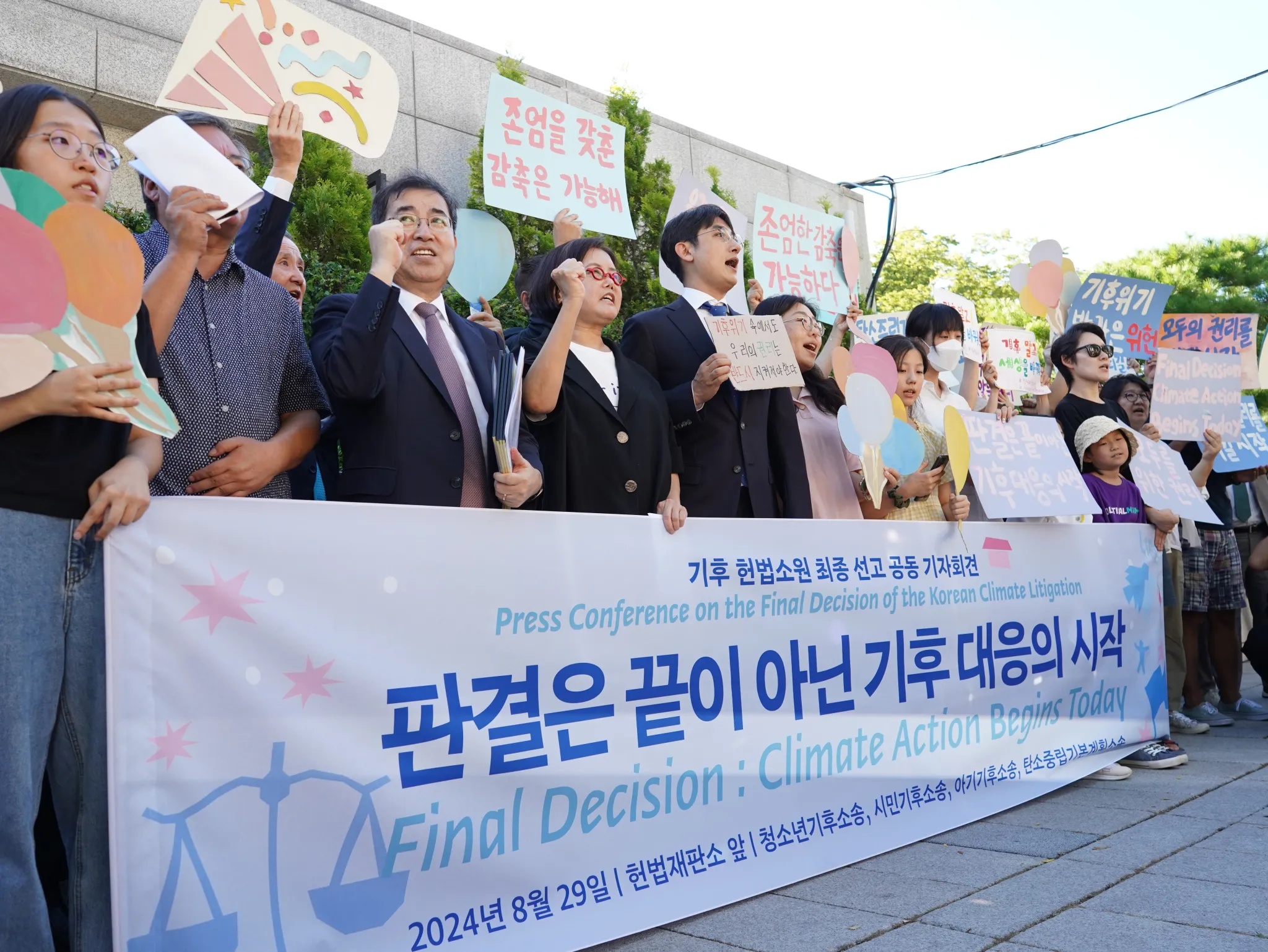
Photo credit SFOC
Case Essentials
Current status
In progress
Judgment Date:
29 Aug 2024
Appeal or follow-up:
No
Last Verified:
01 Nov 2026
Full Case Summary and Files
Sabin Center Climate Litigation Database
Summary
- In Do-Hyun Kim et al v South Korea, the Constitutional Court found that a part of South Korea’s Framework Act on Carbon Neutrality and Green Growth for Coping with Climate Crisis breaches the constitutional rights to a healthy environment (Article 35). The Court found that leaving medium- and long-term greenhouse gas emission reduction targets for 2031 to 2049 undefined shifts the burden of emission reductions excessively to future generations. The case included four consolidated cases, first filed in 2020.1 The Court did not strike down the existing 2030 targets, because the Court concluded that setting the specific target falls under the discretion of the legislative branch.2
- This landmark ruling, a first in East Asia, recognised climate change as a constitutional rights issue in South Korea,3 setting a precedent for future climate litigation in the country and region.4 The case also advanced climate accountability because it linked constitutional law to international environmental law by highlighting the need to consider the rights of future generations in climate policy.5
Ruling
Remedy ordered
- Legislative amendment: The National Assembly was ordered to amend Article 8(1) of the Climate Neutrality Framework Act.6 The amendment must introduce legally binding carbon emission reduction targets for 2031-2049. These targets must be grounded in scientific facts, international standards, and South Korea's fair share of the global efforts, aligned with the Paris Agreement goals.7
Compliance mechanism
- Hard deadline: The Court ordered that Article 8(1) remain temporarily in force but be amended by 28 February 2026.8
Legal Basis
- Constitution: The Court found that Article 8(1) of the Carbon Neutrality Framework Act violates the right to a healthy environment (Article 35) of the Korean Constitution, interpreted as imposing a duty on the State to protect individuals—including future generations—from climate harm.
- The Court invoked two constitutional principles and found: the Principle of Prohibition against Insufficient Protection was violated by the lack of quantified emission reduction targets from 2031 to 2049 in Article 8(1) of the law which results in excessive shifting of burden from the climate crisis to the future;9 and the Principle of Statutory Reservation, including the Principle of Parliamentary Reservation, was also violated as long-term climate policy decisions must be clearly defined by legislation. The lack of specific statutory targets for 2031-2049 is therefore an ineffective legislative framework to address the climate crisis and protect constitutional rights.10
Implementation
Government response
- Proactive: The Ministry of Environment immediately issued a statement in response to the ruling, stating that it respected the verdict and would implement the necessary follow-up measures.11 Members of the Democratic Party’s parliamentary group on climate action indicated support for strengthening climate legislation, including revisiting concerns about how the 2030 emission reduction target was calculated (although this aspect of the case was not ultimately declared unconstitutional).12
- Second NDC: South Korea submitted an updated nationally determined contribution (NDC) in January 2025, setting a 2035 emissions reduction target range of 53–61 per cent compared to 2018 levels.13
Legislation
- The Court ordered a legislative amendment. Although the Framework Act was amended in October 2024, those amendments did not address Article 8(1), which remained non-compliant with the Constitution.
- The 28 February 2026 deadline was missed, due in part to political instability and elections.
- The National Assembly amended the Framework Act in 2026, with the amendments promulgated on 8 September 2026. The revised Article 8 now sets out the governing principle for national reduction targets in Article 8(1) and establishes medium- and long-term greenhouse-gas reduction targets of 53–61 per cent by 2035, 69–80 per cent by 2040, and 84–90 per cent by 2045 in Article 8(4)–(6).14 The higher end of the range aligns with a 1.5°C pathway and reflects the influence of the Constitutional Court's ruling.15
- To support the amendment process, a deliberative polling (citizens’ assembly-style) process involving around 300 randomly selected citizens was conducted in early 2026. This process recommended aligning future emissions targets with the IPCC 1.5°C pathway and prioritising earlier emissions reductions to avoid shifting burdens to future generations.16
Sources
1 Do-Hyun Kim et al v South Korea [2024] 2020HunMa389 1
2 Plan 1.5, ‘Korean Climate Litigation Decision Analysis Memo: Korean Constitutional Court Decision Case No. 2020Huma389’, 1 November 2024, accessed 10 February 2026 <https://cdn.climatepolicyradar.org/navigator/KOR/2020/do-hyun-kim-et-al-v-south-korea_982c43fa89df2c4ec77ea5cdc08490fb.pdf>
3 Lee, K. W. and Park, T. J., ‘South Korea’s landmark ruling on climate justice’, Nature Human Behaviour, 9 (2025), pp. 1067-1068, <https://doi.org/10.1038/s41562-025-02174-w>
4 Phillips, B., ‘South Korean Constitutional Court Ruling: A Landmark Decision in Climate Litigation’, International IDEA, 16 September 2024, <https://www.idea.int/news/south-korean-constitutional-court-ruling-landmark-decision-climate-litigation>, accessed 10 February 2026
5 Nissen, A., ‘Green Court – South Korean Constitutional Court Rules Landmark Climate Judgement’, EJIL Talk, 29 April 2025, <https://www.ejiltalk.org/green-court-south-korean-constitutional-court-rules-landmark-climate-judgement/>, accessed 10 February 2026
6 Do-Hyun Kim et al v South Korea [2024] 2020HunMa389 1
7 Do-Hyun Kim et al v South Korea [2024] 2020HunMa389 23-32
8 Do-Hyun Kim et al. v. South Korea [2024] 2020HunMa389 1
9 Do-Hyun Kim et al v South Korea [2024] 2020HunMa389 29
10 Do-Hyun Kim et al v South Korea [2024] 2020HunMa389 30-31
11 Park, J., ‘Top South Korea court says climate law doesn't protect basic rights’, Reuters, 29 August 2024, <https://www.reuters.com/world/asia-pacific/south-korean-constitutional-court-says-climate-law-needs-more-future-emissions-2024-08-29/?ref=the-wave.net>, accessed 11 February 2026
12 Seungseop, S., ‘Partial Constitutional Incompatibility of the Carbon Neutrality Act, Announcement of Stringent Climate Legislation for 2026’, The Asia Business Daily, 30 August 2024, <https://www.asiae.co.kr/en/article/2024083009581982214>, accessed 12 February 2026
13 Republic of Korea, ‘Submission under the Paris Agreement, The Republic of Korea’s 2035 Nationally Determined Contribution’, December 2025, <https://unfccc.int/sites/default/files/2025-12/The%20Republic%20of%20Koreas%202035%20NDC.pdf>, accessed 28 April 2026
14 Republic of Korea, Framework Act on Carbon Neutrality and Green Growth for Coping with Climate Crisis, art. 8(4)–(6), as amended 8 September 2026, <https://www.law.go.kr/LSW/lsInfoP.do?lsiSeq=289283>, accessed 9 November 2026
15 Presidential Commission on Climate Crisis Response, ‘2024년 제9차 온실가스 감축 분과위원회 회의 결과’ [Results of the 9th Greenhouse Gas Reduction Subcommittee Meeting in 2024], 5 November 2024, <https://www.pcccr.go.kr/base/board/read?boardManagementNo=11&boardNo=4363&searchCategory=&page=4&searchType=&searchWord=&menuLevel=2&menuNo=10>, accessed 12 February 2026
16 Kaminski, I., ‘‘'Not just a single judicial event': South Korea's constitutional climate ruling 20 months on’, The Wave, 22 April 2026, <https://www.the-wave.net/south-korea-constiutional-court-climate-judgment-21-months>, accessed 28 April 2026
Share
Share


Related content