


A coalition of Greenpeace, Germanwatch and 55,000 citizens, including Luisa Neubauer and other litigants from the 2021 case, launched a new climate lawsuit against the German government. They argue that German climate policy no longer complies with this ruling after the current German government reversed parts of the amendment of the Federal Climate Protection Act, thus disregarding the constitutional standard set by this case regarding the protection of future generations from unfair burden.15
Neubauer et al. v Germany (Federal Constitutional Court, 2021)
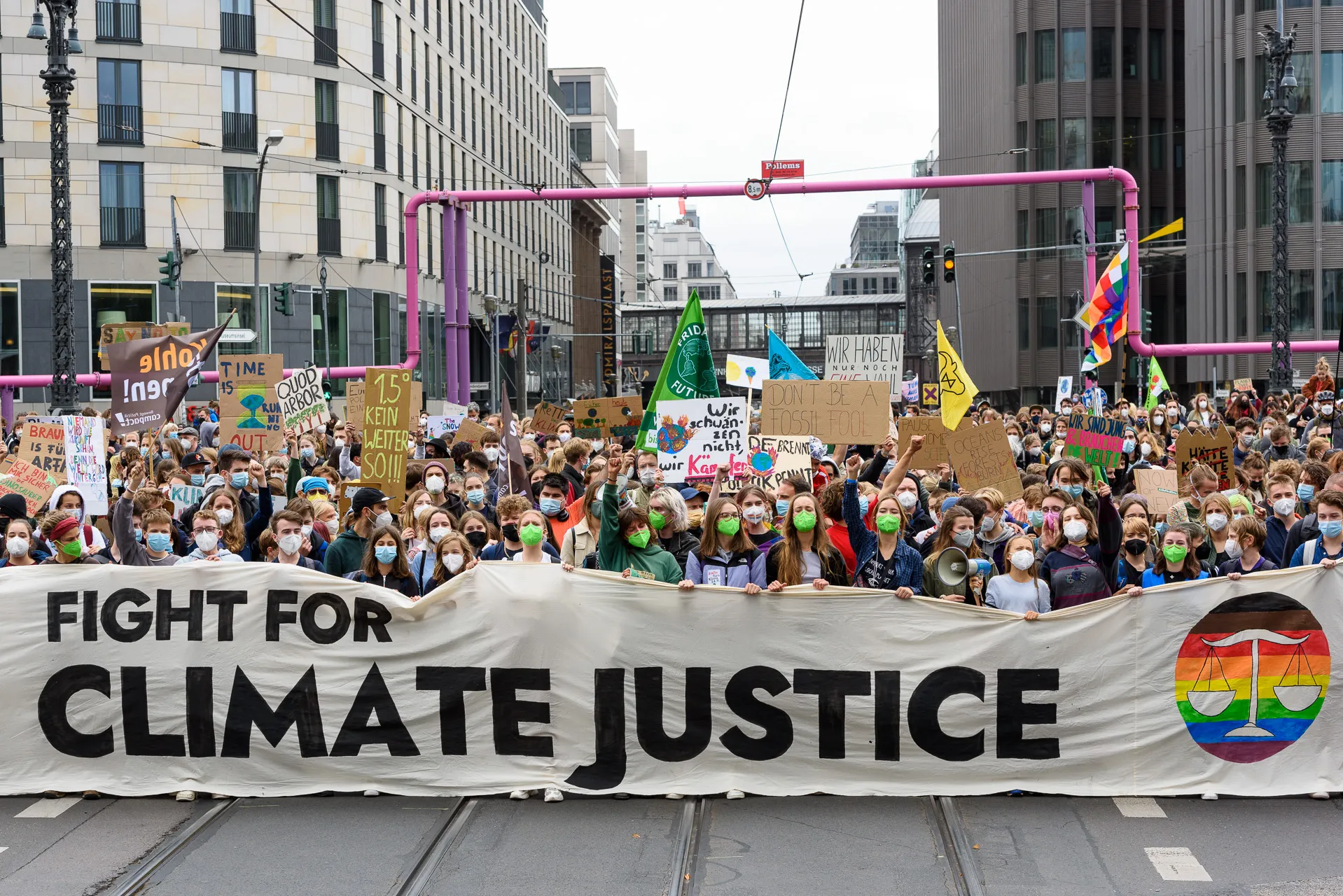
Photo credit Stefan Müller via Wikimedia Commons
Summary
- In Neubauer et al. v Germany, the Federal Constitutional Court held that parts of the Federal Climate Protection Act 2019 (Bundes-Klimaschutzgesetz) were unconstitutional. It found that by setting emissions reduction targets only up to 2030, the Act violated plaintiffs’ fundamental rights to protection of life and physical integrity (Article 2(2) of the German Basic Law) and protection of the natural foundations of life and animals (Article 20a).1
- This landmark ruling established the state’s concrete obligation to protect the environment under the German Basic Law.2 The Court also recognized for the first time that rights are “intertemporal guarantees of freedom”, whereby the Basic Law protects future generations from an unfair burden created by the present generation.3
Case Essentials
Current status
Implemented
Judgment Date:
March 24, 2021
Appeal or follow-up:
Yes
Last Verified:
23 Apr 2026
Full Case Summary and Files
View the case at the Sabin Center Climate Litigation Database
Ruling
Remedy ordered
- Legislative amendment: The Court did not invalidate the entire Act, but struck down (or required revision of) those parts that left no targets beyond 2030. The government was ordered to provide specific greenhouse gas emissions reduction targets from 2031 onwards.4
- Court fees: The Federal Republic of Germany was ordered to reimburse 50 per cent of the expenses incurred in relation to the proceedings by the plaintiffs.5
Compliance mechanism
- Hard deadline: 31 December 2022.6
Legal Basis
- Constitution: The Federal Climate Protection Act of 2019 was declared unconstitutional in part due to German Basic Law Article 2(2) (protection of life and physical integrity) and Article 20a (protection of the natural foundations of life and animals). The Court reasoned that the provided emission reduction targets up to 2030 in the Federal Climate Protection Act create too high a burden on future generations to reduce emissions, thus threatening their constitutional rights.7 The ruling explicitly based these duties on international law and Intergovernmental Panel on Climate Change (IPCC) findings.
Implementation
Government response
- Compliant: Members of the German government reacted positively to the ruling, pledging to comply as quickly as possible.8 The Finance Minister pledged to work with the Environment Ministry to amend the law, and the Environment Minister promised new proposals over the summer of 2021.9 Some politicians, including Germany’s environmental minister, welcomed the ruling of the Constitutional Court as a means of building political momentum and consensus for stronger emissions cuts.10
- Legislation: The parliament amended the Federal Climate Protection Act on 24 June 2021. To ensure compliance with the ruling,11 the revised law accelerates the goal of climate neutrality by five years to 2045. The interim target for 2030 was also raised from 55 per cent to 65 per cent emission reduction compared to 1990 levels, and a new interim target of 88 per cent emission reduction for 2040 was added.12 Although the government complied with the ruling, some observers (including the original plaintiffs) argued the new law still fell short of climate science. Further, the government response has been criticised as not setting an enforcement path to feasibly hit the new targets.13 While the Constitutional Court decision is final (no appeal), a new climate case was launched against the German government challenging the 2024 amendment to the Federal Climate Protection Act as insufficient.14
Sources
1 Neubauer et al. v Federal Republic of Germany [2021] BvR 2656/18
2 Kaminski, I., ‘A very bureaucratic approach to the most existential threat of the century: Neubauer and the German climate case three years on’, the Wave, 2 October 2024, <https://www.the-wave.net/neubauer-german-climate-case-three-years-on/>, accessed 23 April 2026
3 Schick, N., ‘Klimaschutz per Gerichtsentscheid’ [Climate protection by court decision], Max Planck Gesellschaft, 23 July 2025, <https://www.mpg.de/25086456/klimaklagen-uebersicht>, accessed 23 April 2026; Kotzé, L. J., ‘Neubauer et al. versus Germany: Planetary Climate Litigation for the Anthropocene?’, German Law Journal, 22(8) (2022), pp. 1423-1444, <https://doi.org/10.1017/glj.2021.87>
4 Neubauer et al. v Federal Republic of Germany [2021] BvR 2656/18 [268]
5 Neubauer et al. v Federal Republic of Germany [2021] BvR 2656/18 [269]
6 Neubauer et al. v Federal Republic of Germany [2021] BvR 2656/18 [268]
7 Neubauer et al. v Federal Republic of Germany [2021] BvR 2656/18 [268]
8 Deutsche Welle, ‘German climate law doesn't go far enough, top court rules’, 29 April 2021, <https://www.dw.com/en/german-climate-law-is-partly-unconstitutional-top-court-rules/a-57369917?ref=the-wave.net>, accessed 23 April 2026
9 Treisman, R., ‘German Court Orders Revisions To Climate Law, Citing 'Major Burdens' On Youth’, NPR, https://www.npr.org/2021/04/29/992073429/german-court-orders-revisions-to-climate-law-citing-major-burdens-on-youth, accessed 24 April 2026
10 Süddeutschen Zeitung, ‘Urteil zum Klimaschutzgesetz: “Für den Klimaschutz ist das ein Ausrufezeichen”’ [‘Judgment on the Climate Protection Act: “This is an exclamation mark for climate protection’”], 29 April 2021, <https://www.sueddeutsche.de/politik/klimaschutzgesetz-reaktionen-1.5280199>, accessed 23 April 2026
11 Federal Ministry for the Environment, Climate Action, Nature Conservation and Nuclear Safety, ‘Entwurf eines Ersten Gesetzes zur Änderung des Bundes-Klimaschutzgesetzes’ [Draft of a First Act Amending the Federal Climate Protection Act], 12 May 2021, <https://www.bundesumweltministerium.de/gesetz/entwurf-eines-ersten-gesetzes-zur-aenderung-des-bundes-klimaschutzgesetzes>, accessed 23 April 2026
12 Federal Ministry for the Environment, Climate Action, Nature Conservation and Nuclear Safety, ‘Bundes-Klimaschutzgesetz’ [Federal Climate Protection Act], 18 August 2021, <https://www.bundesumweltministerium.de/gesetz/bundes-klimaschutzgesetz>, accessed 23 April 2026
13 Thomas, G., ‘Zwei Jahre Klimabeschluss des Bundesverfassungsgerichts’ [‘Two years of the climate decision of the Federal Constitutional Court’], Verfassungsblog: On Matters Constitutional, 18 March 2023, <https://verfassungsblog.de/zwei-jahre-klimabeschluss-des-bundesverfassungsgerichts/>, accessed 23 April 2026
14 Germanwatch, ‘Securing the Fundamental Rights of Tomorrow’, [n.d.], <https://www.germanwatch.org/en/node/91122?ref=the-wave.net>, accessed 23 April 2026
15 Peters, J., ‘Zukunftsklage zugestellt: Bundesregierung muss Stellung nehmen’ [Future lawsuit served: Federal government must take a stand], 11 September 2025, <https://www.rae-guenther.de/aktuelles/zukunftsklage-zugestellt>, accessed 23 April 2026
Share
Share


Case Essentials
Current status
Implemented
Judgment Date:
24 Mar 2021
Appeal or follow-up:
Yes
Last Verified:
23 Apr 2026
Full Case Summary and Files
View the case at the Sabin Center Climate Litigation Database
Share
Share
Related content


