


Do-Hyun Kim et al v South Korea (Constitutional Court, 2024)
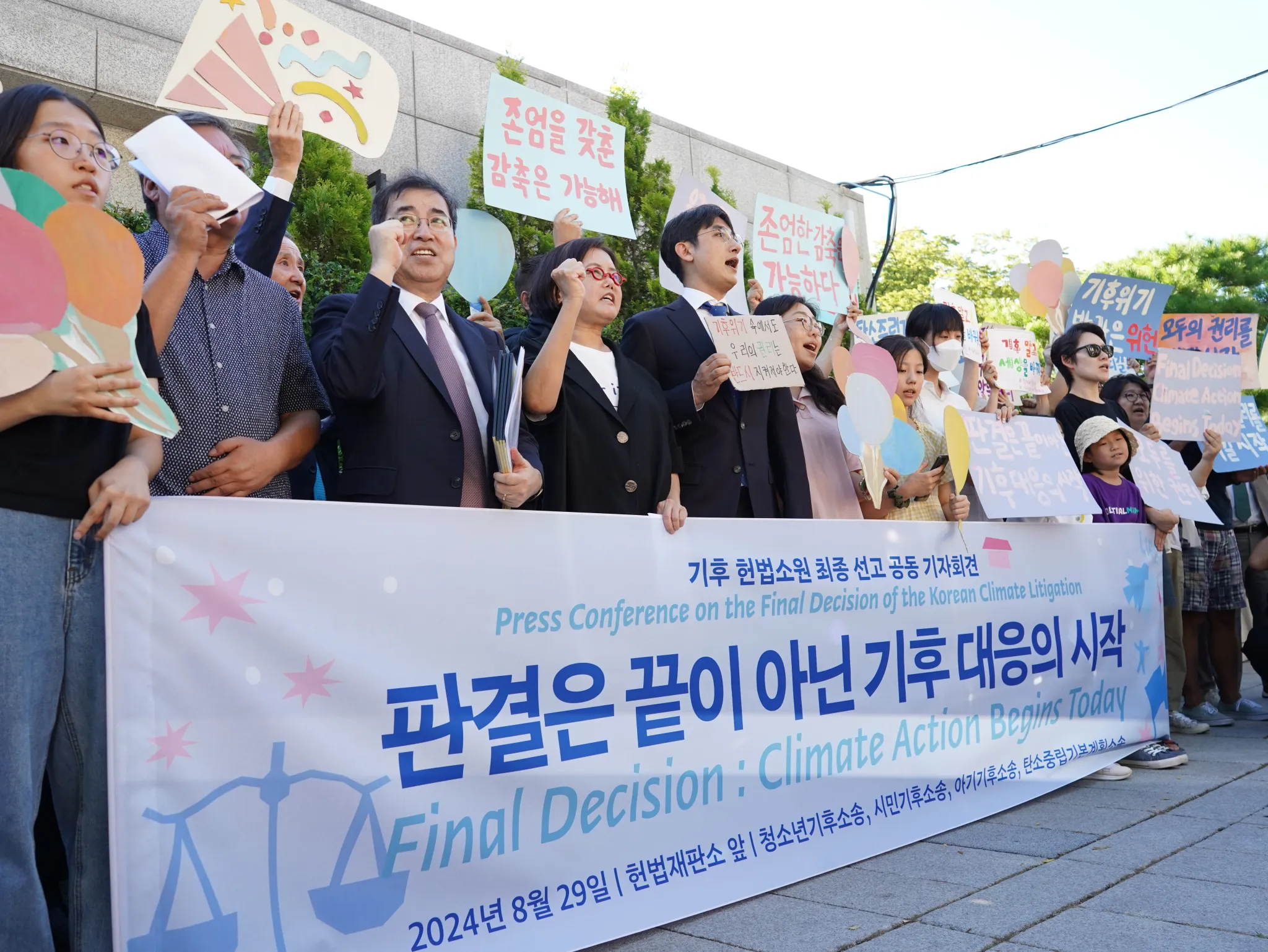
- In Do-Hyun Kim et al v South Korea, the Constitutional Court found that a part of South Korea’s Framework Act on Carbon Neutrality and Green Growth for Coping with Climate Crisis breaches the constitutional rights to a healthy environment (Article 35). The Court found that leaving medium- and long-term greenhouse gas emission reduction targets for 2030 to 2049 undefined shifts the burden of emission reductions excessively to future generations. The case included four consolidated cases, first filed in 2020.1 The Court did not strike down the existing 2030 targets, because six of nine judges (a supermajority) were needed to void a law and only five agreed on that point.2
- This landmark ruling, a first in East Asia, recognised climate change as a constitutional rights issue in South Korea,3 setting a precedent for future climate litigation in the country and region.4 The case also advanced climate accountability because it linked constitutional law to international environmental law by highlighting the need to consider the rights of future generations in climate policy.5
Remedy ordered
- Legislative amendment: The government was ordered to amend Article 8(1) of the Climate Neutrality Framework Act.6 The amendment must introduce legally binding carbon emission reduction targets for 2031-2049. These targets must be grounded in scientific evidence, international benchmarks, and South Korea’s fair share of the global carbon budget, aligned with the Paris Agreement goals.7
Compliance mechanism
- Hard deadline: The Court ordered that Article 8(1) remain temporarily in force but be amended by 28 February 2026.8
- Constitution: The Court found that Article 8(1) of the Carbon Neutrality Framework Act violates the right to a healthy environment (Article 35) of the Korean Constitution, interpreted as imposing a duty on the State to protect individuals—including future generations—from climate harm.
- The Court invoked two constitutional principles and found: (1) the Principle of Prohibition against Insufficient Protection is violated by the lack of quantified emission reduction targets from 2031 to 2049 in Article 8(1) of the law; therefore, it fails to protect future generations from excessive burden from the climate crisis9; (2) the Principle of Statutory Reservation, including the Principle of Parliamentary Reservation, was also violated as long-term climate policy decisions must be clearly defined by legislation. The lack of specific statutory targets for 2031-2049 is therefore an ineffective legislative framework to address the climate crisis and protect constitutional rights.10
Government response
- Proactive: The Ministry of Environment immediately issued a statement in response to the ruling, stating that it respected the verdict and would implement the necessary follow-up measures.11 Members of the Democratic Party’s parliamentary group on climate action indicated support for strengthening climate legislation, including revisiting concerns about how the 2030 emission reduction target was calculated (although this aspect of the case was not ultimately declared unconstitutional).12
Legislation
- The Court ordered a legislative amendment. Although the Framework Act was amended in October 2024, those amendments did not address Article 8(1), which remained non-compliant with the Constitution.
- The 28 February 2026 deadline was missed, due in part to political instability and elections. As of April 2026, the National Assembly is still in the process of preparing amendments to introduce legally binding post-2030 targets with a goal of May 2026.13
- To support the amendment process, a deliberative polling (citizens’ assembly-style) process involving around 300 randomly selected citizens was conducted in early 2026. This process recommended aligning future emissions targets with the IPCC 1.5°C pathway and prioritising earlier emissions reductions to avoid shifting burdens to future generations.14
Policy
- Second NDC: South Korea submitted an updated nationally determined contribution (NDC) in January 2025, setting a 2035 emissions reduction target range of 53–61 per cent compared to 2018 levels.15 The higher end of this range aligns with a 1.5°C pathway and reflects the influence of the Constitutional Court’s ruling.
1 Do-Hyun Kim et al v South Korea [2024] 2020HunMa389 1
2 Plan 1.5, ‘Korean Climate Litigation Decision Analysis Memo: Korean Constitutional Court Decision Case No. 2020Huma389’, 1 November 2024, accessed 10 February 2026 <https://cdn.climatepolicyradar.org/navigator/KOR/2020/do-hyun-kim-et-al-v-south-korea_982c43fa89df2c4ec77ea5cdc08490fb.pdf>
3 Lee, K. W. and Park, T. J., ‘South Korea’s landmark ruling on climate justice’, Nature Human Behaviour, 9 (2025), pp. 1067-1068, <https://doi.org/10.1038/s41562-025-02174-w>
4 Phillips, B., ‘South Korean Constitutional Court Ruling: A Landmark Decision in Climate Litigation’, International IDEA, 16 September 2024, <https://www.idea.int/news/south-korean-constitutional-court-ruling-landmark-decision-climate-litigation>, accessed 10 February 2026
5 Nissen, A., ‘Green Court – South Korean Constitutional Court Rules Landmark Climate Judgement’, EJIL Talk, 29 April 2025, <https://www.ejiltalk.org/green-court-south-korean-constitutional-court-rules-landmark-climate-judgement/>, accessed 10 February 2026
6 Do-Hyun Kim et al v South Korea [2024] 2020HunMa389 1
7 Do-Hyun Kim et al v South Korea [2024] 2020HunMa389 23-32
8 Do-Hyun Kim et al. v. South Korea [2024] 2020HunMa389 1
9 Do-Hyun Kim et al v South Korea [2024] 2020HunMa389 29
10 Do-Hyun Kim et al v South Korea [2024] 2020HunMa389 30-31
11 Park, J., ‘Top South Korea court says climate law doesn't protect basic rights’, Reuters, 29 August 2024, <https://www.reuters.com/world/asia-pacific/south-korean-constitutional-court-says-climate-law-needs-more-future-emissions-2024-08-29/?ref=the-wave.net>, accessed 11 February 2026
12 Seungseop, S., ‘Partial Constitutional Incompatibility of the Carbon Neutrality Act, Announcement of Stringent Climate Legislation for 2026’, The Asia Business Daily, 30 August 2024, <https://www.asiae.co.kr/en/article/2024083009581982214>, accessed 12 February 2026
13 Presidential Commission on Climate Crisis Response, ‘2024년 제9차 온실가스 감축 분과위원회 회의 결과’ [Results of the 9th Greenhouse Gas Reduction Subcommittee Meeting in 2024], 5 November 2024, <https://www.pcccr.go.kr/base/board/read?boardManagementNo=11&boardNo=4363&searchCategory=&page=4&searchType=&searchWord=&menuLevel=2&menuNo=10>, accessed 12 February 2026
14 Kaminski, I., ‘‘'Not just a single judicial event': South Korea's constitutional climate ruling 20 months on’, The Wave, 22 April 2026, <https://www.the-wave.net/south-korea-constiutional-court-climate-judgment-21-months>, accessed 28 April 2026
15 Republic of Korea, ‘Submission under the Paris Agreement, The Republic of Korea’s 2035 Nationally Determined Contribution’, December 2025, <https://unfccc.int/sites/default/files/2025-12/The%20Republic%20of%20Koreas%202035%20NDC.pdf>, accessed 28 April 2026


