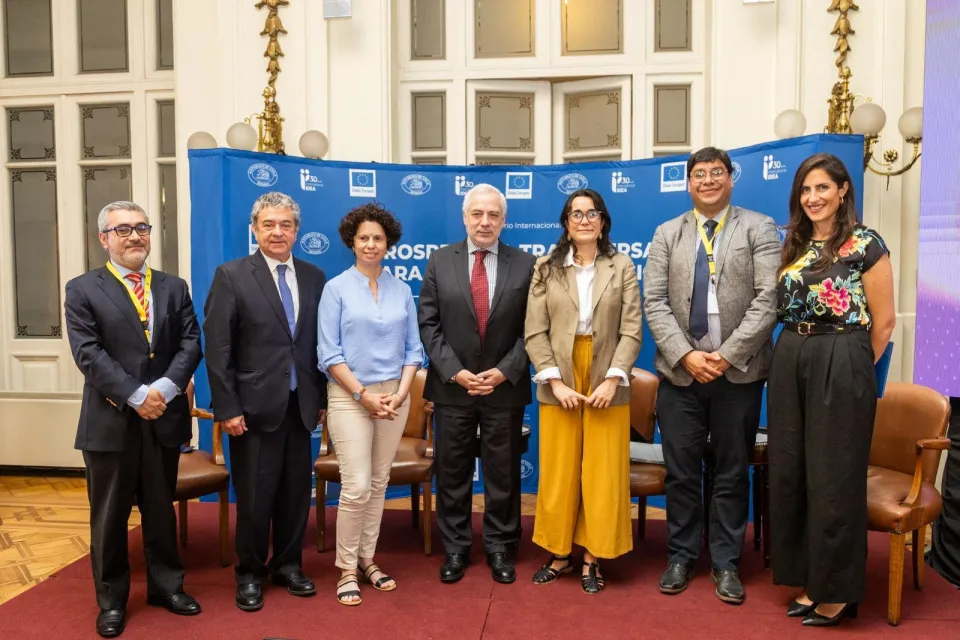
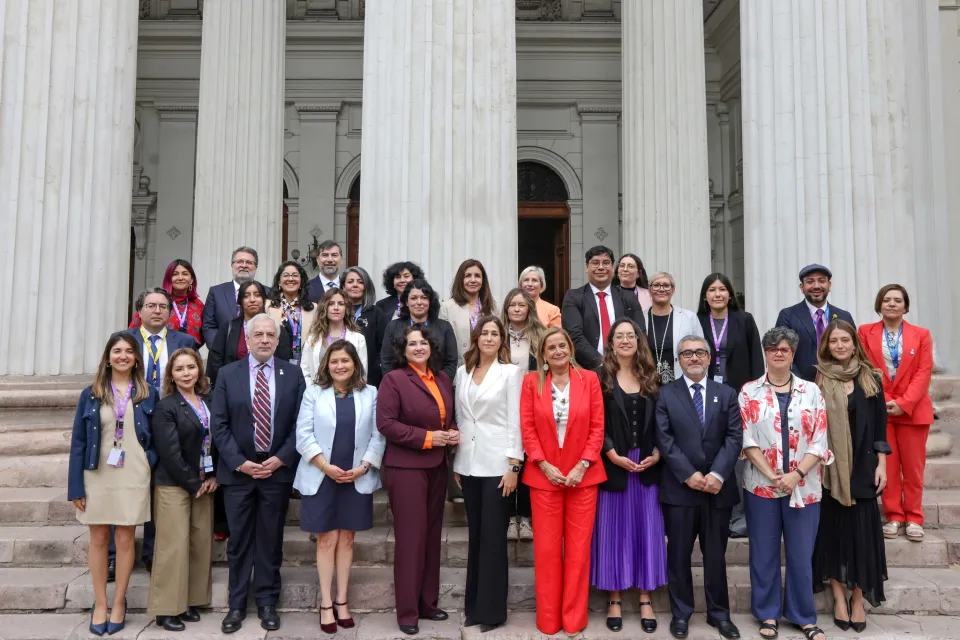
El Seminario “Financiamiento de la Política: Desafíos para la Reforma”, se realizó el jueves 28 de julio en la Sindicatura General de la Nación en Buenos Aires, Argentina.
Búsqueda
Region
Country
Type
4591 results
August 08, 2016
El 19 de julio de 2016, Sergio Bitar, miembro del Board de IDEA Internacional y uno de los editores de la publicación “Transiciones democráticas: Enseñanzas de líderes políticos”, (IDEA Internacional/Galaxy Gutenberg) fue el expositor principal de la primera sesión del ciclo “Ideas y autores, repensando la sociedad chilena”, organizada por la Fundación Chile 21.
News
August 08, 2016
Sergio Bitar, International IDEA Board Member and co-editor of Democratic Transitions: Conversations with World Leaders, was the keynote speaker at the first session of the series Ideas and Authors, Rethinking Chilean Society, held on 19 July and hosted by the Fundación Chile 21.
News
August 05, 2016
Effective service provision entails the efficient and effective provision of public services, but also giving citizens and groups within society—regardless of gender, religion, age, sexual orientation, ethnicity or class—the opportunity to participate in the relevant decision-making processes.
Publication
August 04, 2016
When a country begins a political transition away from violent conflict or non-democratic rule, there are many difficult steps that it must take.
Developing an electoral justice system, which includes the means and mechanisms to ensure that electoral integrity is maintained or restored when an electoral process is damaged by repression, misconduct, or irregularities, may appear to decision-makers to be a secondary concern or even an afterthought.
Publication
August 03, 2016
One of the key recommendations of the Myanmar National Post-Election Conference of March 2016 was that “observers’ rights and duties should be part of the electoral laws and related by-laws”. Thus, on 1 August 2016, International IDEA and Democracy Reporting International (DRI) provided support to the Union Election Commission of Myanmar in initiating a discussion on how to enshrine the role and duties of domestic election observation to civil society organizations (CSOs).
News
August 01, 2016
This report documents the Policy Dialogue on how to deepen the transition to democratic governance in Central Africa, the second in the International Institute for Democracy and Electoral Assistance (International IDEA) Africa and West Asia Regional 2015 Policy Dialogue Series, which took place at the Meridien Re-Ndama Hotel in Libreville, Gabon, on 14–15 December 2015.
Publication
July 21, 2016
For decades, the Middle East has experienced persistent violence and protracted conflict.
Since the beginning of the Arab Awakening in 2010—widely referred to in the coverage of developments in the region as the Arab Spring or the Arab Uprisings—the Arab world has gone through massive change.
Publication
July 21, 2016
The influence of money in politics is a significant threat to democracy, affecting established and emerging democracies alike.
Inadequately controlled flows of money undermine the credibility of elections and the integrity of democratic institutions and processes around the world. Well-designed political finance regulations that are enforceable and anchored in their country’s context play a vital role in ensuring that money is a positive force in politics.
Publication
July 19, 2016
On the occasion of the 24th World Congress of Political Science, which will take place on 23-27 July 2016 at Poznan, Poland, International IDEA is set to lead discussions on key democracy issues and topics. Organized by the International Political Science Association (IPSA), the biennial is considered a key environment to advance and develop the field of political science with the relevant contributions of experts, scholars, and policymakers at all levels.
News
July 19, 2016
El 12 y 13 de julio se realizó el Foro Chileno-Alemán, titulado ‘Desafíos para la Democracia’, en el marco de la visita del Presidente de Alemania, Joachim Gauck, a Chile. El foro fue organizado por el Ministerio Secretaria General de la Presidencia (Segpres), las fundaciones alemanas Konrad Adenauer, Heinrich Böll Stiftung, Friedrich Ebert, Hans Seidel, Rosa Luxemburg y Freidrich Naumann.
News
July 18, 2016
The influence of money in politics is a significant threat to democracy, affecting established and emerging democracies alike.
Publication
July 18, 2016
Since the general elections in Tonga on 27 November 2014, two Peoples’ Representatives in the 26-seat Parliament, comprising of 17 Peoples’ Representatives and 9 Nobles Representatives, have been dismissed. These Representatives were disqualified for breaches of the Electoral Act 1989. Mr Mateni Tapueluelu, (Peoples’ Representative for Tongatapu 4) was disqualified by the Supreme Court on 15 December 2015 for outstanding debts.
News
July 18, 2016
A Chilean-German Forum, entitled “Challenges for Democracy”, was held in the context of a visit to Chile by German President Joachim Gauck on 12-13 July. The forum was jointly organised by the Ministry General Secretariat of Government, and German Foundations Konrad Adenauer, Heinrich Böll, Friedrich Ebert, Hans Seidel, Rosa Luxemburg, and Freidrich Naumann.
News
July 15, 2016
News
July 14, 2016
A total of 67 candidates, including four women, as well as incumbent Member of Parliament (MP) Charmaine Scotty, who is also a government Minister, stood for the 19-seat Parliament in the elections in Nauru on 9 July 2016. These 19 seats are distributed amongst 8 multi-member constituencies. Ubenide and Meneng has 4 and 3 seats, respectively, while the rest are 2-member seats. Both Ubenide and Meneng attracted the highest number of candidates at 16 and 11 candidates respectively.
News
July 14, 2016
United Nations, July 14 2016 – A coalition of international organizations today launched an online initiative to chart progress on one of the most challenging of the UN’s new Sustainable Development Goals (SDGs) – the commitment to “promote peaceful and inclusive societies” in all parts of the world, with measurable objectives in specific target areas.
News
July 13, 2016
The 2030 Agenda for Sustainable Development sets out an unprecedented and ambitious global action plan. Through the endorsement of Sustainable Development Goal (SDG) 16, the international community acknowledged the central role of effective, inclusive and accountable institutions in enabling sustainable development.
News
July 13, 2016
The 2030 Agenda for Sustainable Development sets out an unprecedented and ambitious global action plan. Through the endorsement of Sustainable Development Goal (SDG) 16, the international community acknowledged the central role of effective, inclusive and accountable institutions in enabling sustainable development.
News
July 12, 2016
In recent years the African continent, and the West African subregion, have made significant progress in the area of democratization.
Publication