

Moldova’s Institutions and Civil Society Test a Common Roadmap against Election-Related FIMI
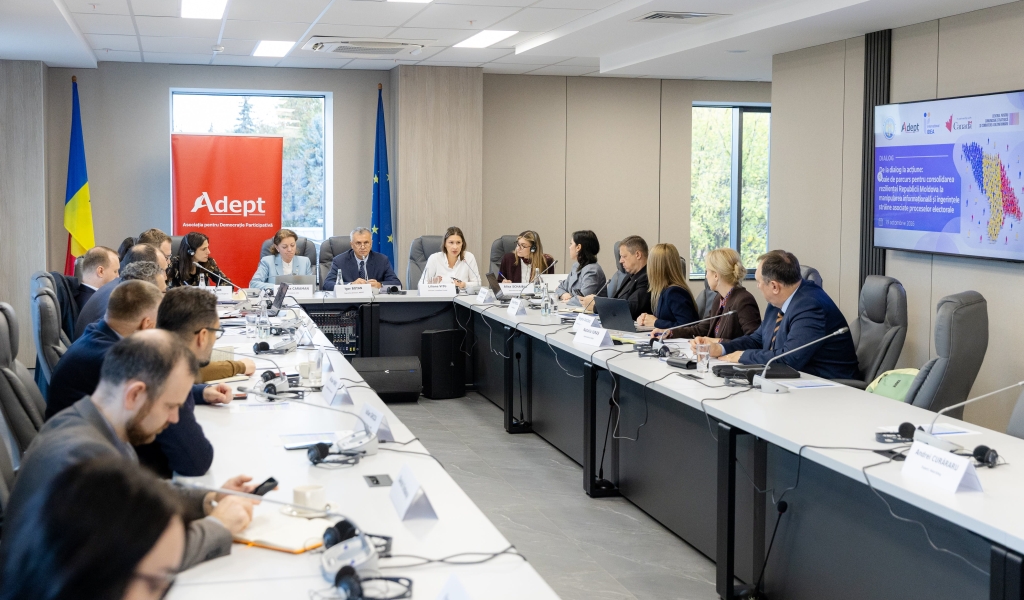
Preparations for the next elections in Moldova should start well before the formal electoral period and rely on the legal and crisis-management mechanisms already in place. This was the main message of a closed-door policy dialogue held in Chișinău on 19 October, where senior officials and civil society experts tested the draft Common Roadmap for Strengthening Resilience against Election-related FIMI.
The event, “From Dialogue to Action”, was part of a series of dialogues organised in Moldova under the International IDEA project on combating election-related foreign information manipulation and interference (FIMI), supported by Global Affairs Canada. The event was organised by the Association for Participatory Democracy (ADEPT) in partnership with the Central Electoral Commission (CEC) and the StratCom Center of Moldova. About 25 participants attended, from electoral, security, crisis-management, financial-intelligence, cyber and strategic-communication institutions, as well as civil society and international partners. Participants discussed the Roadmap which served as a policy document steering the discussion on what proposed actions should be kept, adjusted or developed further.
Igor Boțan, Executive Director of ADEPT opened the dialogue together with Angelica Caraman, Chairperson of the CEC, Liliana Vițu, Chair of the StratCom Center, Laura Atar of the Embassy of Canada, and Alisa Schaible of International IDEA. Opening remarks described the dialogue as a natural continuation of the work done during 2025-2026 to understand FIMI vulnerabilities, strengthen dialogue between institutions and civil society, and move from analysis to practical resilience measures.
Polina Panainte of ADEPT presented how the series developed. It began with a 2025 mapping of FIMI enablers and incentives. In 2026, separate dialogues covered institutional coordination, online electoral communication, regional vulnerabilities and societal resilience. The project also included capacity-building with civil society and public communication activities such as the “Stai Oleacă” (verify before you share) campaign.
Igor Boțan and Polina Panainte of ADEPT and Petru Culeac of the Moldovan Development Institute then presented the draft Roadmap, which covers 12 to 24 months and has four priorities: interinstitutional coordination, a common operational risk picture, coordinated responses to major FIMI risks, and public communication and societal resilience. ADEPT presented it as a civil-society contribution to national efforts already under way. It does not propose a parallel security architecture.
Petru Culeac spoke about foreign money in Moldovan elections, drawing on his upcoming International IDEA-supported paper Money in Moldova’s Electoral Politics. He described a move away from cash schemes toward crypto-assets, electronic money, third-party spending, foreign providers and online advertising. In his analysis, the main difficulty is now attribution, traceability and jurisdiction. Legal prohibitions largely exist already.
In the validation discussion, moderated by ADEPT, participants confirmed the need for steadier preparedness between electoral cycles but warned against over-institutionalising it. Authorities recognised that they are so busy with their daily tasks that they rarely sit down together for a structured exchange like this one. Several participants wanted the “project elections” mode to start well ahead of the next electoral period. The CEC said its independence must be protected if cooperation is organised under a government-led format. Representatives of the National Crisis Management Center (CNMC) pointed to crisis-management instruments that already exist, including reporting flows and working groups that can be activated as needed. The discussion pointed toward clarifying how routine electoral coordination, strategic security coordination and crisis management could work better together.
The need for more scenario-based and table-top exercises was also discussed. “We would like to have these top-table exercises on a permanent basis, so that we are better prepared,” Angelica Caraman said. She also linked the Roadmap to the CEC’s risk-management planning for 2027-2029 and encouraged institutions to build its priorities into their own plans.
Electoral finance was one of the most practical topics. Participants discussed payment instruments, “droppers” who sell or lend bank cards, virtual assets and cross-border flows that complicate investigations. Participants agreed that the Roadmap’s referral mechanism should follow the legal flow of information between the FIU, the National Bank, payment institutions and law enforcement. They asked for stronger crypto-analysis capacity and better cross-border information sharing, and they said citizens should be warned that handing over a bank card can make it part of an electoral corruption scheme.
On digital platforms, participants described uneven cooperation. A platform’s legal review of a complaint can take several days, which is too slow during an election, and Moldova has less access to research and monitoring tools than EU Member States. Participants proposed clearer national rules aligned with the EU Digital Services Act, regular meetings with platforms before elections, standardised requests and documented response times.
Participants also noted that FIMI is often external in origin but domestic in execution. They described civil society broadly, including community actors, trade unions, religious communities and youth networks. Proxies and intermediaries should be judged on evidence of conduct, financing and coordination, they said, with legitimate civic, religious and media activity protected. They also raised influencers and AI-enabled operations, since new accounts are easy to create and democratic actors struggle to reach audiences.
Communication came up repeatedly. “Too often, we communicate post factum,” said Petru Macovei of the Association of Independent Press, as part of the civil society representation at the event. Participants asked for prebunking between elections, stronger state strategic communication and credible messengers such as young people and community networks. Independent media and civil society are important, they said, but cannot replace institutional communication. Iulian Groza called for “permanent engagement for prevention, exposure and reducing polarisation in society.” Participants also suggested inviting political parties to future dialogues.
All participants acknowledged the importance of these structured dialogues, and ADEPT will now revise the Roadmap based on the feedback. Institutions will continue technical dialogue on financial integrity and engagement with platforms will continue. Partners also plan a follow-up phase on implementation, monitoring, continued dialogue with civil society and community-level resilience, to bring the recommendations of the Roadmap into concrete action.
In Spring 2026, International IDEA will also host the first Global Conference on FIMI as a Threat to Democracy in Chisinau, Moldova as a recognition of the important milestones the country has already achieved in countering FIMI and building societal resilience.