

Call for Panel Contributions: Global Conference on Electoral FIMI and Democracy
CALL CLOSED! THANK YOU FOR YOUR SUBMISSION
About the Conference
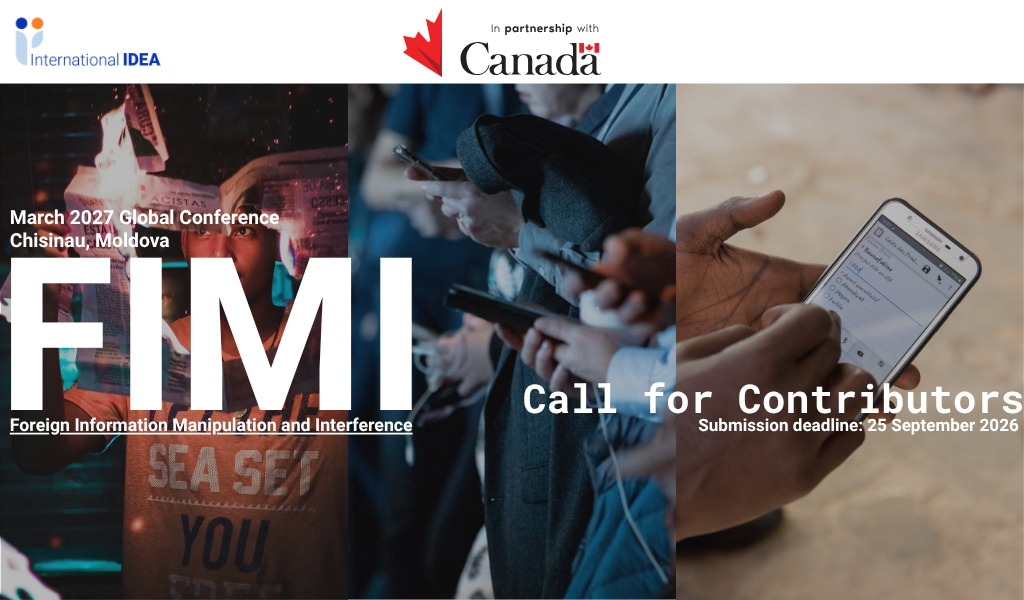
International IDEA invites organisations to submit proposals for panels at a two-day global conference on Foreign Information Manipulation and Interference (FIMI) in electoral contexts and democratic resilience. The Global Outcome Conference on Countering Election-Related Foreign Information Manipulation and Interference (FIMI) will take place in Chișinău, Moldova, at a moment when democracies are facing increasingly sophisticated and transnational information threats. The conference will serve as the culminating global exchange for a project implemented by International IDEA with support from Global Affairs Canada, aimed at reinforcing democratic resilience against election-related FIMI in Moldova, North Macedonia, Ivory Coast and Senegal.
The conference will bring together civil society organisations, academic researchers, and regulatory bodies from across the world to share evidence, methods, legal tools, and strategies for advancing a more global understanding of FIMI, as one of the most emerging threats to democratic integrity.
The event will take place on 17-18 March 2027 in Chisinau, Moldova.
Key Dates
| Extended submission deadline | 25 September 2026 |
| Notification of decisions | Late October 2026 (indicative) |
| Conference dates | 17-18 March 2027 |
| Location | Chisinau, Moldova |
| Application | Applications closed |
Who Can Apply
Proposals are welcome from:
- Civil society organisations (CSOs) and non-governmental organisations working on disinformation, monitoring social media, media literacy, content regulation, information integrity, election integrity, or democratic governance.
- Academic and research institutions with relevant expertise in FIMI, foreign influence operations, political communication, or related fields.
- Government bodies, intergovernmental organisations, regulatory bodies, and policy institutions engaged in electoral oversight, cybersecurity, information integrity, or democratic resilience.
News outlets and media organisations working on the topic.
Proposals for panels from partnerships or consortia across two or more types of organisations are particularly encouraged. International IDEA is committed to geographic diversity and strongly encourages applications from organisations based in the Global South, as well as regions where FIMI poses acute electoral risks.
Thematic Priorities
The conference is structured around four core themes. Proposals should be clearly anchored in one of these themes, though cross-cutting submissions that address multiple themes will also be considered.
1 | The Enablers and Incentives of FIMI This theme focuses on the structural enablers and incentives (IDEA, 2025) that make electoral processes vulnerable to information manipulation. This includes legal gaps, political dynamics, financial flows, and online platform architectures. We particularly welcome submissions that engage with methodological approaches to mapping and analysing these enablers, and that connect empirical research to actionable solutions and recommendations. |
2 | Civil Society Accountability and Advocacy How can civil society organisations move from awareness to strategic action? This theme covers the building of credible evidence bases, narrative monitoring & shaping, disruption operations, institutional engagement, and holding public and private stakeholders to account. Proposals that demonstrate locally grounded, practical approaches to CSO advocacy on FIMI are especially welcome. |
3 | Institutional, Legal and Policy Issues This theme examines the role of representative institutions, policymakers, electoral management bodies, and oversight mechanisms in monitoring, preventing, regulating, and mitigating FIMI. Submissions are invited on evidence that can feed into policy reform processes and implementation roadmaps at national or international levels. Another issue of interest is the regional and global debates on elaborating legal instruments to counter FIMI. |
4 | Gender, Equality, and Inclusion Gender and inclusion are central to how FIMI operates and who it harms. This theme treats gender as an analytical lens: exploring how women, youth, and marginalised communities are disproportionately targeted by information manipulation, and how their meaningful participation and leadership strengthen democratic resilience. |
Panel Format
Each panel will be allocated 90 minutes. Panels should include a maximum of four speakers (not counting a moderator), and proposals must demonstrate a commitment to gender balance across the speaker lineup.
Panels may be structured as presentations followed by discussion, roundtables, fishbowls, or other interactive formats. Applicants are encouraged to consider formats that maximise audience engagement.
Panels will be conducted primarily in English. Simultaneous translation will be available at the conference.
Funding and Support
International IDEA has funding available to support a limited number of selected panels (up to five). Funded support may cover:
- Travel and accommodation for speakers who require it.
- Audio-visual and production support at the conference venue.
- Interpretation and translation services during the event.
The availability and scope of funding will be confirmed with successful applicants following the selection process. Organisations that can contribute their own resources are also welcome to apply, and this will not disadvantage proposals in the selection process.
Application
Proposals for full panels should be submitted through the Microsoft Form below and include the following:
- Panel title and thematic focus: indicate which of the four themes your panel primarily addresses.
- Panel description: a summary of the panel’s focus, key questions, and intended contribution (max. 400 words).
- Speaker profiles: names, titles, organisations, and brief bios for each proposed speaker (up to four speakers). Max. 70 words for each speaker.
- Gender statement: a brief note on how the panel ensures gender balance in its speaker composition.
- Format and structure: a short description of the proposed panel format and how the 90-minute slot will be used.
- Funding requirements: indicate whether you are requesting funding support and, if so, for which elements (travel, research, interpretation)
- Submitting organisation(s): name, type, and country of the submitting organisation(s), and a designated point of contact
Global Conference on Electoral FIMI and Democracy: Panel Contribution Proposal Form
Selection Criteria
Proposals will be assessed against the following criteria:
- Relevance to one or more of the four conference themes
- Quality and originality of the contribution to the field
- Geographic and organisational diversity, including representation from underrepresented regions
- Credibility and suitability of proposed speakers
- Attention to gender balance and inclusion
- Clarity and feasibility of the proposed panel format
- Where applicable, strength of the case for funding support
Further Reading
Analysing Enablers and Incentives of Election-Related Foreign Information Manipulation and Interference: A Global Methodology
Resisting Foreign Information Manipulation and Interference: A Stress Test for Democracies
Questions?
For questions about the call, please contact fimi@idea.int
Edit: The research funding option previously included in this call has been removed. Upon review, we determined that the allocated amount would not have been sufficient to support substantive research work, and chose not to offer it as part of the funding and support category included in this call. The date for the conference has been changed from 3-4 March 2027 to 17-18 March 2027.