

Gender As A Strategic Target: Confronting Information Manipulation in North Macedonia
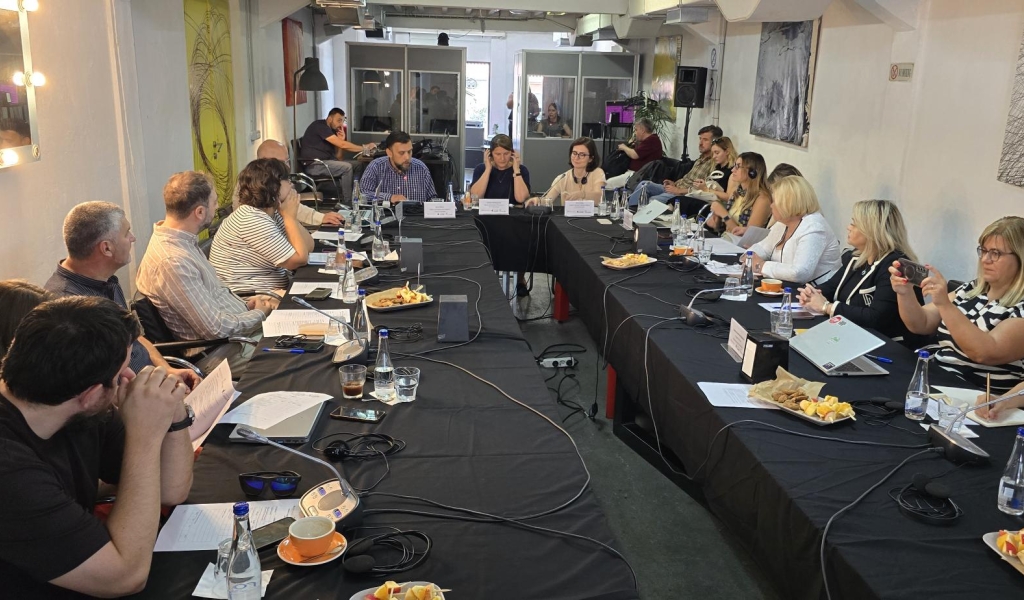
This article draws on discussions from the event "Building Resilience to Gender-Related Information Manipulation," organised by the Metamorphosis Foundation and International IDEA, part of the project "Combating Electoral Foreign Information Manipulation and Interference (FIMI)," supported by Global Affairs Canada.
See more reporting from the dialogue from our partners Metamorphosis Foundation: Anti-gender disinformation undermines democracy and women’s participation in public life – Metamorphosis
Information manipulation rarely occurs through isolated acts. More often, it targets existing social fault lines and exploits these vulnerabilities to undermine trust. In North Macedonia, as across the Western Balkans, gender has become one of the most effective of these fault lines.
This was the key message of a recent dialogue on "Building Resilience to Gender-Related Information Manipulation," co-organised by the Metamorphosis Foundation and International IDEA in Skopje. The event convened election officials, media regulators, diplomats, and civil society representatives to discuss how anti-gender narratives are deliberately used to weaken democracy.
Gender as an entry point, not a side issue
Anti-gender disinformation is often treated as a separate, secondary concern from the broader fight against FIMI. The evidence presented at the dialogue suggests the opposite: gender is frequently the entry point through which foreign and domestic actors alike attack democratic institutions. Framing women's rights, gender equality laws, or LGBTIQ+ visibility as threats to "family," "tradition," or "the nation" is an efficient way to mobilise anger, deepen existing polarisation, and cast doubt on institutions.
Between 2019 and 2023, an estimated $1.8 billion was funnelled into anti-gender movements globally, funding organised, cross-border campaigns designed to spread distrust. North Macedonia has not been spared from this: anti-gender narratives have gained visible traction in recent years, including protests against gender equality legislation, echoing patterns seen elsewhere in the region.
The cost of gendered information manipulation is silence
The consequence of these campaigns has real impact on who can participate in democracy and public life. When hate campaigns become threats to personal security and safety, women stepping back from public life. Female politicians reconsider whether running for office is worth the abuse that follows. Journalists weigh whether the next investigative story is worth another wave of threats. Activists and civil society organisations become targets rather than participants in democratic debate.
When attacks focus on a woman's appearance, morality, or family life rather than her arguments, the goal is not to win a debate but to remove her from it entirely. Reporting shared at the dialogue pointed to concrete cases in North Macedonia, including coordinated online harassment campaigns against investigative journalists, timed to derail specific stories.
A visibility gap that predates any single campaign
Underlying this vulnerability is a structural imbalance already present in the media landscape. Analysis of national television coverage during North Macedonia's pre-election periods found that women accounted for as little as 14.5% of speaking time during the 2020 parliamentary campaign, a gap that narrowed only modestly by 2025. Women were more often shown than heard, appearing as background figures at political events while men dominated as primary speakers and subjects. Gender-related issues themselves featured in only a handful of the more than 1,700 news reports analysed.
This imbalance matters because it is precisely the kind of pre-existing gap that information manipulation exploits. A media environment where women's voices are already scarce is one where their exclusion through intimidation looks less like an anomaly and more like the status quo.
Building resilience means integrating gender
The clearest takeaway from the dialogue is that resilience against information manipulation cannot be gender-blind. Efforts to counter disinformation that treat gender as an afterthought will miss one of the primary mechanisms through which democratic erosion occurs. Institutions monitoring election integrity, media regulators, and civil society need to track anti-gender narratives as a core indicator of FIMI activity, not a niche concern.
As artificial intelligence lowers the cost of producing convincing disinformation, including deepfakes that overwhelmingly target women, this integration becomes more urgent. Protecting the space for women, and all underrepresented voices, to participate freely in public and political life is a precondition for protecting democracy.