


Indonesia
The Republic of Indonesia performs in the mid-range in Representation, Rights and Rule of Law and is high-performing in Participation. It ranks in the top 25 per cent globally in Civil Society, Civic Engagement and Electoral Participation. Compared to five years prior, Indonesia has experienced declines in Access to Justice, Credible Elections, Effective Parliament, Judicial Independence and Predictable Enforcement. The fourth most populous nation in the world and home to the largest population of Muslims globally, Indonesia has a service-based economy largely dependent on domestic consumption.
Modern Indonesia encompasses an enormous diversity of ethnic and cultural groups on hundreds of islands and boasts both global megacities and uncontacted Papuan tribes. Over the course of the 20th century, Indonesians constructed a national identity through the conscious choice, primarily of youth, to promote the national language and a national motto of ‘Unity in Diversity.’ Following decades of struggle against a repressive Dutch colonial regime and Japanese occupation, the longtime nationalist leader Soekarno became the first president of independent Indonesia in 1945. Soekarno’s increasingly unstable rule ended in 1965, when the army general Soeharto seized power. He oversaw mass killings and a 32-year ‘New Order’ authoritarian regime. Riots fueled by the Asian Financial Crisis compelled his resignation in 1998, ushering in the reformasi period and a cycle of democratization, but party politics remain heavily fragmented and often depend on patronage and clientelist networks.
Contemporary national political cleavages revolve around secular and religious divides, with political parties maintaining distinct views on state-Islam relations. Gender is caught up in these cleavages, as conceptions of private morality and women’s roles in society are negotiated using these frameworks. In recent years laws have been more conservative; in December 2022, Parliament adopted a new law that criminalized extramarital sex and unmarried cohabitation. Over the past decade, Indonesia has made progress in achieving gender parity in education and increasing women’s political participation through legislated candidate quotas. However, women’s labor force participation remains low and gender-based violence is a pressing issue.
In recent years, the weakening of the country’s Corruption Eradication Commission (KPK) has been reflected in the Absence of Corruption metrics. Recent elections have seen allegations of governmental interference in the judiciary, including a controversial court ruling to lower the age limit of presidential candidates. There are also broad socio-economic disparities between Indonesia’s diverse islands; almost half the population lives in rural areas where access to basic services and resources is poor, with ‘circular migration’ to urban areas for work. Separatist movements have marked Indonesian history, including the secession of Timor Leste in 1999, the independence struggle in Aceh, which ended after the devastating tsunami in 2004 and ongoing unrest and armed groups aiming for independence in West Papua province.
The return of the military to politics in recent years indicates that it will be important to watch factors of the Rule of Law in the next several years. Judicial Independence in particular should be monitored, given recent politicized court rulings and jockeying for power between the various branches of government. Continued political conflict over the management of natural resources and environmental sectors may be reflected in Absence of Corruption or affect socio-political stability between the islands.
Last Updated: June 2025
https://www.idea.int/democracytracker/
April 2026
Civilians killed as tensions escalate in West Papua
Twelve civilians were allegedly killed by Indonesian troops during an ‘enforcement operation’ targeting the separist West Papua National Liberation Army in Central Papua province on 14 April. The National Commission on Human Rights (Komnas HAM), a state-sanctioned rights watchdog, confirmed the killings and called on the government to adjust its approach and deescalate the rising tensions in the region. Komnas HAM documented 12 other violent incidents in Papua in March and April before the 14 April clash in which an additional five soldiers and three civilians were killed. Student activists held protests across the region on 27 April against the killings and what they argue is ‘militarization’ of the region, some of which were dispersed with tear gas and water cannons.
Sources: Reuters , ULMWP , Human Rights Monitor , Human Rights Monitor, Jakarta Post (1), Jakarta Post (2)



Parliament passes domestic worker protection law
Indonesia’s parliament passed the Domestic Workers Protection Law on 21 April 2026, granting the country’s estimated 4.2 million domestic workers, the majority of whom are women, legal status as employees and the accompanying strengthened labour rights. Domestic workers will now also enjoy access to health benefits and social security programs, and state-provided education and vocational training. The Law has been stalled in the country’s legislature for twenty years, and its passage was met with broad approval from labour unions and civic groups. The domestic workers’ rights group Jala PRT celebrated the ruling but warned that significant work needed to be done to educate employers and enforce the new provisions. Furthermore, the Law does not provide for a minimum wage and grants authorities 12 months to define and develop enforcement mechanisms.
Sources Straits Times, Jakarta Globe Jakarta Post

March 2026
Court acquits four activists prosecuted for ‘incitement’ linked to the August 2025 protests
The Central Jakarta District Court acquitted Delpedro Marhaen, Muzaffar Salim, Syahdan Husein, and Khariq Anhar on 6 March of charges of inciting unrest via social media in connection with the August 2025 demonstrations. The acquitted had made social media posts encouraging people to join the protests. Prosecutors had sought two-year prison terms, and the four were held in pre-trial detention for six months. The four were among the highest profile detainees among thousands arrested in the wake of the August 2025 demonstrations, most of whom have been released without convictions. Rights activists hailed the decision as precedent-setting for freedom of political speech. Coordinating Minister for Law, Human Rights, Immigration and Corrections Yusril Ihza Mahendra also praised the court’s decision and said it showed the government had kept its promise to not interfere with judicial processes connected to the August 2025 demonstrations.
Sources: Tempo, Malay Mail, Kompas, CNN Indonesia, Tempo, International IDEA

Acid attack on a prominent human-rights defender linked to anti militarization advocacy
Human rights activist Andrie Yunus was the victim of an acid attack in central Jakarta on 12 March. When driving his motorcycle, two assailants threw acid on Yunus, causing burns over 20 per cent of his body. On 19 March, four soldiers who allegedly participated in the attack were arrested by military police. Yunus is a well-known activist investigating the military’s history of forced disappearances and a prominent critic of the Military Law passed in March 2025, which allows active-duty military officers to simultaneously hold civilian government posts in 14 institutions. The assailants are to be tried in a military court, which are subject to fewer procedural protections and a less transparency than civilian courts, which activists argue could lead to the attackers escaping justice.
Sources: Civicus Monitor, Tempo, British Broadcasting Corporation

December 2025
Deadly floods shine light on environmental and crisis management policies
Flooding and landslides caused by a cyclone killed more than 1,000 people and destroyed over 100,000 homes in Sumatra in December. Indonesian researchers and environmental experts say the severity of the damage can be credited to years of environmental policies that have favoured the expansion of heavy industry, logging, palm oil and mining over protecting the sustainability of the region’s ecosystem, resulting in a landscape that is no longer capable of absorbing large amounts of rainfall. The central government also received significant criticism for refusing foreign aid and declining to declare a national disaster. The latter measure would have allowed it to access emergency funds and streamline disaster response efforts. Experts speaking to the British Broadcasting Corporation credited the government’s refusal on both counts as attempts to minimize scrutiny of the government’s response efforts and thereby protect its public image.
Sources: The Conversation, The Jakarta Post, Asia Sentinel, British Broadcasting Corporation

November 2025
Police officers to be barred from holding second government jobs
Indonesia’s Constitutional Court ruled on 17 November that the practice of police officers holding additional government jobs is unconstitutional. The 2002 National Police Law contained two conflicting provisions on whether police officers could hold another government job simultaneously, and the ruling struck down the passage, which the justices ruled created legal ambiguity. Over 4,000 police officers hold second government jobs, about 300 of whom are in high-ranking managerial positions. Appointments of the latter have become more common under President Prabowo Subianto, and the ruling was welcomed by democracy advocates as part of preventing a return to the ‘dual function’ role of the security forces of Sukarno-era Indonesia.
Update: A National Police regulation decreed on 9 December was criticized by constitutional law experts as disobeying the Constitutional Court’s decision. The decree allows officers to take on government jobs relevant to police work that are requested by the employing institutions. A spokesperson for the National Police said Article 28(3) of the National Police Law allows for such postings and remains in force despite the Court’s ruling, but allowed that officers will be ‘reassigned’ after taking any such posting to prevent a police officer from holding two jobs simultaneously. However, critics maintain the purpose of the ruling was to prevent active-duty police from holding civilian roles indefinitely–a practice which the new decree explicitly allows.
Sources: Jakarta Post (1), Jakarta Post (2), Jakarta Post (3)

New police procedure law draws criticism
Indonesia’s House of Representatives passed the Criminal Procedure Bill (KUHAP) into law on 18 November, the most broad-reaching changes to procedural criminal law in 40 years. Civil society critics and legal experts say the bill transfers too much investigatory authority to the police, at the expense of judicial or parliamentary oversight. The government maintains the changes are needed to streamline outdated processes. For example, police will now be able to search and seize assets, conduct surveillance and authorize wiretaps without prosecutorial permission or oversight. Civil society experts have criticized the process of the bill’s passage, saying that it was only made public hours before passing into law and the parliament misled the public about the scale of civil society involvement, and have urged President Prabowo Subianto to repeal it.
Sources: Tempo, Jakarta Post, Fulcrum

West Papuan activists sentenced on treason charges
Four West Papua independence activists from Sorong on the island of Guinea were sentenced to seven months’ imprisonment on treason charges on 20 November. Advocates say the sentences are a case of the criminalization of freedom of expression. The four men presented themselves at a local Indonesian government office on 14 April, 2025 as representatives of the unrecognized state of Federal Republic of West Papua (NFRPB) and delivered a letter seeking talks between the Indonesian government and the NFRPB to resolve the ongoing West Papuan separatist conflict. The men were arrested two weeks later and placed in pretrial detention. Their detention and transfer to a more distant prison triggered local protests which, in some instances, became violent. Human rights advocates say the interpretation of treason is inconsistent with Indonesia’s international treaty obligations, as the four men were not armed, did not threaten or call for violence, and did not call on others to support West Papuan secession. The defendants declined to appeal as, due to the length of their pre-trial incarceration, they were due to be released on 28 November, 2025.
Sources: Radio New Zealand, Human Rights Monitor, Tapol, IDN Times, Amnesty International Indonesia
See all event reports for this country
Global ranking per category of democratic performance in 2025

Basic Information

Human Rights Treaties
 State party
 Signatory
 No action
Performance by category over the last 6 months


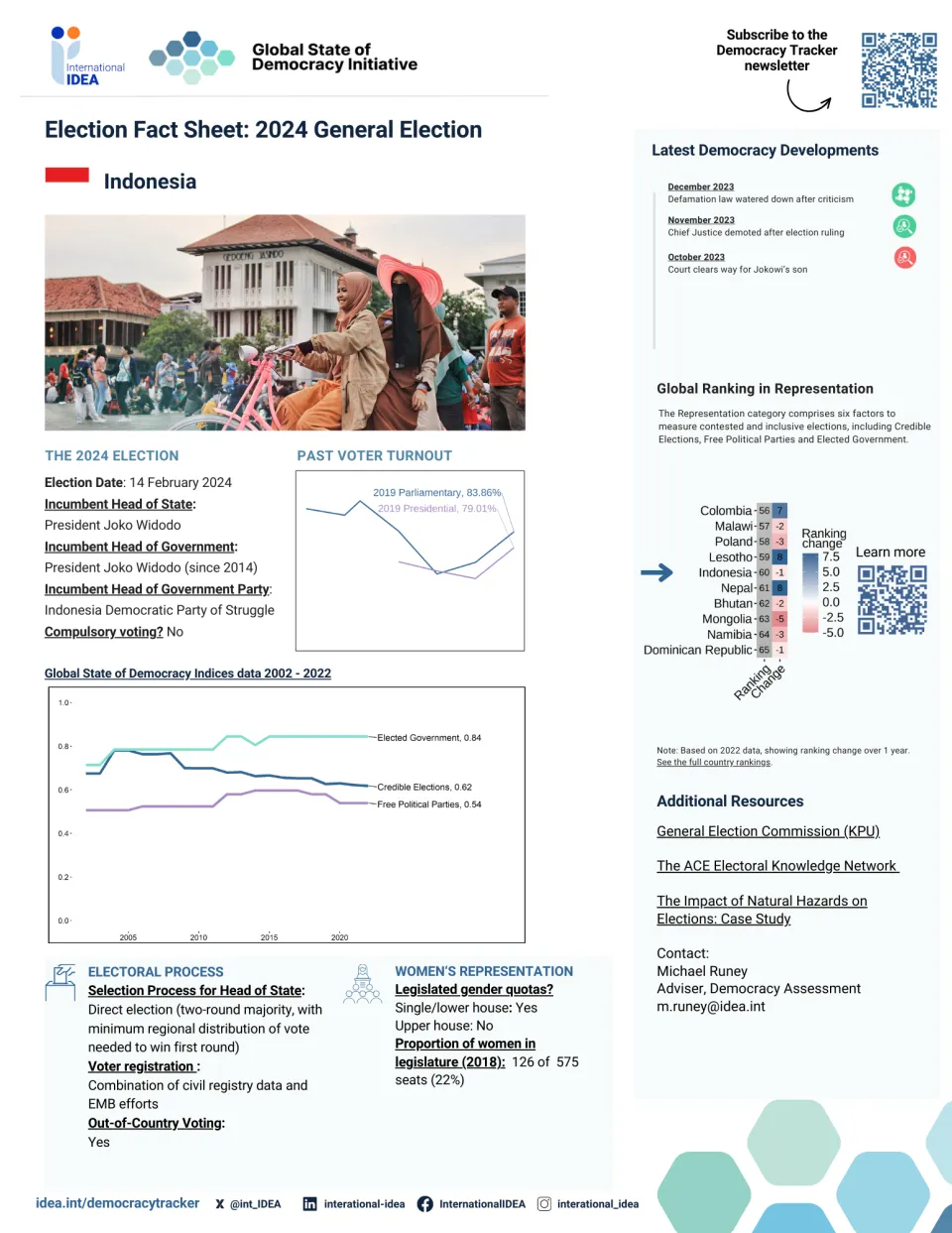
Election factsheets
Global State of Democracy Indices
Hover over the trend lines to see the exact data points across the years


Factors of Democratic Performance Over Time
Use the slider below to see how democratic performance has changed over time