

Maldives
The Maldives performs in the mid-range across all categories of the Global State of Democracy (GSoD) Framework. It is in the bottom 25 per cent of the world’s countries regarding Freedom of Religion and Gender Equality, and in the top 25 per cent with Electoral Participation. Over the last five years, it has experienced significant improvements in Judicial Independence. The Maldives is an upper-middle-income country, heavily reliant on tourism, fishing and boatbuilding. The economy of the Maldives has grown rapidly in recent decades and showed resilience and strong recovery after the loss of tourist revenue during Covid-19. Improvements in health and education have also brought a steady increase to the country’s standing in the Human Development Index.
Formerly a British colony, the Maldives became an independent nation in 1965. The country’s constitution has been amended a total of six times—the most recent of these, in 2008, was an attempt to improve democratic norms, the rule of law, and judicial independence. That same year the country saw its first freely elected president, Mohamed Nasheed. After 2013, Maldives experiences a period of increasing authoritarianism, including the withdrawal from the Commonwealth over foreign criticism of the status of the country’s democratic institutions, individual freedoms, and the rule of law. In 2018, the political crisis worsened over President Abdulla Yameen’s refusal to comply with a judicial ruling ordering the release of political dissidents from prison; many had also disappeared or been killed. That same year, opposition parties united in a successful effort to oust Yameen from power. The new government has made strides in improving democratic norms and strengthening the rule of law. In 2020, it rejoined the Commonwealth after evidence of successful reforms. Corruption is frequently a major issue in the Maldives, as numerous leaders have been implicated in various money laundering and bribery scandals in recent years, including a former president.
Issues of religious identity have also divided Maldivian society, as the Parliament has taken steps to solidify Islam’s status as the state religion, affecting Freedom of Religion. Gender Equality has significantly improved in recent years due to progress achieved through laws and measures promoting gender equality such as the National Gender Equality Action Plan, which aims at reaching the Sustainable Development Goal of Gender Equality, or an amendment to also extend the Sexual Offences Act to married couples. Nonetheless, long-standing provisions remain discriminatory against women, also regarding their political representation and gender-based violence is widespread. Another concern is rising religious fundamentalism, rising restrictions on freedom of assembly as well as discrimination and arrests targeting LGBTQIA+ individuals.
It will be important to watch whether recent improvements continue, especially as significant human rights concerns persist, and Judicial Independence remains threatened. Recent incidents of prisoner torture and life-threatening conditions in Maldivian custody are of concern. Additionally, plans to reinstate the death penalty and failures to enact critical reforms for Freedom of Expressions remain worrying. The country has also seen progress in several key areas, especially with regards to countering violent extremism and labor rights. Furthermore, attention should be paid to the country’s initiatives to increase climate resilience as it is one of the most heavily impacted by the effects of climate change, particularly rising sea levels, beach erosion, severe weather events.
Last Updated: June 2025
https://www.idea.int/democracytracker/
April 2026
Constitutional referendum held alongside local elections fails

On 4 April 2026, Maldives held a constitutional referendum alongside Local Council and Women’s Development Committee elections. Voters were asked whether to approve an amendment to align presidential and parliamentary elections and shorten the current parliamentary term. The proposal was rejected, with 68.7 per cent voting against and turnout at 75.0 per cent. The referendum followed the passage of the amendment bill in Parliament and a presidential decree requiring public approval. Election observers, including ANFREL, noted the complexity of the triple-ballot process and raised pre-election concerns regarding voter information, ballot secrecy and campaign conditions. The vote was the first held under the Public Referendum Act and the first nationwide referendum since 2007.
Sources: ANFREL, Maldives Independent


Police raid independent newsroom amid escalating media pressure
On 27 April 2026, police raided the offices of independent news outlet Adhadhu, seizing journalists’ equipment and data under a court order. Authorities also imposed travel bans on senior staff and pursued criminal charges linked to the outlet’s reporting on allegations involving the president. In early May, two journalists from Adhadhu were detained and briefly jailed on arbitrary contempt of court charges, and courts issued orders restricting discussion of related reporting. Rights experts and international organizations raised concerns about procedural safeguards, including limited time to secure legal representation, the conduct of hearings without adequate defense, and the use of closed proceedings, raising questions regarding due process and fair trial guarantees. The developments represent an escalation in state actions affecting independent media and undermining press freedom in the Maldives.
Update: On 13 July, the High Court accepted an appeal by the Maldives Journalists Association, allowing it to challenge the Criminal Court’s order restricting discussion and circulation of the related reporting. The Court found that the order appeared to lack a proper legal basis and had been issued without hearing both sides. The appeal will now proceed, while the legality of the order itself has yet to be decided.
Sources: Human Rights Watch, Committee for Protecting Journalists, Transparency Maldives (1), Transparency Maldives (2), Maldives Voice


September 2025
New media bill sparks controversy over threats to press freedom
On 18 September, President Mohammed Muizzu ratified the recently passed Media and Broadcasting Regulation Bill, which replaces two previous media regulatory bodies with a new commission. The bill aims to streamline media regulation and seeks to curb disinformation and defamation concerns. The commission will consist of seven members: three (including the chairperson) appointed by the President and four elected by media representatives. The commission will be granted extensive powers, including the ability to block news websites, suspend media outlets’ registrations, issue fines to journalists and criminalize vague offences such as spreading fake news. Press advocates and civil society organizations have criticized the haste and limited public consultation that preceded the bill’s introduction through protests, arguing that it undermines press freedom and grants the executive excessive control. The bill is currently being challenged before the Supreme Court.
Sources: Human Rights Watch, Raajje.mv, Maldives Independent, International Federation of Journalists

April 2025
Judges suspended in the midst of constitutional review
Three Supreme Court judges were suspended in April 2024 in what they allege is an intimidation campaign by the President and Attorney General to compel them to side with the government in the judicial review of a constitutional amendment. The government cited an ongoing disciplinary investigation against the justices as the reason for the suspensions, but the justices deny the allegations. The amendment in question, passed in November 2024, established an anti-defection law for members of parliament. The amendment process was also criticized for being rushed and lacking proper legal consultation. Collectively, these developments are seen as undermining judicial independence and increasing the risk of political interference in the courts. The United Nations and rights experts raised serious concerns over the suspensions.
Update: On 14 May, parliament voted to remove two Supreme Court judges on allegations of abuse of power. The United Nations and rights experts denounced the dismissals as a threat to judicial independence.
Sources: Human Rights Watch, Devdiscourse, Raajje, Jurist, Transparency International, Al Jazeera, FIDH


April 2024
Ruling party secures supermajority in parliamentary election
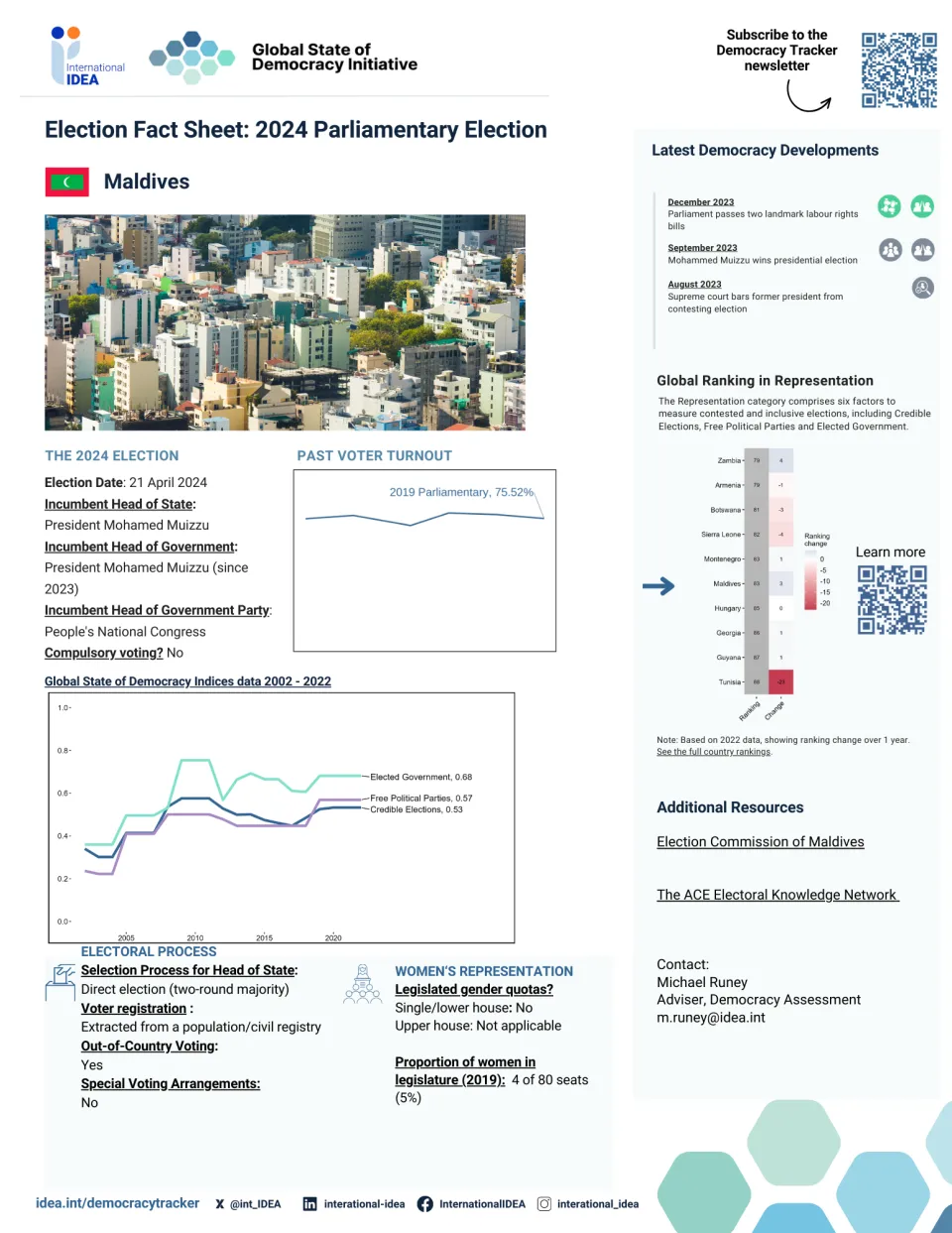
The Maldives parliamentary election on 21 April delivered a landslide victory for President Mohamed Muizzu’s ruling People’s National Congress (PNC), which secured 66 out of the 93-member house seats, while the opposition Maldivian Democratic Party won 12 seats. Voter turnout was approximately 73.9 per cent, down from 81.3 per cent in 2019. According to media reports, female representation dropped to three women winning seats, down one from the 2019 election. Election observers noted that the electoral process was conducted in a peaceful and transparent manner.
Sources: Election Commission of Maldives, Maldives Financial Review, BBC News, International IDEA, ORF, Raajje MV, ANFREL, PSM News
See all event reports for this country
Global ranking per category of democratic performance in 2025

Basic Information

Human Rights Treaties
 State party
 Signatory
 No action
Performance by category over the last 6 months


Election factsheets
Global State of Democracy Indices
Hover over the trend lines to see the exact data points across the years


Factors of Democratic Performance Over Time
Use the slider below to see how democratic performance has changed over time