


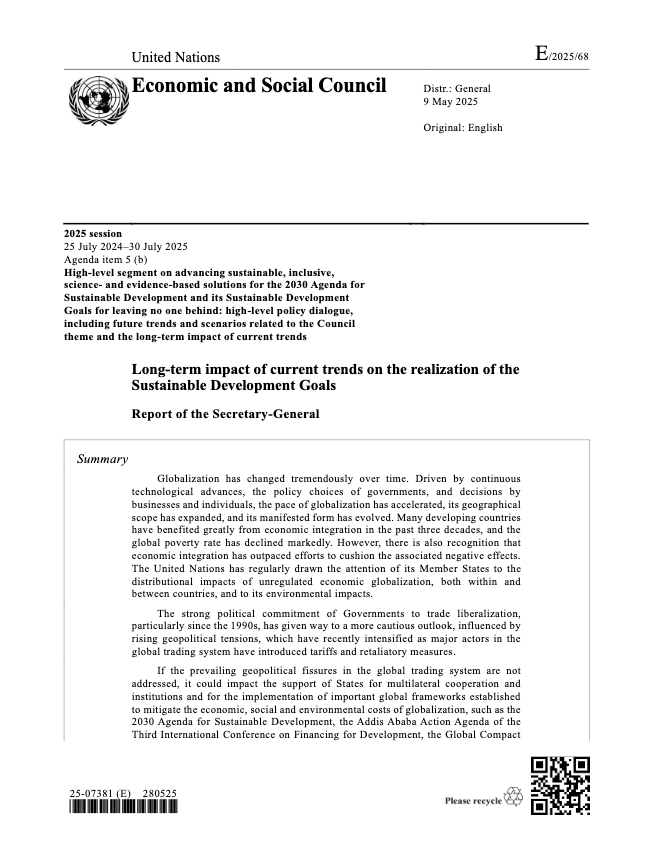
Long-term impact of current trends on the realization of the Sustainable Development Goals: Report of the Secretary-General.
Globalization has changed tremendously over time. Driven by continuous technological advances, the policy choices of governments, and decisions by businesses and individuals, the pace of globalization has accelerated, its geographical scope has expanded, and its manifested form has evolved. Many developing countries have benefited greatly from economic integration in the past three decades, and the global poverty rate has declined markedly. However, there is also recognition that economic integration has outpaced efforts to cushion the associated negative effects. The United Nations has regularly drawn the attention of its Member States to the distributional impacts of unregulated economic globalization, both within and between countries, and to its environmental impacts. The strong political commitment of Governments to trade liberalization, particularly since the 1990s, has given way to a more cautious outlook, influenced by rising geopolitical tensions, which have recently intensified as major actors in the global trading system have introduced tariffs and retaliatory measures. If the prevailing geopolitical fissures in the global trading system are not addressed, it could impact the support of States for multilateral cooperation and institutions and for the implementation of important global frameworks established to mitigate the economic, social and environmental costs of globalization, such as the 2030 Agenda for Sustainable Development, the Addis Ababa Action Agenda of the Third International Conference on Financing for Development, the Global Compact for Safe, Orderly and Regular Migration and the Global Digital Compact. The overarching objective of such global frameworks is to help to ensure that globalization works for all. The world needs more, not less, globalization, but a globalization that is embedded in the principle of leaving no one behind, governed by multilateral rules and shaped by collective action.
Publication date
2025
Author(s)
UN Economic and Social Council
Topic(s)
Inclusive and responsive global governance, Development, South-South cooperation, Emerging Issues, Migration, refugees and displacement, Technology and digitalization
Type
Reports
Language(s)
Arabic, French, Mandarin, Russian, Spanish